A Forecast of the Near Future:
As we close out this remarkable week, discussions are shifting to the impacts of the election on the lame duck, the new committees, and the topics of early bills and funding fights. I want to pan up out of the day to day business and offer some predictions on more macro aspects of politics.
- The new Democratic Majorities that take power in January will not be divided primarily by ideology, whether someone is on the left or in the center. They will instead be divided by seniority. The chairs and their staffs will want to use this moment to achieve long held goals, such as root and branch oversight of corporate America, assuming the freshman will go along. This large freshman class will, like the freshman class after Watergate, realize they have their own different views and will resist being told what to do. In the end, the Chairs probably end up generals without an army.
- There are few deals with the Trump Admin. The Trump WH is not cowed by the results and decides the midterms were a function of the MAGA base being betrayed. While blame is shifted early on (rightfully) to the Iran War as a cause, hardliners inside the WH successfully argue that the base was let down by the lack of more deportations. The WH is disinterested in doing deals with Democrats generally and there are multiple shutdowns. The public sees Washington again as broken.
- The 2028 campaign for President starts early, with the first candidate to declare on the Dem side announcing an exploratory committee before Christmas. The Dems have a massive field, including one statewide elected official who only is sworn into office in January 2027. But unlike 2019, there is a clear S tier of just 3-4 people. The primary is less toxic and contentious than in 2019, as many in the party now realize the policy bidding war was a mistake and need infighting. The absence of Bernie, Biden, and Warren or clear successors to any of them makes the race less about the past and more about the future. On the GOP side, VP Vance chooses not to run but former Secretary of State Rubio does. He does a surprising challenge from the right on both the war and inadequate commitment to hardline immigration policy. The primary is short for the Dems and long for the GOP.
- The next two years of politics are defined, after a short burst of focus on broad oversight, by AI, which continues to pick up speed. The need to have technical knowledge of the subject to do effective oversight and legislation on it favors younger members with less seniority in both parties, reducing the power of the Chairs and Rankers. Technical staff grow in value versus lawyers for the first time in a generation, and surprising “gangs” emerge in the Senate to tackle aspects of the topic for the first real time in a decade. 2028 is the AI election, marked by at least one spectacular hack of major infrastructure during the last 90 days.
- When folks look back on our politics in 2030, it is clear to all that the Trump era, the Long 2016, ended on November 3, 2026, which also marked the end of the Dems long 2016 primary. 2029 also is the first year of an administration in which Dems do not feel compelled to fight over the choices of 2008-2009, whether they win or lose the election, marking the end also of the Long 2009. Trump is gone to Mar a Lago and seen like all former presidents as an artifact of a prior time.
- The Administration that takes office in 2029 experiences a ChatGPT like moment in robotics in its first 9 months. It is a surprise to all in DC.
My daughter showed me the new Olivia Rodrigo Xmas song “take me home (4 christmas)” & it’s a remarkable cultural item.
Song’s motif is female striver meets neo-late WASP. You could imagine this as a song by Kevin MacAllister’s future daughter in law. https://t.co/iWjNDRAGY3
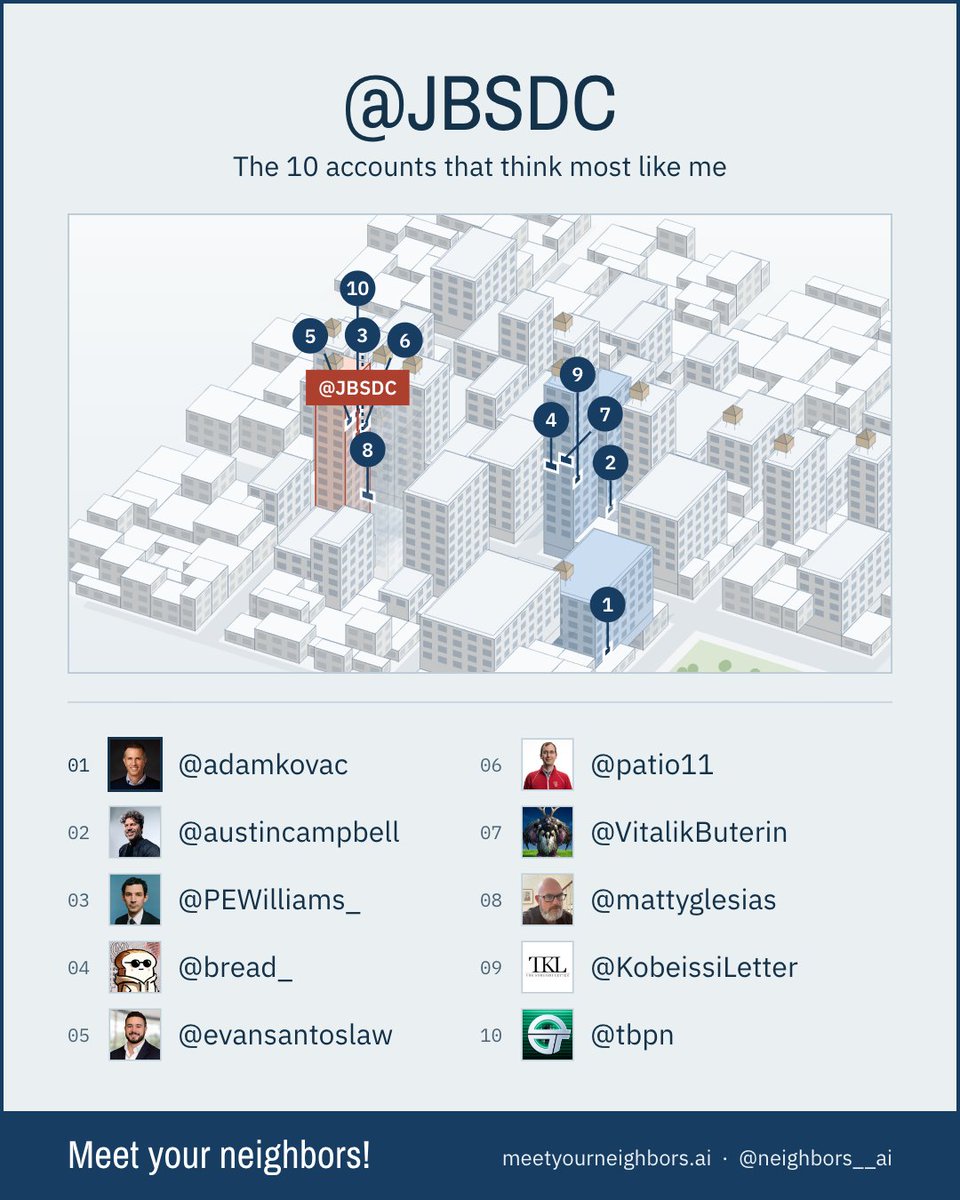
I need an explanation of the summary of views/people that are each of the buildings. Apparently I'm in building 42 with @PEWilliams_, @patio11, & @tbpn. What is this, markets based technocratic opinion leaders with an interest in technology?
@KobiTirey Yes. In general we’ve moving from curated, limited glimpses of people’s image to omnipresent curation; now we will move to total authenticity.
Merging of all culture and politics continues.
As marginal value of intellect drops through democratization of access to it via tech, next key variable of influence is charisma crossed with style/hotness.
Incoming Rep. Bobby Pulido is a prototype of next phase of this.
@adamconner Jacking into the Infinite Scroll feels good in terms of providing a sense of geography of current events, but it also triggers excess presentism for mostly minor events.
Socio-geopolitical life is more episodic than streaming. It is broken up into something like knots on a rope.
The greatest value of newspapers/constant awareness to the news is important mainly around turning points (the Ten Days that Shook the World, Sept 2008, both the French and American July Days).
Absent that, reviewing news 1-2 times a day is fine (also Lindy).
@danielcincu@TheStalwart@conorsen The amount of existing regulations on most consumer facing or involving businesses is quite high. This is one reason people go to VC for capital more than small banks. It’s very hard to get a loan to open a restaurant with low credit.
@iplaymiddles@TheStalwart@conorsen Interesting! Would love to hear more about your experiences.
And I should say that I’m referring to expressed preferences versus revealed preferences. Most policymakers don’t know how awful it is to run a small business or where regulations can be counterproductive.
@IamPurkov Not if they’re standardized enough to have clearing mandate trigger.
My guess is these are more standard than people expect given the compute seems pretty fungible. It’s not quite as distinct as ,say, types of crude oil.
Hot take - if regulators are serious about trying to bring clarity to the AI trade, the most impactful thing they can do in the short term is impose Dodd Frank on compute contracts, to mandate a third party clearinghouse to guarantee the physically settled trade.
That would create a settlement price, counterparty clarity, margin signals & a real forward curve instead of a synthetic one.
This truth about compound interest over last 35yrs explains…a lot of UMC/PMC mania
A guy who went to Yale Law, grinded out 7yrs at Wachtell walks home w/ $600k base+bonus pretax…and despite being top 2% income is competing against *kids* of top ~3% who have that *liquid*
Explained the concept of a rerun to one of my older two; they’d never heard of such a thing. I also notice their peer group is less aware of Millennial child content than we were of Boomers.
I feel like the infinite stream of content that Gen Alpha can access is warping things.
I worry about this. It’s a thin step from running on economic populism to actually trying to govern against the modern economy (instead of trying to do redistribution, provide health care, & focus on worst actors).
Most Dem economic staff seem to think the US economy is fake.
I’m actually more optimistic about Democrats moderating on wokeness than I am about them moderating economically—I see them leaning into Bidenomics 2.0., crossing populism & technocracy but minus woke. Or maybe I’m just really blackpilled by how things are going in Massachusetts.