In theory, the #climatefinance target🎯 has tripled—but will it make a difference?
@CGDev experts discuss the new $300 billion goal decided at #COP29, where it falls short, and where to go from here ⬇
https://t.co/Ft6R7PhOJD
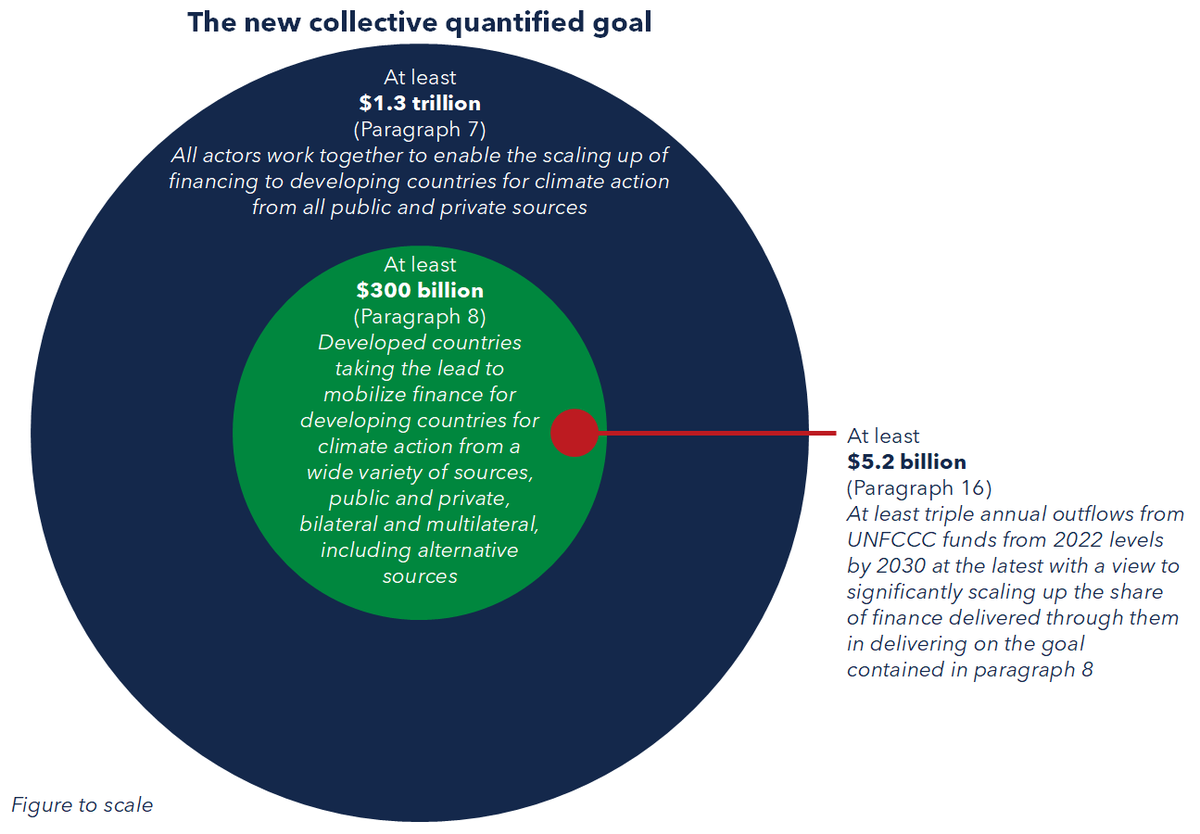
Now that governments @COP29_AZ agreed the #NCQG that sets out future goals for international climate finance, the focus turns to how they will be delivered.
Here are my thoughts, featuring more MS Paint graphics that I know @edking_I loves so much:
https://t.co/qVG3QMpOr3
Obsessing over quantity and forgetting quality of climate finance is the Baku COP’s biggest failure. Not that t$300bn is too low to meet demands for action and justice (though that’s true). It’s that the world’s poorest & least responsible for climate change will be robbed by it.
@Josh_Gabbatiss $300bn is still unambitious. And NCQG hasn’t really learned lessons of the $100bn goal: it’s ill-defined, with no public finance target, no grant equivalent figure, and no clarity on additionality or burden sharing.
Indeed. It’s insufficient, ill-defined, with no public finance target, no grant equivalent figure, and no refs to additionality or burden sharing. So much for learning lessons of the $100bn goal!
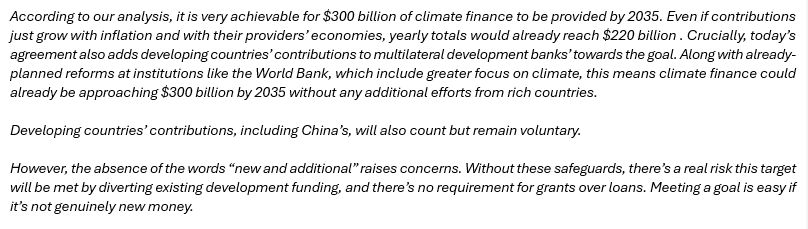
Here's my take on the just-agreed #COP29 climate finance goal (#NCQG) ; based on our model.
It will require barely any additional effort from providers; and creates greater risk of diverting funds from existing development finance
Punchy intervention from authors of UN-backed IHLEG climate finance report re #COP29 text
'This figure is too low and not consistent with delivery of the Paris Agreement. Our analysis shows that the NCQG, based on the components that it covers, should commit developed countries to provide at least $300 billion per year by 2030'
For those negotiating in Baku on the #NCQG climate finance goal
@edwardwickstead and I have calculated two new scenarios in our @CGDev model of baselines relating to multilateral development banks and the latest negotiating text
1/5
@EconMitch But that $250bn seems to include ALL climate finance from MDBs (of which c.30% from developing countries). So even less ambitious than first appears
And if that $250bn includes ALL climate finance from MDBs, then it’s even less ambitious than first appears (since c.30% of MDB finance is paid for by developing countries)
Re #NCQG. Disappointing. No refs to new and additional. No refs to grant equivalence. Refs to additional contributions from developing countries are important (their emissions are now >50% of all GHG emissions since 1850) ). But developed countries simply must commit more.
It's not just China. And the picture even starker if look at all GHGs: 'Developing' countries (non-Annex I) now account for 51% of all GHG emissions since 1850. The figure for non-Annex II countries (countries that aren't currently obliged to provide climate finance) is 63% #NCQG
+++NEW ANALYSIS: China’s CO2 emissions have now caused more global warming than EU+++
Our new analysis comes as the "principle of historical responsibility" is being cited in #COP29 talks on a new climate finance goal
THREAD with details, caveats + bonus chart
https://t.co/9irA2O4cum
1/12
@Josh_Gabbatiss Oh dear. Yes, rich must give more. But non Annex II countries now account for 63% of all GHG emissions since 1850, mostly from a small number of better off countries. Time for them to chip in too (many are)? Isn't that what CBDR-RC requires? Or else the poorest lose out. Again.
Conclusion? Developed countries must do more. But absolving the growing number of large, rich, heavily polluting ‘developing’ countries of responsibility is also unfair to the poorest. Old categorisations of developed and developing are no longer fit for purpose.