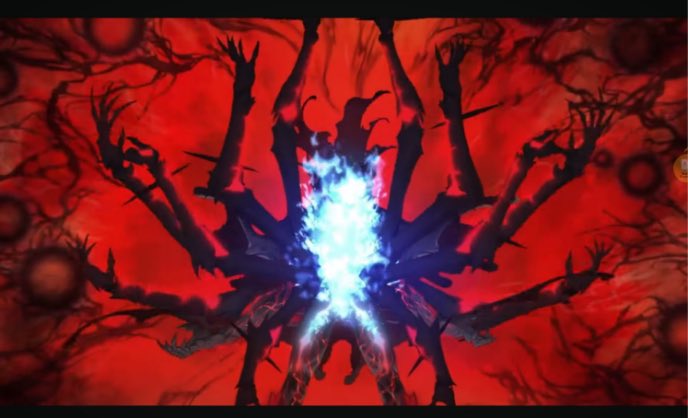
@averse_side I didn't say his limitation on raw material was about them being physical. It's possible he can still project lots of conceptual or immaterial stuff so long they aren't divine constructs. He's even reproducing the years, experiences and skills that comes with it after all.
@averse_side Maybe the difference was made because for the other weapons, they are simply ranked down. But he would still reproduce the raw material and everything else. For Divine Constructs, more of their aspects could be lacking, especially their raw material or production process.
This explains a lot of when Old Man pops up to raise tension during Part 1.
...it also means even with all the experience and age, he still was has a bit of silly left inside of those bones.
[Post 5/14]
Touma Mato
An inspector dispatched from Police HQ to head the Agonist Disorder Task Force—the “Hearse Agency”—who also serves as Ishizue Arika’s supervising officer and doctor. The literal embodiment of “human society,” Mato is a woman of steel: mentally and physically imposing, pompous, and a total badass. Though barely in her late twenties, her authority far outstrips her rank, forcing local precincts to treat her like a live explosive. Behind her questionable credentials lies a machine of violence governed strictly by protocol—an elite enforcer who wields the full weight of law and order against the Possessed.
[Post 4/14]
Karyou Kaie
The devil of the underground chamber—a natural-born, heartless evil with an angelic appearance. Though powerful, Kaie is incapable of surviving or acting alone, relying entirely on prosthetics crowned with the names of emotions. They detest humanity yet love people: not out of genuine care, but because watching them brings a pleasure like no other. If God is a complete, flawless being who is omniscient and omnipotent, devils, conversely, are absurd, formless phenomena that are nescient and impotent. Resembling Tsukihime’s Merem Solomon, Kaie rules from within an isolated sanctuary.
[Post 3/14]
Ishizue Arika
A lackadaisical, closed-off, yet strangely optimistic young man who holds the key to every arc—even as he remains on the periphery of his own story. Having lost his left arm, Arika also lost the ability to sense danger, leading him to walk straight into life-threatening situations that any reasonable person would avoid. Weak, dependent, and aiming merely for a quiet life filled with casual tomfoolery and endless complaining, he suffers from chronic memory loss, routinely locking critical truths away as soon as a crisis passes. While built on the same conceptual foundation as Fate/hollow ataraxia’s Avenger, his path moves in the exact opposite direction: where Angra’s journey reaches outward, Arika’s turns entirely inward.
[Post 2/14]
The Narrative Pitch
“It was a night of faint, grating bone. The beautiful, blossoming sound of life.”
That single line sets the tone for Nasu Kinoko’s darkest, most overlooked work: a tale where horror and beauty breath as one. Its prose is lacquered and aphoristic, intoxicated by its own darkness, with a narrative built to deceive—moving like a quiet current beneath your feet until the final pages reveal how thoroughly you’ve been misled.
At the story’s core lies Agonist Disorder, known on the streets simply as Devil Possession—a sickness that takes root in the darkest corners of the human mind. Guilt, grief, and festering resentment build until the psyche can no longer contain them, spilling outward to rewrite the flesh. It reads the exact wound a person carries within and translates that fantasy into reality: extra limbs unfurl, ungodly abilities awaken, and inner ruin takes form as physical menace.
The setting is Shikura in the early 2000s: a grey, provincial town of a hundred and fifty thousand souls, hemmed in by mountains and farmland, hours from anywhere that matters. Those officially diagnosed are whisked away to Origa Memorial Hospital, a high-security facility reachable only by helicopter—yet the undiscovered still walk the streets.
In a basement cut off from the world—a self-contained microcosm of concrete and hush—languishes a beauty of devilish proportions. This is Karyou Kaie, fitted with four prosthetic limbs, each christened for a human emotion. Opposite sits our protagonist Ishizue Arika—listless, one-armed, the sort of man who lets life pass over him like water. Kaie regards him with an excitement that feels almost like appetite; but beneath that stillness lies a clear purpose, a use for someone so easily shaped. Beyond the unlocked door, the Possessed begin to stir.
The beasts that roam the city are not monsters to be slain but human wreckage—each a tragedy whose contours trace back to the precise moment someone unraveled. In the vein of the psychological aberrations of Monogatari and the sharp, amoral edge of Tokyo Ghoul, DDD conjures a world where the thing you fear is often the one you ought to mourn. It draws from the same raw, trauma-forged devils that would later define Chainsaw Man, yet strips away the explosive spectacle in favour of a dread that is quiet, suffocating, and unbearably intimate.
This is Nasu at his most unfiltered: a supernatural mystery built not on hope, but human emotion.








![theUdonSamurai's tweet photo. [Post 5/14]
Touma Mato
An inspector dispatched from Police HQ to head the Agonist Disorder Task Force—the “Hearse Agency”—who also serves as Ishizue Arika’s supervising officer and doctor. The literal embodiment of “human society,” Mato is a woman of steel: mentally and physically imposing, pompous, and a total badass. Though barely in her late twenties, her authority far outstrips her rank, forcing local precincts to treat her like a live explosive. Behind her questionable credentials lies a machine of violence governed strictly by protocol—an elite enforcer who wields the full weight of law and order against the Possessed.](https://pbs.twimg.com/media/HO3qchSawAAj_hx.jpg)
![theUdonSamurai's tweet photo. [Post 4/14]
Karyou Kaie
The devil of the underground chamber—a natural-born, heartless evil with an angelic appearance. Though powerful, Kaie is incapable of surviving or acting alone, relying entirely on prosthetics crowned with the names of emotions. They detest humanity yet love people: not out of genuine care, but because watching them brings a pleasure like no other. If God is a complete, flawless being who is omniscient and omnipotent, devils, conversely, are absurd, formless phenomena that are nescient and impotent. Resembling Tsukihime’s Merem Solomon, Kaie rules from within an isolated sanctuary.](https://pbs.twimg.com/media/HOyZPoTaYAABHaZ.jpg)
![theUdonSamurai's tweet photo. [Post 3/14]
Ishizue Arika
A lackadaisical, closed-off, yet strangely optimistic young man who holds the key to every arc—even as he remains on the periphery of his own story. Having lost his left arm, Arika also lost the ability to sense danger, leading him to walk straight into life-threatening situations that any reasonable person would avoid. Weak, dependent, and aiming merely for a quiet life filled with casual tomfoolery and endless complaining, he suffers from chronic memory loss, routinely locking critical truths away as soon as a crisis passes. While built on the same conceptual foundation as Fate/hollow ataraxia’s Avenger, his path moves in the exact opposite direction: where Angra’s journey reaches outward, Arika’s turns entirely inward.](https://pbs.twimg.com/media/HOtdoFwa4AA_13j.jpg)