코인 관련 이야기를 조금 더 해보자면,
나는 여전히 코인에 회의적인 편이다.
특히 알트코인은 실질적인 현금흐름보다 유동성, 내러티브, 거래소 상장, 마켓메이킹, 커뮤니티 분위기에 더 크게 움직인다고 본다.
프로젝트가 좋아 보인다고 해서 토큰 홀더가 돈을 버는 구조도 아니다.
이게 주식과 가장 큰 차이다.
주식은 회사 이익이 커지면 EPS, 배당, 자사주 매입, 지분가치 상승으로 연결될 수 있다.
하지만 많은 코인은 그렇지 않다.
프로젝트는 성장할 수 있다.
파트너십도 나올 수 있다.
TVL도 늘어날 수 있다.
기관 도입 뉴스도 계속 나올 수 있다.
그런데 토큰 홀더에게는 아무 현금흐름도 없을 수 있다.
토큰이 회사 지분도 아니고, 매출 청구권도 아니고, 배당권도 아니기 때문이다.
오히려 증권성 리스크를 피하기 위해 토큰 홀더에게 직접적인 경제적 권리가 가지 않도록 설계된 경우도 많다.
그래서 코인을 볼 때는 “이 프로젝트가 뭘 하느냐”보다 먼저 봐야 할 게 있다.
이 사업이 잘됐을 때 토큰 홀더가 뭘 가져가는가.
수수료가 토큰 홀더에게 가는가.
프로토콜 수익으로 토큰을 매입하거나 소각하는가.
토큰을 반드시 써야 서비스를 이용할 수 있는가.
토큰이 담보, 가스비, 정산 자산, 보안 자산으로 쓰이는가.
공급량 증가보다 실제 수요 증가가 더 큰가.
이 질문에 답이 없으면, 그 토큰은 산업 성장에 투자하는 자산이 아니라 그냥 테마성 베팅 수단에 가깝다.
이 관점에서 RWA도 봐야 한다.
스테이블코인과 RWA 토큰화는 분명히 볼 만한 변화다.
WEF는 2026년 디지털자산 주요 흐름 중 하나로 자산 토큰화를 꼽았고, Citi는 2030년 스테이블코인 발행 규모가 기본 시나리오 기준 1.9조 달러까지 커질 수 있다고 봤다.
SEC 웹사이트에 올라온 증언자료에서도 2025년 말 기준 스테이블코인을 제외한 토큰화 RWA 시장이 360억 달러를 넘었다는 수치가 언급됐다.
중요한 건 이 숫자들이 “코인 불장”을 말하는 게 아니라는 점이다.
스테이블코인은 디지털 달러 결제망에 가깝다.
RWA 토큰화도 단순히 실물자산을 코인으로 포장하는 게 본질은 아니다.
더 중요한 쪽은 미국채, 머니마켓펀드, 사모신용, 펀드 지분, 담보 관리, 증권 정산이다.
전통 금융에서는 거래 후 결제, 보관, 담보 이전, 기준가 산정, 권리 처리, 보고가 복잡하게 나뉘어 있다.
토큰화는 이 중 일부를 실시간 장부, 자동화, 24시간 이전, 원자적 결제 구조로 바꾸려는 시도다.
그래서 RWA는 코인 투기보다 금융 백오피스 변화에 가깝다.
다만 여기서 바로 “그럼 관련 코인이 오른다”로 가면 논리가 틀어진다.
RWA 산업이 성장하는 것과 RWA 코인이 오르는 것은 같은 말이 아니다.
예를 들어 Ondo Finance가 토큰화 미국채 상품을 키운다고 해서 ONDO 토큰 가격이 자동으로 오르는 구조는 아니다.
ARB, OP, LDO 같은 토큰도 마찬가지다.
각각 중요한 인프라와 프로토콜을 대표하지만, 토큰 홀더가 네트워크 수수료나 프로토콜 매출을 주식처럼 자동으로 배당받는 구조는 아니다.
프로젝트가 좋아도 토큰 가치 포착 구조가 약하면 가격은 별개로 움직일 수 있다.
그래서 RWA에서 돈을 버는 쪽은 오히려 코인보다 인프라 쪽일 가능성이 크다.
스테이블코인 발행사.
커스터디.
브로커딜러.
결제망.
온오프램프.
자산운용사.
토큰화 플랫폼.
KYC/AML 인프라.
기관용 정산·담보 관리 시스템.
스테이블코인이 커지면 발행사는 준비자산 운용수익을 얻는다.
토큰화 미국채가 커지면 자산운용사와 플랫폼은 운용보수와 유통 수수료를 얻는다.
기관이 온체인 담보를 쓰기 시작하면 커스터디, 컴플라이언스, 브로커딜러, 정산 인프라가 중요해진다.
반대로 관련 코인은 “RWA 대표 코인”이라는 서사만으로는 부족하다.
그 토큰이 실제로 어떤 경제적 권리를 갖는지 봐야 한다.
내 결론은 이거다.
RWA 토큰화는 볼 만하다.
스테이블코인도 금융 인프라 변화로 봐야 한다.
하지만 RWA 산업에 투자하는 것과 RWA 테마 코인을 사는 것은 같지 않다.
금융 인프라 변화는 진짜일 수 있다.
다만 그 수혜가 관련 코인 가격으로 자동 반영된다고 보면 안 된다.
Some of my perspective on where the @ethereumfndn is going.
First of all, this is only my own view. The board is not just me, and I have no extra special powers on the board that the other board members do not. @aerugoettinea is the one executing much of this transition. My input has been largely on technical questions. The board is in the process of expanding, and my own power within the org will continue to decrease, which is honestly what I want.
The 2025 era brought many important improvements to EF and its ability to execute. Many issues were resolved, and EF continues to benefit from its improved efficiency and greater focus on concrete goals to this day. And so with those problems resolved, early this year, the largest remaining hole that I perceived was something different nagging at me: I would regularly spot people saying things like "vitalik says these beautiful things about ethereum needing to be decentralized, and have privacy, and be a sanctuary technology, but why do the EF's actions not reflect that?"
Now, you may have been hearing something different. You may not have been sensing a feeling of crisis at all, and maybe were hearing people saying that finally we were taking execution and BD seriously and the main task for us is to keep going that way and be even better and faster. Then probably there is genuine difference between you and me, in what kinds of criticism I take most seriously, and what kinds of critics through their criticism are most able to make me feel pain.
As an analogy, let's briefly switch over to a different domain.
One belief you can have about Google is that it is a success story, and has brought a lot of good to humanity in organizing the world's information. Another belief you can have about Google is that they had a beautiful idealistic beginning, but at some point the corruption of mainstream corporate attitudes seeped in, and they slowly bit by bit completely abandoned the "don't be evil" slogan.
My belief on Google specifically is probably somewhere between the two. BUT, if you had taken me back in time to ~2008, and offered me a button to press to make Google one or two standard deviations more "dogmatic", eg. give Richard Stallman permanent veto power over some key policies, I would immediately press it.
Why? Because a choice for one company is not a choice for the world, or even one country. Google existed and exists in the context of a technology industry generally drifting away from early idealistic don't-be-evil roots and toward greed for financial gain, totalizing visions of accelerated superintelligence, infiltration by sociopaths, and craven capitulation to (or worse, active participation in) government pressure for ideological control, surveillance and war. And so *one company* doing something different, positioning itself to be what George Bernard Shaw calls the Unreasonable Man, resisting the trend of the times, would have been better for freedom, balance of power and stability of society as a whole, than *all* large companies bending to dominant trends. This is a part of my version of pluralism.
This line of thinking is not just mine, but I also is not too far off from what Aya and others had in mind with the Mandate.
Now how does this all get to the role of the EF?
EF is not a "center of Ethereum", rather EF is "one node, with a defined purpose, alongside other nodes". We've always said that the EF should be the latter, but many in the Ethereum ecosystem (and even within the EF) wanted us to be the former. Now, we are taking action to ensure that we will be the latter.
This is particularly important because EF is a limited organization, with limited resources and limited organizational capacity. The EF has only ~0.16% of all ETH (less than many other individual ETH holders), whereas among other blockchains it's common for "the central foundation" to have 10-50%. Fiscally, the EF was originally designed to fulfill a limited work scope defined in the token sale docs and other pre-launch materials (building the chain software; getting through Frontier, Homestead, Metropolis, Serenity), which was fully completed in 2022; it was not designed to be an eternal steward.
And so today, the EF is choosing to use its remaining resources to pursue longevity over breadth (yes, this means we sell less ETH). The EF focuses *specifically* on those activities critical to the success of ethereum as a censorship/capture-resistant, open, private and secure system, that would not happen otherwise. This means making hard choices, and in some cases even activities that we highly approve of and people that we highly respect becoming outside of the EF. People of great technical talent, public respect and even alignment with the mission and CROPS being outside of the EF is in fact necessary if we want important tasks to be able to attract outside capital. This also means the EF taking opinionated stands culturally.
This is all intended in cooperation with all other parts of ethereum. We recognize that many other parts of the ethereum world highly respect CROPS and related values. But highly respecting is not the same as choosing to specialize and totally dedicate to a domain (Compare in a different domain: I think reducing animal cruelty is important, and I like vegan food, but am not full unconditional vegan myself)
EF is still in a transition period, and we expect its new long-term form to stabilize over the next few months. What are the guiding principles of this new form? Again, I am only one person, but I can give my answer from a technical perspective (there are also critical non-technical aspects).
At the core, *Ethereum must be impressive*. We are living in an age of highly intelligent AI and all kinds of other technological acceleration. "Status quo EVM, with a hard fork or two a year to optimize for short-term needs of users" is not interesting.
To some, "impressive" means: 250ms latency and 1M TPS. I think Ethereum trying to go that route is a mistake. Being as fast and as scalable as possible, and only a small epsilon more decentralized than the others, is a route to mediocrity, and if we try it we will lose.
I think Ethereum should scale. But I think Ethereum should strive the hardest to be deeply impressive in a different dimension: the CROPS dimension. This means things like:
* Provably bug-free Ethereum. This is a goal that all cybersecurity researchers would have thought is absurd and impossible, up until roughly 6 months ago. Now, it's on the cusp of being possible, thanks to AI-assisted formal verification. So we should be frontrunners in doing this.
* Available chain consensus. Ethereum is, and with lean consensus will cotninue to be, the ONLY chain that has both (i) traditional-BFT style properties that it's safe under asynchrony up to a high level of fault tolerance, and (ii) the bitcoin PoW-style property that under synchrony it's safe up to 49% attackers. As far as I can tell, literally no other chain has this or is planning for it; bitcoin goes for (ii) only and most other chains go for (i) only. Some will remember I fought hard for this, Unreasonably insisting that it is not OK for ethereum to rely on social consensus and hard forks to rescue ethereum from 34% of nodes going offline. It's OK for chains like hyperledger, bnb, solana, tempo, etc. It's not OK for bitcoin or ethereum or eg. zcash.
* Intermediary minimization. The fact that smart contract wallets, protocols like railgun, etc have to send transactions through intermediaries to get included onchain is honestly embarrassing, and it's a constant point of fragility. Hence the work on FOCIL and EIP-8141 (and 7701 and years of work before) to make transaction sending intermediary-minimized with public mempool and strong inclusion properties, in a truly general-purpose way, that covers not just eg. secp256r1, but also privacy protocols and much more. Kohaku is pushing intermediary minimization at the user layer, pulling Ethereum away from the dystopian status quo world where our wallets don't even verify the chain, send our private data out to a dozen third-party servers, and toward a brighter CROPS future.
Some of these goals are Unreasonable - maybe Ethereum would be "fine" getting only 50% of the way - what if we depend on intermediaries, but make it easy to switch? But going 50% of the way would not make Ethereum Deeply Impressive in the CROPS way. So we push for 100%.
Fortunately all these goals are compatible with high TPS, this is a major focus of research (esp. on scaling the state). Well-designed L2s can also help, especially L2s optimized for specific applications (eg. high-volume trading, privacy...). These goals are even compatible with significantly lower slot times, thanks to Raul's work on erasure-coded P2P, and many other optimizations.
The most high-value "product" of the ethereum blockchain, financially speaking, is ETH the asset. Ethereum secures $250 billion of ETH. The types of properties of Ethereum that I mentioned above are very good for ETH the asset. Nearly 90% of my net worth is in ETH, and most of the remainder is ~$40m of onchain fiat of which every dollar has already been allocated for some open-source biotech or software or hardware initiative. That said, there are aspects of supporting ETH the asset - *necessary* aspects even - that are outside the scope of the EF. This is where we need other heroes (some of whom hold more ETH than the EF does) to step in and help. EF has been recently thinking more about how it will relate to other such organizations, and give them needed initial support.
EF will be a smaller ship than in previous years, a more opinionated one - in some cases more opinionated in ways that might be difficult to comprehend - but a longer-lasting one, and one suited to making sure that ethereum brings something meaningful to the world. We are grateful to all those inside and outside the EF who are helping to make this happen.
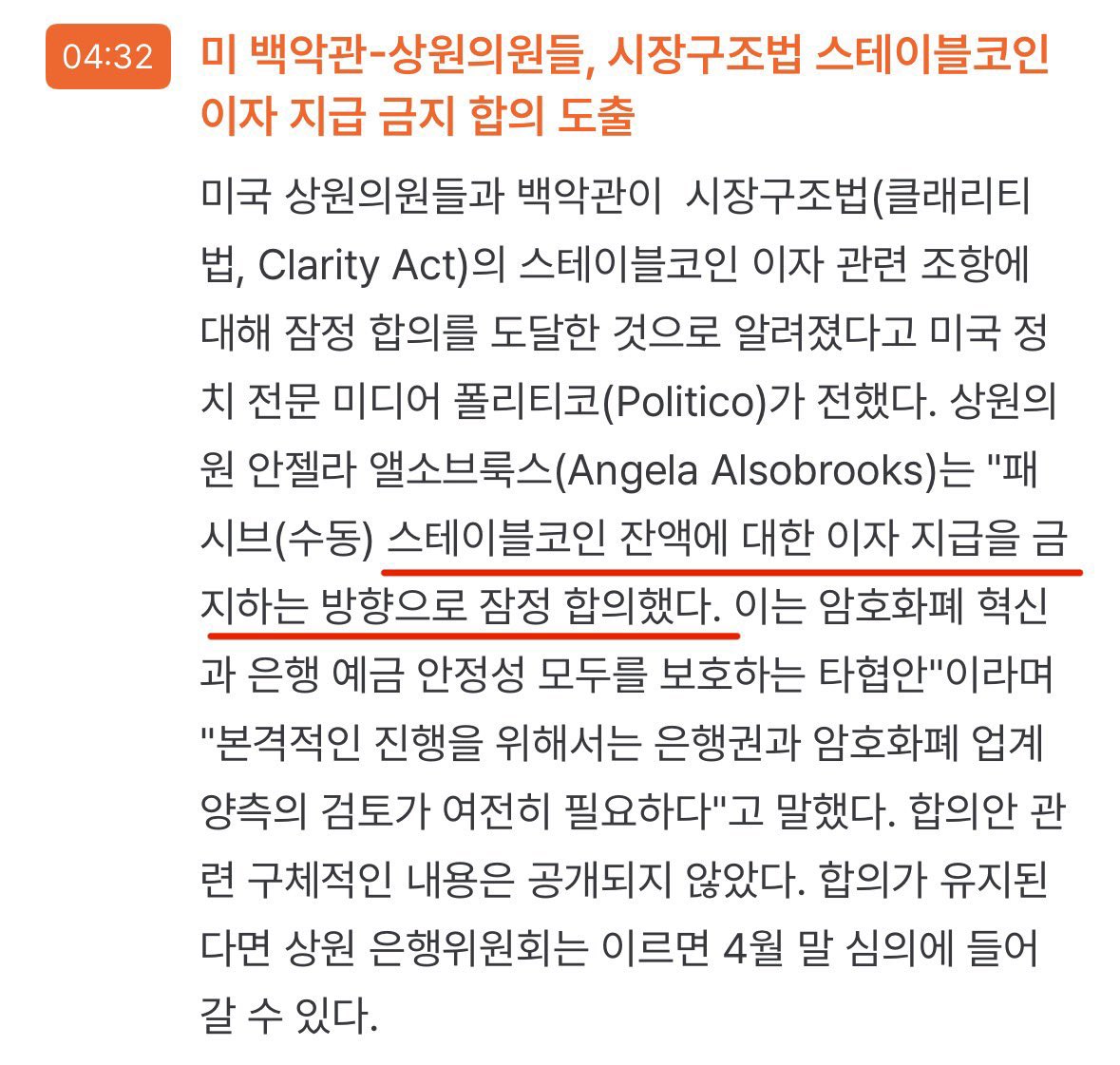
<2달 남은 '클래리티' 입법 시계..."다른 법안 통과 지연으로 난항 전망">
미국 가상자산(디지털자산) 포괄법안 클래리티 법안(CLARITY Act) 입법 기한이 사실상 2달 남은 가운데 상원에서 다른 법안 통과 지연으로 남은 시간 내에 본회의 상정 및 표결이 쉽지 않을 거라는 전문가 분석이 나왔다.
앤 켈리 머큐리스트래티지 파트너는 21일(현지시간) X에 "상원에서 교통안전청(TSA) 셧다운(일시적 업무정지)을 끝내기 위한 예산조정법안 처리가 6월로 밀렸다"며 "클래리티 법안은 이제 본회의 상정을 두고 각종 인준, 주택 법안에 더해 예산조정법안과도 경쟁해야 하는 처지에 놓였다"고 설명했다.
이는 클래리티 법안이 공직자 디지털자산 이용을 제한하는 윤리조항, 스테이블코인 보상 지급 등의 쟁점을 서둘러 마무리해도 아직 통과되지 않은 다른 법안들과의 경쟁에서 밀려 본회의 상정이 늦어질 수 있다는 의미다.
전문가들은 클래리티 법안이 통과되기 위해서는 법안이 11월 중간선거 전인 8월 의회 휴회(현지시간 8월 10일~9월 11일) 전까지 상원 본회의를 통과해야 한다고 보고 있다.
9월부터는 연방 의원들이 중간선거 준비를 위해 지역구에 집중해야 하기 때문이다.
5월 25~29일, 6월 29일~7월 10일 휴회 일정을 감안하면, 앞으로 8월 휴회 전까지 남은 시간은 단 8주다.
이 법안은 의회 새로운 회기가 시작되는 2027년 1월 3일까지 통과되지 않으면 폐기된다.
https://t.co/vwntcap6Cz
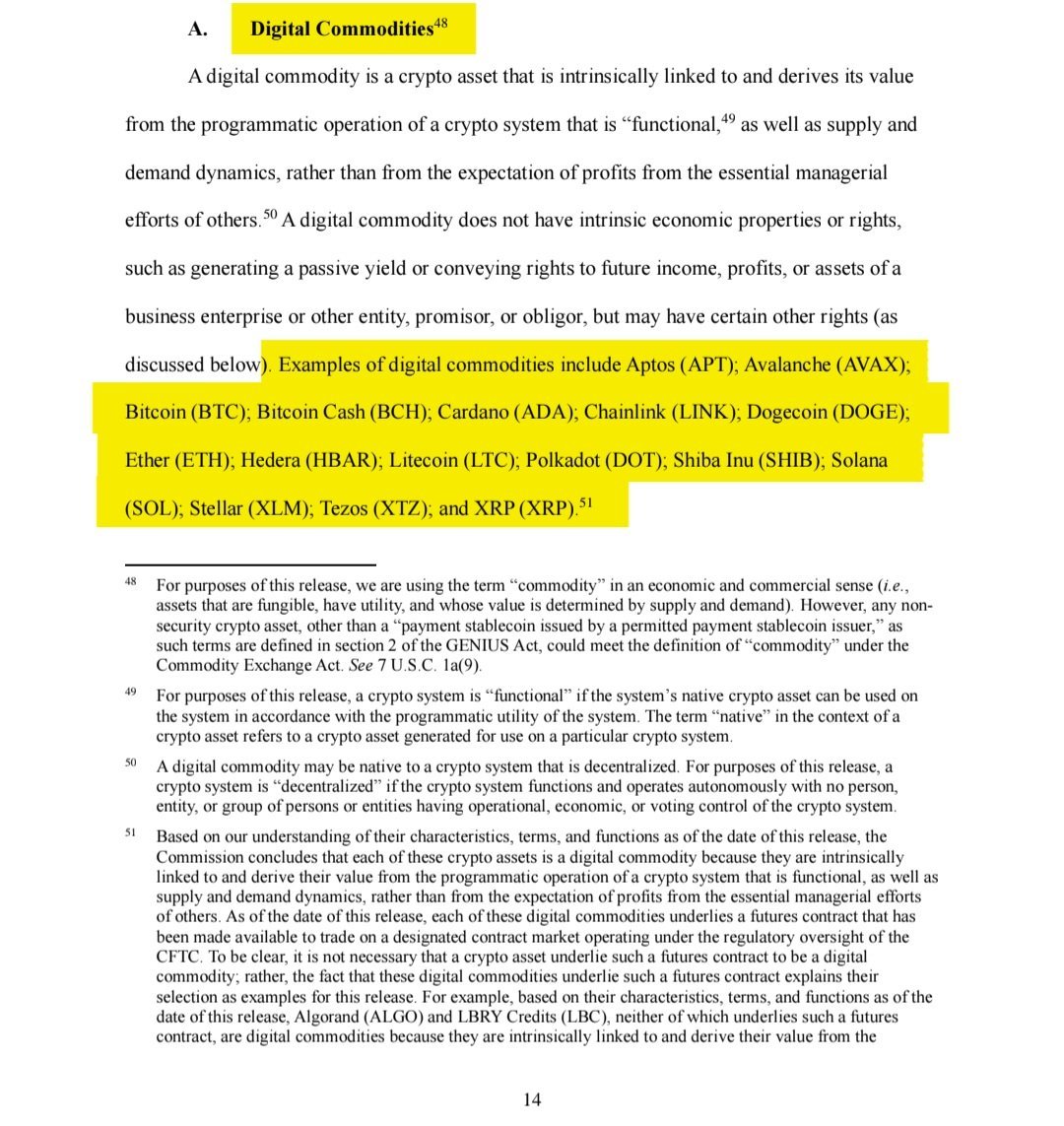
🚨 SEC, “대부분의 암호화폐는 증권이 아니다”
미국 증권거래위원회(SEC)가 2026년 3월 17일 공식 보도자료를 통해 연방 증권법의 암호화폐 적용 기준을 명확히 했습니다.
• 대부분의 암호화폐 자산은 증권이 아니다
• 투자계약 성격을 띄는 특정 토큰만 증권법 적용
• 디지털 상품, 유틸리티 토큰, 스테이블코인 등은 증권에서 제외되는 방향
속보: 미국 SEC, 암호화폐 16개 자산을 공식적으로 ‘디지털 상품’으로 분류
해당 자산은 다음과 같습니다:
$XRP, $APT, $AVAX, $DOGE, $SOL, $ADA, $BCH, $ETH, $HBAR, $ALGO, $LTC, $DOT, $SHIB, $XLM, $XTZ, $LINK
아무도 관심이 없을때
미국은 조용히 암호화폐 미래를 구축하고 있습니다.
- 어짜피 OpenClaw를 사용하기로 했다면..
이제는 어떻게 하면 OpenClaw를 나에게 더 잘 맞게, 더 깊고 넓게, 더 효율/효과적으로 사용할 수 있을지에 대해 고민해야할 겁니다.
아래 인용글 처럼 이미 OpenClaw에 자신의 자원(시간, 비용, 노력 등)을 갈아넣어 본 사람들의 조언은 큰 도움이 될 겁니다.
- 참고로, 경험상 어느 한 사람의 말만 들어선 안됩니다. 여러 사람들의 말을 골고루 들어보고 거기에서 본인에게 도움되는 것들을 본인이 직접 분별, 선택하여 본인이 적용해야 합니다. 각 사람마다 여건, 환경, 스타일, 성격 등..이 너무 다르기 때문입니다.
"나만의 에이전트 만들기 - 이 부분이 진짜 중요합니다!
대부분의 사람이 이 단계를 건너뛰고는 왜 자기 에이전트가 고객 서비스 봇처럼 딱딱하게 구는지 의아해합니다.
OpenClaw는 에이전트의 정체성을 정의하는 세 가지 파일을 사용합니다.
https://t.co/VtgBj5DkkP: 에이전트의 성격. 말투, 관심사, 스타일 등을 정의합니다.
https://t.co/rftlptExzn: 여러분에 대한 정보. 이름, 직업, 선호도, 특이한 습관 등입니다.
https://t.co/gr5OaiZk9p: 장기 기억. 에이전트가 시간이 흐름에 따라 이를 업데이트하여 대화 간의 내용을 기억하게 합니다.
이 내용들을 직접 쓸 수도 있겠지만, 제가 했던 방식을 추천합니다. 에이전트가 여러분을 인터뷰하게 하세요.
텔레그램에서 에이전트가 응답하기 시작하면 다음과 같이 보내십시오.
"너는 방금 처음으로 온라인 상태가 되었어. 이제 나를 알아가기 위해 나에게 질문을 해줬으면 해.
내 이름, 내가 하는 일, 내 목표, 네가 나에게 어떤 식으로 말해주길 원하는지, 내가 매일 사용하는 도구는 무엇인지, 어떤 도움이 필요한지 말이야.
질문은 한 번에 하나씩 해줘. 그다음 내 답변을 바탕으로 https://t.co/VtgBj5DkkP와 https://t.co/rftlptExzn를 작성해줘."
에이전트가 10~15개 정도의 질문을 던질 것입니다. 솔직하게 대답하십시오. 여러분의 실제 상황, 직업, 사이드 프로젝트, 일정, 원하는 격식의 정도를 알려주세요.
꿀팁: 타이핑보다 음성 메모로 답장하십시오. 훨씬 빠르고 더 자연스러운 답변을 줄 수 있습니다. 이 과정이 끝나면 에이전트는 적절한 문맥을 갖게 됩니다. 여러분이 누구인지 알게 되고, 기억하게 됩니다. 이것이 일반적인 챗봇과 '진짜 내 것'처럼 느껴지는 것의 차이입니다."
회원권 자체가 소비재라 가치가 높고 낮음을 논하기 어렵네요. 자동차처럼 중고 거래시 가격은 떨어져서 거래되는데 요즘 리조트 운영으로는 아난티 보다는 소노가 더 낫습니다.
가족 구성원에 아기가 있다면 경제적으로 여유 있다는 가정하에 소노회원권 추천합니다. 회원권 사용자로 만족하는편입니다 ㅎㅎ
대한베이스 x Bankr - Base App 코드 이벤트
아직 베이스앱 코드 없으세요? Bankr와 대화하고, Base App의 베타 코드를 받아가세요!
대한베이스와 @bankrbot 이 Base App 코드 500개와 Bankr Club 멤버십 200개를 준비했습니다.
Base App은 포스팅, 거래, 수익률 파밍, 친구들과의 채팅까지 모두 한 곳에서 할 수 있는 온체인 슈퍼앱입니다.
지금 참여하면 베타 패스 NFT는 물론, 매주 포스팅에 대해 USDC 보상도 받을 수 있습니다! 온체인을 즐기는 데 별다른 장벽도, 규칙도 없습니다.
자유롭게 포스팅하고, 미니앱을 체험하세요.
Bankr는 말 한 마디면 DeFi를 손에 넣어주는 나만의 AI 크립토 은행원입니다.
X, TG, Base App에서 공개적으로 혹은 DM으로 트랜잭션을 처리할 수 있어요.
[Base App 코드 이벤트 참여 방법]
- Base Korea 및 Bankr 공식 소셜 채널 팔로우 ( @daehan_base, @bankrbot, https://t.co/BSA6Qo98CC )
- 본 이벤트 게시글 좋아요 및 리트윗
- Bankr 터미널(https://t.co/llE1btBaHo) 에 본인의 X / Telegram 계정 등록
- 이벤트 종료 이전, 댓글에서 @bankrbot을 태그하고 AI 챗봇과 대화 해보기
- ex)
•요즘 Base에서 인기 있는 토큰 알려줘!
•특정 Base 토큰 기술적 분석 요청
여기까지 마쳤다면 Base App 코드는 참여 완료!
+ (선택 사항) Bankr를 통해 최소 1건 이상 스왑을 수행한 신규 사용자는 Bankr Club 멤버십 200개의 추첨 대상이 됩니다.
Bankr Club은 Bankr의 월간 정기 구독으로 $20 상당이며, Club 멤버는 다양한 에어드랍 대상이 됩니다.
이번 주에는 Bankr Club 멤버 500명에게 총 10,000 $EDEL (1인당 $500 상당)이 배포되었습니다!
이벤트 기간 : 11월 20일 18시 ~ 11월 26일 17시59분
Base App 코드 지급 예상 기간 : 12월 첫째 주
본 Base App 초대 코드 이벤트는 Base Korea 및 주요 커뮤니티 파트너를 통해 참여주신 분들 중 추첨을 통해 배포됩니다.
이벤트에 관련한 문의는 대한베이스로 남겨주시기 바랍니다.
<이더리움 재단이 생각하는 '스테이블코인'>
이더리움 재단(EF)에서 Stablecoins & RWA를 총괄하는 Ash Mogan(@ashmorgan)이 무대에 올랐습니다. 정장을 차려입고 나타난 그는 “이제 이더리움도 기관과 직접 대화하는 단계에 들어섰다”라며 발표를 시작했습니다. 단순한 개발자 커뮤니티를 넘어 글로벌 금융기관과 나란히 서는 새로운 챕터가 열렸다는 메시지가 강하게 전해졌습니다.
Ash는 이더리움을 단순한 블록체인이 아니라 “글로벌 금융 시장 인프라”라고 규정했습니다. Vitalik이 디파이를 이더리움의 킬러 앱으로 포지셔닝한 것이 지금의 스테이블코인과 RWA 채택을 떠받치는 토대가 되었다고 강조했습니다. 실제로 발행, 거래되는 스테이블코인의 70%가 L1, L2 이더리움 위에 있다는 사실은, 이더리움이 안정성과 보안성에서 독보적 위치임을 보여줍니다.
“어떤 정부도, 어떤 기관도 이더리움을 멈출 수 없다.” 그는 이 점을 강조하며, 결국 국채, MBS, 이자 지급 토큰 같은 실물 자산이 이더리움 위에서 담보화되고 거래될 것이라 전망했습니다.
또 하나 중요한 주제는 '프라이버시'였습니다. EF (@ethereumfndn)는 최근 기관 전용 프라이버시 태스크포스를 신설했으며, 70명의 ZK (영지식 증명)전문가가 참여하고 있습니다. “프라이버시는 기관 채택의 가장 큰 허들”이라는 그의 말처럼, 이를 해결하는 것이 채택의 핵심 열쇠가 될 것입니다.
스테이블코인에 대해서도 뚜렷한 비전을 제시했습니다. 단순히 1달러 페깅을 유지하는 수준이 아니라, 국채 수익률을 반영한 ‘수익형 스테이블코인’이 은행 예금과 경쟁할 것이며, 머지않아 은행이 오히려 스테이블코인과 통합하게 될 것이라는 시각입니다.
L2 전략도 발표의 중심이었습니다. EF는 100밀리초대 파이널리티를 목표로 상호 운용성을 혁신하는 프로젝트를 준비 중이며, 곧 아르헨티나에서 개최되는 DevConnect에서 공개할 예정입니다. L2 생태계의 판도를 바꾸고, 이더리움 기반 애플리케이션 확장을 가속할 수 있는 시도가 될 것입니다.
“많은 사람들이 이더리움이 뒤처졌다고 말했지만, 사실 우리는 묵묵히 생태계를 발전 시켜왔다”라고 말했습니다. EF는 250명 규모지만, 인프라 빌더까지 합치면 3만 명이 넘는 인력이 Vitalik의 비전을 실현해왔습니다. 이 네트워크야말로 이더리움의 진짜 힘이라는 메시지였습니다.
마지막으로 Ash는 이렇게 정리했습니다. “세상의 99.99% 자산은 아직 블록체인에 올라오지 않았다. 지금은 늦은 게 아니라 이제 막 출발선에 선 것이다.”
이 발표는 단순한 기술 설명이 아니라, 왜 이더리움이 앞으로도 금융의 중심 무대에 설 수밖에 없는지를 강하게 보여주는 순간이었습니다. 한국 시장 역시 은행과 기관이 스테이블코인을 통합하고 국채 기반 수익 상품을 온체인에서 다루는 시대가 곧 열릴 것임을 예고하는 장면이었습니다.
@model_x_tesla 저도 그 부분이 고민이긴 합니다. 회원권 구매 이유가 예약 보장 때문이라고 생각은 하는데 워낙 리조트 경험이 없다보니 아기 친화적인 시설은 소노랑 한화밖에 떠오르는게 없어서요.
예산을 최대 3억까지는 고려하고 있는데 워터파크, 시설내 키즈카페 같은 부분때문에 소노를 고려했었네요
연준 25bp 금리 인하
1. 경제 성장(GDP)
2025년 실질 GDP 성장률 전망: 1.6%
2026~2028년 전망: 1.8~1.9% 수준
장기 성장률: 1.8%
6월 전망치(1.4%)보다 상향 조정됨.
2. 고용(실업률)
2025년 실업률 전망: 4.5%
2026~2028년 전망: 4.2~4.4%
장기 실업률: 4.2%
이전 전망 대비 거의 동일, 완만한 하락 예상.
3. 물가(PCE 인플레이션)
2025년 PCE 물가상승률 전망: 3.0%
2026년: 2.6%
2027년: 2.1%
2028년 및 장기: 2.0%
물가는 점진적으로 2% 목표치로 수렴할 것으로 예상됨.
4. 근원 인플레이션(Core PCE)
2025년: 3.1%
2026년: 2.6%
2027~2028년: 2.1~2.0%
전체 PCE와 유사한 경로로 하락 전망.
5. 기준금리(Federal Funds Rate)
2025년: 3.6%
2026년: 3.4%
2027~2028년: 3.1%
장기 금리: 3.0%
6월 전망(3.9%)보다 낮춰짐
→ 금리 인하 속도가 조금 더 빨라질 수 있음을 시사.
6. 불확실성 및 리스크
FOMC 위원들은 GDP·실업률·인플레이션 전망에 상당한 불확실성이 있음을 강조.
리스크는 대체로 균형적이나, 일부 위원은 성장 둔화/인플레이션 지속 가능성을 우려.
정리하면,
성장은 소폭 상향,
실업률은 안정적,
인플레이션은 점진적 하락,
금리 인하 속도는 다소 빨라질 가능성이 담긴 전망.
1/ Spacecoin Airdrop Season 2 is live, Cadets! 🛰️ Bigger rewards
🛰️ New, smoother platform
🛰️ Choose your own airdrop journey!
Read on to know how to participate 👇