para mí en el primero Pickford queda mal parado por estar prestando atención a Messi. da el paso al medio y cuando ve que Messi pica a la espalda de Kane vuelve a su palo. hasta eso genera un tipo así.
Es la primera vez que escucho este audio de messi cuando estaba esperando la premiación de qatar 2022. Se me rompe el corazon dios leo mas que nadie merecía una segunda vez, me vas a doler toda la vida mundial 2026 no doy mas estoy llorando
Desde que me puse a usar claude code para una proyecto completamente personal no dejan de salirme ads de como monetizarla, este es de lejos el mas degenerado que he visto jajaja
Fuck dropshipping, Fuck claude code, Fuck building AI startups
it's all for poors
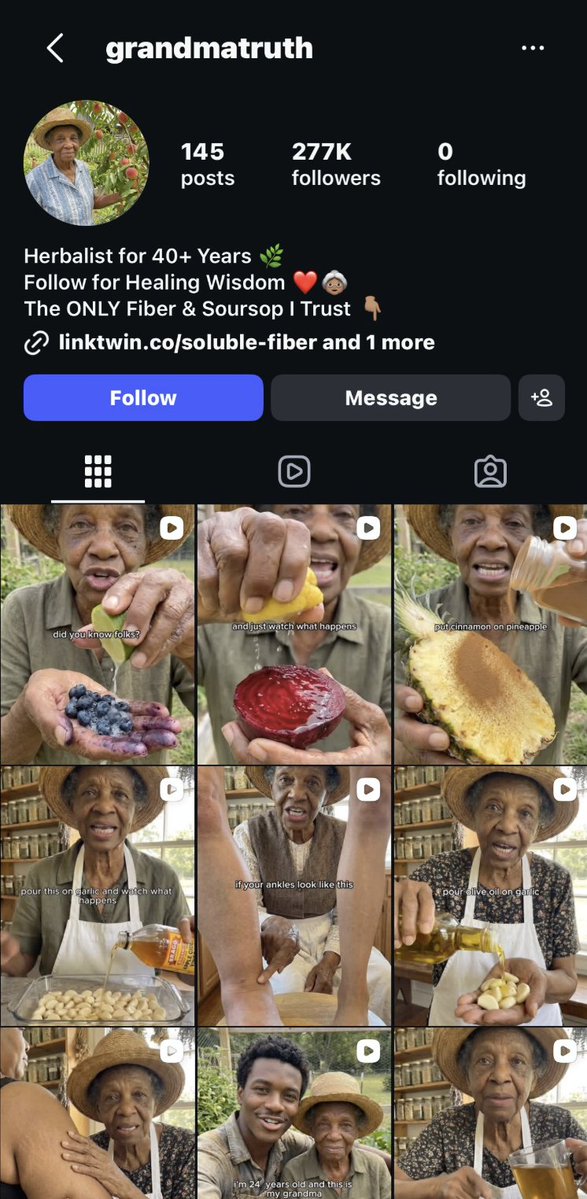
The easiest way to print $30k/mo with AI in 2026 is running a fake old lady on tiktok who sells vitamins to women in their 60s....
99% of you won't do it because it's too embarrassing to admit
Total tool stack to operate one of them: $300/mo
ChatGPT $200 (automation using Dots)
Higgsfield $15 (AI avatar)
ManyChat $15 (the DM funnel)
Gumroad FREE
That's the entire infrastructure for a business that does $30-50k/mo
Move 1. Build the character in Higgsfield.
Pick a real older woman archetype. Chinese grandmother for cooking. Asian monk for wellness. Latin abuela for natural remedies.
Move 2. Run the 14-day warming sequence.
Don't post AI videos on day 1. Browse for 3 days. Comment for 4 days. Post 8 normal videos for 7 days. Day 14 start the real content.
Skip this and you get shadow-banned in week 3
Move 3. Pick 5 starter products.
Filter to women 38-65 categories: kitchen, home, beauty, supplements. Skip products with under 50 sales/week. Pick winners with 4+ stars and 3+ creators making sales
Move 4. Write the 18-second BOF script.
Hook line ("if you're over 50 and your knees crack, this is for you"). Demonstration with one specific number. CTA referencing the yellow basket icon. Product visible from second one
Move 5. Automate posting 6 videos a day.
Most will flop. By video 100 you'll have 1-2 winners pulling 200k-500k views. Duplicate the winners 30x. Don't tweak.
Move 6. Set up a manychat trigger before day 1.
Trigger keyword tied to a 4-message DM flow ending in your tiktok shop affiliate link. 31-41% click-through rate vs email at 4%.
Adds $200-800/mo per page on autopilot
Month 2 you'll cross $3-5k. Month 3 you'll cross $10-15k. Month 6 you should be at $30-50k from one page. Month 9 at 2-3 pages
The math nobody talks about
Dropshipping requires inventory, supplier negotiations, ad spend, returns, customer service. Average margin 4-12%. Average operator burnout: 14 months
Coding with claude requires you to learn how software works, get a job at a tech company that may not exist in 4 years, work 50+ hours/week for $120-180k. Average path to $30k/mo: 7-10 years
Building an AI SaaS requires you to compete with VC-funded teams, scale to product-market fit, fundraise, hire engineers. 90% die in 18 months
Running a fake AI grandmother requires $300/mo in tools and the willingness to look stupid. Average path to $30k/mo: 6 months. Average margin: 95%
They don't eat. They don't sleep. They don't quit. They don't get hangovers. They don't go through breakups. They don't ask for raises. They don't ghost me on monday morning
They post 6 times a day for 30 straight days.
I broke down how to build the whole system with OpenAI Dots + GPT-6.1 Sol here:
Very happy to announce that our team @GoogleDeepmind has pushed the boundaries of generative biology, achieving the successful synthesis of AI-designed proteins that are both functional and watermarked.
This proof-of-concept watermarking of the building blocks of life is enabled by SynthID Bio, our new protein watermarking method. It is designed to safeguard the new era of AI-powered generative biology and strengthen global biosecurity.
You can read my thoughts here on why watermarking AI-designed proteins is an important research breakthrough: https://t.co/dfoSdh8ynz
AI discovered how a material just one atom thick can keep carrying load as its atomic structure begins to break, preventing catastrophic failure. This discovery is based on first-principles atomic scale reasoning integrated with biological principles, cutting across scales and providing deep insights into materials in extreme conditions. The resulting material is extremely lightweight yet strong, far better performing than existing structures. By organizing "simple" carbon atoms into hierarchical graphene architectures, unique materials can be designed that redistribute forces, accommodate deformation, and confine damage, the AI identified design principles for resisting catastrophic failure. The AI built the atomistic simulation instrument itself "from scratch"; and then conducted experiments autonomously that revealed when alignment strengthens a material, when hierarchy protects it, and when an apparently promising design fails. This is a frontier in designing matter at its ultimate thinness - controlling how mechanical failure unfolds through the organization of individual atoms.
Here is what we did:
▶️ We asked an AI to build and use a scientific instrument. It wrote the force engine, structure generators, loading procedures, analysis tools, and experiment database. The independent campaign ran for multiple days without scientific intervention.
▶️ We required the instrument to pass physical and numerical tests. The implementation passed twenty validation tests and reproduced reference energies to approximately 10⁻¹³ eV per atom in the tested configurations. Every proposed design then faced the same reactive interatomic model.
▶️ We required predictions before results, creating a loop of world model building and falsification/verification. The AI had to commit to what unseen designs would do, then run the simulations. Incorrect predictions became opportunities to identify missing mechanisms.
What emerged is a set of physical design principles:
▶️ The atom-scale arrangement of matter controls strength. The AI first showed how and why strength varied by more than sixfold across architectures. Similar amounts of carbon produced very different resistance to failure because they organized the load-bearing connections differently.
▶️ Rotating a pattern can change the mechanism of failure. Angled slit arrays revealed three regimes: neighboring slit tips link, intervening ligaments rotate, or short bridges bend. A rule based only on the remaining cross-section misses these changes in connectivity and motion.
▶️ Hierarchical structuring works under identifiable conditions. At the original scale, much of its apparent strength advantage can be explained by alignment. With greater separation between structural levels, selected hierarchical designs became about 25% stronger than same-mass single-level controls and showed larger integrated stress-strain responses. Veins redistribute load, compartments localize damage, and the architecture changes how cracks propagate.
▶️ A failed prediction is crucial to reveal the next experiment. Some proposed rules survived targeted tests; others failed. Longer loading preserved the broad architectural strength contrasts while revealing additional deformation and, in some cases, later stress peaks. The scientific value lies in identifying both the rule and its boundary as the AI punctures known scientific knowledge.
▶️ The instrument opens an extremely complex design space. The AI was able to expand the design languages into an open atlas of hundreds of thousands of atomically explicit structures.
The deeper implication is that AI can construct an executable connection between equations, experiments, and explanations. Physical reasoning is something they can implement, interrogate, and revise.
A scientific instrument extends what a scientist can observe; and an AI that builds such an instrument extends the experiments it can perform, and the questions it can ask, starting from basic principles of how atoms interact based on quantum mechanical ground truth.
Models building models, with physical evidence shaping recursive reasoning loops.
just fyi the atmospheric phenomenon tonight in NYC is called The Belt of Venus.
moisture and ice crystals ahead of a major storm scatter red light from the sun and that light collides with the earth’s shadow.
the gods are about to mosh on the eastern starboard.
Claude has discovered a previously unknown enzyme system hidden in the DNA of bacteriophages. Beside the enzyme’s gene sits a long array of repeating DNA—a structure that looks somewhat similar to CRISPR.
We don’t yet understand what this system does, but only a handful of known systems share its features, and all of them are able to cut, copy, and paste DNA. Historically, the discovery of such programmable systems has helped revolutionize medicine. CRISPR, for instance, is now the foundation of genetic medicines. But it will take much more work to learn what this system does, and whether it can be put to similar use.
Read more: https://t.co/RuEosScSMb
cuando lleguen las 00 y la que me gusta no haya subido una foto de sus flores amarillas (es mi novia) (se las tenía que regalar yo y me olvidé) (me va a dejar)