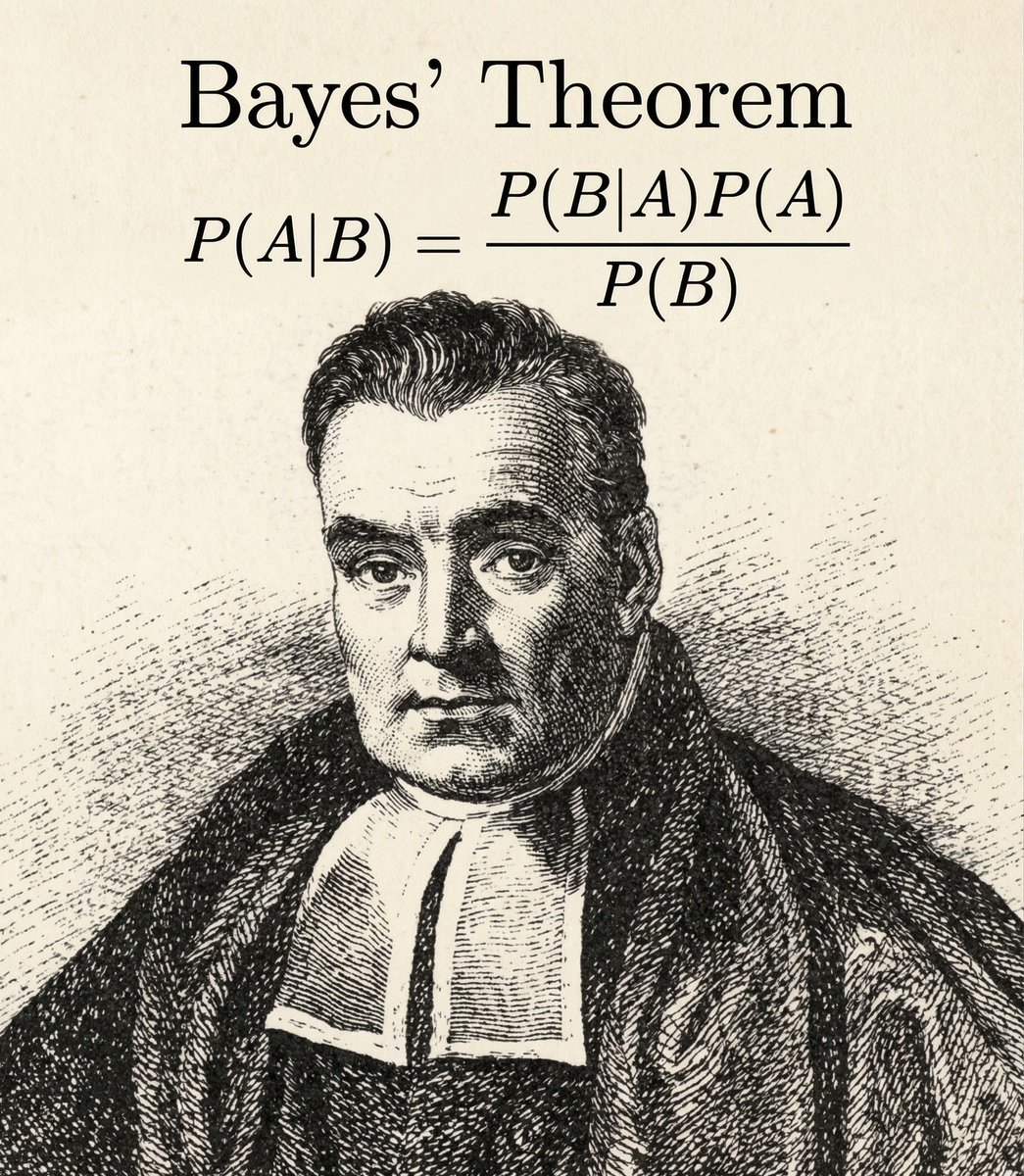
Most engineers have seen this formula.
P(A|B) = P(B|A) × P(A) / P(B)
Almost none can explain what it actually does.
Here's Bayes' Theorem in plain English, and where it's hiding inside systems you use every day.
The core idea in one sentence:
Bayes' Theorem updates your belief about something after seeing new evidence.
That's it. Four terms:
Prior → what you believed before the evidence
Likelihood → how probable the evidence is, given your hypothesis
Evidence → how common the evidence is overall
Posterior → your updated belief after seeing the evidence
A concrete example:
Say 40% of all emails are spam (your prior).
You see a new email containing the word "lottery."
10% of spam emails contain "lottery." Only 1% of legitimate emails do.
Plug into Bayes:
P(spam | "lottery") = (0.10 × 0.40) / P("lottery") ≈ 87%
The word "lottery" updated your belief from 40% → 87%.
That's Bayes in action. Prior belief + new evidence = updated belief.
Where it lives in AI:
1/ Spam filters
The Naive Bayes classifier, the algorithm behind most spam filters - applies this exact calculation word by word across an entire email. Each word shifts the probability up or down. It's called "naive" because it assumes each word is independent of the others, which isn't realistic, but works remarkably well in practice.
2/ Medical diagnosis AI
A patient has symptom X. What's the probability of disease Y? Bayes updates the base rate (how common the disease is) with the likelihood of seeing that symptom in patients who have it. Same formula, different domain.
3/ Your LLM's uncertainty
Modern language models don't just predict the next token, they assign a probability to every possible token. The sampling process (temperature, top-p) is directly working with those probability distributions. Bayesian reasoning is embedded in every response your model generates.
The insight most engineers miss:
Bayes doesn't give you certainty. It gives you a rational way to update uncertainty.
That's exactly why it's foundational to AI - real-world systems are never certain. They're always working with incomplete, noisy, probabilistic information.
Every model that learns from data is, at its core, doing some version of this:
Start with a belief. See evidence. Update the belief.
That's Bayes. That's machine learning.
Everyone should learn to code with AI! At AI Fund, everyone - not just engineers - can vibe code or use AI assistance to code. This has been great for our creativity and productivity. I hope more teams will empower everyone to build with AI. Please watch the video for details.
The health care crisis has gone mainstream. On the latest episode of the NEJM AI Grand Rounds podcast, Dr. @zakkohane explains how the conversation has shifted from “Will AI replace doctors?” to “Can AI help solve our health care workforce crisis?" https://t.co/Kv56B1rYJq
A new study examines the vulnerability of LLMs tuned to medical data to adversarial attacks. The results demonstrate the effectiveness of such attacks and underscore the critical need for enhanced defenses in the training of health care–focused LLMs. https://t.co/97WAwH2sYZ
Understanding the difference between Standard Deviation (SD) and Standard Error (SE) is crucial for accurate data interpretation. SD measures the variability within your data, indicating how spread out the individual data points are from the mean.
In contrast, SE measures the uncertainty around the sample mean as an estimate of the population mean. It reflects the precision of the mean, with SE decreasing as the sample size increases, making your estimate more reliable.
The relationship between SD and SE is given by the formula: SE = SD / √(sample size). While SD remains relatively constant with larger samples, SE diminishes, highlighting the reduced uncertainty in the mean estimate.
A common mistake in research is using the “±” notation without specifying whether it refers to SD or SE, leading to potential misinterpretation of the data. Clear distinction is essential for transparency and accuracy in reporting.
Key Takeaways:
• Use SD to describe data variability.
• Use SE to indicate the precision of the mean.
• Always specify which measure you are reporting.
If you have any interest in epidemiology, in cancer, in genetics and evolution, and in causal inference, then this short chapter by Richard Peto from 1984 on “The Need for Ignorance in Cancer Research” https://t.co/kQ4Li1R6f1 will change the way you think about the issues/cont
For those asking how I implemented AutoGPT, I just followed this guide. Insanely easy.
(Personal note: AutoGPT is earlier and worse-performing than I thought, but I'm still convinced it's the next iteration of GPT. It has 100k stars for a reason.)
https://t.co/NspDECtYwT
My posts on the OpenAI API has 1.5 million views and counting.
Here is my step-by-step breakdown for non-technical users to implement the GPT API in Google Spreadsheets so you can ask AI 500 questions at once👇
https://t.co/bq5asCyWxM
Our March newsletter highlights research in IeDEA Southern Africa on cancer and on vertical transmission - reflecting the broad range of #HIV research our investigators are conducting around the world!
PLUS our investigator profiles: https://t.co/yhNNiHQwOs
@iedea_sa @NIAIDNews
📢 Breaking news: Leading academic publishers like Elsevier and Cambridge University Press say you *can* use apps like ChatGPT for academic writing.
You *can* use text generated by apps like ChatGPT and Bing but you *can't* list them as authors or co-authors.
Scholarcy is an AI-powered app that can convert any research paper into a PowerPoint presentation — instantly.
This will save you hours of work.
Here's how to use Scholarcy:
SciSpace is an AI-powered tool that will make reading research papers easier and faster. It's like ChatGPT for research papers.
Simply upload a paper and start asking it questions.
Best part: it's totally FREE!
Here's how to use it:
With this extension, you can read papers in your browser and ask your Copilot questions about the paper.
Open the paper you want to read. Then click on the Copilot in the top-right corner of your screen, and start asking it questions.