This is brilliant. If you want to understand energy policy, why electricity is so expensive, and how and why climate policies contribute to that, have a listen. Perhaps the clearest explanation I’ve ever heard.
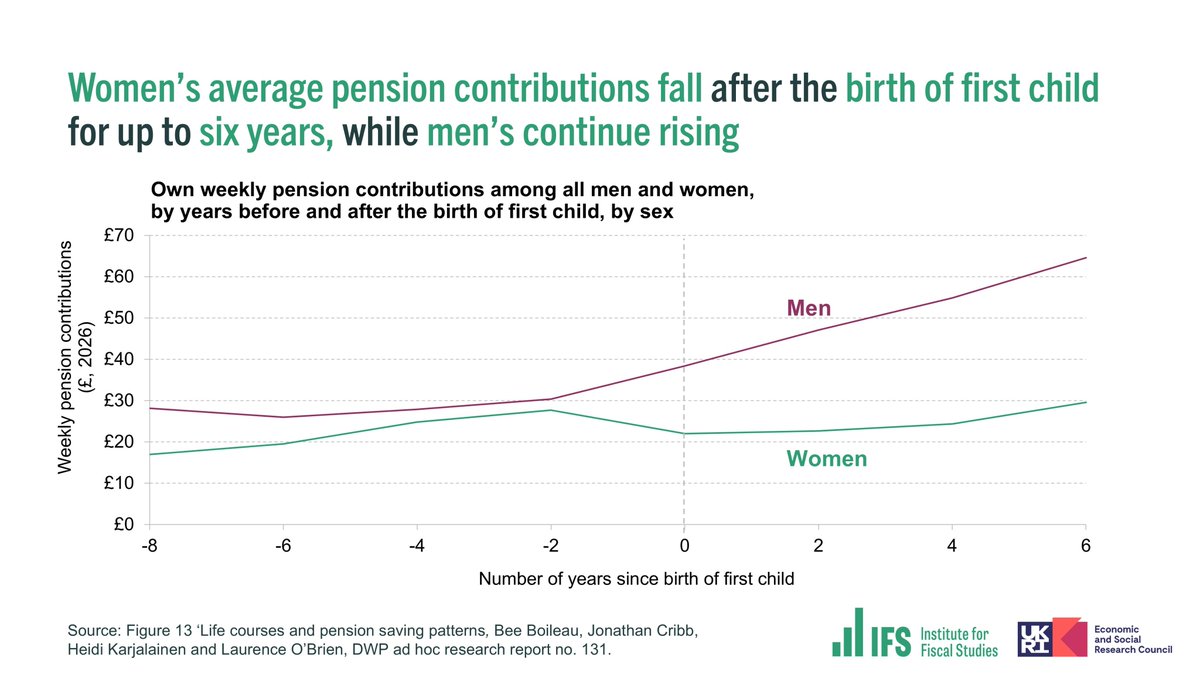
NEW: A gender gap in the average pension contributions of men and women opens at the time of the birth of their first child, our new research finds.
The @DWPgovuk report for the Pensions Commission provides new evidence on how labour market life-course trajectories link to pension saving and retirement outcomes:
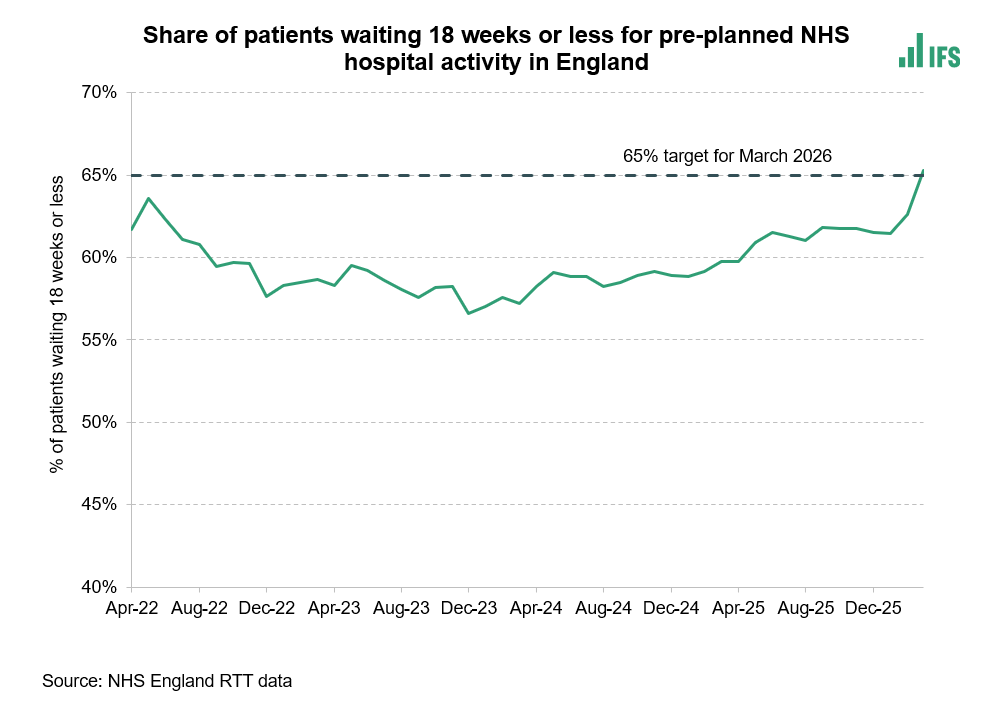
The key question now is whether these recent changes are temporary or if the NHS is able to continue making further improvements to 18 week performance – it's still a long way to get to the headline target of 92%. I suspect next month’s data will be v interesting. [12/13]
@MaxWarnerIFS knows huge amounts about NHS waiting lists...
here's a key update from my @TheIFS colleague on NHS performance against targets and the info released yesterday.
It wasn’t the biggest story yesterday, but the NHS in England hit its intermediate target that 65% of patients should be waiting 18 weeks or less for elective care by Mar26. That’s after big recent improvements from 61.5% in Jan to 65.3% in March. So how was this achieved?🧵
Pretty good news on growth in the first quarter of the year, but worth not over-interpreting.
In each of the last four years, we've seen higher growth in Q1 than later in the year - you'd want to see good news later in the year to think this is a sign of a genuine improvement.
The change in debt interest spending in recent years is v important. In the 2000s & 2010s, 5% of UK government spending was on debt interest on avg. It's now 8% and forecast by the OBR to stay at that level. That's before any impact of events in the Middle East on borrowing costs
@Heidi_Karj and I joined @HelenMiller_IFS last week for an IFS podcast episode about pensioner incomes and wealth:
https://t.co/HxIugYJ6W8
We are going to be back again this week for a discussion about people working into their late 60s (or beyond).
Do tune in!
@BenZaranko has been a huge asset to the IFS over the last 9 years. While there's a large part of me that wishes he was staying, I know he'll do great things in journalism.
And I'd argue it shows why IFS is a great place to start and build a career.
Some personal/professional news: today is my last day at the IFS. There’s nowhere else I’d rather have spent the last nine years and leaving is such a wrench. But it’s time for something new, and I’m excited to be joining The Observer as Economics Editor from 7 April.
NEW PODCAST: Are pensioners richer than everyone else?
@HelenMiller_IFS, @JCribbEcon and @Heidi_Karj examine what the evidence says about pensioners' incomes, wealth and living standards in our new IFS Zooms In podcast episode.
🎧 Listen here: https://t.co/Rd6wXoj7WU
I am no fan of the triple lock as there much better, more sustainable, ways of increasing the state pension.
But the triple lock has cost about £12bn per year so far (0.3% of GDP) with pension spending now 5% of GDP.
I don't think you can call this "strangling". (1/2)
Even if we keep it for 50 (!) more years - it would push up spending by 1.5% of GDP.
Reaching about 7.7% of GDP in 2075. (US: 7.1% in 2019)
Re: long run public finances, I worry more about health spending
See
https://t.co/rxR3quX4c7
and OBR : https://t.co/dteHJCr8su
(2/2)
NEW: Despite substantial increases in spending and some recent progress, Scottish public services are still performing substantially worse than before COVID.
Our new Scottish election report, funded by @RobertsonTrust and @NuffieldFound, investigates: [THREAD]
NEW PODCAST: The Spring Forecast explained
@HelenMiller_IFS, @benzaranko and @beeboileau discuss the Spring Forecast. We cover rising energy prices and what the big forecast uncertainties mean for government spending plans.
🎧 Listen here: https://t.co/B7s5lZWj06
The news from the spring forecast today isn't the change in the forecast - those changes are tiny compared to the uncertainty around them
Big picture remains: debt is high; borrowing is high; borrowing costs are high. Big challenges lie ahead..
There's a v striking difference between Conservative and Lib Dem HE proposals.
Lib Dem proposal immediately cut repayments for many (but loan balances are higher)
Cons proposal (to cut interest rate) doesn't cut repayments straight away but does push down the loan balances.
NEW: How would proposed changes to Plan 2 student loans affect graduates?
📗 We’ve modelled proposed reforms from the Conservatives, Lib Dems and Rethink Repayments and more in our new report: [THREAD]
I had a great time chatting about older people with @TimHarford on @BBCMoreOrLess. The starting question was – are one in four pensioners really millionaires? Quick thread below:
https://t.co/wHOgtM41U2
📕 @LordsEconCom has today published its report into Preparing for an Ageing Society, drawing heavily on evidence from IFS Deputy Director @JCribbEcon.
The Committee argues that a government strategy is needed to address the challenges of an ageing society ⬇️
This is a careful, valuable piece of research demonstrating that cuts to non-disability benefits in the 2010s led to more people claiming disability benefits. Notable, though, that extra spending on disability support only undid a very small % of the original savings.
We're looking for an outstanding economist to lead our health team.
This is a rare opportunity, with a great team. If you want to lead economic research with real-world policy impact, there really is nowhere better than the IFS.
https://t.co/Zg1UlVKZIA





![TheIFS's tweet photo. NEW: Despite substantial increases in spending and some recent progress, Scottish public services are still performing substantially worse than before COVID.
Our new Scottish election report, funded by @RobertsonTrust and @NuffieldFound, investigates: [THREAD] https://t.co/d7PtLypKv7](https://pbs.twimg.com/media/HCy67rjXwAETRUk.jpg)

![TheIFS's tweet photo. NEW: How would proposed changes to Plan 2 student loans affect graduates?
📗 We’ve modelled proposed reforms from the Conservatives, Lib Dems and Rethink Repayments and more in our new report: [THREAD] https://t.co/iuQVBOOtkC](https://pbs.twimg.com/media/HCKP2XqXUAAuN8-.jpg)





