MD-PhD radiation oncology resident at @UWMadisonRadMed; passionate about AI, cancer, & people; clinician by day, researcher by night; views my own, RT/❤️≠ agree
AI’s greatest contribution to medicine may be giving clinicians more time to be human.
On The HealthCast, I discuss the intersection of AI in healthcare and why innovation must strengthen, not replace, the physician-patient relationship.
https://t.co/P11EuEsmyY
#AI#Healthcare
Our #ASTRO26 poster on cribriform prostate cancer in SEER: first-course surgery + RT was rare (8.6%), and OS was similar for RT alone vs surgery (HR 1.02). Small cohort, hypothesis-generating. w/ @AndrewFarach@UWMadisonRadMed@HMethodistMD@utmbhealth https://t.co/1OtWZe26nX
The future of AI in healthcare isn't just better models. It's translating them into tools clinicians trust and patients benefit from.
I joined Nic Espanet on the Flex Forward Podcast to discuss AI, medicine, and what's next.
https://t.co/cI0dYq521a
#AI#Healthcare#Cancer
After 10 long years of MD/PhD training, I am honored to announce I have matched at U Wisconsin for Radiation Oncology training and prelim year! All these kids were born during my time in med school! They're going to learn what winter is!❄️❄️❄️ @UWMadisonRadMed#Match2026#radonc
More amazing talks from #ACRO2026 breast session! Big takeaways:
- Ahead of NRG BR008, NCDB analysis suggests OS benefit to RT even in low risk Her2+ pts
- Ongoing studies to delay SGY for DCIS patients, and prospective studies for omitting RT for low genomic risk DCIS
I'm honored to share our recent research findings about the positive role of radiation for early-stage HER2+ breast cancer.
Conclusion: In this HERO-aligned national cohort, RT omission was associated with inferior OS in patients treated with adjuvant systemic therapy after BCS.
📢New in @Cancers_MDPI: In early-stage HER2+ #breast cancer treated with breast-conserving surgery, adjuvant radiation was associated with improved overall survival in a national HERO trial-aligned cohort.
✍by @JCummock, Bin S. Teh et al.
📌https://t.co/PFDbxyhyK2
Excited to present 2 abstracts at #ASTRO25
• Glioblastoma: Radiotherapy fractionation scheme outcomes in elderly (Mon 9/29, 8AM, Hall F)
• Breast Cancer: Survival impact of adjuvant radiation in HER2+ early-stage disease aligned with NRG-BR008 HERO trial (Mon 9/29, 3PM, Hall F)
Presenting today at the 13th Annual Houston Methodist Cancer Symposium
Topic: Closing the Gap After NRG-BR008 HERO: Real-World Evidence for Adjuvant Radiation in Early-Stage HER2+ Breast Cancer
Ten years, thousands of patients, one clear message: Keep the RT
#RadOnc#BreastCancer
I'm grateful for the opportunity to present at AIHES 2024: Investigating the Role of Brain Connectivity and Social Environment in Hispanic Adults with Depression and Anxiety: A Multiomics Approach
#AIHES2024#AIM_AHEAD#AI#HealthEquity@AIM_AHEAD@SCHUB_AIM_AHEAD
We trained an #AI to "see" catheters & detect tip position on fluoroscopy. A first step towards AI-augmentation and autonomy in #neurointervention 🦾
Excited to share my PhD work in @JNIS_BMJ & grateful for mentorship from Drs.@KelvinWongPhD, STC Wong, YJ Zhang, and @gwb777!
Excited to announce Med-Flamingo, a new multimodal few-shot learner specialized for the medical domain!
Last week, we uploaded the pre-print, now it’s finally live!
Paper: https://t.co/v2B7HptMpT
Code: https://t.co/zGtDyZ9NHP
Model: https://t.co/aS1HYyb3ls
A short 🧵.
1/n
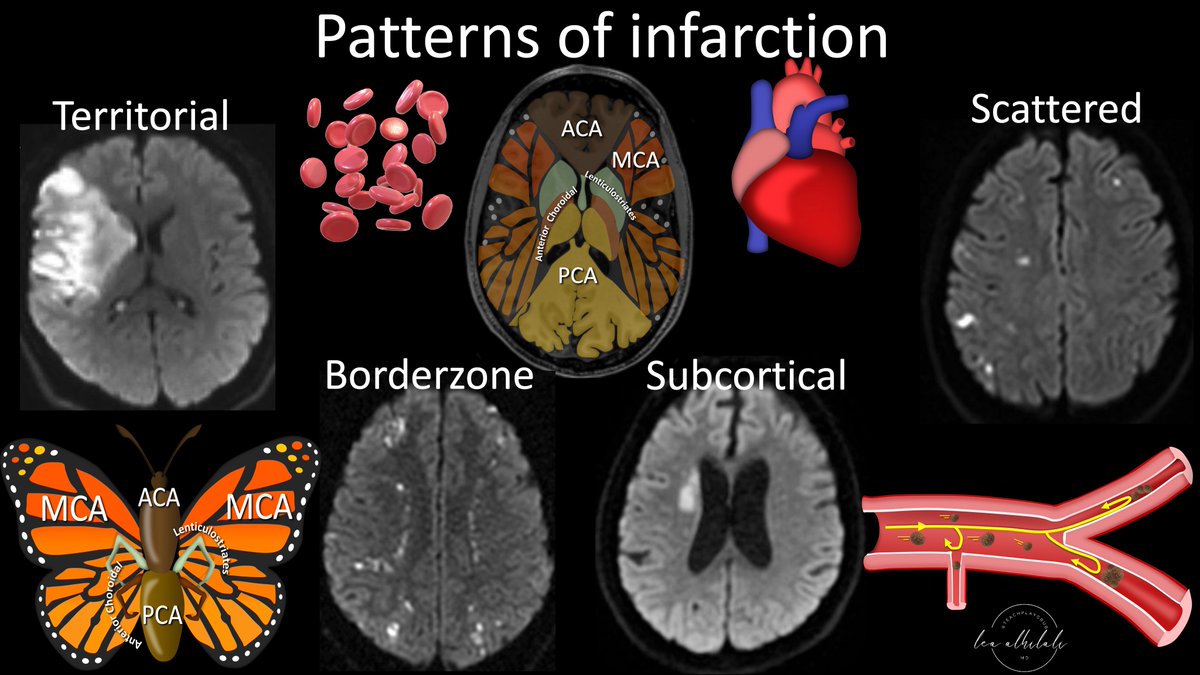
1/I always tell my fellows, “Anyone can see the bright spot on diffusion—what sets you apart is if you can tell them why it’s there!”
Can you tell a stroke’s etiology from its appearance on MRI?
Here’s a #tweetorial to show you how!
#medtwitter#neurotwitter#stroke#neurorad
First, with their CNN's, they came for the radiologists, And I did nothing.
Then, with their LLM's, they came for the rest of us.
Heads up: tuned PaLM would get a low pass on USMLE.
cc: @jeremyphoward@DrLaurenOR@mattlungrenMD@curtlanglotz
https://t.co/9XBr34JAeL