Paper stops alpha, aluminium stops beta, lead stops gamma and X-rays, water stops neutrons.
Alpha particles are helium nuclei that dump all their energy in the first few micrometres of matter. Beta particles are fast electrons that travel farther before they slow. Gamma rays and X-rays are photons that lose energy only through rare interactions, so only dense metal finally absorbs them. Neutrons carry no charge, so they ignore electric fields and need light nuclei in water or concrete to scatter and slow.
Shielding works because each particle asks matter a different question.
The Universe Might Be Nearly Twice as Old—and Dark Matter and Dark Energy Might Not Exist
What if the “missing” mass and energy that have haunted cosmology for decades are an illusion? What if the universe isn’t a frantic 13.8-billion-year-old rush of galaxies assembling in the dark, but a slower, more deliberate 26.7-billion-year-old process?
That’s the claim of the CCC+TL model (covarying coupling constants plus tired light), and a new University of Ottawa study shows it is surviving some of the toughest tests cosmology can throw at it.
A different set of rules
Rajendra Gupta and postdoctoral researcher Nikolaos Samaras didn’t just tweak the standard ΛCDM model. They rebuilt the relevant equations from the ground up. In their framework, the fundamental constants that govern how forces and particles interact slowly change over cosmic time. The effects we normally attribute to invisible dark matter and mysterious dark energy emerge from those evolving constants instead.
Decades of searches have failed to detect dark matter or dark energy directly. At the same time, the James Webb Space Telescope keeps finding surprisingly mature, massive galaxies in the very early universe—objects that seem to have formed too quickly under standard timelines. CCC+TL offers a single mechanism that could address both problems.
Passing the tests
The model has now been checked against several major pillars of cosmology:
- Big Bang nucleosynthesis: It correctly predicts the observed abundances of hydrogen, helium, and other light elements formed in the first minutes after the Big Bang, matching the standard model’s success here.
- Cosmic chronometers: Using the ages of galaxies to measure how fast the universe has expanded, the model agrees with the data.
- Galaxy rotation curves: Applied to all 175 galaxies in the SPARC database, it reproduces their rotation speeds without any dark matter.
- Bullet Cluster: The extra gravitational effect tracks the galaxies rather than the hot gas—consistent with the model’s predictions (though the researchers call this an early proof-of-concept).
- Supernova time dilation: A separate study (still under review) also supports the framework.
Gupta notes that most alternative models explain only a narrow set of observations. This one, he says, holds up across multiple independent tests—including a cosmic microwave background analysis that is still in preparation.
Why early galaxies suddenly make sense
In the standard model, the universe was only about 300 million years old at the epoch we call “cosmic dawn.” Under CCC+TL, the same observed redshift corresponds to a universe that is already about 4.6 billion years old. That extra time gives galaxies far longer to grow.
In the researchers’ calculations, early galaxies come out roughly 12 times larger in size and mass than ΛCDM predicts. “Impossible early galaxies become predictable galaxies,” Gupta says. The model further predicts that galaxies should exist well beyond the distances JWST has currently reached. The telescope’s upcoming GLIMPSE program, which will hunt for objects at redshifts possibly exceeding 50, could put that prediction to a direct test. Where the standard model struggles to find enough time, CCC+TL has no such limit.
A challenge to the standard picture
The work doesn’t claim to have overturned ΛCDM. It does argue that a consistent alternative exists—one that removes the need for undetected dark components and simultaneously eases the tension created by unexpectedly mature early galaxies. Whether the broader community will accept the more complicated mathematics remains to be seen, but the model has now cleared several of the high bars any serious contender must clear.
As Gupta puts it: the success should encourage astronomers to take the new model seriously. It is challenging to understand and apply, but it may extend the physics of the universe beyond the limits of the current standard framework.
(Based on research by Rajendra P. Gupta et al., published in *Universe*, 2026, and related papers.)
The Big Bang wasn't an explosion into space. It was space itself expanding, everywhere at once.
In less than a minute, the universe underwent extraordinary changes. Over 13.8 billion years later, stars forged the iron flowing through your blood.
The matter that makes up your body carries a history almost as old as the universe itself.
“We are banking 60 degrees.”
I built this Learjet 60 N722BD crash visualization using ADS-B flight tracks, altitude and ground-speed records, final ATC radio calls, aerial imagery and crash-site photos.
Radio-timed cockpit and exterior views put the descent into perspective, followed by actual dashcam impact footage. Estimated portions are clearly marked.
Greenacres / West Palm Beach, Florida · Nov. 1, 2026
#Learjet60 #N722BD #WestPalmBeach
Every second, you move about 230 kilometers through the galaxy. And you never feel it. We picture the solar system like a clock: planets circling a Sun that stays put. But the Sun does not stay put. It is racing around the center of the Milky Way at about 230 km/s (828,000 km/h)
The largest math proof in human history is now computer-verified.
Today, Axiom announces a complete Lean auto-formalization of the Classification of Finite Simple Groups, the "periodic table of symmetry."
About 15,000 pages, built by over 100 mathematicians across generations.
A powerful gene-editing technique has been used to edit DNA directly in a person’s body — the first known instance of such a treatment.
https://t.co/hoSR2fXR2V
LEDs are more energy-efficient, yet they also pose a threat to human health.
For the past two decades the global shift toward energy-efficient light-emitting diodes has drastically altered how we light our homes and offices. While highly beneficial for reducing electricity bills, these lights emit a narrow spectrum dominated by short blue wavelengths and entirely lack the long-wavelength red and infrared light found in natural sunlight and older incandescent bulbs.
Emerging research led by Professor Glen Jeffery at University College London shows that our cells’ powerhouses, the mitochondria, rely on these missing red wavelengths to function. Without them, mitochondrial respiration is suppressed, leading to systemic infrared starvation that can disrupt cellular energy production, cause chronic inflammation, and accelerate aging.
This lack of natural spectrum light is more than a matter of eye strain; it has deep metabolic consequences. Studies show that exposing the body to specific red and near-infrared light stimulates mitochondria to consume more glucose and oxygen, dramatically reducing blood glucose spikes and regulating insulin levels. Conversely, prolonged indoor exposure to red-deficient, blue-heavy LEDs is linked to metabolic dysfunction and cellular degeneration, contributing directly to chronic conditions such as type 2 diabetes, cognitive decline, and vision loss.
As public health researchers warn of this modern environmental hazard, experts suggest reintroducing balanced full-spectrum lighting or simple red-light exposure to help restore our natural metabolic rhythms and protect long-term health.
[Barrett, E. M., & Jeffery, G. (2026). LED lighting (350-650nm) undermines human visual performance unless supplemented by wider spectra (400-1500nm+) like daylight. Scientific Reports, 16(1), 3061. DOI: 10.1038/s41598-026-35389-6]
There are times when you think AI has gone too far, but then there are moments when you see Uncle Phil from The Fresh Prince of Bel-Air scoring Mesut Özil's goal against Ludogrets, and suddenly it all feels worthwhile.
An orbit can be understood without first drawing the orbit itself. For a fixed angular momentum, its possible radial motion is encoded in the effective potential: minima support stable circular orbits, maxima support unstable ones, while the energy determines which radial regions can be reached.
This turns orbital dynamics into a problem of geometry and energy. From a single curve, we can identify turning points and distinguish the conditions for bound motion, scattering, or capture by the black hole. The curve reveals the possibilities before we trace the trajectory.
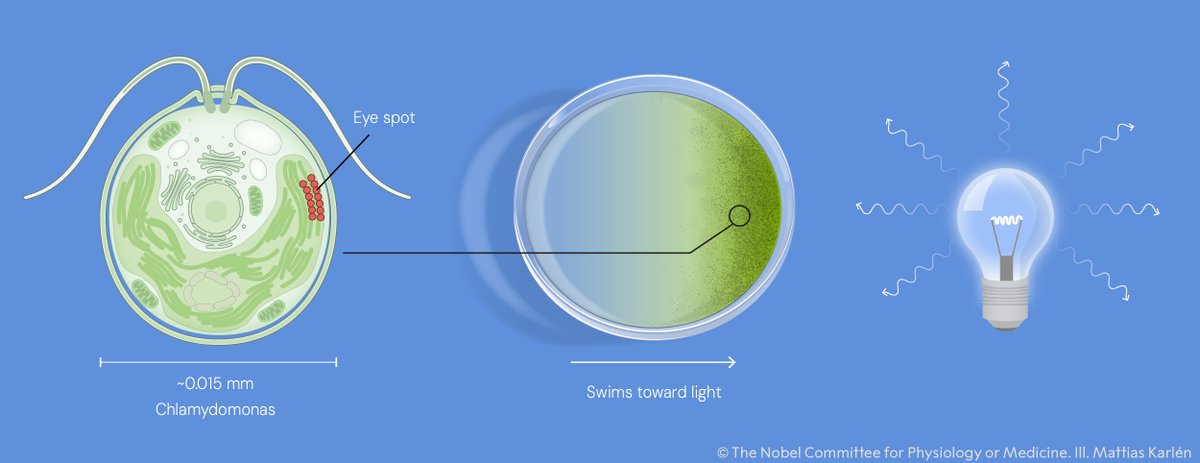
Peter Hegemann and Georg Nagel – awarded the 2026 medicine prize – discovered a remarkable protein, channelrhodopsin, in a single-celled alga.
Hegemann wondered how Chlamydomonas, a single-celled alga, is able to swim towards a light source. In the early 2000s, he and Georg Nagel discovered channelrhodopsin, an algal protein with unique properties, found on the surface of the cell. When it is illuminated by blue light, a channel opens through the protein. Charged ions then flow into the cell, creating an electrical impulse. They found that regardless of which cell they put the protein in, those cells became light sensitive.
#NobelPrize