Training one limb increases strength in the opposite limb but does not promote contralateral hypertrophy. Supports the use of unilateral within-subject designs for interventions focusing on muscle growth but not for strength
https://t.co/EJaJtY5hZY
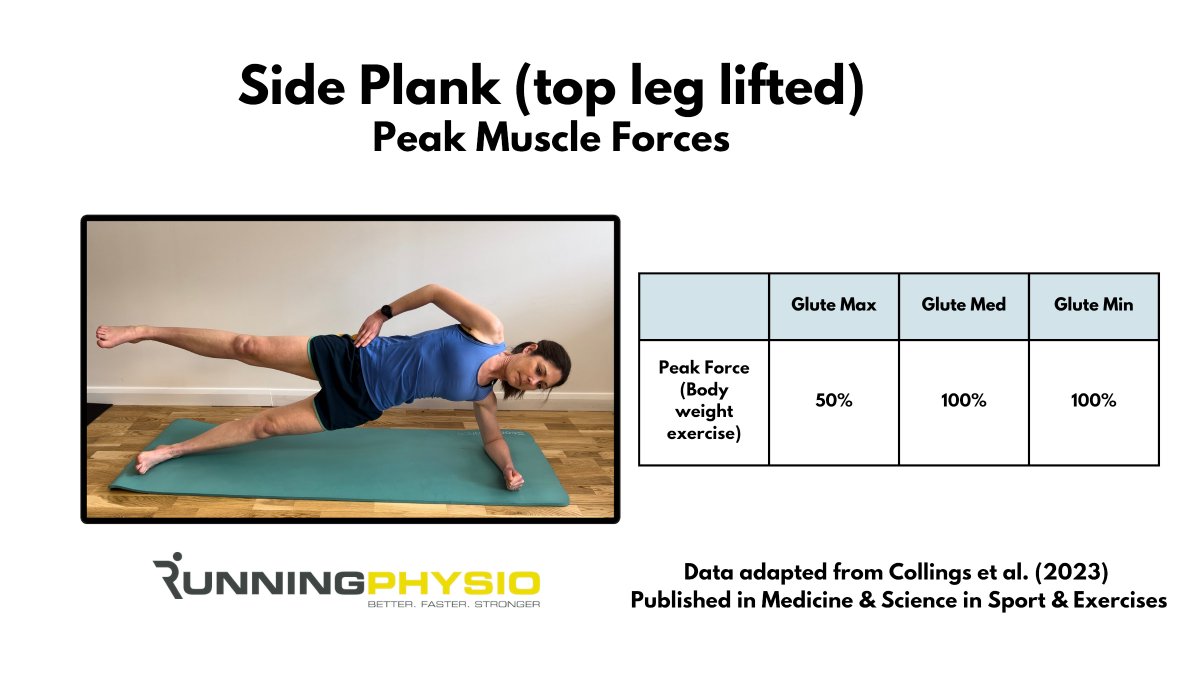
Target the glutes and get the buns burning with these 3 exercises!! 🔥
Reference:
Collings TJ, Bourne MN, Barrett RS, Meinders E, GONçALVES BAM, Shield AJ, Diamond LE. Gluteal Muscle Forces during Hip-Focused Injury Prevention and Rehabilitation Exercises. Med Sci Sports Exerc. 2023 Apr 1;55(4):650-660.
Explosive performance isn’t only about how much force you can produce, but how fast. Early RFD (~50–75 ms) is largely driven by rapid neural activation.
Strong muscles build the engine; fast neural drive hits the accelerator.
https://t.co/xE48Rc1npk
Muscle growth follows the law of diminishing returns: the first few hard sets provide the biggest gains, while additional volume yields progressively smaller benefits.
For many, less training than they think is enough.
https://t.co/nCwmdsWHG2
Want to get better at your sport? Train your sport. Want to become stronger, more powerful, resilient, and injury-resistant? Strength train.
Sport develops the skill; strength training develops the engine.
https://t.co/J0oT6qcrLT
New research shows that high-load (8–12RM) and low-load (20–30RM) training performed to failure produced similar increases in biceps tendon thickness. These findings challenge the common belief that heavy loads are necessary for tendon adaptation and instead support the idea that intensity of effort—not load magnitude—may be the key stimulus for tendon remodeling. Nice work from the lab of @jploenneke
https://t.co/ewTBPEL5oR
Muscle growth is not just muscular—it’s neural.
When central fatigue accumulates, CNS drive can drop, reducing force production and recruitment of high-threshold motor units.
So a brutal session today may blunt tomorrow’s hypertrophy stimulus.
https://t.co/XgMY0QvnoA
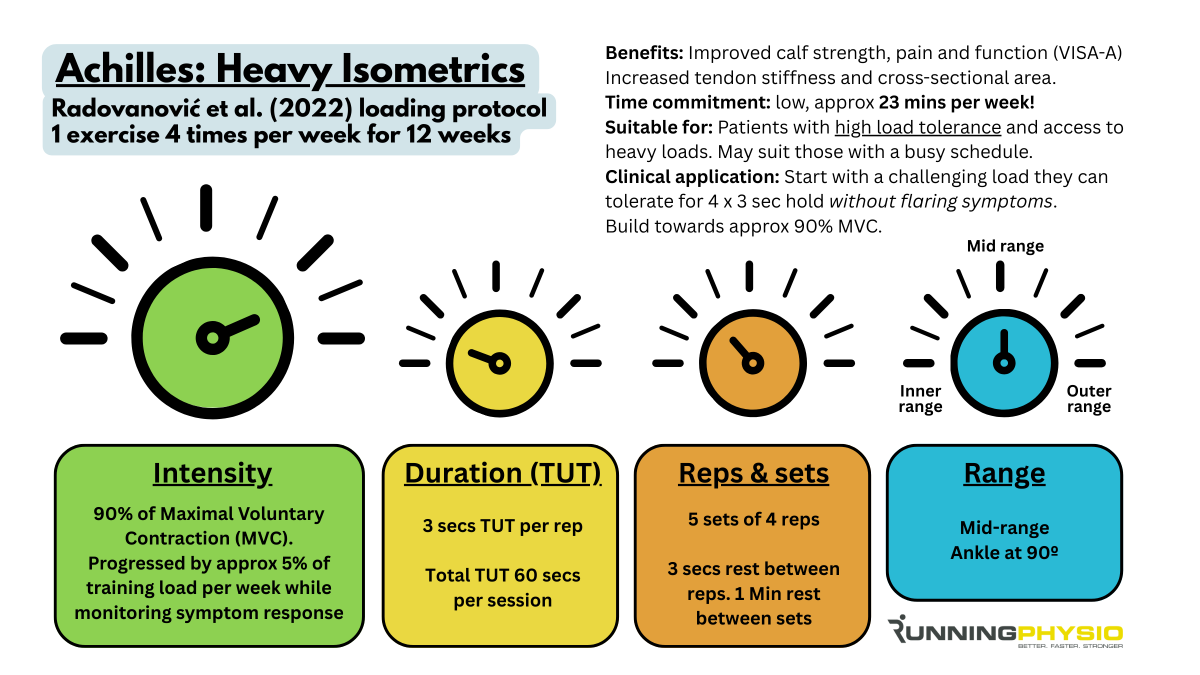
The heavy isometric programme for Achilles Tendinopathy from Radovanonić et al. (2022) has somewhat gone under the radar but has lots of potential benefits 💪
It’s just one exercise and takes less than 25 mins per week!
Athleticism is not just being strong.
It is the ability to express strength rapidly: sprinting, jumping, decelerating, changing direction and producing force at the right moment.
Strength builds the engine. Lift heavy. Move fast. Stay athletic.
https://t.co/J0oT6qcrLT
Power is simple: it depends on only two physiological qualities—strength and velocity (Power = Force × Velocity).
To maximize explosiveness, train both.
Stronger + faster = more powerful => improved sports performance 🤸
https://t.co/pZPniHi1DD
Consistent with the broader body of research, this study found that training with a moderate proximity to failure (20% velocity loss) produced the greatest strength gains, whereas training closer to failure (40% velocity loss) elicited the largest increases in muscle size.
Take-home message: Proximity to failure appears to be goal-dependent. Training closer to failure becomes increasingly important when the primary objective is maximizing hypertrophy, whereas strength development may be optimized by stopping sets somewhat further from failure.
https://t.co/v7OmQSlFO3
Two workouts can have identical volume loads yet produce different hypertrophic outcomes depending on proximity to failure and motor unit recruitment.
Focus on accumulating hard sets (close to failure), not just kilograms lifted.
https://t.co/53FgG4I7ru
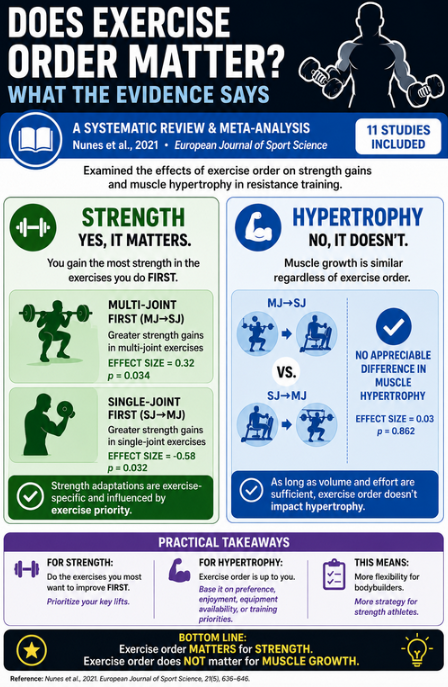
Common resistance training prescription is to perform multi-joint exercises before single-joint exercises. Our group, led by @joaonunesjpn, conducted a meta analysis to determine whether exercise order affects strength and muscle growth.
Results indicated that strength gains were greatest for exercises performed first in the workout. OTOH, muscle hypertrophy was similar regardless of exercise order.
There were some notable limitations. From a strength standpoint, all of the included studies assessed strength using repetition-maximum tests specific to the exercises performed in the study (e.g., if a squat was used in the workouts, 1RM testing was carried out in the squat). These results cannot necessarily be extrapolated to general strength, which would require testing a neutral modality (i.e., dynamometer).
From a hypertrophy standpoint, most studies measured muscles that were the primary mover in only one of the exercises being compared. For example, the biceps is the main target during curls but only a synergist during lat pulldowns. Thus, the finding that exercise order doesn't affect hypertrophy may simply reflect that performing an indirect exercise before a direct one doesn't impair growth. That said, the only study to directly compared exercise order when both exercises targeted the same muscle group showed similar hypertrophy irrespective or exercise order.
The general take-home from the evidence is:
For strength, prioritize the exercises you most want to improve by performing them early in the workout. However, it remains unclear whether exercise order influences the transfer of strength gains to broader functional tasks and activities of daily living.
For hypertrophy, exercise order appears to be largely a matter of preference, convenience, and individual training goals. That said, when training multiple muscle groups in the same session, it may be advantageous to prioritize lagging muscle groups. Mental focus and fatigue tend to decline as a workout progresses, potentially compromising training quality later in the session. Therefore, targeting less-developed muscles when you are freshest may help maximize the effectiveness of your efforts.
https://t.co/o1SmtgRebg
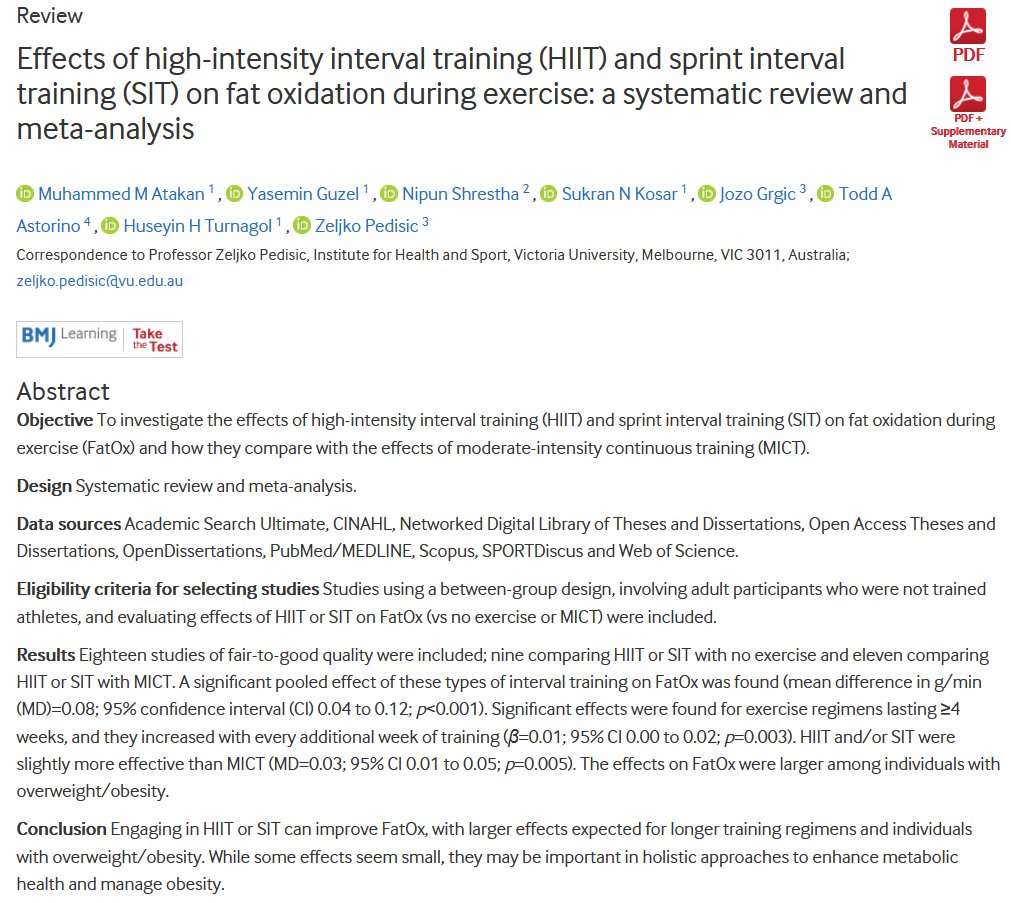
Effects of high-intensity interval training (HIIT) and sprint interval training (SIT) on fat oxidation during exercise: a systematic review and meta-analysis
https://t.co/Hf7wNSQgkW
My go to exercise for foot and ankle rehab! 🦶
Recent research shows that adding a forward lean or load to foot exercises increases intrinsic and extrinsic muscle activation.
This makes the forward lean calf raise a valuable exercise option with a host of benefits!
Reference:
Osborne JWA, Menz HB, Landorf KB, Whittaker GA, Cotchett M, Kelly LA. The influence of body posture and added mass on intrinsic and extrinsic foot muscle activation and force output during common foot strengthening exercises. J Sport Health Sci. 2025 Dec 16:101110. doi: 10.1016/j.jshs.2025.101110. Epub ahead of print. PMID: 41412495.
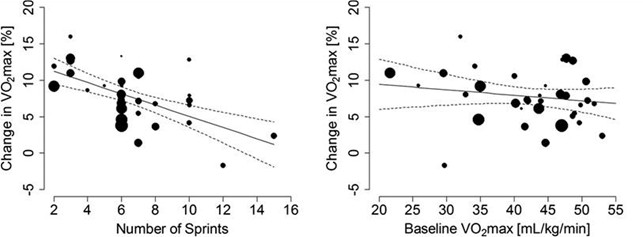
Just 2–3 all-out sprints may be enough to get most of the cardio fitness benefits of sprint interval training.
A meta-analysis of 34 studies found that:
- Sprint interval training increased VO2 max by ~8% overall
- Doing MORE sprint repetitions did not improve results
- Every 2 additional sprints led to ~1.2% lower improvement in VO2 max
Shorter, harder workouts may actually be more efficient, but you have to make them count.
I researched and tried the most popular HIIT protocols so you don't have to: https://t.co/ZRib4bttLn
Study: PMID: 28079707
Muscle growth is not caused by “training volume” per se.
Hypertrophy is primarily driven by mechanical tension and recruitment of high-threshold motor units. This occurs with heavy loads (>85% 1RM) or when training near failure, i.e., ”effective reps”
https://t.co/rO0TnOigIR
Muscle growth needs mechanical tension.
But fatigue can reduce motor unit recruitment and force output — meaning less tension and potentially less hypertrophy.
High-rep sets to failure may cause more neuromuscular fatigue than low-rep sets to failure.
https://t.co/anpHnhPwL4