Visited this afternoon Tripple J Agro farm in Bombo. Its an 80 acre dairy farm with 140 dairy animals indoors ( zero grazing). They are powering their operations 100% with Bio-gas from the animal waste. Its zero waste for them.
They are also processing yogurt and gradually going into pasteurized and powdered milk.
Excited to see commercial farmers investing and developing whole value chains on farm and therefore creating Jobs!
Our strategy as government in the next 5 years is to ensure that all clusters of farmers ( small, medium & large ) get supported to fully produce with added value. PDM interventions will be scaled up to support more small holders while favorable ( low or no interest) credit facilities will be rolled-out through UDB and other government banks to support the medium and large scale clusters. This is how the agriculture sector will create more jobs and contribute substantially to the 10 fold growth strategy of the economy and be able to sustain the agro-industries.
@Hajjat_Masavu You haven't been to Kenya yet. The women there have confidence on another level. I can say they are more empowered when it comes to approaching suitors.
Uganda now leading coffee exporter in Africa
Uganda’s coffee exports for the year ending October 2025 increased to 8.4 million 60-kilogramme bags valued at 2.4 billion dollars, the highest the country has ever earned. The coffee exports increased from 5.8 million bags worth 1.3 billion dollars the previous year.
The coffee performance is contained in the October report by @MAAIF_Uganda . The coffee export figures are higher than Ethiopia’s 7.82 million bags in 2024/25, making Uganda the number one exporter on the African continent.
https://t.co/53coeRVraZ
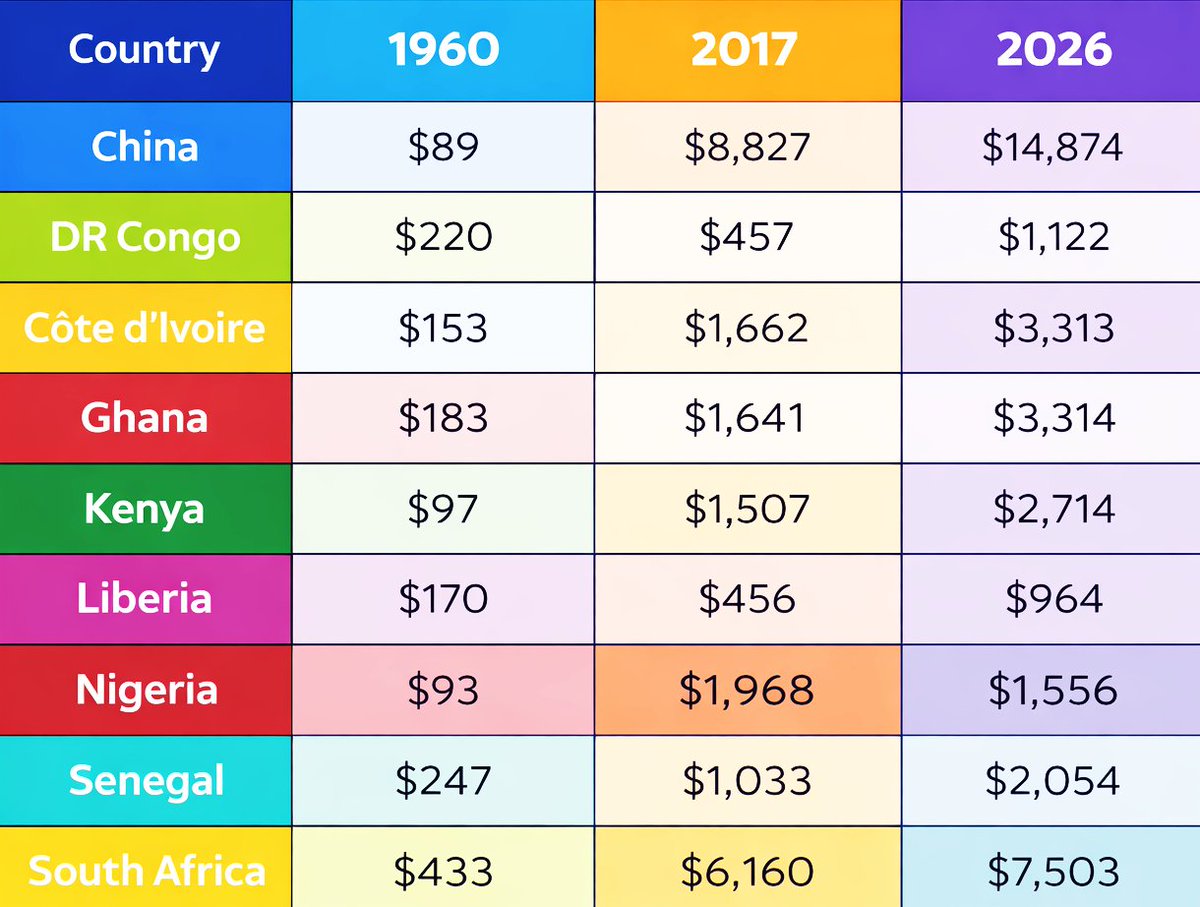
In 1960, China had a lower GDP per capita than every single African nation listed on this table. As of 2026, China's massive economic expansion means its average GDP per capita is double that of the highest-ranking African nation on this list (South Africa) and over 15 times that of Liberia, which in 1960 had a GDP per capita nearly twice as high as China's. Food for thought.
This gentleman is called Robert Kirunda (PhD, MCIArb). He has the kind of intellect that makes law look like the simplest thing in the world.
If you want to understand who he is, look at how he and his team represented Vantage Mezzanine Fund in its long-running legal and arbitration battles against businessman Patrick Bitature and his Simba Group companies. Those cases showcased a legal mind operating at the highest level, navigating complex cross-border finance disputes, arbitration proceedings, enforcement actions, and high-stakes commercial litigation with remarkable precision. He stood at the center of a legal team that secured major victories for Vantage across multiple proceedings and appeals, consistently defeating attempts to block enforcement and derail arbitration processes. His legal stature goes beyond the Bitature disputes. His expertise in arbitration and commercial law earned him appointment to the Permanent Court of Arbitration in The Hague, a rare distinction reserved for lawyers whose work commands international respect. Dr. Kirunda is one of the strongest commercial litigation and arbitration lawyers Uganda has been blessed with. He belongs to that rare class of lawyers who can walk into the most complex commercial dispute and make the law appear effortless. The frightening thing about people like him is that they make extraordinarily difficult legal work look normal. I am certain he inspires many lawyers because excellence at that level cannot be hidden.
Rwanda keeps showing most of Africa what it refuses to try.
Most people think brick means red. Brown. The colour of laterite and fired earth. That’s all we imagine when someone says “build with local materials.”
This is African Leadership University, Kigali. The brick is pale. Almost cream. Still clay, still local, made in Muhanga, 1.5 hours from the site, fired in coffee-husk-powered kilns. Same earth, different result. Rwanda didn’t abandon local material for aesthetics. They refined it.
The structure underneath is compressed stabilized earth blocks fabricated on site. Six terraced levels down a 40-metre hillside. No air conditioning in most of the building. Shaded corridors and natural ventilation handle Kigali’s climate. An 1,800 cubic metre stormwater pond manages the rain. The hill, the wind, the earth, all doing structural and environmental work.
Furniture made on site. Lighting made on site. Signage, lockers, benches, all local fabrication. Rwanda didn’t just use local material for the walls. They used local hands for everything inside.
This is not an exception. This is a pattern. And the buildings speak for themselves.
MASS Design Group | Kigali Innovation City, Gasabo District 🇷🇼 | 6,500 m² | 2021
RATIONALISATION OF GOV'T EXPENDITURE:
The PSST Dr @rggoobi has said that effective next FY 2026/27, @GovUganda will not spend money on organising public functions (public holidays) including: Women's day,Labour day,Independence day etc). He says money will only be spent on the few religious functions.
According to Dr.Ggoobi,H.E the President @KagutaMuseveni will address Ugandans on Radio and Television from State House,adding that the money saved will be used to finance the priorities of Gov't (ATMS & Enablers).
@amronaldo Even with 529 MPs for a population of 46 million, I think Ugandans are overrepresented. That figure of 80 ministers is a proportionate reflection of the size of Parliament.
NO 'EXCESSIVE DANCING' IN KENYA. HOW GLOBAL COLONIAL & SLAVER POWERS BANNED 'NATIVE' DANCING, BOOZE, DRUMS, AND PARTYING
Colonial rulers and slave owners often saw music, dance and simple pleasures as dangerous sparks of rebellion. In Kenya local chiefs wielded powers under the Chiefs’ Authority Act, a law rooted in the 1920s and kept after independence. They could ban “excessive dancing” if it seemed too lively, went on too long, or risked stirring up a crowd.
The same rules let them crack down on village brews that brought people together. These controls only ended with democratic reforms in 1997 - 24 years after independence!
In South Carolina the Negro Act of 1740 came straight after the Stono Rebellion. It outlawed drums, horns and any loud instruments among enslaved Africans, along with unsanctioned gatherings. Planters and magistrates enforced it ruthlessly, convinced the beats could help people plan revolts or hold on to their culture.
British officials in India took aim at living traditions too. Devadasis (girls dedicated as children to temple service and trained in sacred song and dance as offerings to the gods), saw their art condemned. In 1910 the Madras Presidency banned dancing inside Hindu temples, calling the graceful performances immoral.
Nautch dancers, professional women who performed intricate storytelling routines with music at private gatherings and courts, faced fierce campaigns by missionaries and reformers that ruined many livelihoods.
Everyday drinks suffered as well. Toddy, the fresh mildly fermented sap tapped from coconut or palm trees, was a traditional village refreshment. Heavy colonial taxes and licensing crushed small tappers while favouring imported liquor.
Under French rule the Code de l’Indigénat, introduced in 1881 and used across Algeria, West Africa and Indochina, gave local administrators power to punish “insolence” or unsanctioned gatherings. They often used it to shut down traditional dances, drumming sessions and celebrations judged too noisy or defiant.
Portuguese authorities in places like Cape Verde suppressed batuku, a vigorous women’s group dance full of clapping, drumming and swaying rhythms. They labelled it primitive and indecent, fearing it encouraged resistance to colonial order.
In the United States the 1883 Code of Indian Offenses, banned indigenous peoples' ceremonies such as the Sun Dance and Ghost Dance together with their songs and feasts. Agents withheld rations or locked people up, seeing these events as obstacles to Christian conversion.
Across these places the goal was the same: to weaken cultural ties, kill collective joy and impose outsiders’ rules on how people should move, sing and celebrate. A drumbeat, a dance or a shared drink carried memory and solidarity, exactly what rulers dreaded. Most of these restrictions only faded in the 20th century under pressure from independence and civil rights movements.
📸This licence is a parody.
I understand perfectly. If I were an African Big Man who couldn’t get a crowd of more than 5,000 unless it was rented, I too would be angry and jealous to see 500,000 of my country’s citizens wildly celebrating Arsenal FC’s EPL championship
@ssetu24924@NankabirwaRS@KagutaMuseveni@MEMD_Uganda@mkainerugaba You're attacking Hon. @NankabirwaRS for nothing and without doing enough research.She's served for a long time. Sometime back she requested to retire from active politics so that she concentrates on serving the church, now that she's a Canon. Your anger is really misguided.