Biologist fond of critters and their interactions with other forms of life 🌲🌻🐝🐜
PhD student (SLU). Forest ecology, pollination and climate change.
🏳️🌈🐝
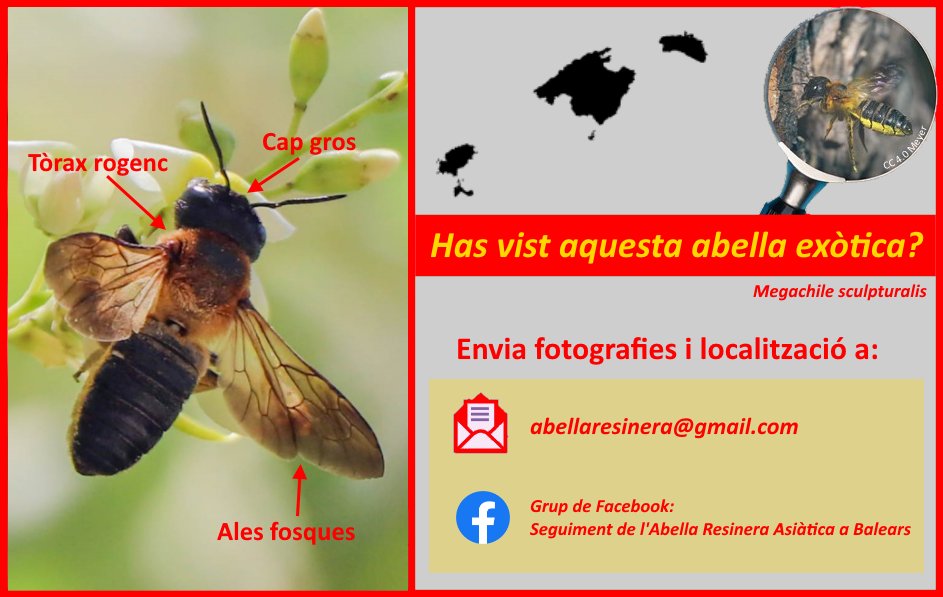
L'abella resinera asiàtica (Megachile sculpturalis) continua la seva expansió a Mallorca. Si vols col·laborar en l'estudi de la distribució i dispersió d'aquesta espècie exòtica a Balears, envia'ns fotos a [email protected]
S'agraeix difusió!
🌍 Take-home: fly pollination in boreal forests is shaped by climate and forest structure. As climates warm, local conditions (canopy cover, tree composition, microclimate) will strongly mediate how pollinators respond. Read more here: https://t.co/x5nrX5k5E8 🪰🌡️🌼🌳🌲
The problem with forest understories, though, is that flowers are not available in the shadiest areas, and we really wanted to measure pollinator foraging under different light conditions.
🐝 Unlike bees, many pollinators in boreal forests are flies (Diptera, especially Muscidae, Phoridae and Syrphidae). These ectotherms depend heavily on external heat for activity.
📢 New paper out in
@oikosjournal.bsky.social
! We investigated how climate🌡️, forest structure🌲🌳 and flower resources🌼🌷 shape fly pollinator foraging in boreal forest understories 🪰🪰🪰
https://t.co/x5nrX5jxOA
🌿 New paper alert! We used flower-based eDNA metabarcoding to uncover how forest structure and microclimate shape the diversity of flower-visiting arthropods in a Swedish boreal forest. #pollinators#eDNA
🧩 Conclusions: Flower eDNA is a promising non-invasive tool for capturing arthropod–plant interactions in forest ecosystems. However, detection rates are patchy—likely influenced by flower traits, visitor behavior, and methodological nuances.