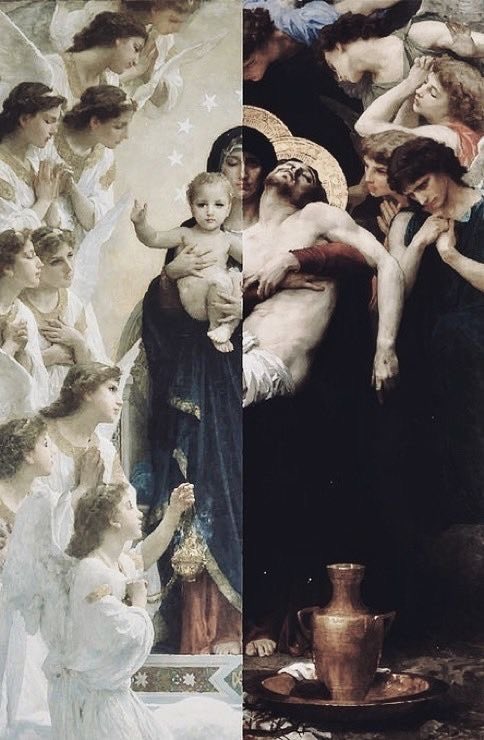
“God, who made the sun, also made the moon. The moon does not rob the sun of its brilliance. It merely reflects it. So it is with Mary and Christ."
Venerable Fulton J. Sheen
The @ symbol on your keyboard, which powers every email address on Earth, was invented by Catholic monks🇻🇦
In the Middle Ages, before the printing press existed, every book in Europe had to be copied out by hand. The men who did the copying were almost entirely monks, working in the scriptoriums of Catholic monasteries. They spent their days bent over parchment, writing one word at a time by candlelight.
To save time and precious parchment, the monks invented hundreds of abbreviations and shorthand symbols. One of them was the @. They created it as a shorthand for the Latin word "ad," meaning "toward" or "at," by drawing the letter "a" and curving the tail of the letter "d" around it.
The symbol survived for centuries in religious manuscripts. The earliest known use of the @ in history is found in a Christian manuscript from 1345 held today in the Vatican Apostolic Library, where it appears as the first letter of the word "Amen."
From there it spread to merchant ledgers across Europe, then to typewriters, and in 1971 it was chosen by the engineer Ray Tomlinson to separate a username from a domain in the world's first email.
A symbol born in a Catholic monastery now connects billions of people every day across the globe.
@acloudofsaints The Argentine football association took the Cup they won to Our Lady of Lujan ,
and And Messi's shoes were blessed at the Basilica of Luján before the start of the World Cup.
We are great believers in the protection of our beloved mother.
https://t.co/vF8VXPMfBJ
Today, June 11, 2026, the United States Conference of Catholic Bishops will consecrate our nation to the Sacred Heart of Jesus as part of the celebration of America's 250th anniversary.
❤️ And you can participate from home.
📺 Watch the consecration live:
4:00 PM ET / 3:00 PM CT / 2:00 PM MT / 1:00 PM PT
🔗 USCCB Consecration Page: https://t.co/E1vebTfm6z
🔗 USCCB YouTube Channel: https://t.co/lPzh7THF2y
May this final day be a beautiful opportunity to unite your prayers with Catholics across the country. Together, let us ask Jesus to pour out His mercy, healing, and love upon our nation.
As we take part in this special act of consecration, may our trust in the Sacred Heart deepen, our devotion grow stronger, and our own hearts become more conformed to His.
Sacred Heart of Jesus, have mercy on us and on our nation. ❤️🔥🇺🇸
Here is the text - looks like the AI image had errors....
Dear [Name],
I hope this letter finds you well. For the past few years, I’ve seen you almost every day at daily Mass, and your evident devotion to Our Lord in the Blessed Sacrament has been an encouragement to me. Your prayerful presence is truly a blessing to our community.
For some time now I have felt a persistent nudge from the Holy Spirit to share something with you. I’ve resisted it longer than I should have, not wanting to overstep our acquaintance. But the prompting has only grown stronger, so I’m trusting it’s from the Lord and writing this in a spirit of friendship and Christian brotherhood, hoping it might be a blessing for you.
I simply wanted to invite you to prayerfully consider receiving Holy Communion on the tongue instead of on the hand. In my own life this practice has deepened my reverence for Jesus truly, really, and substantially present in the Holy Eucharist—the same awe the Israelites were commanded to show before the Ark of the Covenant, which only consecrated hands could touch.
Receiving directly on the tongue from the priest’s consecrated hands helps us approach the King of Kings with that holy fear and love, and it safeguards even the tiniest particles of Our Lord’s Body so that none are lost or inadvertently profaned. It is also the centuries-old tradition of the Church, the way the saints and recent popes like Benedict XVI encouraged people to receive Jesus, and the practice the Angel of Fatima himself modeled before the Eucharistic Lord.
I know how sincerely you love Our Lord. I share this not in any spirit of judgment—only as an invitation to consider whether this small but beautiful act of adoration might draw you even closer to Him. There is no pressure at all; simply a brother in Christ encouraging you to bring it to prayer.
I continue to pray for you and am grateful for your faithful witness at Mass. If you’d ever like to talk about this (or anything else) after Mass, I’d be happy to. May the Lord bless you abundantly and keep you always close to His Eucharistic Heart.
Most people have no idea why ladybugs are called ladybugs.
It has nothing to do with science.
It has everything to do with the Virgin Mary.
For centuries, Christians in Europe associated these small red beetles with Our Lady. One popular medieval tradition says that farmers prayed to the Blessed Virgin Mary when insects were damaging their crops. Soon afterward, ladybugs appeared and helped control many of the pests. While historians cannot verify every detail of the story, the connection between ladybugs and Our Lady became deeply rooted in Christian culture.
That's why the name stuck.
In English, they were once called "Our Lady's birds" or "Our Lady's bugs." In German, they are still called *Marienkäfer*, meaning "Mary's beetle." Similar Marian names for ladybugs can be found across Europe.
There's more.
The common seven-spotted ladybug was often connected to the Seven Sorrows of the Blessed Virgin Mary. This was never official Church teaching, but a popular Christian tradition that helped people remember Mary's suffering alongside Jesus.
Even the Oxford English Dictionary notes that the insect's English name developed in honor of the Virgin Mary.
An insect.
Named after Mary.
Of course, Catholics do not believe every ladybug is a message from heaven. But this story reveals something many people have forgotten. Earlier Christians saw reminders of their faith everywhere, even in the smallest details of daily life.
💬 Before today, did you know the name "ladybug" was connected to the Virgin Mary?
“For not as common bread and common drink do we receive these; but in like manner as Jesus Christ our Savior, having been made flesh by the Word of God, had both flesh and blood for our salvation, so likewise have we been taught that the food which is blessed by the prayer of His word, and from which our blood and flesh by transmutation are nourished, is the flesh and blood of that Jesus who was made flesh.”
- St. Justin Martyr (155 AD)
In First Apology, Chapter 66
📅 Feast Day: June 1
St. Justin Martyr wrote these words around 155 A.D., only a few generations after the Apostles. What makes this quote so important is that it shows what the earliest Christians believed about the Eucharist.
Justin does not describe the Eucharist as a symbol, a reminder, or ordinary bread and wine.
He says that Christians had been taught that the food blessed by prayer is truly the flesh and blood of Jesus Christ. This belief was not invented centuries later. It was already being taught and defended in the early Church.
His words also points back to Jesus Himself.
In John 6, Christ repeatedly tells His followers that His flesh is true food and His blood is true drink. Many people left because the teaching was difficult, but Jesus did not take it back.
Justin eventually gave his life rather than deny the Christian faith.
His testimony reminds us that the Eucharist is not just something we receive. It is Someone we receive. If this is truly Jesus, then nothing on earth is more valuable.
💬 Do you believe the Eucharist is truly the Body, Blood, Soul, and Divinity of Jesus Christ, or do you see it differently? Why?
Someone you know may have never heard what the earliest Christians actually believed about the Eucharist.
In multiple Church-approved Eucharistic miracles, where the consecrated Host has visibly become human flesh and blood, scientific tests consistently reveal the same remarkable things:
🩸 The tissue is human heart muscle, often from the left ventricle, in a state of extreme stress or agony.
🩸 The blood is always Type AB (human, and in many cases appearing fresh and alive).
This matches forensic studies on the Shroud of Turin (believed by many to be Jesus’ burial cloth), where the bloodstains are also identified as Type AB.
Examples include:
• Lanciano, Italy (8th century) — AB blood, heart tissue, preserved for over 1,300 years.
• Buenos Aires (1990s) — AB blood.
• Tixtla, Mexico (2006) — AB blood.
• Sokółka, Poland (2008) — AB blood.
• Legnica, Poland (2013) — AB blood.
AB is a rare blood type, found in only about 3-5% of the global population.
Theologically, this is profoundly beautiful.
Type AB is known as the Universal Recipient, it can receive blood from any other type without rejection.
Many see this as a powerful sign pointing to Jesus: His Precious Blood is open to everyone, no one is excluded from His sacrifice and mercy. Christ “receives” all sinners, all nations, all who come to Him, regardless of background. It’s like a divine invitation: His Blood accepts us all, washes away our sins, and unites us in the Eucharist.
Of course, the Church doesn’t dogmatically declare Jesus’ blood type, these are scientific observations on approved miracles, not doctrine. But the consistency across centuries and continents is striking, especially since blood typing wasn’t discovered until 1901.
It feels like another quiet whisper from God affirming the Real Presence: This is truly His Body and Blood, the same Jesus who suffered, died, and rose for us.