Not a comet? The object on the right is globular star cluster Messier 30 (M30), whilst comet 10P/Tempel 2 is on the left. Charles Messier catalogued M30 precisely because it wasn't a comet. Seen 29 July, Tempel 2 is 3.5 light-minutes away; M30 is 28,000 light-years distant.
The Rubin Observatory has captured over 500,000 galaxies in the COSMOS field. Unobscured by Milky Way stars, it reveals an astonishing array of galaxies whose light has travelled for billions of years. Rubin will revisit every few days for a decade to track changes.
The sharpest image of the Sun, captured by the Inouye Solar Telescope, confirms the Kelvin-Helmholtz instability (KHI). These city-sized swirls of magnetic plasma on the edges of solar granules could explain how energy is transferred to heat the solar corona.
Decades of observation reveal Saturn’s ring spokes vary with the seasons. Though their origin is uncertain, they are likely dust and ice levitating due to electromagnetic interactions between the solar wind and the planet’s magnetic field.
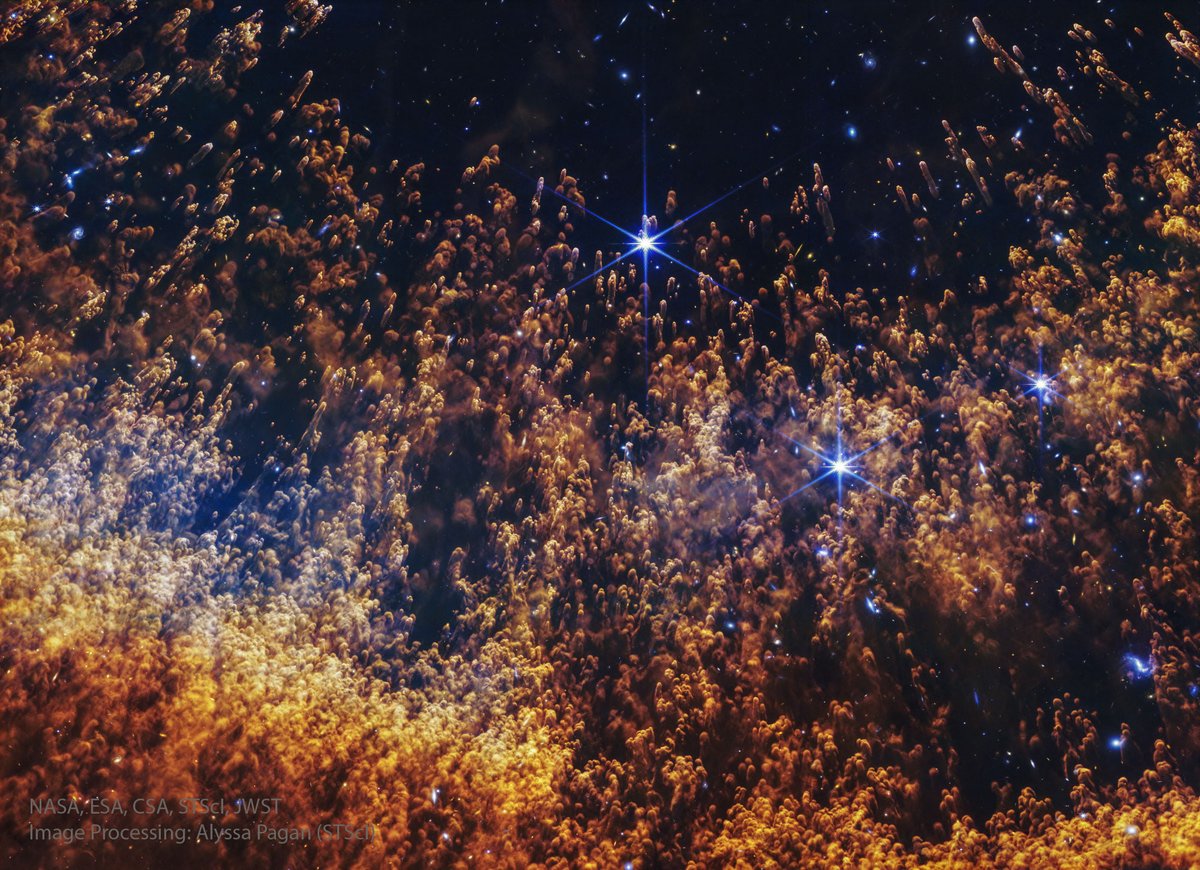
The origins of Earth-mass gas knots in planetary nebulae like the Helix (in Aquarius) remain mysterious. Pictured by JWST 650 light-years away, these vast clumps may form when energetic stellar winds from a dying, Sun-like star fragment existing gas.
Captured over the Great Lacerta Nebula, this meteor reveals its composition via its colours as it vapourises. Despite a bright Moon now, three showers are active. The Perseids peak in 10 days during a new Moon - which will completely eclipse the Sun for some!
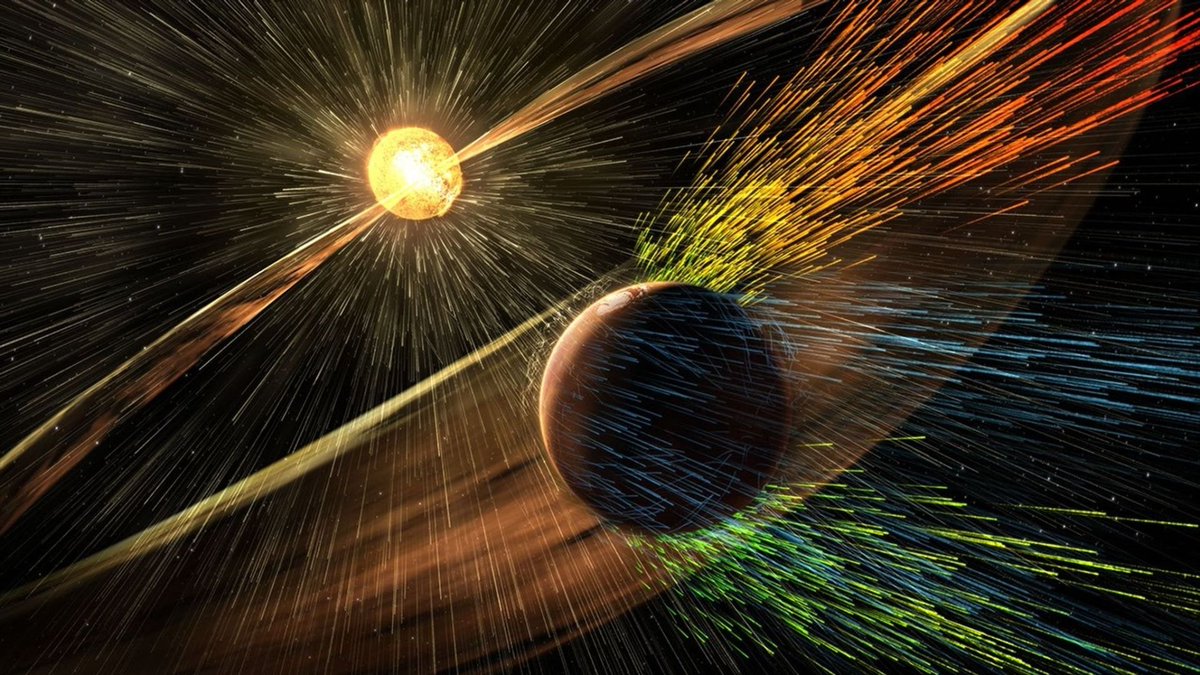
This illustration depicts charged particles from a solar storm stripping away charged particles of Mars' atmosphere, one of the processes of Martian atmosphere loss studied by
MAVEN miccion
NASA's James Webb Space Telescope's Mid-Infrared Instrument (MIRI) reveals the nearby galaxy Centaurus A, exposing the dusty structures and hidden activity that shape this unusual system.
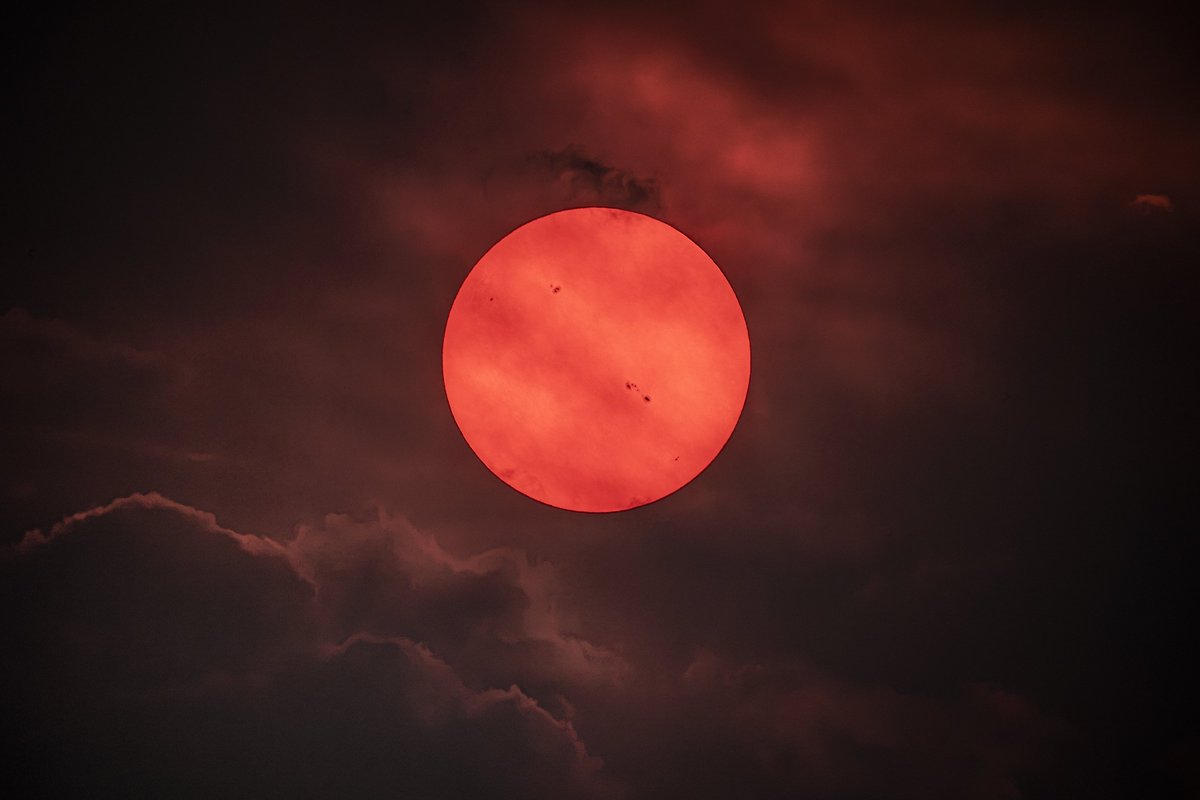
Looks like a red dwarf, but it's our Sun! Wildfire smoke in British Columbia scattered blue light, making the Sun appear dimmer and redder. Sunspot AR 4493 is visible near the centre. Some 6 billion years from now, the Sun will turn redder as it nears its red giant phase.
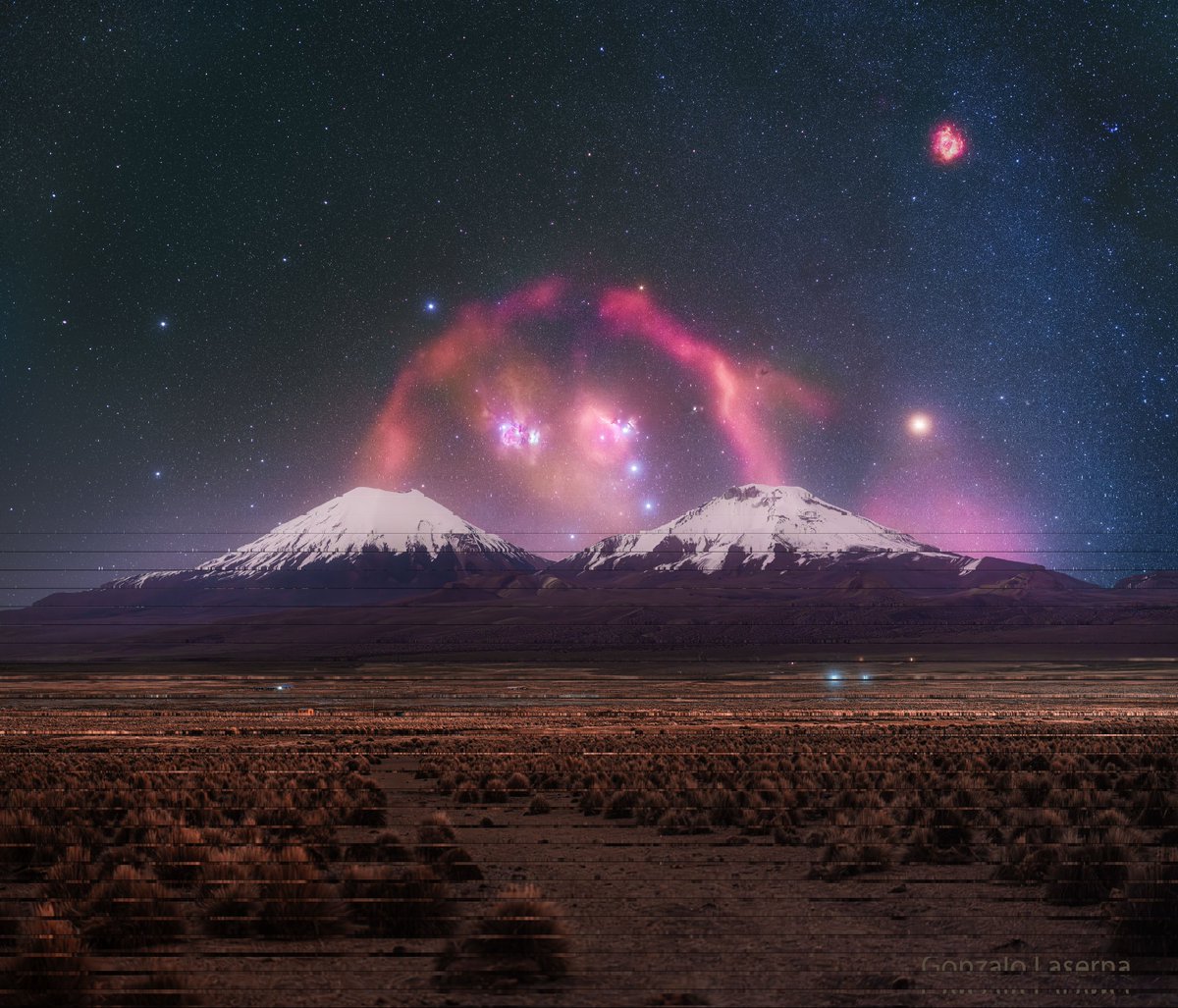
Captured from Bolivia in mid-April, this well-planned composite image shows Barnard's Loop appearing to connect volcanic peaks. It also features the Orion Nebula in the centre, Betelgeuse on the right, and the Rosette Nebula on the upper right.
Sony wants to abandon fans? Let's give them a small taste of their own medicine!
Together with other creators we call for a 1 week #PSBlackout in August. No logins, no play sessions, no purchases on any of Sony's platforms.
What created the Bubble Nebula (NGC 7635)? This delicate-looking, 10 light-year wide cosmic bubble 11,000 light-years away in Cassiopeia was violently carved from a molecular cloud by fierce winds and radiation from a star 10-20x the mass of our Sun.
How do galaxy clusters form? The universe moves too slowly to watch, so the TNG50 simulation helps us find out. Tracking cosmic gas, merging galaxies, black hole outflows, and stellar streams helps us better understand how our Earth, Sun, and Solar System originally formed.
Have you ever seen another galaxy with your own eyes? South of 20°N, you can spot the Large Magellanic Cloud. It’s a dwarf galaxy 163,000 light-years away. Though just 10-20% of the Milky Way's mass, our tides fuel its star formation before we collide in 2 billion years!
The Southern Crown dazzles with young and ancient stars! Just 430 light-years away, a star-forming cloud births protostars that paint the nebula blue, energised by a binary system. Far beyond, the distant Chandelier Cluster twinkles with stars as old as the universe.
Statue of Liberty Nebula in RCW 57 Bright stars & PAHs (key molecules possibly linked to life's origins) are forming. It resembles a monument, superhero or weeping angel. Image shows dark dust, glowing hydrogen & gas loops from dying stars. NGC 3576 has 33+ massive stars forming.
NASA JPL scientists have identified a puzzling near-Earth object with a dual personality: it appeared asteroid-like with no visible comet activity in past images, but its irregular motion matches a comet. Findings published in Nature Astronomy.
Comet 10P/Tempel 2 orbits the Sun once every 5.4 years. Currently visible in binoculars or small telescopes toward the constellation Capricornus, the periodic comet is captured in this sharp telescopic image from July 11 sporting a bright nuclear region and pretty greenish coma.
This sparkling, colourful gemstone is a spiral galaxy, NGC 300. It is one of the closest spiral galaxies to Earth, only about 6 million ly away. This unusual image combines the light from the stars and dust within the galaxy with the light from ionized clouds of interstellar gas.
Red sprites are millisecond events triggered by positive cloud-to-ground lightning. They extend up into the mesosphere where the air is too thin for thunder. Their red glow comes from heated molecular nitrogen.