@kittypurrzog It is so counterproductive to insist that there is only one true path to recovery. But I've encountered the same type of myopic backlash when I talk about how helpful medication has been to me.
https://t.co/XHYYCLsFPR
@asymmetricinfo@AliceFromQueens This may be true arithmetically, but it’s not how it works in practice. Health insurers must offer competitive premiums to attract customers. Once the premium is set, every basis point of medical expense savings flows to the bottom line.
@MattGlassman312 A classic that I look forward to reading every four years. But impressive how much fresh and timely content you have added this cycle!
NIAAA’s new definition of recovery from Alcohol Use Disorder affirms what many of us in recovery know: moderation is a legitimate goal, associated with marked improvements in health and well-being. Less is more.
Some tools to help you drink less have been around for decades, like the medication we prescribe at Oar. Other options, like no and low-alcohol cocktails, are burgeoning daily. @ideasimprove provides a handy guide to the latter in this @OarHealth piece.
"A new movement is fomenting, one where no- and low-alcohol cocktails are front and center. Though I’d like to take credit for the movement, there isn’t one singular person who created it." -Derek Brown @ideasimprove for #OarHealth
https://t.co/ltVSxubz1A
@samdylanfinch@OarHealth Thank you for being so honest and vulnerable in sharing your story, Sam! I am confident that many will see themselves in it in some way.
"I don’t know where I would be now if I hadn’t found naltrexone. This medication—combined with therapy, physical activity, and support groups—has given me my life back."
Proud to publish Megan's inspiring story.
https://t.co/xLEp5713yI
"So, did AA 'work?' I don’t know — I guess that depends on how you determine success. I’m not sober anymore, yet I rarely drink and drink very little when I do."
Really proud to publish @samdylanfinch's powerful story of resilience and community. 💙 🏳️🌈
"It wasn't clear if I was 'truly' an alcoholic. Being transgender also made me fearful of going into community spaces without knowing if I would be welcome."
Read what @samdylanfinch has to say about his experience with AA as a queer person. #Pride 🏳️🌈
https://t.co/Nle2A1Vd63
I believe that cutting back on alcohol use is a legitimate goal of recovery. But part of mindfully cutting back is staying alert to signals that full sobriety might be a better personal choice. @kellyfitz11 has great advice on what to look out for.
Not sure if it's time for you to stop drinking completely? Writer and recovery coach @kellyfitz11 outlines five signs it might be time to get sober for good. #OarHealth
https://t.co/neLhjaEAiI
April is National Alcohol Awareness Month, which is a great time to talk about the outdated concept of “rock bottom."
At Oar, we don't believe you have to hit rock bottom in order to change your relationship with alcohol. 🧵
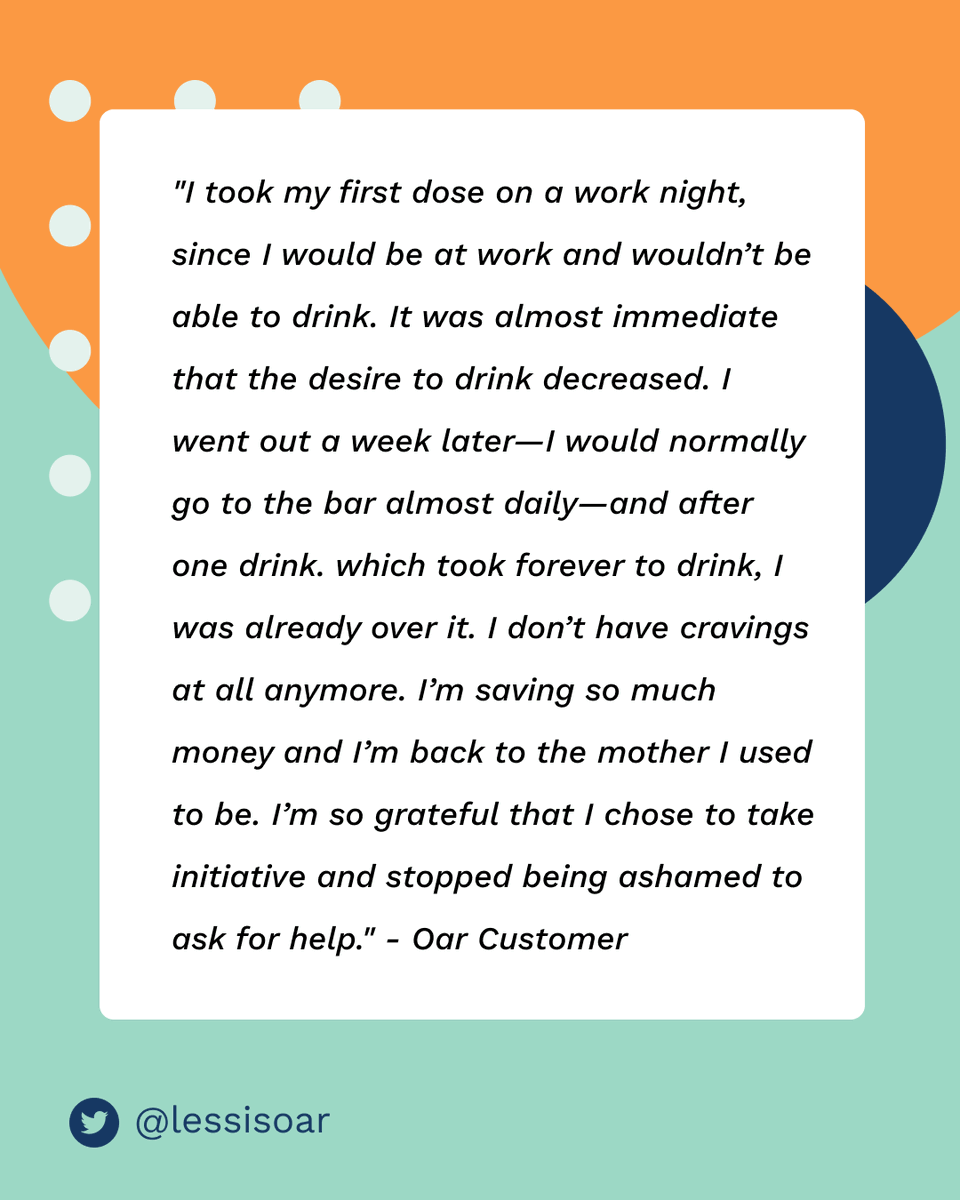
The most rewarding thing we hear at Oar (https://t.co/ORnLSiPFLC) is that we have helped parents get back to being the mothers and fathers they know they can be. I'm really grateful to the Oar member quoted below for sharing her story with us.
Motherhood is demanding, unpaid, often thankless work. It's no surprise that this intense pressure makes some moms turn to alcohol. If you're a #sobercurious mom, we offer hope and help geared for your busy lifestyle.
Take an alcohol use assessment now: https://t.co/4ZsWBDFex5
The most common question I get about https://t.co/kxdUQJqNVq is: "Is there really a legitimate medication that can help me drink less or quit?" The answer is yes, and we are building Oar to simplify access to naltrexone and other safe, effective treatments.
Naltrexone isn’t magic, but it is an effective, scientifically proven tool for treating AUD.
It works by disrupting the chemical feedback loop that can make it hard to stop drinking once you’ve already had a few drinks.
Learn more about Naltrexone at https://t.co/OKUcZqCZyy
At https://t.co/m92Zbh1hqQ, we don't shy away from prescribing FDA-approved medication to treat Alcohol Use Disorder like the medical condition that it is. This approach reflects leading clinical guidelines, but it is also deeply rooted in my personal experience.
Writers! I'm currently open for pitches at @lessisoar.
You: Write about alcohol use disorders, especially from the lens of lived experience. This could be a personal essay, an opinion piece, a helpful guide or resource.
Check out this form for details: https://t.co/TjNoSom29U
"Telehealth goes beyond routine check-ins; people living with addiction and substance use disorders can also seek help virtually, without going to the doctor’s office or rehab center."
https://t.co/taAuRdTW0p
Excited to share what I have been up to professionally for the last few months. Please follow us at @lessisoar and join us on our mission to make effective addiction medicine approachable.
We're making science-backed addiction medicine approachable and accessible for the millions of consumers who feel excluded from today's addiction treatment options, including those for whom moderation—not just abstinence—is the primary goal. 💙
https://t.co/vZiFIjrOxt
@lessisoar There are so many more treatment & support options out there than you might think. If the options you hear the most about don't feel right for you or you didn't get the results you were hoping for, consider it an invitation to find a new path, not a dead end.