My new home for the next 30 days, at least.
I may make it permanent.
A troll keeps making false reports to X, X keeps locking me up.
I'm very close to leaving this mess, but there's many of you with whom I enjoy interacting. I even disagree with some and we find common ground.
@soli_Jesum X is horrible. Why do I stay.
I have to live over here on this handle for 86 more days, because some liberal at at a screen got hurt feelings.
Numbers on this are based on an incorrect understanding of the exit polling, but the fact remains that far too many evangelicals sat this one out because our pastors failed to communicate the importance of voting against the left.
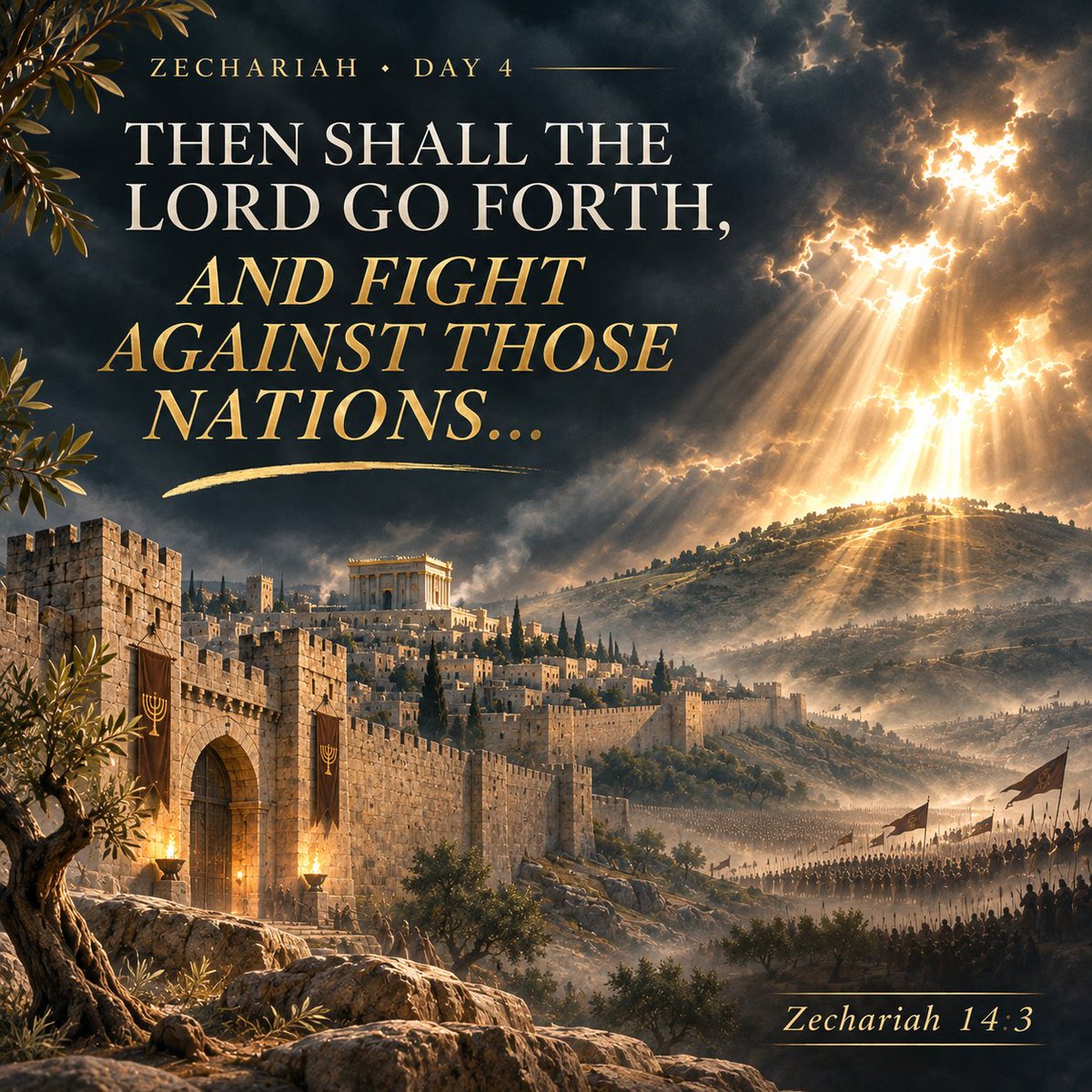
WHAT HAPPENS WHEN THE NATIONS COME AGAINST JERUSALEM—AND GOD HIMSELF ENTERS THE BATTLE?
The armies gather. Jerusalem is surrounded. The city is suffering. The nations believe its future rests in their hands.
But they have overlooked one terrifying reality.
The God of Abraham, Isaac, and Jacob has already declared what happens next.
“Then shall the LORD go forth, and fight against those nations.” — Zechariah 14:3
The nations will come to determine Jerusalem's future.
They will discover that the LORD has already declared it.
More than 2,500 years ago, the Jewish prophet Zechariah foretold an extraordinary confrontation centered on one city.
Not Babylon. Not Rome. Not Washington.
YERUSHALAYIM (יְרוּשָׁלַיִם). JERUSALEM.
And the outcome will not ultimately be determined by armies, political alliances, or international resolutions.
1. A CUP THEY CANNOT DRINK. A STONE THEY CANNOT LIFT.
Zechariah describes Jerusalem using two extraordinary images.
Zechariah 12:2 — “Behold, I will make Jerusalem a cup of trembling unto all the people round about.”
The Hebrew imagery conveys staggering and disorientation.
The nations believe they can control Jerusalem's destiny.
But the city will become a cup that causes those opposing her to stagger.
Then comes a second warning.
Zechariah 12:3 — “And in that day will I make Jerusalem a burdensome stone for all people: all that burden themselves with it shall be cut in pieces, though all the people of the earth be gathered together against it.”
A cup that makes the nations reel.
A stone that injures those attempting to lift it.
The nations believe Jerusalem is their problem to solve. Zechariah declares that their opposition to God's purposes will become their undoing.
Why Jerusalem?
Because God repeatedly identifies this city with His name and covenant purposes.
Psalm 132:13 — “For the LORD hath chosen Zion; he hath desired it for his habitation.”
And following Israel's judgment and exile, God declared:
Zechariah 2:12 — “And the LORD shall inherit Judah his portion in the holy land, and shall choose Jerusalem again.”
God did not abandon Jerusalem after judging His people.
He reaffirmed His choice.
2. GOD WILL REMEMBER EVEN THE TENTS OF JUDAH
Here is a remarkable detail that many readers overlook.
Zechariah 12:7 — “The LORD also shall save the tents of Judah first.”
Why distinguish Judah's tents from Jerusalem?
The verse explains that Jerusalem and the house of David must not exalt themselves above the rest of Judah.
God's promised deliverance extends beyond the capital.
Beyond its walls.
Beyond its rulers.
The God who remembers Jerusalem also remembers the people of Judah.
This is the same covenant-keeping God who declared:
“God hath not cast away his people which he foreknew.” — Romans 11:2
The Jewish people have endured exile, persecution, scattering, and suffering.
Yet God's promises remain.
His covenant faithfulness does not depend upon Israel's military strength or political influence.
It depends upon His own unchanging character.
3. THE DAY OF THE LORD: JERUSALEM'S DARKEST HOUR
Zechariah repeatedly uses the Hebrew expression Bayom Hahu (בַּיּוֹם הַהוּא).
“IN THAT DAY.”
Again and again, the prophet points toward God's decisive intervention.
But we must not overlook something troubling.
Zechariah does not promise that Jerusalem will escape suffering.
Zechariah 14:2 describes the city being captured, houses plundered, women violated, and part of the population taken into captivity.
This is not an easy prophecy.
Jerusalem will experience terrible distress.
And then comes one of the most consequential words in the entire chapter.
THEN.
Zechariah 14:3 — “Then shall the LORD go forth, and fight against those nations, as when he fought in the day of battle.”
Jerusalem's suffering will not be the end of Jerusalem's story.
The nations will not have the final word.
THE LORD HIMSELF WILL INTERVENE.
Notice the contrast.
The nations gather against Jerusalem.
The city experiences devastating judgment and suffering.
Then the LORD goes forth to confront those nations.
Human power reaches its limit.
Divine sovereignty is revealed.
4. THE KING RETURNS TO THE MOUNT OF OLIVES
Now Zechariah reveals something astonishing.
Zechariah 14:4 — “And his feet shall stand in that day upon the mount of Olives, which is before Jerusalem on the east.”
The Har HaZeitim (הַר הַזֵּיתִים).
The Mount of Olives.
An identifiable mountain east of Jerusalem.
And Zechariah describes that mountain splitting, creating a great valley.
Now consider Acts 1:9–12.
Yeshua ascended into heaven from the vicinity of the Mount of Olives.
And the angels declared:
“This same Jesus ... shall so come in like manner as ye have seen him go into heaven.” — Acts 1:11
The Jewish Messiah who entered Jerusalem riding a donkey will return in glory.
The suffering Shepherd will be revealed as the reigning King.
The One who was pierced will be recognized by His people (Zechariah 12:10).
Israel's greatest deliverance will not merely be military. It will be spiritual.
The LORD promises to pour upon the house of David and the inhabitants of Jerusalem the spirit of grace and supplication.
The people will mourn.
They will recognize their Messiah.
And God will accomplish His promised redemption.
“And so all Israel shall be saved.” — Romans 11:26
Not through a separate path of salvation.
But through Yeshua, Israel's promised Mashiach (משיח).
5. FROM A BATTLEFIELD TO A PLACE OF WORSHIP
Here is one of the most extraordinary reversals in biblical prophecy.
Zechariah 14:9 — “And the LORD shall be king over all the earth: in that day shall there be one LORD, and his name one.”
These words echo Israel's great confession of faith, the Shema:
“Hear, O Israel: The LORD our God is one LORD.” — Deuteronomy 6:4
And the declaration of the LORD's universal kingship in Zechariah 14:9 also appears in the traditional Jewish Aleinu prayer.
But Zechariah reveals something else.
Zechariah 14:16 describes survivors from the nations that came against Jerusalem traveling there to worship the King and celebrate the Feast of Tabernacles.
Sukkot (סֻכּוֹת).
The biblical festival commemorating God's provision for Israel during the wilderness journey.
Even today, Zechariah 14 is traditionally read in synagogues during Sukkot.
Consider the extraordinary prophetic reversal.
The nations gather against Jerusalem.
The LORD intervenes.
The King establishes His reign.
And survivors from those nations journey to Jerusalem to worship Him!
THE CITY ONCE SURROUNDED BY ENEMIES BECOMES A CENTER OF WORSHIP FOR THE NATIONS.
Isaiah foresaw the same remarkable future:
“For out of Zion shall go forth the law, and the word of the LORD from Jerusalem.” — Isaiah 2:3
The nations will no longer gather to conquer Jerusalem.
They will come to worship the King who reigns there.
And God's ancient promise to Abraham will find extraordinary expression:
“And in thee shall all families of the earth be blessed.” — Genesis 12:3
God's purposes for Israel have always included blessing the nations.
THE QUESTION THE WORLD MUST CONFRONT
Who determines Jerusalem's ultimate future?
The nations?
The international community?
Political leaders?
Military alliances?
Or the God who declared:
“For the LORD hath chosen Zion; he hath desired it for his habitation.” — Psalm 132:13
Zechariah does not describe a God struggling to preserve His promises.
He describes a sovereign God bringing His promises to fulfillment.
The nations will gather.
Jerusalem will suffer.
The LORD will intervene.
Israel will recognize her Messiah.
And the King will reign.
The nations will come to determine Jerusalem's future.
They will discover that the LORD has already declared it.
And Zechariah reveals one final extraordinary transformation.
The nations that once gathered against Jerusalem will send their survivors to worship the King.
The place of conflict becomes a center of worship.
The city surrounded by enemies becomes the city from which the LORD reigns.
“And the LORD shall be king over all the earth.” — Zechariah 14:9
God has not abandoned Israel.
He has not canceled His covenant.
He has not forgotten Jerusalem.
THE WORLD MAY DEBATE JERUSALEM'S FUTURE. BUT THE GOD WHO CHOSE HER HAS ALREADY DECLARED HIS PURPOSES.
A polite reminder
"My Kingdom is not of this world" is oftentimes interpreted to refer to Jesus having begun a spiritual-only kingdom on earth which would begin upon His ascension to Heaven.
This view assumes Jesus replaced the deferred Davidic Kingdom with a spiritual kingdom. And most of Christianity embraces this, not realizing what a kingdom requires, as defined by in Scripture.
This, of course, is a hot potato as Covenant Theology has redefined what a Kingdom means, and generations of Christians have actually believed that their present age was in the Kingdom.
Sadly, the translators who rendered "My kingdom is not of this world" evidently embraced Platonistic philosophy which views all material as corrupt and only the spiritual as virtuous.
Jesus told His disciples, those standing on earth in front of Him, "you are not of this world".
"Not of" refers to ownership, not location, that is, if we respect context.
"My Kingdom is not of this world" should be understood as "My coming Kingdom will never be under the authority nor of ownership of the present world system". We must recognize that this present world system is ruled by the present lord and king of the world, who is the Devil.
Jesus returns to change that.
Me: “All right, let’s check in with the far-right Christians, maybe they’re doing some long overdue reflection on how they got where they are.”
Far-right Christians: “IT’S THE FAULT OF ALL THESE BROWN PEOPLE! THEY NEVER SHOULD HAVE LET BROWN PEOPLE VOTE!”
The ERLC under Moore and then Leatherwood only accelerated this direction by appeasing Feminists in opposing state laws that recognize the full personhood - with legal protections and adjudications - of the preborn.
If you think Malcolm Yarnell is a theoliberal, then you took a wrong turn in Albuquerque because you’re way off course. At least he thinks you’re elite at it though, @MusingsOnChrist. ;)
It’s official: Christian’s don’t know the basics about the book we stake our lives on. I wrote about it at @thegospelcoalition today in conjunction with the release of results of a Bible literacy survey conducted by Lifeway Research.
https://t.co/InQ87YkSlY