"Niocorp remains the highest priority for @EximBankUS right now in terms of critical strategic mineral projects"
According to $NB CEO Mark Smith, the comment came directly from the highest-ranking EXIM official present at the meeting yesterday.
@NioCorp CEO Mark Smith expects EXIM to spend the next few weeks reviewing the feasibility data to determine how much EXIM may lend, what the debt-to-equity ratio will be, and how much additional fundraising, if any, will be needed going forward.
"Niocorp remains the highest priority for @EximBankUS right now in terms of critical strategic mineral projects"
According to $NB CEO Mark Smith, the comment came directly from the highest-ranking EXIM official present at the meeting yesterday.
@NioCorp CEO Mark Smith expects EXIM to spend the next few weeks reviewing the feasibility data to determine how much EXIM may lend, what the debt-to-equity ratio will be, and how much additional fundraising, if any, will be needed going forward.
"Niocorp remains the highest priority for
@EximBankUS
right now in terms of critical strategic mineral projects" According to
$NB
CEO Mark Smith, the comment came directly from the highest-ranking EXIM official present at the meeting yesterday.
@NioCorp
CEO Mark Smith expects EXIM to spend the next few weeks reviewing the feasibility data to determine how much EXIM may lend, what the debt-to-equity ratio will be, and how much additional fundraising, if any, will be needed going forward.
IS IT TIME?
President Donald Trump is expected to attend a roundtable on Friday with top mining executives hosted by the U.S. State Department
$MP $USAR $UUUU $NB
https://t.co/WDm922beuM
🚨 BREAKING: President Trump signs an executive order tightening restrictions on critical materials sourced from adversarial nations,
Defense contractors being encouraged to qualify new domestic suppliers.
$UAMY
Mineral miners’ stocks are acting like the US has already locked in supply lines away from China — while rare earths are still called a struggling relic of the past.
Nuclear energy in the West is in the exact same spot. Both are critical to real supply chain security, yet undervalued like believing your iPhone is made in an Apple store and your fridge runs on magic from the outlet."
Imagine this.
Sunday, July 19.
China retaliates. Rare earth export restrictions tighten again… completely legal in Beijing’s eyes under the strategic mineral laws it recently codified. The legal framework is already in place.
Rare earth stocks would probably trade at levels most people can’t even imagine.
I’m not saying it’s going to happen.
But it’s fascinating to me how heavily shorted some of these companies are when a single geopolitical catalyst can completely change the narrative overnight.
The biggest thing I’m watching right now is the proposed $14 billion U.S. weapons package for Taiwan. It’s currently stalled, but the reasons why depend on who you ask….
Some officials have pointed to munitions priorities and stockpile concerns related to the Iran conflict, while others insist the package was never actually “paused” and is simply still under review as part of the normal approval process. Trump outright said it’s a bargaining chip.
If that package ultimately moves forward, Beijing would almost certainly view it as a major escalation. China has repeatedly warned that U.S. arms sales to Taiwan cross one of its core red lines.
Whether you’re bullish or bearish, the U.S. x China conflict isn’t going away. I think we’re entering a new era of strategic competition: one where critical minerals, trade, and technology become increasingly central.
Buckle up.
Trump Officials Reportedly Say China Isn’t Following Critical Minerals Agreement $MP $USAR $UUUU $UAMY $TMC $AREC
Reopening access to critical minerals and rare earths, crucial for US companies manufacturing a wide range of products including cars and fighter jets, was a central objective of the pact Trump struck with Chinese President Xi Jinping last year in South Korea.
But in meetings and messages described by people who requested anonymity to detail internal discussions, staffers at the White House and Office of the US Trade Representative acknowledge Beijing simply isn't abiding by the Trump administration's understanding of the deal.
Moreover, the people say, a code of silence has gripped the trade team since the Busan summit.
While there's plenty of internal grumbling and frustration voiced among Trump officials, those familiar with the situation describe a hush culture where the US government is reluctant to publicly admonish China and risk plunging the countries back into a trade war.
Some officials believe Trump is particularly disinclined toward registering any objection that could endanger his plans to host Xi for a lavish state visit in September. There's also concern that pushing back could prompt the Chinese leader to escalate retaliation in a way that could rock markets ahead of November's midterm elections or fully turn off access to critical minerals.
The US-China Business Council said in its member survey last month that access to rare earths from China "remains uneven amid operational challenges, including lengthy and opaque licensing processes, delays, and increasingly complex coordination with suppliers." It said that some rare earths remained "nearly unobtainable."
Still, other US officials are worried that China is testing how far it can go before it provokes a US response — and may interpret months of inaction as license to push Washington for even greater concessions.
A major concern is that US negotiators have still been unable to convince Chinese officials to put anything specific in writing on critical raw materials access, leaving the commitments open to interpretation. That allows China to claim it's adhering to the terms, even while violating their spirit.
While exports of military equipment were explicitly excluded from the Busan deal, defense contractors and subcontractors are also feeling the pinch. During one recent meeting at the Pentagon, military officials were informed that major contractors — and subcontracting partners — were struggling to deliver fully functional defense platforms on time because magnets aren't being delivered from China at a reasonable pace.
More broadly, the officials worry that the Chinese will interpret the relative silence by the US in response to provocations as a signal Trump lacks the appetite or attention span for a sustained trade fight, particularly as the Iran war resulted in higher energy prices.
https://t.co/StW3bu5duf
BREAKING: President Trump says the U.S. is going to bomb Iranian power plants and bridges next week if Iran does not “come to the table” and negotiate.
“We are going to knock out all of their power plants, we are going to knock out all of their bridges,” Trump says.
180 Days Have Passed. Still No Critical Minerals Update $MP $USAR $UUUU $TMC $UAMY $AREC
The 180-day period outlined in the White House’s January 14 Proclamation on Processed Critical Minerals has now passed.
The proclamation stated that if agreements with trading partners were not entered into within 180 days, were not being carried out, or proved ineffective, the President may take additional actions to adjust imports of processed critical minerals and their derivative products.
As of today, there has been no announcement of any Section 232 measures.
Could an update be coming soon or did the United States completely drop the ball here?
https://t.co/ky8bTLtmxm
🚨 China's rare earth exports just fell off a cliff — again.
📉 June 2026: 5,105 tonnes exported
▪️ Down 7% MoM (from 5,490t in May)
▪️ Down 34% YoY (vs record 7,742t in June 2025)
▪️ H1 2026 total: 30,483t — down 6.4% vs H1 2025
This isn't a blip. It's the direct fallout from Beijing's April 2025 export controls on 7 critical heavy REEs — and the squeeze is still tightening 14 months later.
💰 Meanwhile prices are telling their own story (SMM, June 2026):
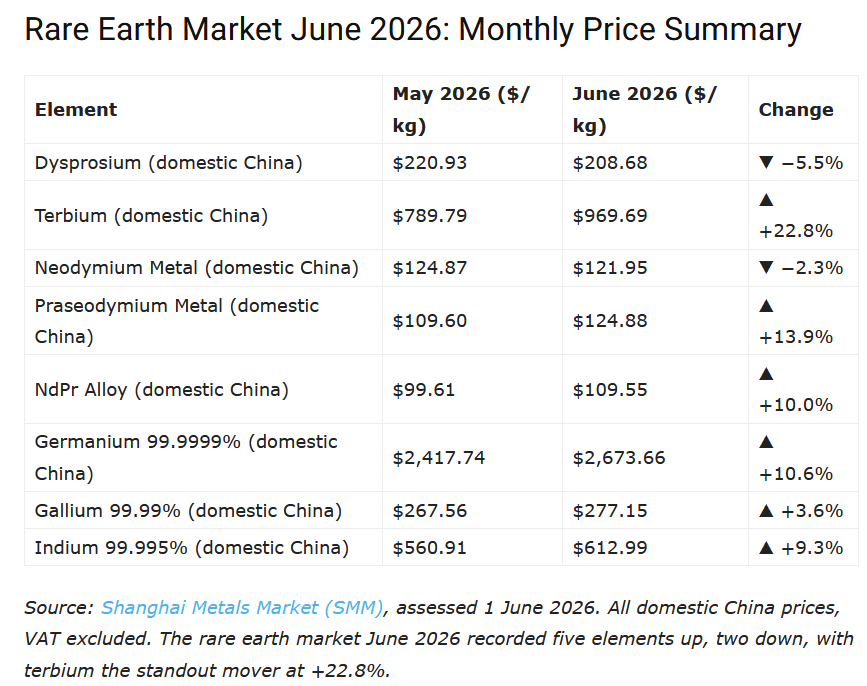
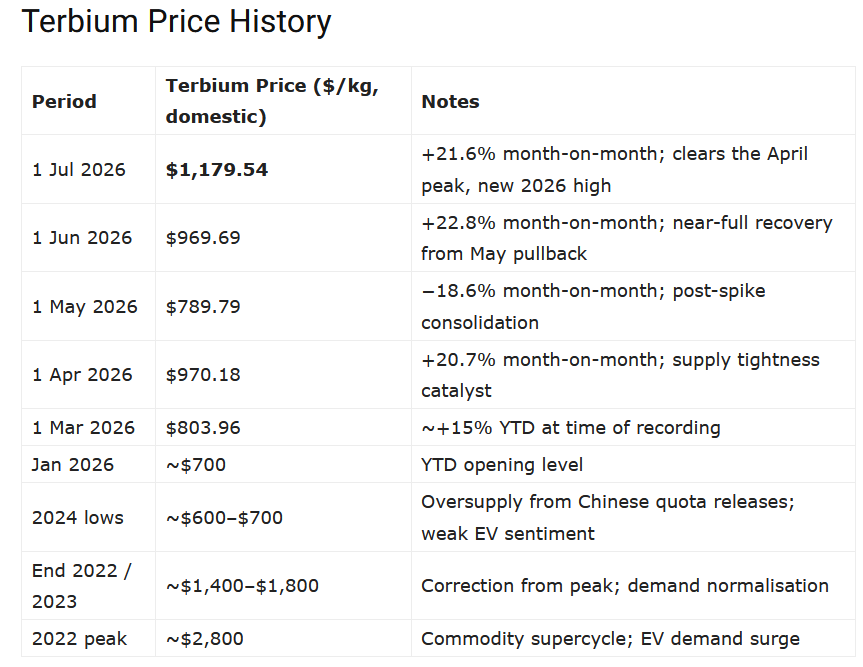
🔺 Terbium +22.8% → $969.69/kg — near April's all-time peak. FOB price: $1,406/kg (+$436 premium)
🔺 Germanium → 2026 high of $2,673.66/kg. Western warehouse price: $6,150/kg = 130% premium over domestic
🔺 Praseodymium +13.9% | NdPr Alloy +10.0% | Indium +9.3% | Gallium +3.6%
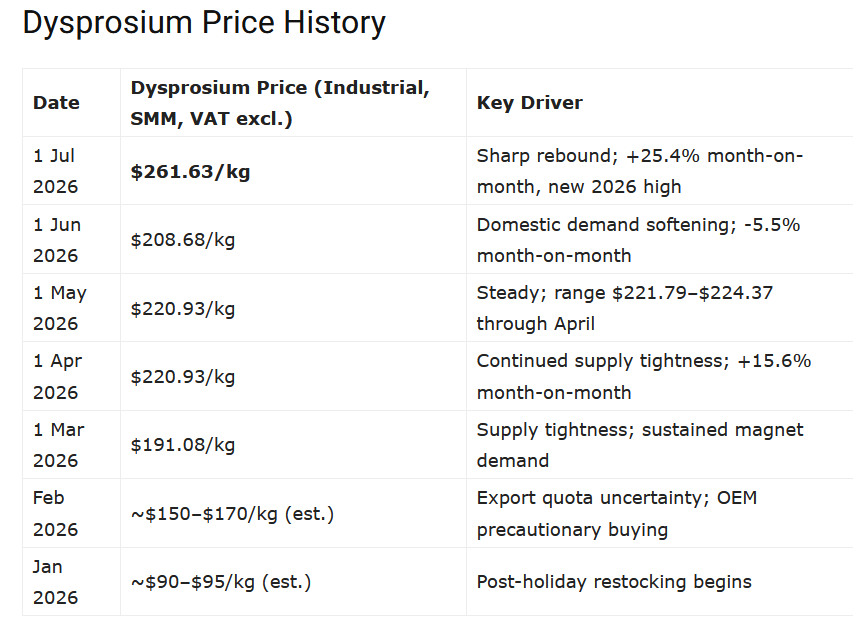
🔻 Dysprosium −5.5% (2nd straight month) — the lone outlier, cushioned by a larger global supply base (2,000+t vs terbium's 300–400t)
But the bigger tell is in the pricing:
🔹 Terbium rebounded 22.8% in June to $969.69/kg
🔹 NdPr alloy rose 10.0% to $109.55/kg
🔹 Praseodymium metal gained 13.9%
🔹 Germanium hit a new 2026 high at $2,673.66/kg
🔹 Dysprosium was the outlier, easing 5.5% to $208.68/k
⚙️ The structural read:
China still controls ~92% of refined NdPr and 98-99% of separated heavy REEs. Combined Western NdPr output covers <15% of global demand. Analysts say fully independent Western supply chains are 10-15 years away.
The volatility is not telling us the shortage is over. It’s telling us ex-China supply is still structurally tight, especially in heavy rare earths. May looked like an inventory correction. June looked like the constraint reasserting itself.
👀 What to watch in July: MIIT's H2 quota call, terbium licence flow, germanium's US warehouse breaking $6,200/kg, and Q2 EV output data.
Meanwhile, Western buyers are still paying big structural premiums for licensed material, and the midstream bottleneck — separation, metallisation, alloying — remains the hardest part to rebuild outside China. 🧲🏭
Watch next:
👀 China’s H2 quota announcement
👀 Terbium licence flow
👀 Germanium warehouse stocks
👀 Q2 EV production data
Falling export volumes + rising prices = the deficit narrative isn't cyclical noise. It's structural.
The market is reminding everyone that rare earth supply chains are still driven more by geopolitics and processing control than by mine output alone.
#RareEarths #REEs #Terbium #Dysprosium #Germanium #NdPr #China #CriticalMinerals #SupplyChain #Magnets #EV #Mining #Geopolitics #ExportControls #Gallium #Indium
Very interesting article flagged to the Koala overnight from 2025
By Hunan Oriental Scandium's own analysis, the only production of #scandium oxide outside of China is Coral Bay, Sorel-Tracy, and Russia
And as @hntrbrkmedia and @CrossroadsOnX both observed, Bloom Energy $BE consumes ~30 tonnes per year TODAY
13 is less than 30 in every version of math the Koala is aware of
Shortages of scandium and other rare earths are squeezing the Japanese economy due to its overdependence on imports from a single source, geopolitical volatility, and export restrictions, Reuters reports.
Japanese corporations are increasingly warning of shortages of rare earths, which are critical to a wide range of applications in next-generation technologies, advanced manufacturing, and defence. This feels like a new-economy canary in the coal mine. Last month, American companies also expressed growing concern about their dwindling and increasingly restricted supply of rare earths due to export restrictions and licensing delays. Japan is perhaps in the most trouble now, but this problem is not isolated to any one country.
“Japan's economy took a hit in 2010 during a previous bout of trade restrictions,” said @Reuters reporter @SatoshiJournal, “but the effect could be worse this time around now that rare earths have grown in importance in a variety of supply chains.”
Governments around the world have long outsourced the production and processing of scandium and rare earths, and we are starting to see the negative effects of this overreliance come to fruition. Bringing new rare earths projects online and establishing domestic or friend-shored sources is vital to sustaining global economic growth.
Projects that establish reliable, long-term supplies of rare earths are becoming increasingly important. Sunrise Energy Metals is developing the Syerston Scandium Project, the world’s largest and highest-grade scandium deposit. Today, scandium is usually mined as a by-product in operations targeting other metals. Syerston will become the first mine designed to specifically target this essential rare earth. Our deposit holds over 32,000 tonnes of contained scandium in mineral resources: enough to meet global demand for many decades to come.
Find out more about Sunrise Energy Metals’ Syerston Scandium Project: https://t.co/eEPs4OLjvg
Read the Reuters article: https://t.co/qnNNeecioN
#RareEarths #SupplyChains #Scandium #Technology