New York’s strength has always been its economic dynamism—people taking risks, starting businesses, and achieving their ambitions. But a higher share of NYC storefronts are empty than before COVID, a wasted opportunity. My latest in @nypost:
https://t.co/rjvhA7oN0b
Zohran Mamdani says he’ll take “aggressive legal action” to seize buildings from negligent private landlords and transfer them to nonprofits and tenant associations.
New York tried this 50 years ago — it didn’t work.
In the 70s and 80s, NYC seized thousands of abandoned properties, spent ~$10.6b managing them, and gave many of them to nonprofits. Living conditions deteriorated (77% of city-managed units had rats), and city-appointed landlords fell behind on payments.
Old buildings deteriorate and need money to be fixed; changing a building’s owner doesn’t change its economics. The real issue here is rent regulation, which sharply limits legal rent increases; NYC’s progressive left either doesn’t know or hasn’t acknowledged history, and as @JKetcham91 argues, Mamdani is exploiting their ignorance to build his political base.
Full story 👇
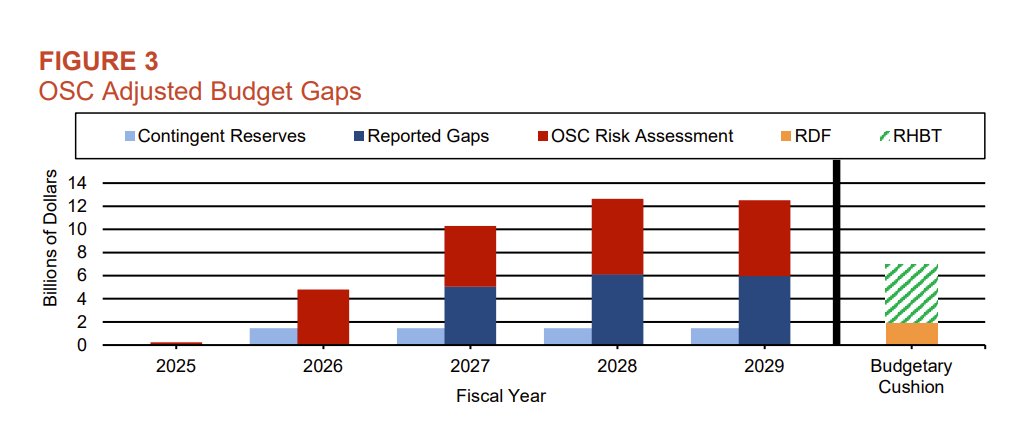
This is a remarkable claim, given the warnings that were circulating in mid-2025 about NYC's looming money problems (and a reminder of why NYC needs careful state oversight). From August 2025:
Often lost in the tit-for-tat nature of the redistricting wars is a simple fact: Republicans have an inherent advantage as Americans continue to vote with their feet, leaving blue states for red ones.
If Democrats were wise, one of their most effective anti-gerrymandering strategies would be improving public safety, quality of life, and the business climate in the big cities they govern.
The mayor’s budget isn’t a socialist budget. It’s just a regular bad budget. Ironically, we spend so much, we can’t afford socialism!!! https://t.co/1ClettIxe8
Long Island Rail Road employees are the highest-paid railroad workers in the nation. In 2025, 168 LIRR employees made more in pay than Governor Kathy Hochul. 25 of those employees made over $300,000 per year.
The LIRR strike is over, but the work rules that contribute to these numbers remain.🧵
Here’s where I’m coming from.
The federal deficit is 5.8 percent of GDP at a time when unemployment is 4.3 percent, a sign (to me, admittedly a deficit-hawk caveman) that massive fiscal expansion is not the right move. Given that there’s a lot of need in a lot of different places, I don’t think a congressman from NY-12 will be able to make a compelling case that a city and state with extremely high fiscal capacity and extremely perverse homegrown anti-housing policies is the neediest claimant for a huge influx of federal funds.
We might just disagree about whether and how much demand subsidies tend to inflate demand (net effect on rents depends on supply elasticity, which NYS has suppressed), how hard lawmakers would fight to avoid losing transportation funds, if a massive program of public housing construction would be an easy sell (or desirable).
And I do appreciate that there is a bipartisan post-neoliberal Warrenite consensus to — as JD Vance and Tim Walz put it in their VP debate — “decommodify housing.” It is absolutely bipartisan to back further increases in deficit spending, ban new build-to-rent housing, etc. My argument definitely leans against this new bipartisan consensus, which I see as largely counterproductive.
My core claim is that NYS has the capacity to greatly mitigate its own housing emergency without the (I suspect illusory) promise of billions in additional federal spending for urban multifamily housing.
This may well be foolish of me, but I sincerely believe unraveling bad, homegrown supply-dampening policies is the best place to start and that we have much further we can go on that front.
First, the NYS housing emergency was made in NYS, and it’s worth asking whether our state lawmakers have made things better or worse. Since 2019, NYS has become (even) more hostile to market-rate development and new rent regs have exacerbated the housing emergency.
Second, the federal policies outlined below fail to grapple with yawning federal deficits and NY’s shrinking political clout. 1. Rental subsidies tend to inflate demand. 2. Federal conditions will have to be weak enough to win the marginal Senate vote. 3. Building new public housing will mean handing billions of borrowed federal dollars to entities that don’t have a sterling track record when it comes to efficient spending.
These are ideas that sound substantive, but the real bite-the-bullet reforms (easing affordability mandates, zoning reform, permitting reform, etc.), have to be made in Albany and other state capitals.
That is where assembly members like @MicahLasher and @AlexBores have had an opportunity to tell uncomfortable truths and build coalitions to do something about the housing emergency.
The federal government won’t rescue us from our own fecklessness and stupidity.
Because the TWU can’t strike without crippling penalties, the game here was to use the LIRR strike to establish a wage “pattern” that will drastically raise costs across MTA agencies. In cultural-political terms, these unions might seem markedly different — Long Island Republicans vs. outer-borough Dem stalwarts — but they’re working in concert against NYS taxpayers (who are, alas, almost completely unaware). This has been a TWU strike by proxy.
I’m struck by the gap between what seems to be going on (the story advanced by unions and their allies, by reporters who might be wildly biased or might innocently not have the experience, context, or time) vs. what is actually going on (which requires some understanding of history, clashing interests, etc.)
Thankfully, we have @JKetcham91 and @PolicyEngineer and team.
The LIRR strike is over, but old work rules and the bigger threat remain. In today's @nypost, @policyengineer and I explain how LIRR unions leveraged the strike to try to set a costly pattern for future MTA-TWU labor deals that could hurt riders and taxpayers across the region.
Hochul’s MTA has offered a perfectly fair deal from which the unions walked away. Insane to run a GOP campaign based on giving in to a union strike, but that’s Long Island, a place whose insane union dysfunction depends entirely on access to NYC wealth. We save $ sticking with the socialists honestly.
The LIRR unions nightmare is that tomorrow *isn't* a nightmare: most people work from home; those who can't will carpool, get dropped off by a relative at the subway, or take one of the MTA shuttles. And things are ... not fine but not that bad.
Giving credit where it's due. Last week, I praised @GovKathyHochul for her intent to opt NYS into the SGO tax credit. She again deserves recognition for protecting taxpayers and LIRR riders against insatiable public-union demands.
New York State politics is funny because the Manhattan Institute is Kathy Hochul’s strongest soldier on taking a firm line with the LIRR union meanwhile actual Long Island and New York Republicans…
Governor Hochul can be the Margaret Thatcher of New York State, if she can hold firm (a big if). You will never fix crazy union costs and rules in New York unless you demonstrate you can stand up to the worst offenders -- the LIRR work-rule overtime featherbedders -- and politically survive.
We’re happy to cheer for a Democrat who shows the backbone needed to stand up to public sector unions.
The people who keep accusing us of being blind partisans should maybe try following Hochul’s example.
@CSElmendorf@reihan@ProfSchleich Fusion only applies in the general election, after the game is over. The Dem primary is the real race, with no cues to help voters—especially now that RCV has added complexity and encouraged more candidates to stay in the race.
New York's one million rent-stabilized apartments are now significantly CHEAPER than they were a decade ago, owing to persistent below-inflation rent-increase caps. But don't be fooled: this is no free lunch — we end up paying anyway. Here's why, in the short thread below 👇🏼