I want to share my story about how I got into Web3 and what drew me to this space. It all started in 2022, when the market was going through a rough time. I watched the collapse of FTX, bankruptcies everywhere, and total uncertainty, but for some reason, that didn’t scare me away. On the contrary, that’s when I started diving deeper into the crypto industry. At first, I tried learning Solidity and Move, thinking development was my path, but I quickly realized coding wasn’t really my thing. I had a full-time job, and balancing that with intense programming studies was tough. So, I decided to take another route - I started analyzing projects, researching fundamental tokens, making small investments, and testing different strategies. By mid-2022, I decided to start investing. The market was still down, but I was curious. One of the first tokens I bought was $ETH, which was around $1,200 at the time. I also looked into L2 solutions like $MATIC (Polygon) and $OP (Optimism) because I believed Ethereum scaling was the future. Then, in June 2022, Hop Protocol launched its $HOP token. I had already been following the project for a while, and when the airdrop happened, I knew this was something worth paying attention to. Cross-chain solutions were becoming more important, and I was convinced that Hop had a strong use case. I started using the protocol actively and eventually decided to buy and hold $HOP as part of my portfolio. In early 2023, I realized that blockchain bridges weren’t just a trend but a critical part of the ecosystem. That’s when I applied for a position at Hop Protocol. The team was still relatively small, and I saw an opportunity to contribute. Looking back, that was one of the best decisions I ever made. Working at Hop Protocol, I got to see Web3 from the inside. Before, I thought decentralized projects were just about code and smart contracts. But now, I understood that behind all of it were people, communities, and an open-source culture. Of course, there were challenges -the market was volatile, interest in bridges fluctuated, and new competitors kept popping up. But this experience solidified my belief that Web3 isn’t just a technology - it’s a real revolution in finance, access to capital, and financial independence. Now, in 2025, the industry is moving forward—scalability is becoming a reality, L2s are growing, and more institutional players are entering crypto. I’m still learning, building, and investing because I see the potential. I’m holding $ETH, $MATIC, $OP, $HOP, and a few DeFi tokens. Lately, I’ve also started exploring RWA (Real-World Assets) because I believe tokenization of real-world assets is one of the most underrated sectors in Web3. Web3 still feels like it’s just getting started, and anyone willing to learn and take risks has the chance to be part of something huge. If you’re reading this and wondering if you should jump into Web3 - here’s my advice: just do it. Yes, you’ll make mistakes. Yes, there will be bear markets. But if you have the passion and curiosity to dig deep, the results will come. #livestory #web3
2/4 Fabric (2026)
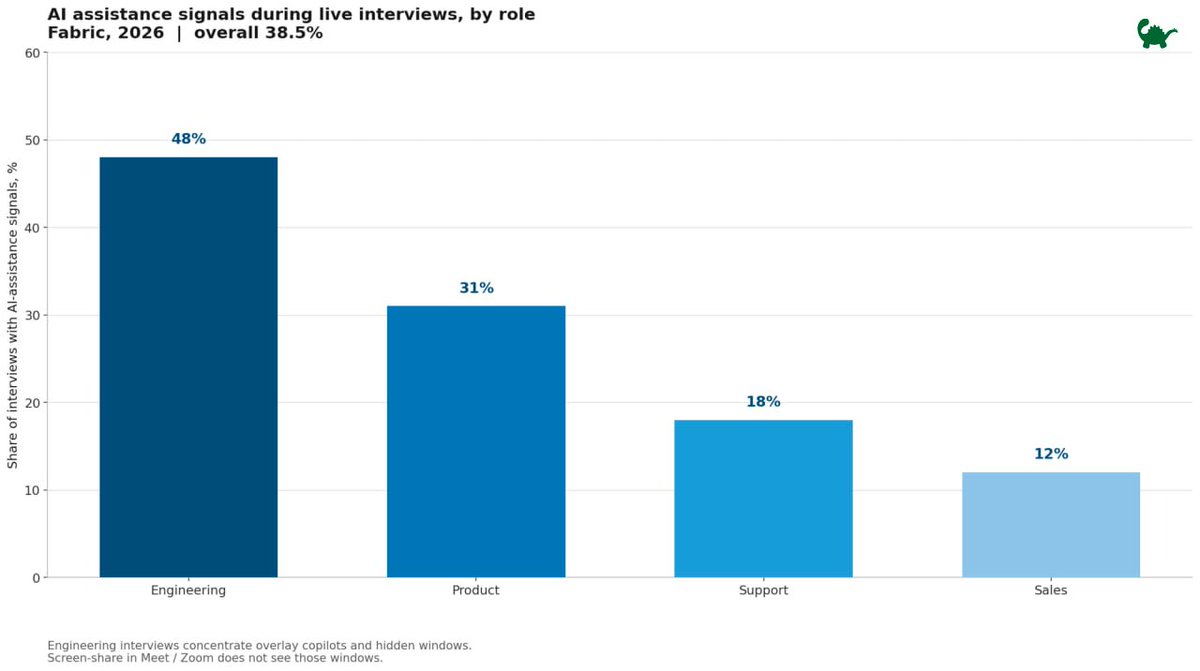
38.5% of candidates show signs of AI help. Engineering interviews: 48%. Sales: 12%. That is not everyone cheats but It is where the answer can be read off a screen versus where it cannot. A code pad and a system-design canvas give more surface than a talk about a sales pipeline.
Most interview tools treat integrity as a feature you bolt on after the call exists. That is why they miss the actual cheat: the cheat happens beside the call.
This diagram is the opposite construction. The session is a closed interval. Collectors boot at consent and die at hangup. If either consent is missing, the graph stops employer sees did not proceed, nothing else.
The five OS boxes are not a score. They are inputs that a browser compositor never receives. Overlay windows sit above capture. A virtual camera sits below the meeting client. A second display is a fact, not a screenshot.T
he interesting edge is the last row. Transcript is local so the raw speech never has to leave the machine for STT. Analysis hits an EU API with zero retention and comes back as a draft. The report is copied to both sides before anyone on the hiring panel can privately annotate a cheat flag.
If you skip the dispute box, you have a detector. If you skip symmetry, you have proctoring. The arrows are there so neither skip is possible in the product.
This is not us watching the candidate.
This is the part of the stack Meet never gets: windows excluded from capture, a process that should not be there, a camera that is not a camera. We log it against a timestamp and shut up until the call ends.
What you actually need from a live coding round is the path: first approach, the dead end, the rewrite, whether they ran anything before they claimed it worked. That trail sits in the editor timeline, not in the final blob you paste into GitHub.
We keep the trace on the session, not as a personality score. The model can write tried a regex, backed out, split-and-filter. An interviewer still has to confirm the competency tick against a timestamp. Unconfirmed drafts do not reach the panel. If you only store the last function, you ran a take-home inside a video call and called it structured.
2/3
The cheat is not the model. It is the hidden overlay. Capture-excluded ChatGPT
A second display with the reply. Audio that is not the candidate. The meeting client never sees those four. The OS does.
If only one side can see the window, you are not using a tool. You are running a prompt through a person.
2/2 This is why we opened.
The session has to be ours. Invite, media path, device list, hangup. Not a tab on meet. google. com. Collectors boot after both consents and die on hangup. Same log, both sides.
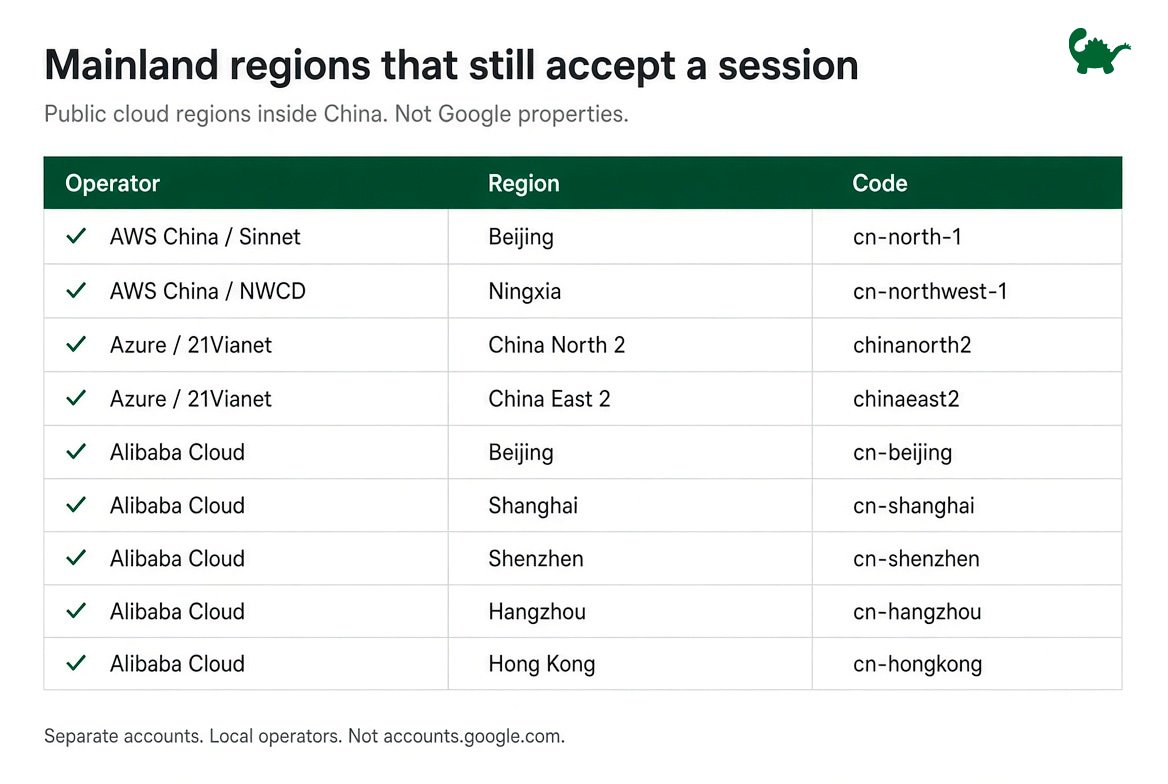
The path has to resolve from the network the candidate is actually on. That is not a Google property. It is a local operator and a separate account: AWS China Beijing (cn-north-1, Sinnet), Ningxia (cn-northwest-1, NWCD), Azure China North 2 / East 2 (21Vianet), Alibaba cn-beijing cn-shanghai cn-shenzhen cn-hangzhou. Hong Kong is the edge, not the workaround for Meet.
We did not leave Google’s model because we never studied it. We studied it, then built the part their client will not do: a native session on a path that still answers.
1/2🧵👇
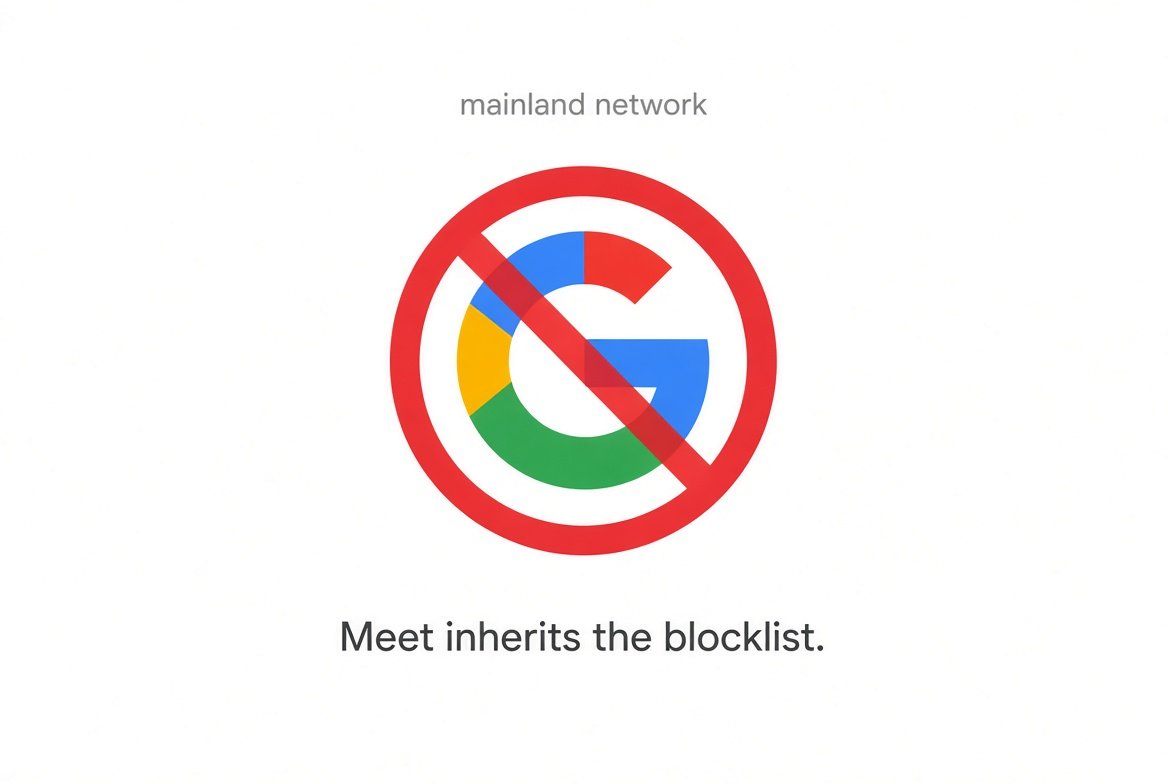
Google is not flaky in mainland. It is filtered.
Search, Gmail, Drive, Calendar, accounts. google. com, Meet. The handshake dies at the border. A hiring stack that lives inside Workspace inherits that map. The candidate does not join a bad call. They never get a session.
We learned that stack in their rooms first. I/O, Cloud Next, smaller engineering talks. Conversations with people who ship the client. Meet was built to move faces and voice between two browsers that can already see Google. It was not built to inspect the OS under the call, and it was not built to survive a network that has already decided the domain is gone.
A Meet bot does not fix this. If the signaling host is a Google property, the bot sits on the same side of the wall as the client. No room, no recording, no integrity layer.
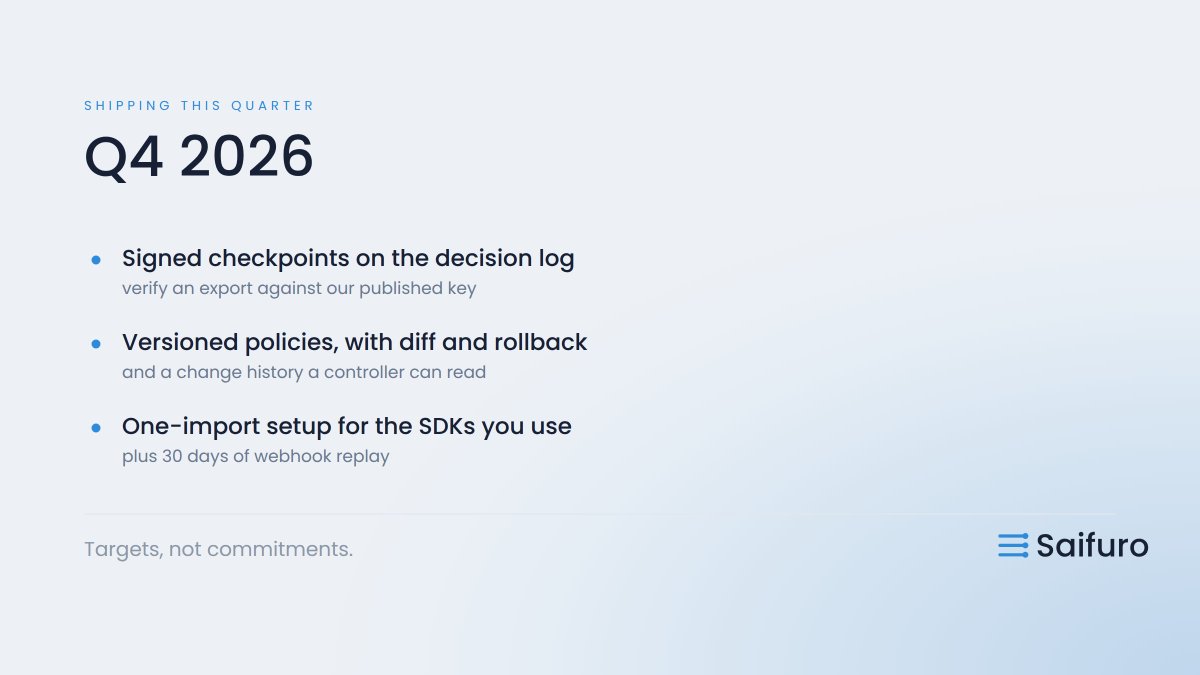
What we're shipping this quarter. Verification you can run yourself, policies you can version and roll back, and setup that takes an afternoon.
roadmap: https://t.co/aE6YMFJfwg
The one that stuck: a keynote slide telling colleagues to abandon generative models, probabilistic models, contrastive methods and RL closing with if you are interested in human-level AI, don't work on LLMs.
Room took it calmly. That's the actual information. Useful calibration on how settled any of this is, if you're building next to LLM agents.
Notes: https://t.co/Dc32O9znZy
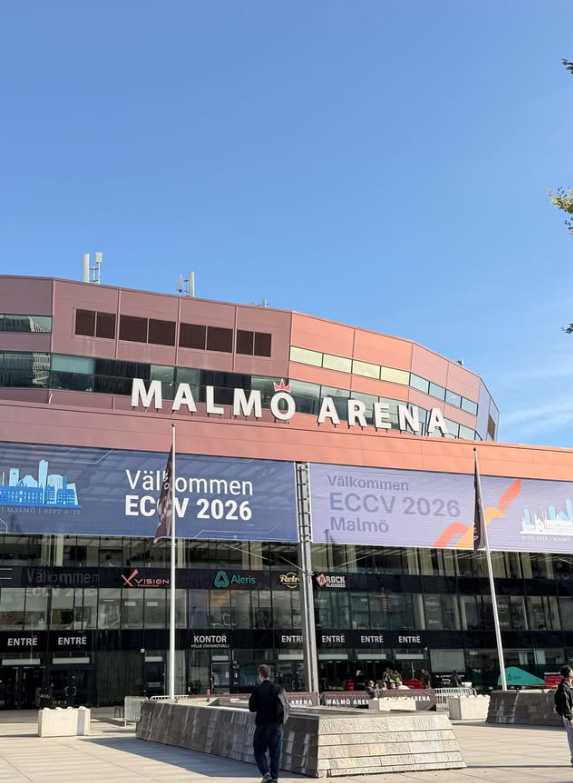
Spent last week at ECCV in Malmö. Not exhibiting, not presenting just in the room 😎
Going to a conference outside your field is underrated. At your own you hear what you already believe, phrased better. At someone else's you find out which of your assumptions are local.
3/6 Your spending rules are commercially sensitive.
A policy states which vendors you buy from, what you pay them, which teams have which budgets, and where your approval thresholds sit. Published on a public chain, that's a competitor's research project, and in some cases a map for whoever wants to structure payments just under your review line.
Encryption moves the problem rather than solving it - you've now got key management plus a permanent public record of your ciphertext.
2/6 Policies change far more often than anyone expects going in.
A new vendor gets allowlisted. A cap moves for one team. A time window gets added after someone's agent bought something at 3am. In a normal month a policy goes through several versions, each needing a diff, a rollback path and an explanation a controller can actually read.
Immutability is the correct property for a ledger and the wrong one for the part that keeps changing. Contract upgrade patterns exist, but you're then maintaining a mutable system that pays gas for the privilege of looking immutable.
A question we get from crypto-native teams, roughly monthly: if the settlement is on chain, why isn't the policy on chain too?
1/6 🧵👇
It's a fair question. Putting the rules in a contract sounds strictly better trustless, auditable, no vendor in the middle. We looked at it seriously and concluded the opposite, for reasons that have nothing to do with ideology.
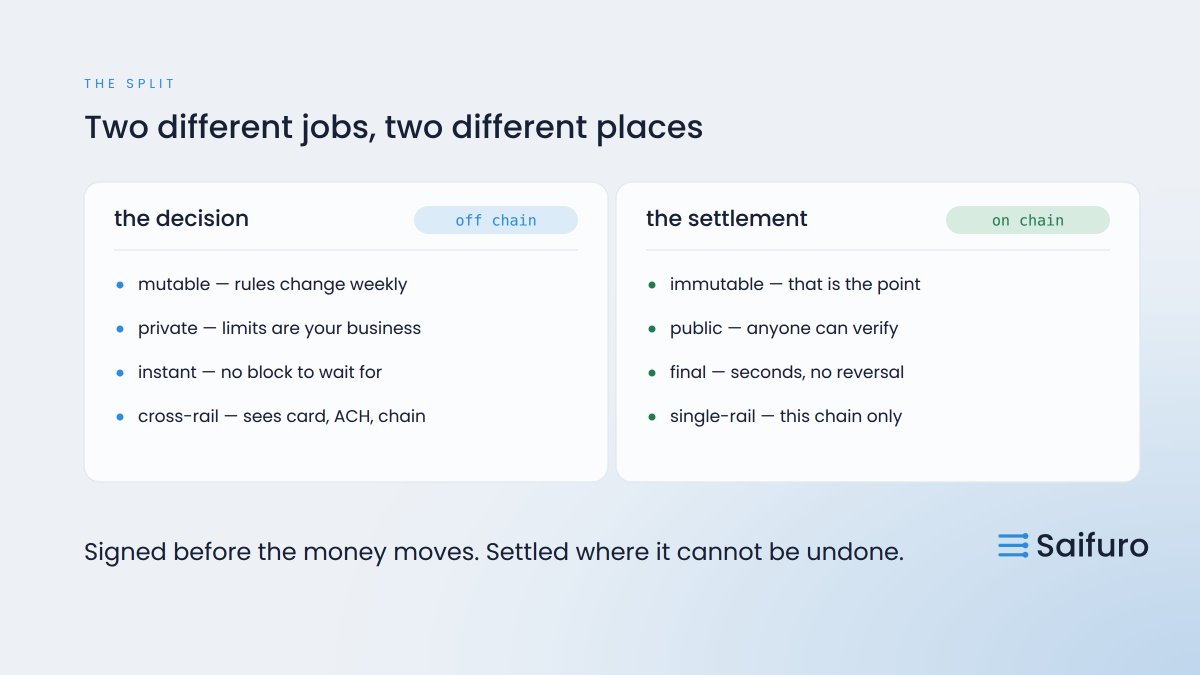
A chain is exceptional at the thing settlement needs: finality, public verifiability, no one able to quietly undo it. A policy needs almost the reverse. It changes constantly, it contains information you'd rather not publish, and it has to apply to payments that never touch a chain at all.
So we split it. The decision happens off chain and gets signed. The settlement happens wherever the payment actually goes: Base, Solana, a card rail, an ACH batch. The verdict is verifiable either way, against a published key, without trusting our database.
Five reasons below, including the one that surprised us.