$1 Billion dollars over a decade to improve food security.
$100 million a year...
And we just spent $14 Billion to send out cheques, helping folks with food insecurity, but it won't fix anything.
Got it.
So let me get this straight...
Canada is in a recession—the only G7 country currently in one. Unemployment is up. Inflation is rising. Food insecurity is at a record high.
Yet the highest proportion of Canadians since 2017 now say the country is on the right track.
That's either a remarkable display of optimism—or a sign that many Canadians aren't getting the full economic story from the news they consume.
Steven Guilbeault is leaving federal politics, and not a moment too soon.
He may go down as one of the ministers who most aggressively weaponized science, funding questionable research groups like the Canadian Climate Institute and other pet projects to reinforce a single “climate crisis” narrative.
Anyone claiming Guilbeault truly believed in science is fooling themselves. He treated science like a buffet — picking only what supported his agenda. That’s not science.
He even misquoted me in the House of Commons, attributing claims to me that I have never said or published. That alone tells you everything you need to know about how evidence and dissent were handled under his watch.
Good riddance.
It’s April 1.
The industrial carbon tax is rising to $110 per tonne today—120% higher than when we last faced a major geopolitical energy shock during the Russian invasion of Ukraine.
Make no mistake. This will amplify cost pressures across the entire food supply chain.
No April Fools’ joke, unfortunately.
“This hour has 22 minutes” (a legendary Canadian sketch comedy show) did a Pitt parody on the Canadian healthcare system.
“Robby” using hand sanitiser every 10 seconds is taking me out 😂😂😂
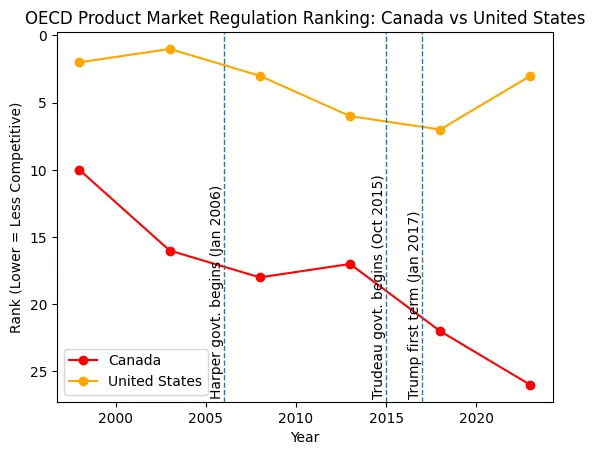
Canada’s regulatory competitiveness has steadily declined over the past 25 years, falling from 10th place in 1998 to 26th in 2023 in the OECD’s Product Market Regulation ranking. Over the same period, the United States has remained among the most competitive economies, highlighting a widening regulatory gap between the two countries.
The OECD Product Market Regulation ranking measures how restrictive a country’s regulations are for businesses, indicating how easy or difficult it is for firms to enter markets, compete, and grow within the economy.
Things Canada has:
Strategic Oil Reserve❌
Strategic Maple Syrup Reserve✅️
Which pretty much sums things up.
Also, some Liberal Boomer named Margaret:
"But...experts say"
"All countries around the world will likely see food prices rise as oil prices surge, including Canada. Those with an industrial carbon tax that is increasing this Spring will suffer even more—and Canada is among them."
"Higher energy costs, coupled with the increase in the industrial carbon tax to $110 per metric ton in April, will be a double whammy for the entire food chain. Not a great time to raise the carbon tax."
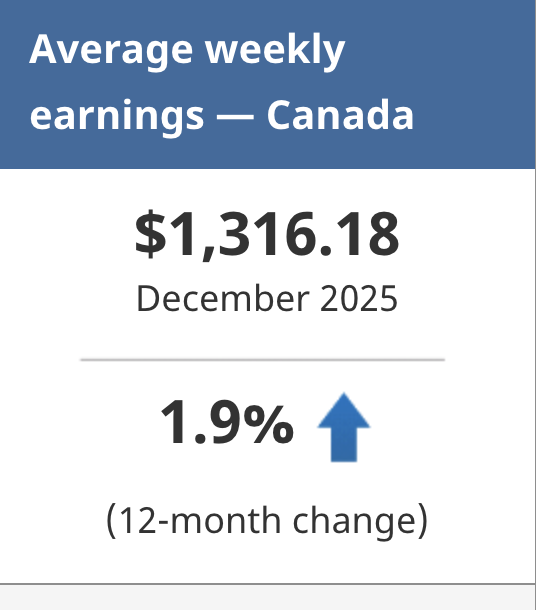
payroll data released today shows average earnings across the Canadian economy are ~$68K a year, growing 1.9% annually
the PBO report from last week has federal employee total comp at $143K, growing 5.1%
the economy that funds the public service is barely growing while public service compensation compounds at nearly triple the rate
Food inflation has undeniably become a political issue in Canada.
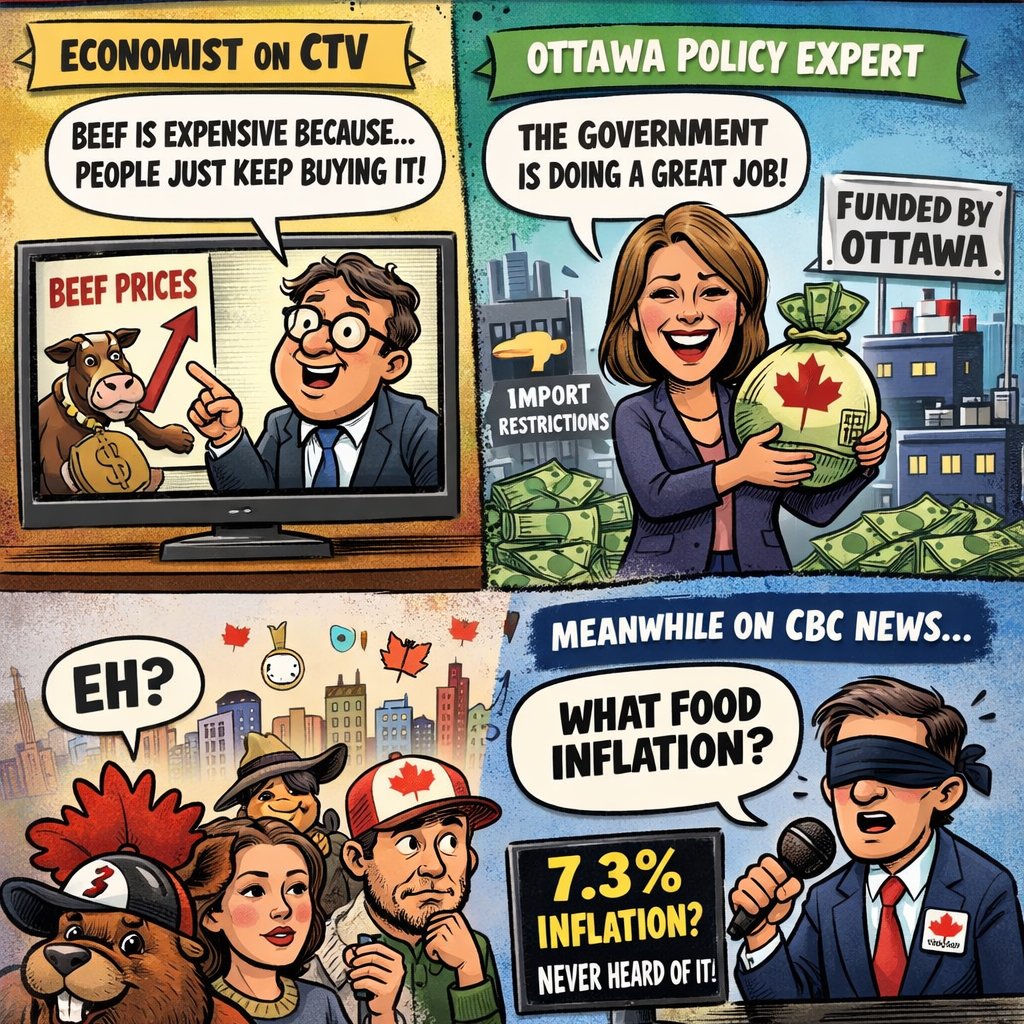
Need evidence? Yesterday on CTV, an economist who does not conduct forecasting or price analysis suggested that beef prices are “skyrocketing” simply because consumers continue to buy beef — effectively blaming demand, you, the consumer, not the reality of a highly concentrated processing sector dominated by two foreign-owned firms, nor the role of import restrictions and policy choices in shaping supply.
Another commentator, with no research background in food pricing, praised the Carney government’s “strong policy direction,” while acknowledging that her agency is fully funded by Ottawa and that her grant is up for renewal this year.
And the CBC? Not a single mention of Canada’s G7-leading 7.3% food inflation rate.
This is precisely why Canadians remain poorly informed about why food prices are rising.
Canada’s prime minister, Mark Carney, recently visited Beijing. This trip sparked rumors that Canada was ditching the US and buddying up with China instead. Let's pump the brakes a bit.
Full Newsletter: https://t.co/ybkAA0C8OQ
So Trump and Xi just hit pause on their trade war. Great news — for American soybean farmers.
Meanwhile, Canadian canola growers are still staring down 75% tariffs and frozen exports to China.
Can we ask Trump to negotiate for us?