21,000 jobs gone at Oracle. Around $70 billion in capex ahead. Another $40 billion to be raised in debt and equity.
That was the clearest AI signal I saw this week. Not a product launch. Not a demo. A balance-sheet decision.
Then Amazon added another $13 billion to AI and cloud infrastructure in India, taking its planned total there to $48 billion through 2030. Microsoft has pledged $17.5 billion. Google has committed $15 billion. The AI race is moving out of the innovation budget and into capital allocation.
A lot of companies are still talking about AI like it is a seat license and a prompt library. It is not. It is compute, power, contracts, financing, and org design.
Stop calling this a productivity program. The winners will treat AI like an operating model change before the budget does it for them.
#AI #CIO #Cloud #DigitalTransformation #CIOChat
If your firewall, VPN, or edge stack is sitting in next year’s budget, that’s not thrift. It’s an accepted intrusion path. CISA spent this week pairing 3-day KEV deadlines with a 12-month order to rip out unsupported edge gear. Refresh debt is breach debt. #CIO#CISO
Most AI strategy decks still treat model choice like a feature comparison.
That is already outdated. Reuters reported on June 22 that Siemens, Renault, Orange, and ChapsVision are mixing U.S., Chinese, and European models after access limits exposed how fragile remote AI services can be. That is not experimentation. That is continuity planning.
At the same time, CIO warned this week that AI is becoming a single point of failure as companies redesign workflows around tools they do not fully control. If a provider can rate-limit you, reprice you, or restrict access by policy, your operating model is now carrying vendor concentration risk in plain sight.
The real issue is not whether your teams use AI. It is whether revenue, delivery, and service commitments now depend on one external model stack staying available on someone else’s terms.
Stop treating model selection like a feature bake-off. #CIO #AIStrategy #EnterpriseAI #AIGovernance
🔥 Hot take: Enterprise AI is moving out of the lab and into the admin console.
When OpenAI ships spend controls and usage analytics on June 18, and Google pushes an AI control center for Workspace, that tells you where the market is headed.
The hard part is no longer getting a model to answer. The hard part is knowing who is using it, what data it can touch, and which team owns the bill.
That matters more than most AI roadmaps admit.
Once agents start touching finance, HR, legal, and operations, the buying decision stops being which model is smartest. It becomes which platform gives IT and finance enough control to let this scale without cleanup later.
#ScaleAI #EnterpriseAI #AIGovernance #CIO #CTO #CAIO #CEO #BoardofDirectors #CIOChat
Shadow AI is usually a procurement failure, not an employee failure.
Thomson Reuters put real numbers on it this week: 74% of professionals now use AI every week, 91% say their organization is falling short on value, and one-third are already using unsanctioned tools. That is not a policy problem first. That is an execution problem.
The market is adjusting fast. OpenAI rolled out enterprise usage analytics and spend controls. Samsung expanded ChatGPT Enterprise and Codex across employees in Korea and its DX division worldwide. The serious players are moving past AI access and into AI operating models.
If your teams have deadlines and your sanctioned tools are weak, they will route around you. Every time. Blanket restrictions look disciplined in a board slide, but in the field they usually create invisible spend, invisible data flow, and invisible dependency.
Stop treating AI policy as the rollout. The rollout is budget control, approved use cases, manager-level overrides, and clear accountability for where AI is actually changing work.
#CIO #AI #EnterpriseAI #AIGovernance #CIOChat
The clearest sign AI is leaving pilot mode is not a better demo.
It is governance showing up in the product.
This week Google added Agent Registry governance and allow/deny egress controls for agents and MCP servers in Gemini Enterprise. A day later, OpenAI added workspace-level plugin governance and role-based access controls in ChatGPT Enterprise.
That matters because agents are no longer just generating text. They are connecting to data stores, plugins, SaaS actions, and remote systems. The minute an agent can act, AI governance stops being a policy document and becomes an operational control problem.
A lot of companies are still treating agent rollout like a sandbox experiment. Stop doing that. If there is no registry, no role boundary, and no deny path, you do not have AI adoption. You have shadow automation with a nicer interface.
#CIO #AIGovernance #EnterpriseIT #AI #CIOChat
The most common mistake I see in AI risk assessments: scoping only to internally built AI.
The majority of enterprise AI risk lives in third-party tools — SaaS platforms with embedded AI features that most procurement teams waved through without a security review in 2023.
If your AI risk assessment didn't include every tool your org uses that has an AI feature, it's incomplete.
The other five risk categories to cover:
https://t.co/i22LsdPCtW
#AIGovernance #CEO #BoardOfDirectors
$150 million a month for compute. A 20-year power deal. A direct memory-and-storage agreement tied to an AI funding round.
That was all one day of AI news.
Reuters reported Reflection signed a compute deal with SpaceX worth about $150 million a month. Reuters also reported Microsoft locked in a 20-year power arrangement with Chevron for a West Texas data center campus expected to add 2 gigawatts of capacity. Anthropic signed with Micron for memory and storage as part of its infrastructure push.
This is why I keep saying most AI strategy decks are too soft. The real battle is moving below the app layer and into power, silicon, storage, and contract structure.
Stop treating AI like a software SKU you can switch on later. The companies that win will secure capacity before they announce use cases.
#CIO #CTO #AIGovernance #EnterpriseAI #CEO #CFO #BoardOfDirectors
You can tell AI has left the lab when the org chart moves before the revenue line does.
Oracle disclosed this week that its workforce fell 13% in fiscal 2026, about 21,000 people, and said AI adoption across operations contributed to the reductions. That is not a tooling story. That is operating model surgery.
Three days earlier, Commonwealth Bank of Australia named a new CIO and CTO specifically to sharpen digital, data, and AI execution. The CTO remit explicitly includes engineering, security, and AI capabilities. Banks do not make that kind of split for theater.
Most companies are still treating AI like a product trial. The companies moving first are treating it like org design: who owns the platform, where the budget sits, what gets automated, and which layers of management survive the change.
Stop calling this an innovation initiative if it changes headcount, spans of control, and capital allocation. That is executive architecture.
#CIO #AI #DigitalTransformation #CIOChat #AIGovernance
"We have an AI policy" is not an AI governance program.
There are four levels of AI governance maturity:
— Initial: ad hoc, ungoverned, high exposure
— Developing: policies exist, inconsistently followed
— Defined: structured, broadly adopted
— Optimizing: embedded, continuously improving, audit-ready
Most organizations that think they're at "Defined" are actually at "Developing."
The gap is usually enforcement, not documentation.
How to assess where you actually are:
https://t.co/XnngfITZYx
The biggest AI risk in enterprise right now is not bad output. It's vendor kill-switch risk.
On June 12, Reuters reported Anthropic disabled Fable 5 and Mythos 5 globally after a U.S. export-control order tied to foreign access. On June 15, Reuters reported Commerce used powers under the 2018 Export Control Reform Act for the first time in this fight.
Then read the June 5 White House national security AI memo. It says agencies should ensure no commercial entity can prevent use of, disable, degrade, or materially modify an AI system without government knowledge and approval. That language will not stay inside defense forever.
Too many AI buying decisions still look like feature shootouts. If a vendor, regulator, or geopolitical event can shut off your top model in a day, your AI roadmap is really a dependency map.
#AIGovernance #AI #Mythos #CIO #CTO
"We have an AI policy" is not an AI governance program.
There are four levels of AI governance maturity:
— Initial: ad hoc, ungoverned, high exposure
— Developing: policies exist, inconsistently followed
— Defined: structured, broadly adopted
— Optimizing: embedded, continuously improving, audit-ready
Most organizations that think they're at "Defined" are actually at "Developing."
The gap is usually enforcement, not documentation.
How to assess where you actually are:
https://t.co/iBiefTorMQ
#AIGovernance #CEO #BoardOfDirectors #CAIO #CISO
🔥 **HOT TAKE:** The real AI bottleneck isn't compute—it's watts. Global data centers now consume more electricity than Japan, and 50% of new US builds are stalled by power shortages. We're chasing AGI while the grid can't handle today's models. Time to innovate on energy, not just parameters. #AIenergy #SustainableAI #CIO #CISO #CTO
97% of firms have active AI initiatives. Only 5% say their data is ready!
That means most companies do not have an AI strategy yet. They have an access strategy.
More licenses, more copilots, more model demos. Same broken identity, messy records, disconnected systems.
If your AI can write a summary but cannot trust the customer, supplier, or entity it is acting on, you did not scale intelligence. You scaled guesswork.
Stop treating the model as the hard part.
The hard part is getting your data clean enough that the business will let AI touch revenue, compliance, and operations.
#CIO #AIStrategy #DataGovernance #CEO #BoardofDirectors #CFO
**I Started a weekly #AIGovernance newsletter with 50 subscribers so far! Sign up and read past issues here https://t.co/q00zXZk1rw **
https://t.co/q00zXZk1rw Sign up for The Governance Gap Newsletter! Weekly takes on AI governance, cybersecurity, and enterprise technology — written for board directors and C-suite executives who need to understand the stakes, not the specs. #CIO#CIOChat#AIGovernance#AI #BoardOfDirectors
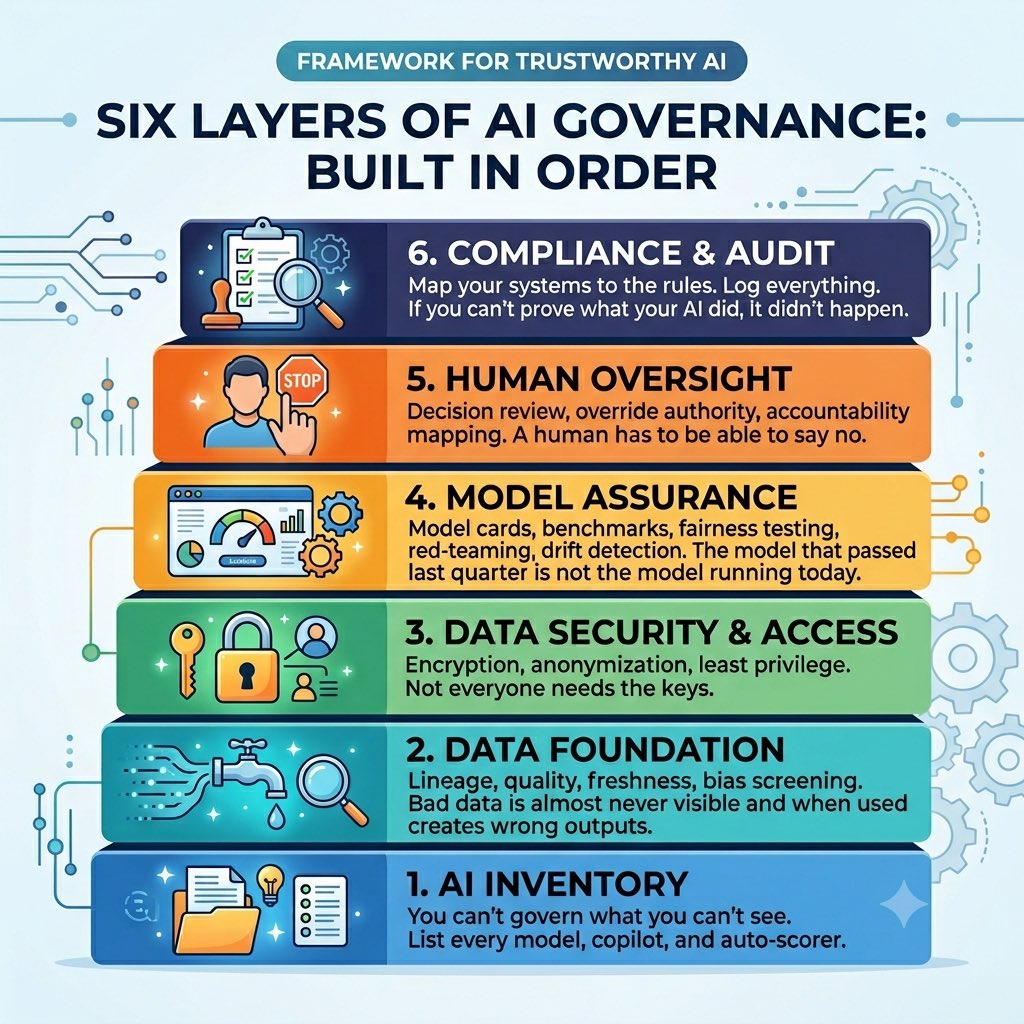
Most AI governance programs I see are missing the same thing: GOVERN.
The NIST AI Risk Management Framework has four functions — GOVERN, MAP, MEASURE, MANAGE. Organizations invest heavily in the last three and neglect the first.
GOVERN is the one that asks: who's accountable, what policies exist, and who authorized this AI system to run?
Without it, everything else is just technical controls floating with no organizational ownership.
I wrote a breakdown of the full framework and how to benchmark your org against it:
https://t.co/S537SCosda
Nearly two-thirds of companies still haven't scaled AI across the enterprise. That's not a technology gap; it's a governance gap. The teams moving fastest are treating AI governance as a decision system: what can ship, what needs human review, and what must wait. That turns risk management into operating leverage.
Board question: where does your governance process still slow adoption that should already be scaling?
#CIO #AIGovernance #CTO #CAIO