"In the past 50 years, countries like India, the Philippines, the Congo now owe their former colonial masters 189x what they owed in 1970"
~ @gladstein
(Thanks IMF, World Bank)
By providing countries like Bhutan a debt-free path to financial sovereignty, Bitcoin fixes this
We are witnessing the unwind of the WW2 economic order.
What's happening now is much bigger than tariffs. For nearly 80 years the US exported dollars while importing goods & debt. That system is failing.
What's next? A move back to a neutral reserve currency. Got #Bitcoin?
DOLLAR INFLATION IS GLOBAL TAXATION
There is just a fundamental misconception about what the USA actually is.
It is the seat of a global financial empire (or was). It makes its money by printing it. For example, it printed $1.25T for just one purchase back in 2010.
Do you know many Nikes you’d have to sell to make a trillion dollars?!?
The reason the American Empire had the right to print a trillion dollars at its whim is because it was managing the global financial system for everyone. So it had the right to impose global taxation via dollar inflation. Every time it printed $1T, that was divided by the 6B+ direct and indirect dollar holders worldwide, not just the 330M Americans.
In other words: the whole world paid the US to run the empire. And got diluted down (aka taxed) every time the US printed another dollar. That’s why Milton Friedman said inflation is taxation without legislation.
Anyway — the USA could impose global taxation via dollar inflation because it was a stable jurisdiction for multinational business, due to Delaware. It issued visas for scientists and workers from all over the world. It didn’t have psychos bombing cars, shooting CEOs, or blocking roads. It advocated free trade, respected property rights, and only sanctioned rogue states.
Now all that is gone. The US is no longer a neutral arbiter of the rules-based order that it once set up for its own benefit. And so it’s going to lose that money-printing power. But before it goes, you should understand what it’s losing.
Because the money-printing business model was way, way, way more profitable than working for a living. Yes, it had long-term negative consequences, but in the short and medium-term (meaning: multiple decades) it had absolutely no peer.
Exiting the money-printing business to return to the abandoned manufacturing business is likely not even possible because of the societal instability such a sharp decline in living standards will cause.
Anyway, the people who ran American Empire could have spent this money more wisely. They could have taken far better care of their own citizens, and dropped fewer bombs on non-citizens. Then they wouldn’t be at this juncture.
But *how* it spent the trillions is distinct from the indisputable fact that the US printed trillions in the first place. So the American Empire as an entity wasn’t being ripped off by the world, especially by countries like Vietnam.
More the contrary.
The people who want to "mobilize" the €10T in private citizens' savings, and who are overseeing €13.8T in combined government debt, seem to be excited as ever about subsidizing questionable regimes all around the world.
The move in the DXY this week was absolutely massive.
This kind of decline has only happened three other times in the last twelve years. And when we look at what it meant for Bitcoin going forward, it's pretty eye-opening...
Back in August 2015, when we saw that -4 standard deviation event, Bitcoin went on to do an 87x move into the cycle peak by December 2017.
Then in March 2020, we saw Bitcoin go on to 10x into the peak in November 2021.
And finally, in November 2022, when this signal triggered again, Bitcoin is already up 5x, or 500%.
Here are the two key takeaways:
1) Financial conditions lead risk assets by a couple of months.
2) Right now, financial conditions are easing – and fast...
Trump's tariffs could be stealth QE—weakening the dollar, fueling inflation, and forcing the Fed to cut rates or expand the balance sheet. Liquidity might be coming faster than expected.
AI paying with Bitcoin is here. 🚀
We hacked together a demo where an AI agent buys an eSIM using Bitcoin. But here’s the cool part—it pays from a Euro balance using Lightning ⚡
A thread with more details 🧵
Thread of the best #bitcoin papers 🧵
1. The Bitcoin Whitepaper
Satoshi Nakamoto once posted, "I had to write all the code before I could convince myself that I could solve every problem, then I wrote the paper"
Read here: https://t.co/kXJ49TdwQY
The MOST important #bitcoin video I’ve ever watched.
Note: I’ve spent 7 years studying BTC.
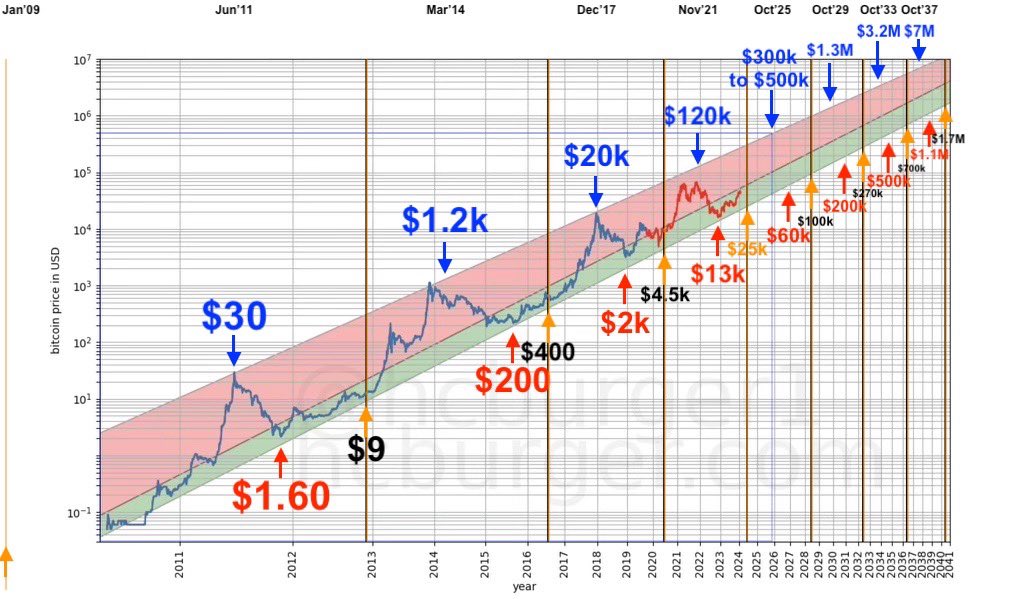
This right here left me speechless. If I ever go ALL IN on Bitcoin it will be because of the Power Law. Now I understand @saylor
Salute 🫡 @Giovann35084111
Zero growth in the money supply means that money becomes more valuable over time.
Let's say society has an average of 2% growth in productivity.
Then the money you save will be worth 2% more each year.
And let's say you manage to save a sum of money in year zero that is sufficient to sustain yourself for 15 days.
Due to the effect of positive compound interest, after 36 years your money will be enough to sustain yourself for 30 days.
In comparison, let's see what happens if you are forced to use money that inflates in a way that means that it's programmed to lose 2% of its value each year.
In the same way as in the first example, you save a sum of money in year zero that is sufficient to sustain yourself for 15 days.
Due to the effect of negative compound interest, after 36 years your money will be enough to sustain yourself for 7.5 days.
As we see, over 36 years, money that is programmed to lose 2% value each year robs you of 22.5 days, or 75% of the time you otherwise would have at your disposal, compared with money that has a supply fixed at zero percent growth per year.
National currencies are programmed to lose their value at 2% each year when compared with the way government tracks the price development of consumer goods and consumer services.
This typically allows governments to expand the money supply at 7% each year, meaning that national currencies lose about 7% of their value when measured against everything else.
The difference between monetary inflation and measured consumer price inflation should therefore be around 5% (7% - 2% = 5%).
#Bitcoin, on the other hand, has a fixed protocol that ensures that the increase in money supply is halved every four years.
Currently the annualized increase in the supply of new bitcoins, its monetary inflation, is 1.74%.
Around 19 April 2024, the supply of new bitcoin is cut in half, to 0.87%.
Let's for the sake of simplicity round it off to 1%.
If consumer price inflation is 5% less than monetary inflation, then you will have a consumer price DEflation after the halving of about 4% when measured in bitcoin, meaning that bitcoin increases in value at 4% per year.
If we revert to the example of being able to save enough money to sustain yourself for 15 days, and let's say that you save in bitcoin.
If we for the sake of simplicity says that the halving next year is the last one, an amount of bitcoin that in April 2024 is enough to sustain yourself for 15 days at that time, will be enough to sustain yourself for 60 days after 36 years.
As we see, over 36 years, money that is programmed to lose 2% value each year robs you of 52.5 days, or 87.5% of the time you would have at your disposal, with money that has a supply fixed growth at 1% growth per year.
If we factor in that the value of bitcoin increases as adoption of bitcoin increases, the effect becomes even more significant.
So, what's the message here?
The message is that it's the combination of basic knowledge about mathematics, basic knowledge about national currencies and basic knowledge about the Bitcoin protocol that drives bitcoin adoption, not speculation.