Tokyo’s new-condo headline just got extreme.
Average July launch price:
Tokyo 23 wards: ¥265.2 million
Greater Tokyo: ¥164.9 million
Both were record highs.
But the 96% YoY jump in the 23 wards was heavily influenced by major high-end projects launched during the month.
In today’s Tokyo market, the average increasingly reflects what gets supplied—not what the average household can afford.
While many global cities are still dealing with excess office space, Tokyo’s vacancy rate has dropped to 1.5%.
Strong return-to-office demand is tightening supply and supporting rents.
Tokyo offices are becoming a relative-strength story.
Tokyo property prices remain high. Rents are hitting records.
Yet Japanese real estate stocks are falling to year-to-date lows.
Why? Interest rates.
Higher yields raise financing costs and put pressure on real estate valuations—even when underlying assets remain strong.
Tokyo’s condo market is sending mixed signals.
Price momentum is slowing, but rents just reached a record high.
For investors, the story is gradually shifting from capital appreciation to rental fundamentals.
Japan’s policy message is shifting:
Not “keep prices low at all costs,” but raise wages faster than prices.
If that sticks, Japan’s real estate market will also change—away from a deflation/ultra-low-rate mindset toward a market driven by income growth, rents, productivity, and higher financing costs.
Japan is raising income requirements for highly skilled foreign professionals.
That may better reflect today’s wages—but Japan also faces a weaker yen and growing competition for international talent.
Raising the bar only works if Japan remains attractive enough for talent to come.
Tokyo’s definition of “affordable” is changing.
New small detached homes in the 23 wards now average ¥93.21 million, yet demand remains strong because they look relatively affordable compared with condos.
Japan’s housing affordability problem is moving into the middle class.
Yet housing support for middle-income households remains relatively limited, while many European countries make greater use of rent subsidies.
Rising housing costs may force Japan to rethink who housing policy is designed to support.
Housing affordability is becoming one of Japan’s biggest urban challenges.
In Tokyo, homeownership is increasingly out of reach for middle-income households, while renting is becoming less affordable as well.
The issue is no longer just rising prices—it’s access to housing.
Japan’s Flat 35 fixed mortgage rate has risen to 3.29%, the highest since the current system was introduced in 2017.
Higher financing costs are becoming another headwind for homebuyers, alongside elevated property prices.
Tokyo’s existing condo market isn’t collapsing—it’s maturing.
Transaction data suggests price growth has largely stalled in central Tokyo, while rents have also leveled off.
The next phase of the market will likely be driven by fundamentals rather than momentum.
Leasehold condominiums are moving into the mainstream in Japan.
As land prices continue to rise, more first-time buyers are accepting lower upfront costs in exchange for limited land rights.
Affordability is reshaping the meaning of homeownership.
Tokyo homeowners are increasingly choosing to sell rather than rent out their condominiums.
Rising resale prices are making capital gains more attractive than rental income.
In today’s market, appreciation is outperforming yield.
Japan’s youngest households now carry the highest debt among all age groups.
Rising home prices and ultra-long mortgages are making homeownership possible—but increasing long-term financial risk.
Affordability is being achieved by extending time, not lowering prices.
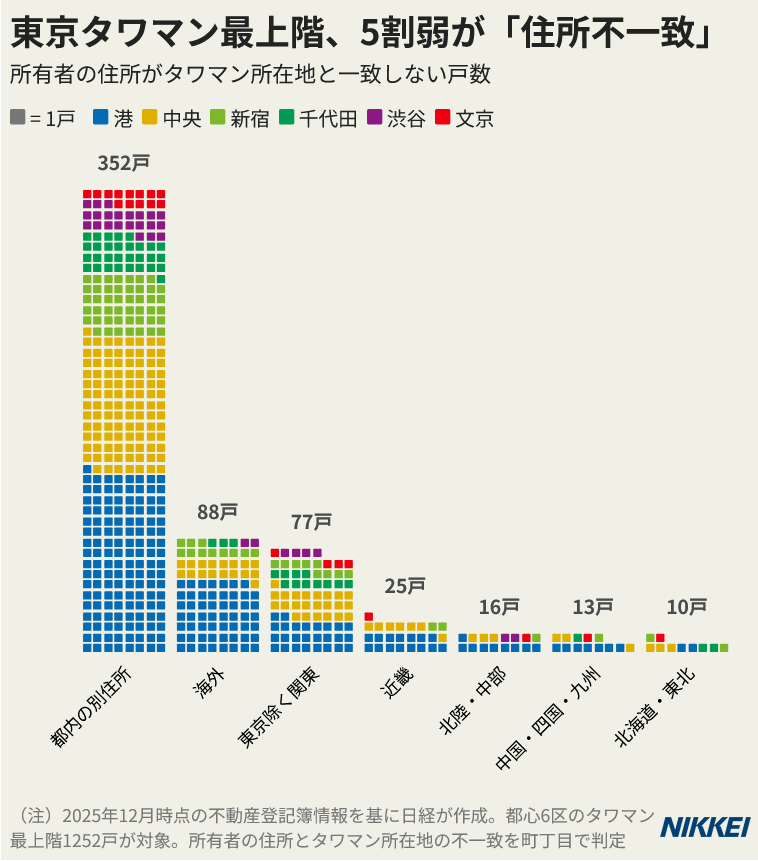
Nearly half of the top-floor units in central Tokyo and Osaka tower condominiums are not registered as the owner’s primary residence.
Luxury housing is increasingly serving as an investment asset rather than a place to live.
Housing affects more than affordability.
A Japanese study found that smaller homes and longer commutes are associated with a significantly higher risk of insomnia.
Urban housing policy is also public health policy.
Japan remains attractive to global capital—but the weak yen is becoming harder to ignore.
Goldman Sachs COO John Waldron calls it “probably the biggest risk” to Japan’s economy, even as M&A and higher interest rates create new investment opportunities.
Despite higher interest rates, central Tokyo land values continue to rise.
The driver isn’t speculation alone—it’s a shortage of high-quality office space meeting strong demand.