Special Issue Call for Papers: "Global Perspectives on Occupational Licensing: Data, Comparisons, and Consequences"
The main goal of this proposed special issue is to expand the literature on occupational licensing internationally.
💡Take a look at this!💡
How should ESG ratings be regulated?
New research shows pricing rules shape information quality, price floors can fix underinvestment, while caps address excess.
#ESG#Economics
Learn more by accessing “The industry costs and benefits of occupational licensing: measuring differences in establishment behavior and quality” - Journal of Regulatory Economics
https://t.co/Ib2ViwBP4y
💡Take a look at this!💡
Does occupational licensing improve quality?
New evidence shows it reduces firm entry and competition, but offers little to no quality gains, and sometimes lowers it.
#Economics#Regulation
Learn more by accessing “The impact of energy retailers’ loyalty programmes on the effectiveness of regulation of retail energy markets” - Journal of Regulatory Economics
https://t.co/CFp3g1OBjk
💡Take a look at this!💡
Better information doesn’t always mean better choices.
New research shows energy retailer loyalty programs can offset transparency policies by shifting consumer attention away from price and energy source.
#Economics#Energy
💡Take a look at this!💡
Cross-border rail pricing can be inefficient.
New research shows lack of coordination leads to higher prices, but cooperation and smart regulation can improve outcomes for both consumers and providers.
#Economics#Infrastructure
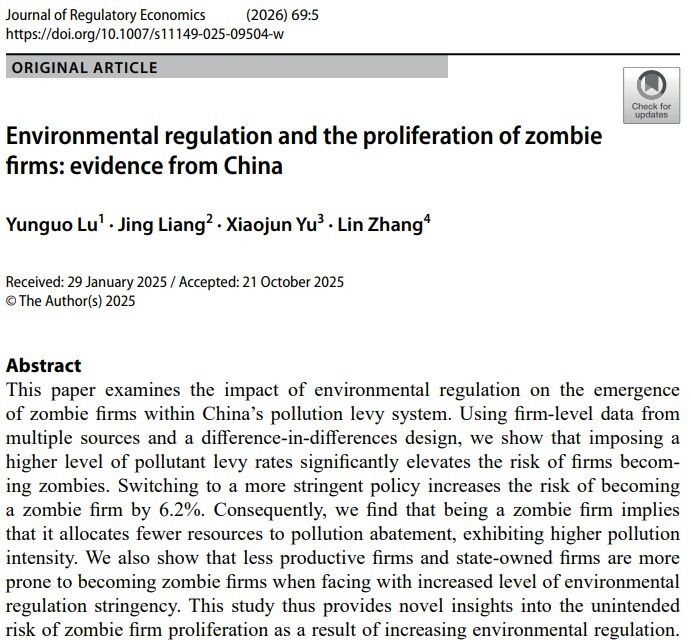
Learn more by accessing "Environmental regulation and the proliferation of zombie firms: evidence from China" - Journal of Regulatory Economics
https://t.co/IR47YPIzSs
💡Take a look at this!💡
Stricter environmental regulation can have unintended effects.
New evidence shows higher pollution levies increase “zombie firms”, which pollute more and invest less in cleanup.
#Sustainability#Economics
Learn more by accessing “Regulatory arbitrage and partitioned pricing: evidence from U.S. rail fuel surcharges” - Journal of Regulatory Economics
https://t.co/iHAcFF21tr
💡Take a look at this!💡
Fuel surcharges in rail appear to be formula-based, but aren’t.
New evidence shows firms charge more in less competitive markets, using pricing structures to exercise market power.
#Economics#Regulation
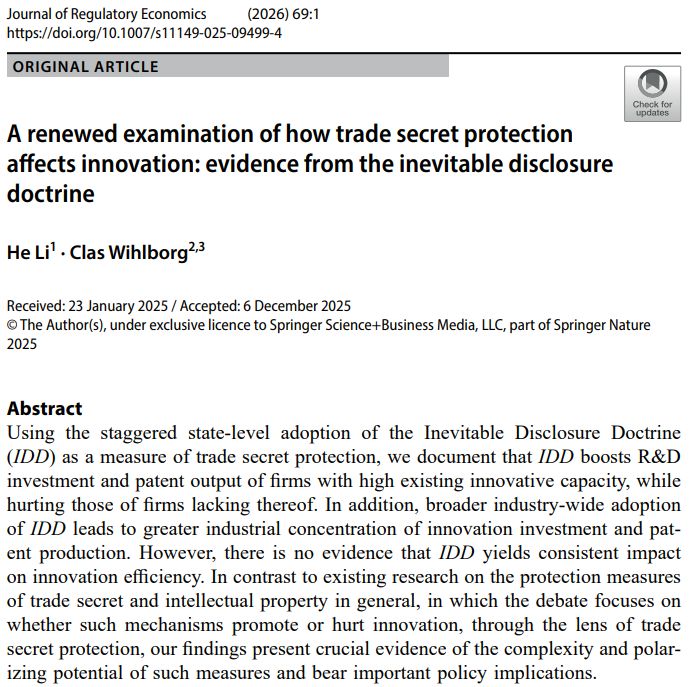
Learn more by accessing “A renewed examination of how trade secret protection affects innovation: evidence from the inevitable disclosure doctrine" - Journal of Regulatory Economics
https://t.co/PJ7kWf85tL
💡Take a look at this!💡
Trade secret protection boosts innovation—but only for already innovative firms.
New evidence shows it can reduce innovation for others and increase industry concentration.
#Innovation#IP#Economics
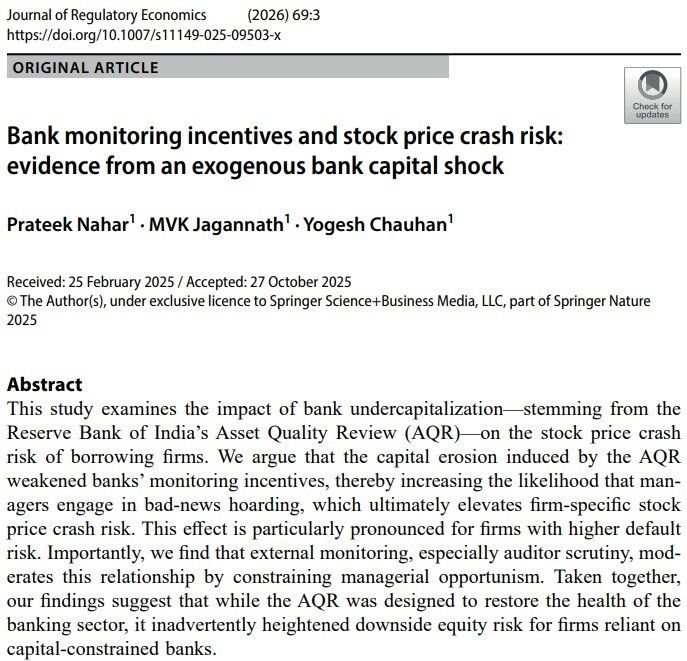
Learn more by accessing “Bank monitoring incentives and stock price crash risk: evidence from an exogenous bank capital shock” - Journal of Regulatory Economics
https://t.co/wKCcP71gT4
💡Take a look at this!💡
When banks lose capital, firms get riskier.
Evidence from India’s AQR shows weaker bank monitoring leads to more bad-news hoarding and higher stock price crash risk—especially for vulnerable firms.
#Banking#Risk#Economics
Learn more by accessing "“Regulatory quality and value-chain participation in regional comprehensive trade partnership (RCEP): evidence of nonlinear effects" - Journal of Regulatory Economics
https://t.co/N3B6QLTsJ2
Regulation doesn’t affect global value chains the same way for everyone.
This research shows benefits depend on the level of regulatory quality—too little or too much can both limit participation.
#Trade#GVC#Economics