Very interesting synthesis by @claudiashandi on Argentina:
- @JMilei has delivered a great deal of his program
- there are positive effects
- some very worrying problems persist
- the most radical promises are yet to be fulfilled
https://t.co/eYkJKUMOFy
Ohne Zentralbank gäbe es ständig Depressionen, sagt MMT-Ökonomin Pavlina Tcherneva. Ob man lieber Massenpleiten wolle?
@saifedean vergleicht das Fiatgeld mit einem Drogensüchtigen.
Quelle: The Bitcoin Standard Podcast #351 / Doha Debates
John Locke is one of the most influential classical liberal thinkers. The core of Locke’s classical liberalism is presented in the "Second Treatise of Government."
Here Locke laid out his famous doctrines of natural rights, property rights, the consensual creation of government, and the conditions under which individual and collective resistance to government is justified.
According to Locke, to understand the purpose, justification, and limits of political authority, we should inquire into the condition that people would find themselves in were all political authority absent.
Beyond the rights to life, limb, liberty, and property, individuals in the state of nature also possess rights to enforce the law of nature—to defend against violations of their rights and to enforce reparations and punish.
MMT has been deceiving you. Government deficits don't create money. That's what Steve Keen is finally coming round to agreeing with me.
See https://t.co/DbjiWncSUi
Or my book New Paradigm in Macroeconomics. Or my book Princes of the Yen, new only at www https://t.co/YD5eDeGYov
CLIMATE CHANGE IS A COMPLEX SYSTEM THAT BEHAVES LIKE A DOUBLE PENDULULM
Climitards only see earth's climate system behaving like a uniform system where oscillations follow the predictable changes of varying temperatures like the oscillations of single pendulum. But Climate change is far more complex with several independent factors causing unpredictable changes similar to the chaotic changes seen in a double pendulum.
"I used to love your magazine," I tell @SteveForbesCEO. "Now there are silly articles about the benefits of the minimum wage, how free trade hurts us..."
"We don't stamp out intellectual diversity," Forbes says.
Our full interview:
@EvonomicsMag As I explained to Michael Liebowitz @Lieboisout, a thorough reading of Adam Smith's work compels the conclusion that, far from being the "Father" of capitalist economics, Smith was capitalism's DRUNKEN UNCLE (link). https://t.co/KhrfGUcTsG
"We want to be transparent where we are but we also want people to understand that we're not sitting back and accepting where things stand."
Hear from #Canucks Co-Presidents Henrik & Daniel Sedin from this morning's press conference.
WATCH FULL | https://t.co/evXimhcXqv
"Socialism is the bedtime story that envy tells itself."--the oh-so-articulate Adam MacLeod, Catholic U law professor. Prof MacLeod gave the second annual Edith Hollan Jones Lecture at Coolidge House tonight. He defended property rights. Congratulations, Professor!
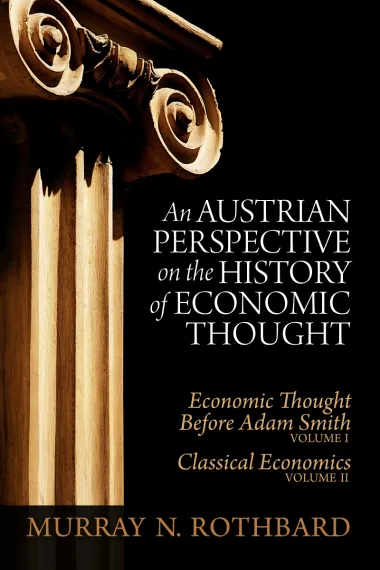
Murray Rothbard spent two volumes and over 1,500 pages doing what mainstream economics departments refuse to do: tracing the intellectual lineage of economic thought without flattering the victors.
The result, published posthumously in 1995, is the most thorough and unapologetic history of economic ideas ever written. Rothbard tears into the standard narrative that economics began with Adam Smith and improved steadily until John Maynard Keynes saved civilization. That story is mythology.
The Scholastic thinkers of 14th and 15th century Spain, particularly the School of Salamanca, worked out subjective value theory, the nature of price, and the basics of sound money centuries before Smith touched a quill. Juan de Mariana, writing in 1609, condemned currency debasement as theft by the Crown. He was right then. Governments still do it, and you still pay for it every time your grocery bill climbs faster than your wages.
Smith himself takes serious damage in Rothbard's account. Rather than a heroic founder, Smith appears as a step backward in certain respects, introducing the labor theory of value and muddying the subjective insights his predecessors had already clarified. Ricardo hardened that confusion into doctrine, and Marx ran with it to its logical and catastrophic endpoint.
The rehabilitation extends to figures the mainstream barely mentions. Richard Cantillon, writing around 1730, produced a more sophisticated monetary analysis than most 20th-century textbooks contain. He traced how new money enters an economy at specific points, enriching those closest to the source before prices rise across the board. The Cantillon effect explains why quantitative easing fattened Wall Street balance sheets while your purchasing power shrank after 2008 and again after the Federal Reserve's 2020 and 2021 interventions.
Rothbard also prosecutes the myth of Adam Smith's originality. The "invisible hand" gets far less analytical weight in the actual Wealth of Nations than the metaphor's fame implies. Rothbard shows that the core insights attributed to Smith circulated widely in France and Spain decades earlier. Credit went to Smith partly because he wrote in English and partly because intellectual history rewards bold synthesizers over quiet pioneers.
Rothbard treats the history of thought as a battleground where good ideas can lose and bad ideas can dominate for a century before collapsing under their own contradictions. Mercantilism dominated European policy for 200 years despite being wrong in its basic premises about wealth. Keynesianism captured every major finance ministry by 1970 and produced a decade of stagflation that the model said was impossible.
Rothbard's history should be viewed as a warning about which bad ideas are dominating right now.
Veterans Day grew out of the relief that a devastating war was finally over. Today, politicians use it to praise the kind of sacrifice they continue to demand in wars that do not need to be fought. | @connorokeeffe
https://t.co/dL1dG7V9II
This week's podcast episode is my full @DohaDebates on the nature of money with two MMT economists, @jasonhickel and @ptcherneva. This was a good one you don't want to miss!