The woman at the door told me to bring nothing, and I trained for eleven hours.
It started with a phone call. A warm American voice asked me to dinner. I gripped the receiver like a sword.
"What may I bring?"
"Nothing! Just bring yourself."
I stopped breathing. In my homeland, a guest who arrives empty-handed insults eight hundred years of dead grandfathers. She had forbidden gifts. So she wanted the BEST self.
I did not sleep. I prepared.
I shaved with a blade older than her nation. I memorized forty facts about the local sports team. I cut my toenails like a man going to war.
I arrived perfected. Hands empty. Heart loud.
She opened the door, looked at my empty hands, and smiled.
"Oh, you did not have to dress up!"
Did not have to. I had trained for ELEVEN HOURS. I bowed and said it was my honor. She told me to relax, honey.
Relax. Another command. I sat with my back straight as a spear.
I complimented the lamp. I told her husband his handshake had the grip of a general. I ate three plates so my joy could not be doubted. When she offered more, I said a warrior does not refuse a host's mountain.
She blinked. "It is just casserole, hon."
I nearly wept. These people build a feast and call it nothing. They demand your whole self and call it relaxing.
She packed the leftovers and pressed them into my empty hands. Then her neighbor arrived with wine and pie, casual. They meant yourself tonight, not nothing forever.
I came with nothing. I left with treasure. I still over-prepare when someone says just come, in case the self they want is the best one.
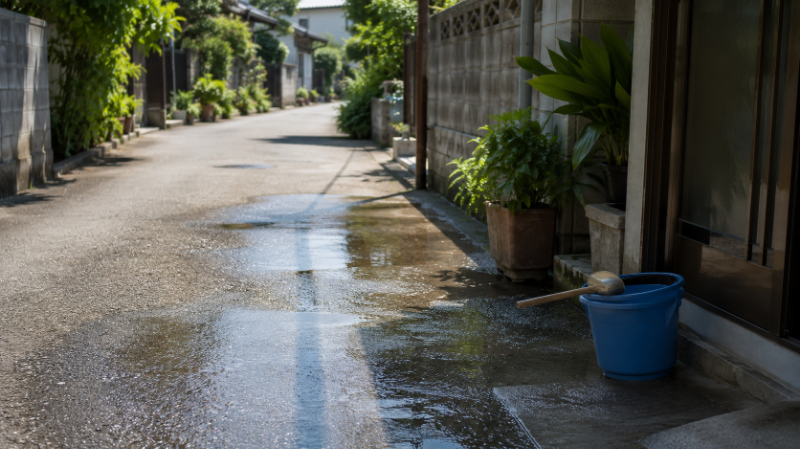
In Japan,
some people water the street
as if the road itself is tired.
Real Daily Life in Japan #33
Uchimizu in Japan.
A small bucket.
Water on the ground.
Dark wet patches on hot pavement.
Evening light.
A quiet street after a long summer day.
It does not defeat the heat.
It never could.
But for a moment,
the air feels different.
Before machines cooled every room,
people found small ways
to live with summer.
A wind chime by the window.
A bamboo shade over the light.
Water sprinkled on the ground.
Not to conquer nature.
But to ask it, gently,
to become a little softer.
For many Japanese people,
uchimizu is not just water on pavement.
It is an old summer habit
that says something very Japanese.
We do not always try to win against the season.
Sometimes,
we simply make room
to live with it.
Uchimizu(打ち水) = sprinkling water to cool the ground 🌸
🇯🇵 I love seeing scenes of Harajuku in the late 90s. Despite all of the pedestrian traffic and noise, the atmosphere just feels completely different from now in a real indescribable way.
The final boss of ADHD in the ocean. This tiny pufferfish spends an entire week flapping its fins to create a perfect seven-foot mandala in the sand, then decorates it with shells—all to impress a single female that may or may not swim by.
Japan used to have a ton of overnight sleeper trains.
Hokutosei.
Twilight Express.
Cassiopeia.
Names like luxury hotels on wheels.
Bullet trains killed them off, one by one.
Too slow, not enough seats, no point sleeping through a 3 hour trip.
By 2016 there was exactly one left.
The Sunrise Express.
Leaves Tokyo at 9:26pm.
You walk into a tiny private room.
Bed, desk, a door that locks with a keypad.
No dining car. No food cart either.
People just bring their own dinner and eat it watching Osaka go by around 1am.
953.6 km later, the door opens and you're in Izumo.
This is where Japan's oldest shrine sits. Izumo Taisha. Nobody actually knows when it was built. The records go back too far.
Once a year, around November, legend says most of the gods in Japan pack up and head to Izumo.
They spend a week there deciding who's going to fall in love with who.
You get off an overnight train and walk straight into that.
Tickets drop exactly one month before departure, 10am sharp. Good dates are gone in minutes.
One train. Every single night.
The last sleeper car left in a country full of bullet trains, and it ends at a shrine older than recorded history.
Skip the rooftop bars.
One of Tokyo’s best seasonal drinking spots is on a mountain just 50 minutes from Shinjuku.
Most people think of Tokyo as skyscrapers and neon lights.
But one of my favorite ways to unwind is leaving the city behind for an early evening hike and a cold beer with a view.
Just 50 minutes from Shinjuku, you’ll find Mount Takao.
Around 3 million people visit every year, making it one of the world’s most popular hiking destinations.
Think: forest trails, sunset views, and a beer on top of a mountain.
↓
All the Shinkansen from Tokyo to Osaka are on hold after a person was hit by the bullet train at Hamamatsu station.
Only the second fatality on Shinkansen tracks since its inception in 1964.
First was in 2022 near Toyohashi station
Imagine being able to make stone translucent.
Giovanni Strazza possessed that extraordinarily rare skill. His bust of the Virgin Mary, executed in flawless Carrara marble, is one of the most impressive feats by any sculptor.
Strazza's "wet drapery" technique continued the legacy of previous Italian sculptors like Giuseppe Sanmartino, who produced mind-bending veils from marble a century earlier — the famous "Veiled Christ" is a canonical example.
The tradition also dates back to much earlier sculptors known for carving intricate folds, in particular Renaissance artists like Michelangelo and ancient masters from Greece's Hellenistic period.
But in the mid-19th century, Strazza took the technique to its extreme. The subtle layered effect he achieved allows the viewer to easily discern Mary's facial features from the delicate veil, and at the same time creates the illusion of total weightlessness.
How he created something so soft and fluid from solid stone, using only basic hand tools, is a mystery.