Early this year, there was a lot of optimism in the market.
Then the war with Iran started, and a lot of that momentum stalled.
People held steady for longer than anyone expected. Now a lot of them are waiting until after the midterms. We see this in election years. Everybody takes a wait-and-see approach, and then things start moving once the dust settles.
I get it. But I don’t necessarily agree with it.
There’s always going to be a next event to wait out. If you wait for the calendar to clear every time, you’re usually the last one back in.
Look at the top 1% of earners in the U.S., and a huge portion of their portfolios is in real estate.
You see it in the headlines too. Actors and athletes are always buying houses. A lot of them end up selling for less than they paid, which is obviously not a good investment.
But it shows you how much real estate people own.
I’m not saying the stock market has no place. It does. I still place trades myself.
But real estate is a great complement to a portfolio, and the people with the most money tend to hold a lot of it.
I didn't know what I wanted to do after college.
What I DID know is that a few classes got me interested in finance.
That was enough to get me started. I took a job at a mortgage company right after graduation, and that was the start of my career in financial services.
I've been in that world ever since. The titles changed. The interest never did.
You don't always need a plan. Sometimes you just follow what keeps you curious.
Ancillary markets are getting a lot more attention right now.
Major metros are saturated. Too much new supply, too many buyers chasing the same deals, and prices that already reflect all of it.
Outside of big cities, there's more opportunity and more value. Markets most investors skip because they're a little far, or the margins don't look as flashy on paper.
That's where we're spending our time. South Texas, including the Valley, is a big part of it.
Some strategies simply don't work in a place like Austin. It's too expensive. In a market where nobody else is looking, the demand is real and the competition isn't there yet.
When the crowded markets stop working, go where the crowd isn't.
Right now, I'd pass on most multifamily. There's just too much supply.
A buddy of mine at a title company has seen his transaction volume drop hard, and a lot of people are still waiting on distressed deals.
Before I say yes to any deal, I'm looking at a few things.
1. Location. In the big metros, land is so expensive that a lot of developers are just holding steady.
2. The entry point. You really make your money when you buy the land, so I want to know the operator isn't overpaying for it.
3. Operator history. Who's running it and what they've actually done.
4. The competition. How many similar projects are nearby, and can the area sustain the rents?
If the answers aren't clear, I pass.
My first job out of high school was two weeks on a loading dock at a mattress company. Short-lived, but a real job.
From there it was Blue Bell, then a mortgage company fresh out of college, then oil and gas, then USAA, then Schwab, then a handful of real estate firms before J-19.
A lot of jobs. A lot of different industries.
Each one taught me something unique. The mattress dock and Blue Bell taught me what hard, physical work actually feels like. Oil and gas taught me how to underwrite risk. The licensing years taught me the financial side inside and out.
None of them felt connected at the time. Looking back, every one of them built a piece of what I do now.
I guess the point is, you don't need one job to make sense of your whole career. You just need enough of them to figure out what actually sticks.
I get pitched deals constantly. I pass on most of them.
They're not bad necessarily. A lot of them are run by good people doing solid work. It's just not always the right fit.
Every operator has a lane they understand at a level that creates real conviction, not just interest. Chasing something outside that lane because the numbers look attractive is how good operators end up making bad decisions.
I'd rather say no to a decent deal than yes to something I can't fully stand behind.
That discipline is probably the most unglamorous part of this job.
Saying no is a skill. Nobody teaches it, but everybody needs it.
"Credit invisible" sounds like a red flag. It's usually not.
It just means someone doesn't have enough traditional credit history on file for a bank to feel comfortable approving them. No credit cards, no auto loan, no mortgage history. Not necessarily bad credit. Just not enough data points for the system to recognize.
Plenty of people in this category pay every bill on time, every month, without exception. They just haven't built the kind of paper trail a traditional lender wants to see.
It's a gap in the system, not a reflection of the person.
We like to look at payment history instead. If someone's proven they pay on time, that tells us more than a credit score ever could.
The best piece of advice I've ever gotten: know your identity.
For me, that means knowing my identity is rooted in my faith first.
Not my job title or how the fund performs this quarter or what anyone else thinks success should look like.
That might sound disconnected from running an investment fund, but it's actually the opposite. When you know who you are outside of the work, the work stops carrying all this extra weight.
A bad week doesn't threaten who you are.
A good one doesn't define it either.
Everything else, how I treat investors, how I handle a hard conversation, how I show up on a rough day, runs through that first.
When an investor already understands the product, there's almost nothing to sell.
I've had a few conversations like this. The investor already knows the space, understands the structure, has usually been looking at something similar elsewhere. There's no convincing involved.
Just confirming the details line up with what they're looking for.
Compare that to someone starting from scratch, where most of the conversation is education before you ever get to the actual opportunity.
The education piece matters. It's most of the job, honestly.
But when someone walks in already fluent, the conversation moves fast, and it's usually a sign they're going to be a good long-term investor.
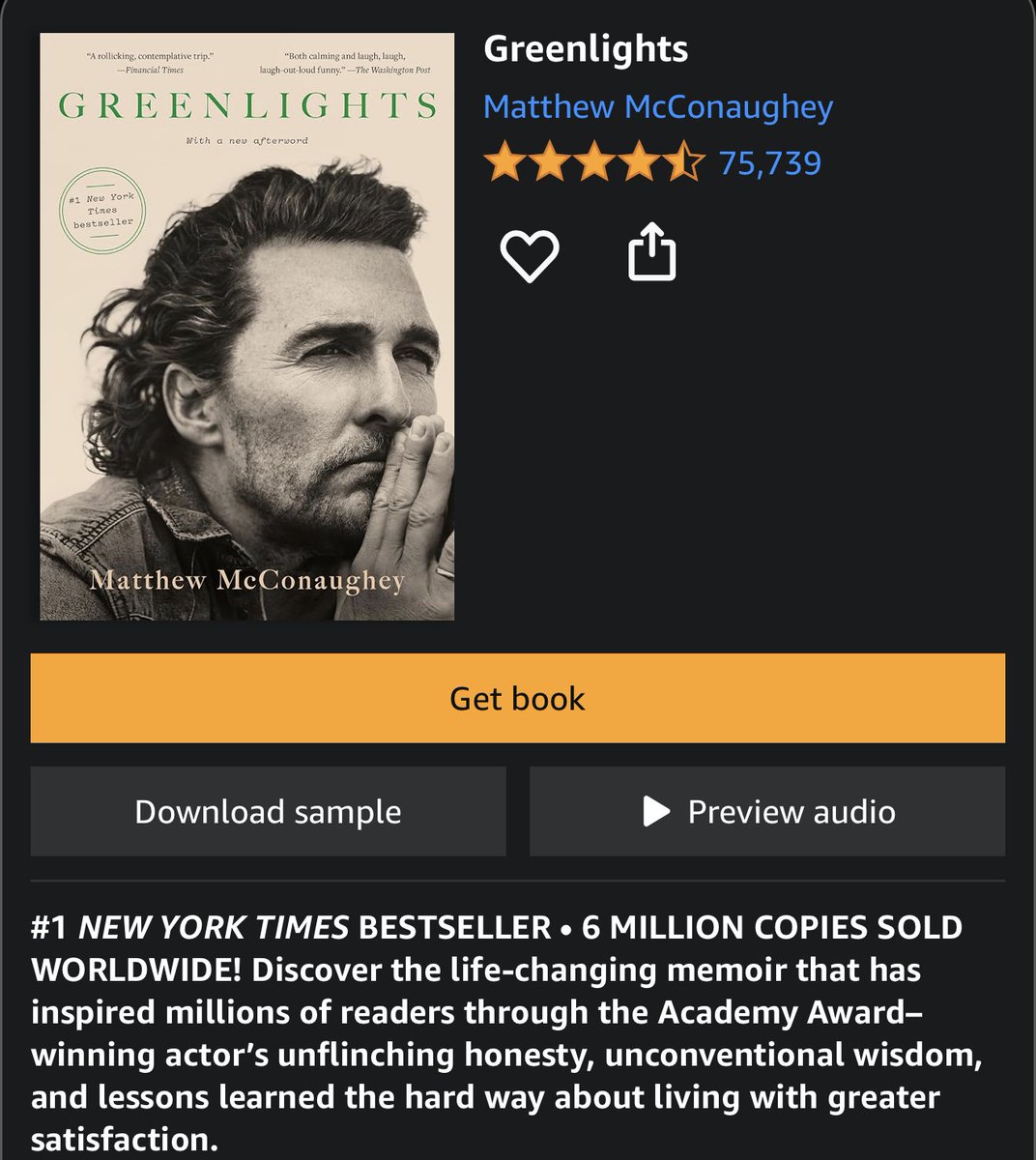
Recently finished up Green Lights, Matthew McConaughey's memoir. Anyone read it?
I don't have time to sit down and read most days, so this one was an audiobook, like most of what I get through.
Worth adding to the list if you're looking for something outside of business and finance.
I have to actively stop myself from over-explaining real estate.
I could talk IRR calculations, tax structuring, capital stack mechanics for an hour if you let me. Some of that stuff genuinely interests me.
But most people don't need the mechanics. They need to know one thing: is this going to pay me, and can I trust the person telling me that.
Every time I catch myself going too deep into the weeds, I have to pull back and ask what actually matters to the person in front of me.
The reality is, I'd rather be understood than sound impressive.
Persistence wins more deals than talent ever will.
I've met plenty of talented people in this business who never made it very far. And I've watched people with no obvious edge outwork everyone around them until they did.
Talent gets you in the room. It doesn't keep you there.
The people who actually make it are the ones willing to grind through the years nobody's watching, before anything is working the way they hoped.
That's the real skill. Not being the smartest person in the deal. Being the one who's still standing after everyone else gave up.
My kids ask me the same question almost every day after work. "Did you close any deals today?"
I actually love it. (Even if the answer's no)
What gets me is that they're asking at all. As they've gotten older, they've started actually caring about what I do.
It's a small thing, but it's made me think more about financial literacy at home. If they're curious enough to ask, I owe them more than a one-word answer.
I want them to actually understand what I do.
Q3 into Q4 is when things actually start moving.
A lot of people push to get deals done before year end. Tax reasons, business reasons, just wanting to close the book on the year with something to show for it.
We see it with our commercial broker relationships too. Things pick up every year around this time. I don't fully know why, but it's consistent. Q4 to close things out, then Q1 hits with everybody starting fresh.
This year it's been a little slower than usual. More people sitting on the sidelines longer than expected. But there's still more movement than earlier in the year.
If you've been waiting all year to make a move, this is usually when the market gives you a reason to stop waiting.
https://t.co/xfVylIsAjn
Developing from scratch means betting on what a property MIGHT become. Buying a producing asset means betting on what it already is.
We buy assets that are already generating income, day one.
When you develop, you're exposed to construction delays, cost overruns, and the years it takes before anything even starts paying you back.
When you buy something already producing, income starts immediately. No guessing what the finished product will look like. No hoping the market cooperates by the time you're done building.
"Pay me now" beats "pay me eventually, if it works out".
Every year, something happens that scares people back onto the sidelines.
COVID, rate hikes, the Iran conflict. It seems like almost every year for the last five, there's been some kind of event that rattles people right when momentum starts building.
People hate uncertainty. So they park their money in T-bills, money markets, wherever feels safe, and wait for things to calm down.
The best investors aren't waiting.
While everyone else parks their capital on the sidelines, they're the ones still moving. Still doing the diligence and finding the deals that make sense regardless of what the headlines say that week.
Uncertainty will always be there it just changes shape every year. The people who wait for it to disappear completely are going to be waiting a long time.
Toilets. Tenants. Trash. That's what finally burns most self-managing landlords out.
You're running your own business. Most days, that's already a full-time job by itself.
I've talked to a lot of people in this position who also have money sitting in real estate they manage themselves. Rentals, their own development projects, that kind of thing.
At some point, they hit a wall. Not because the real estate stopped working. Because they stopped having the time or energy to run it themselves.
That's usually when they come to us. Same asset class they already believe in. Just passive instead of active.
You don't have to choose between running your business and having your money work for you.
You just have to stop trying to do both jobs yourself.
An investor showed me his portfolio statement the last time we met. Something about it stuck with me.
He's done well for himself. A real mix, equities, fixed income, alternative investments. All balanced, adjusted as the market shifts.
He's about $7M deep, and it's constructed well.
What stood out was the balance. He wasn't all in on one thing, chasing whatever looked hottest that year. He had a little of everything, weighted toward what actually made sense for him.
A well-built portfolio is about having enough pieces that no single one has to carry the whole thing.
Funds have a reputation of paying quarterly. We pay monthly.
I'm not mad about a quarterly check but it's also not at the front of my mind. It doesn't excite me.
A monthly distribution stays in front of you. It's on repeat. You see it hit, every single month, and it becomes part of the rhythm of how you think about your money working for you.
It's a small structural choice, but it changes how connected an investor feels to their own capital. Out of sight isn't what we're going for.