New paper!📰
This study details two computational methods leveraging commercial video analysis data that have been central for:
- Synchronise HAEs to video footage
- Quantify HAE risk from rugby match events
- Rapidly generate iMG reports for teams
📉How can we reduce HAE exposure in rugby league and rugby union?
❓Why is probability so much higher in rugby union?
📈How can we monitor and manage players with elevated HAE exposure?
https://t.co/8W3YV8cgfj
✏️New paper!
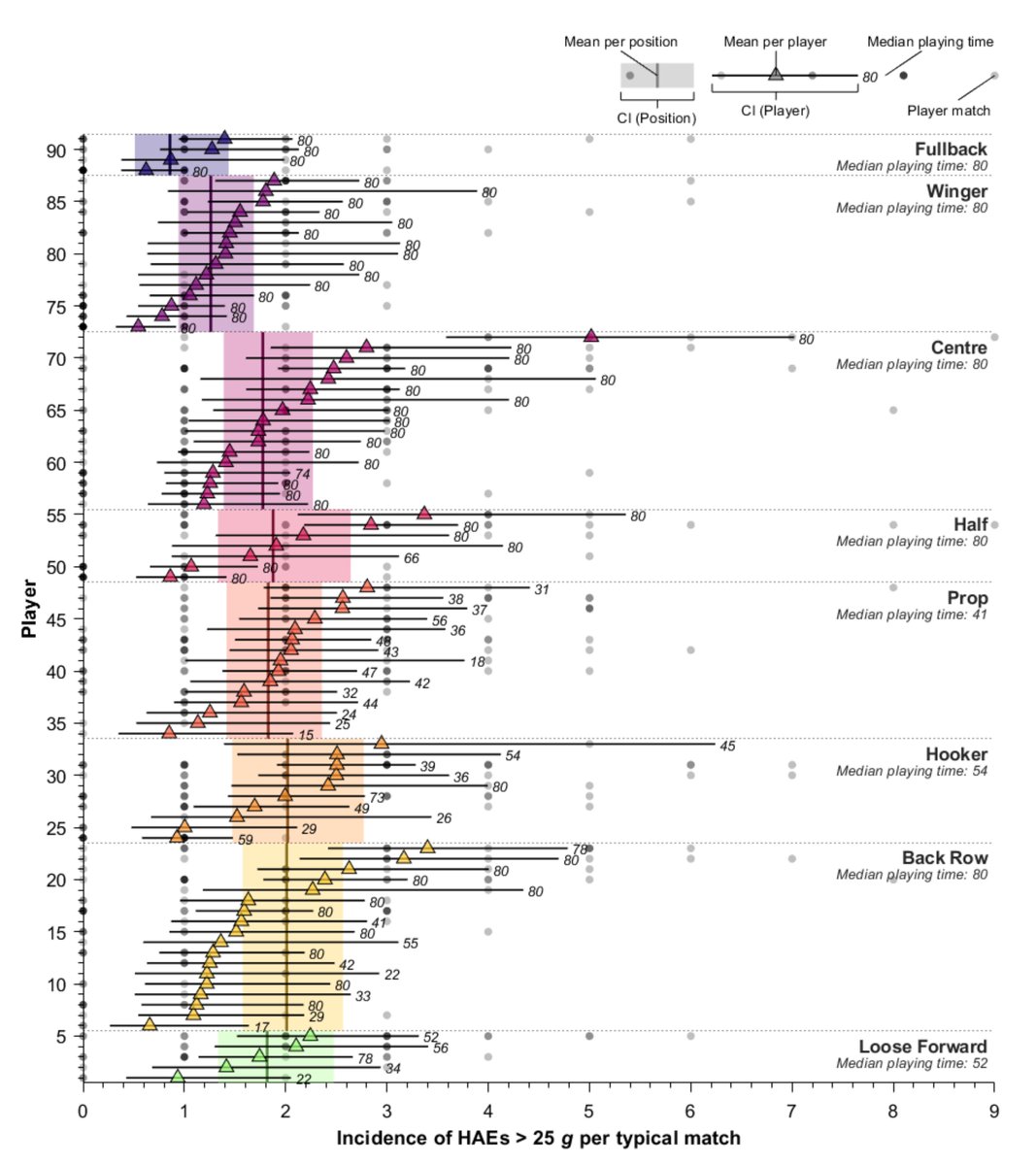
Head acceleration event (HAE) exposure in professional men’s rugby league:
📉Fewer HAEs per player match in rugby league compared to union
📉HAEs less likely in rugby league tackles compared to union
📈Individuals with elevated HAE values
🔓https://t.co/8W3YV8cgfj
Despite these lower findings on average, some players exhibit elevated values
🧠If these are persisted over multiple matches and seasons, these players may be at an increased risk of neurological effects
@SmilerTurner Hi Gary! Sort of - it shows two faster/more efficient methods for something that previously was very time consuming and costly. Now we can estimate the probability of match events (e.g., tackles/carries/rucks) of resulting in a recorded HAE rapidly!
New paper!📰
This study details two computational methods leveraging commercial video analysis data that have been central for:
- Synchronise HAEs to video footage
- Quantify HAE risk from rugby match events
- Rapidly generate iMG reports for teams
New paper!📰
This study details two computational methods leveraging commercial video analysis data that have been central for:
- Synchronise HAEs to video footage
- Quantify HAE risk from rugby match events
- Rapidly generate iMG reports for teams
It is important to note that these methods rely on the availability of a dataset of video-coded match events, however, they have also been effective with another dataset since this paper was written!
These methods continue to be used in rugby research and practice, and may also be implemented in different sports. All source code is available in the Supplementary Materials of the paper!
Post-synchronisation event matching (catchy, I know!) simply aligns each SAE to the coded match event which we think caused it, based on their newly aligned timestamps. For example, if we have a dataset of coded rugby tackles, we can identify which one caused each SAE.
Cross-correlation synchronisation takes a dataset of potential head impacts (PHI) and a dataset of sensor acceleration events (SAEs) to determine the synchronisation point that aligns the most together. This allows us to identify the SAEs in video footage.
📢New paper by @xianghao_zhan et al.!
We used an AI model to eliminate some of the noise measured by instrumented mouthguards: "peak kinematics after denoising were more accurate"
Such models will help improve the quality of our head impact datasets! 👀
https://t.co/x3eV2Mg6E9
@EnoraLeFlao Definitely an interesting predicament! I lean towards giving the video analyst as much info as possible to make their decision. Not just for video verification but also for analysing/labelling causes of HAEs. Could be good to jump on a call to discuss this and other research?
@SmilerTurner Ideally all HAEs would be filtered with > 200 Hz filters, but due to noise in the signal of some HAEs (~5%), we need to use lower cut off frequencies to avoid really high, erroneous magnitudes from being reported from noise
New current opinion piece📝
https://t.co/RbLcwcqmUf🔓
With the growing use of iMGs across sports, this piece explores the technical constraints of the devices for measuring head acceleration events and considerations for the interpretation of iMG data...
[1/13]
@SmilerTurner Sorry no, let me try an explain differently. Let’s imagine a 20g head acceleration occurs. The peak magnitude without filtering might be 30g, ~20g with a 200Hz filter, ~15g with 100 Hz, and ~10g Hz filter…




![JToobyResearch's tweet photo. New current opinion piece📝
https://t.co/RbLcwcqmUf🔓
With the growing use of iMGs across sports, this piece explores the technical constraints of the devices for measuring head acceleration events and considerations for the interpretation of iMG data...
[1/13] https://t.co/HUfImKKeWG](https://pbs.twimg.com/media/GIYefNvWMAATD1n.png)





