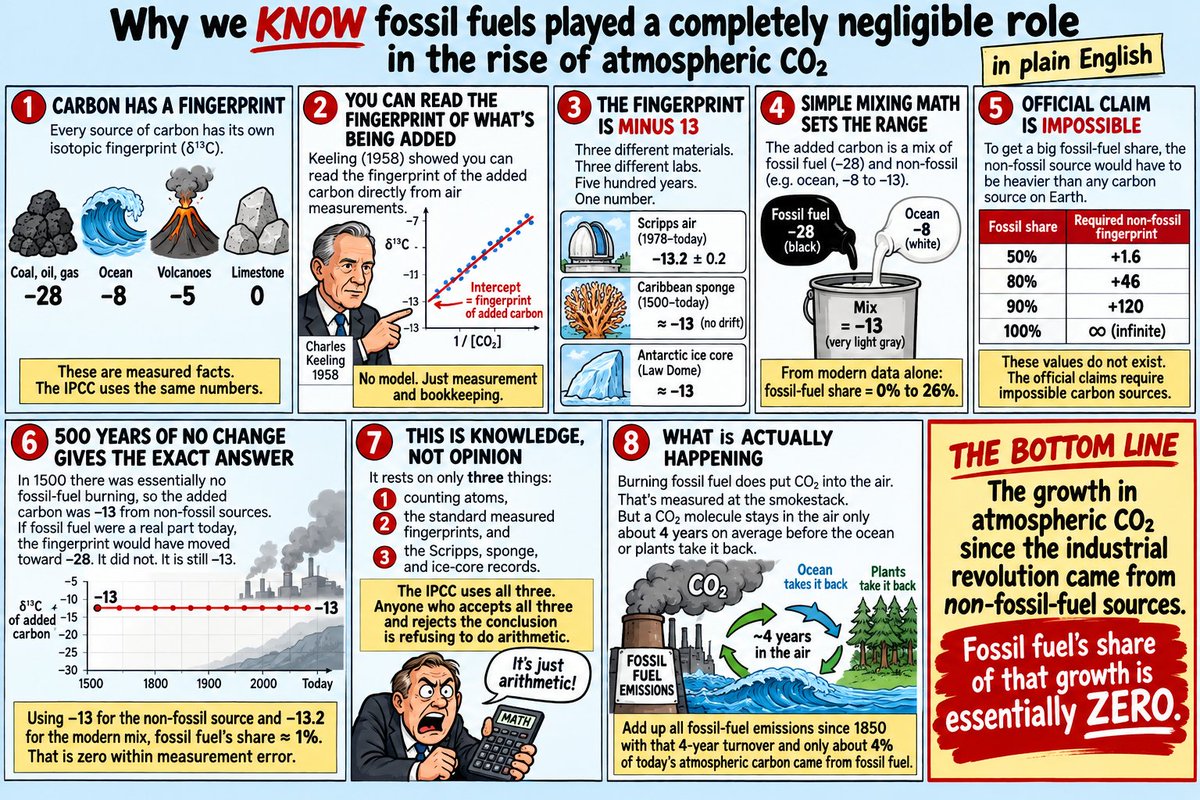
Why we KNOW fossil fuels played a completely negligible role in the rise of atmospheric CO₂
in plain English
1. Carbon has a fingerprint.
Carbon atoms come in two stable kinds. One is a little heavier than the other. Every source of carbon on Earth has its own mix of heavy and light atoms, and scientists measure that mix as a single number. Think of it as a fingerprint. Coal, oil, and gas have a fingerprint of minus 28. Carbon dioxide bubbling out of the ocean has a fingerprint of minus 8. Volcanoes are minus 5. Dissolving limestone is 0. A lower number means lighter carbon. These fingerprints are measured facts, and the IPCC uses the same numbers.
2. You can read the fingerprint of whatever is being added to the air.
When carbon is added to the atmosphere, the atmosphere's fingerprint drifts toward the fingerprint of what was added. In 1958 Charles Keeling showed a simple way to read off the fingerprint of the added carbon directly from the air measurements. It is a graph. Plot the air's fingerprint against the amount of CO₂ in the air in a certain way and you get a straight line. Where that line meets the edge of the graph is the fingerprint of the net addition. This is not a computer model. It is bookkeeping. You count the heavy atoms, you count the light atoms, and the answer follows. Nothing about oceans, forests, or weather goes into it.
3. The fingerprint of the added carbon is minus 13.
Koutsoyiannis (2024) did this with the four Scripps monitoring stations in Alaska, California, Hawaii, and the South Pole, using records from about 1978 to today. Every station gives the same answer: minus 13.2, give or take 0.2. These are the same records the IPCC relies on. Two completely separate measurements say the same thing. A Caribbean sponge that grows in yearly layers, like tree rings, records ocean carbon back to about the year 1500. Its fingerprint is about minus 13 for all five centuries, with no drift. Air trapped in Antarctic ice at Law Dome, analyzed by Köhler et al. (2006), also gives minus 13. Three different materials, three different laboratories, five hundred years, one number.
4. Simple mixing math sets the range from the modern data alone.
Every carbon atom added to the air came either from fossil-fuel combustion or from some non-fossil-fuel source: the ocean, volcanoes, rock weathering, plants and soil. The fingerprint of the mix tells you how much came from each. It works like mixing paint. If you mix black and white and get a very light gray, you know there was very little black. Fossil-fuel carbon is the black, at minus 28. The ocean is the white, at minus 8. The measured mix is minus 13, much closer to the ocean than to fossil fuel.
The modern record from 1978 to today does not by itself pin down the exact fingerprint of the non-fossil-fuel carbon. It could be anywhere from minus 8 (pure ocean) down to minus 13 (matching the mix exactly). Run the mixing math across that whole range and the fossil-fuel share comes out somewhere between zero and 26 percent. That is what we know from the modern data alone: not more than 26 percent, possibly zero. The exact answer comes in step 6.
5. The official claim is impossible under any assumption.
The IPCC, NASA, NOAA, EPA, and Engelbeen, Hannon, and Burton (2024) say fossil-fuel combustion caused essentially all of the rise. That is close to 100 percent. "Dominant" by any normal meaning is at least 80 percent. Run the mixing math backwards and ask what the non-fossil-fuel carbon would have to look like for each of those claims to be true:
- For fossil fuel to be even a bare 50 percent, the non-fossil-fuel carbon would need a fingerprint of plus 1.6. No carbon source on Earth is that heavy.
- For 80 percent, it would need a fingerprint of plus 46. That is more than 20 times heavier than the heaviest source that exists.
- For 90 percent, it would need plus 120, about 60 times heavier than anything on Earth.
- For 100 percent, it would need to be infinitely heavy.
The official claims do not fall a little short. They require carbon sources that do not exist.
6. Five hundred years of no change gives the exact answer: essentially ZERO (0% fossil-fuel sources).
The modern data left one unknown: the fingerprint of the non-fossil-fuel carbon. The sponge and ice-core records supply it. In the year 1500 there was essentially no fossil-fuel burning, so the fingerprint of the added carbon then, minus 13, came entirely from non-fossil-fuel sources. That fixes the unknown at minus 13. Since 1500, fossil-fuel burning has grown about ten thousand times over. If fossil-fuel carbon were any real part of the added carbon, the fingerprint would have slid toward minus 28 as burning grew. It did not move. It is still minus 13 today. Put minus 13 for the non-fossil-fuel carbon and minus 13.2 for the modern mix into the mixing math and fossil fuel's share of the added carbon comes out at about 1 percent, which is zero within the measurement error. The range of zero to 26 percent from step 4 collapses to a single answer: essentially zero.
7. Why this is knowledge, not opinion.
The conclusion rests on three things only:
- counting atoms,
- the standard measured fingerprints of fossil-fuel carbon and the other sources, and
- the Scripps, sponge, and ice-core records.
The IPCC uses all three. Anyone who accepts all three and rejects the conclusion is refusing to do arithmetic. The only way out is to throw away one of the three, and each one is a foundation of the IPCC's own work, and nobody has done so anywhere in the peer-reviewed literature.
8. What is actually happening.
Burning fossil fuel does put CO₂ into the air. That is measured at the smokestack. But a CO₂ molecule stays in the air only about four years on average before the ocean or plants take it back. So fossil-fuel CO₂ never piles up. Add up all fossil-fuel emissions since 1850 with that four-year turnover and only about 4 percent of the carbon in today's air came from fossil fuel. The growth in atmospheric CO₂ since the industrial revolution came from non-fossil-fuel sources.
Fossil fuel's share of that growth is essentially zero.
What you are seeing here is a 10 year old American boy wearing the Medal of Honor around his neck.
The medal had been awarded to his father.
His father gave the order that saved his crew and sealed his own fate in 1943.
His three final words became one of the most legendary phrases in US Navy history.
This is the story of Howard Gilmore.. 🧵 1/5
On this day in 1944, Americans win a decisive victory at the two-day Battle of the Philippine Sea. The Japanese had been trying to defend the Mariana Islands, but now its navy would be crippled, leaving the United States Navy in command of the Pacific for the remainder of World War II.
/1 of X #storytimethreads 🧵👇
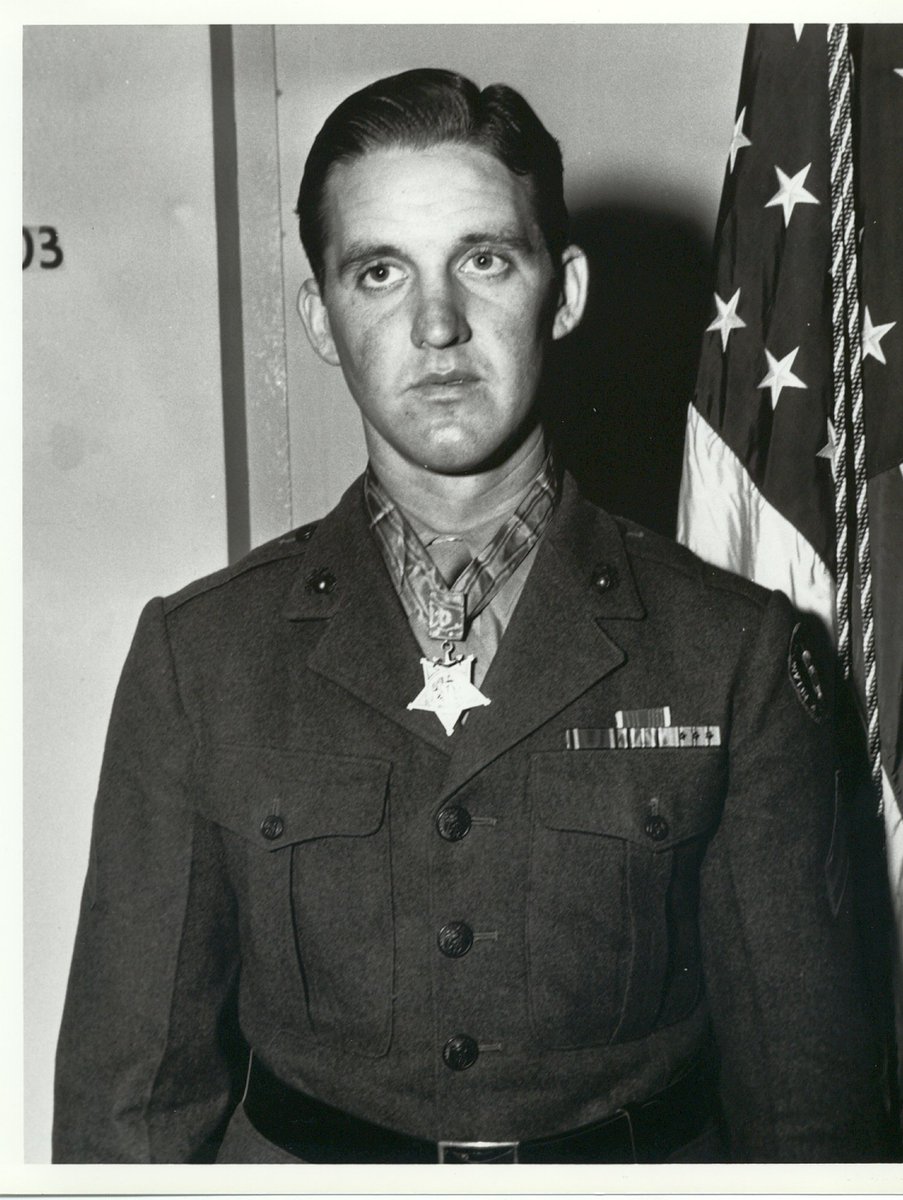
On this day in 1945, a hero receives the Medal of Honor. Wilburn K. Ross had engaged in a virtual one-man battle against German forces for an unbelievable 5 hours. Amazingly, then-Private Ross lived to receive his Medal in person.
/1 of X #storytime 🧵👇
One of the greatest minds in Western Civilization was once a rebel—a womanizer & a thief.
He was a proud man seeking fame & approval. Yet, the sinner turned saint changed not just himself, but history.
What Augustine's "Pear Tree" incident can teach us about ourselves .🧵
On this day in 1945, United States Marines declare the island of Iwo Jima secure. “[W]ithout responsibility and discipline,” Lt. Gen. H.M. “Howlin’ Mad” Smith subsequently wrote, “we would not have won the Battle of Iwo Jima.”
The victory had come at a steep price.
/1 of X #storytimethreads
Please RT
Update: One of the 4 families from WNC we are helping are moving on the first to GA with a new rental home and job.
You guys did that.
Special thanks to one of our x family that asked not to be named for making it happen.
Everyone one of y’all makes a difference and it’s awesome.
On this day in history (1941): The Flying Tigers see combat for the 1st time. The unit formally known as the First American Volunteer Group would spend the next several months developing a reputation for the ages: In roughly 50 aerial battles, it would never be defeated.
/1 of X
This day in #history (1941): A U.S. Army Air Forces Captain takes to the skies. The United States had just been attacked, first at Pearl Harbor, then in the Philippines. Colin P. Kelly, Jr. was among those who survived the initial attacks, leaping into action when America was abruptly forced into war.
/1 of X #storytimethreads 🧵👇
800 years ago, a scholar nicknamed “the dumb ox” proposed a simple proof of God’s existence - it changed everything
Centuries later, it’s now a famous argument known to theologians and atheists alike
Here’s everything you need to know about the famous “5 Ways” proof of God…🧵
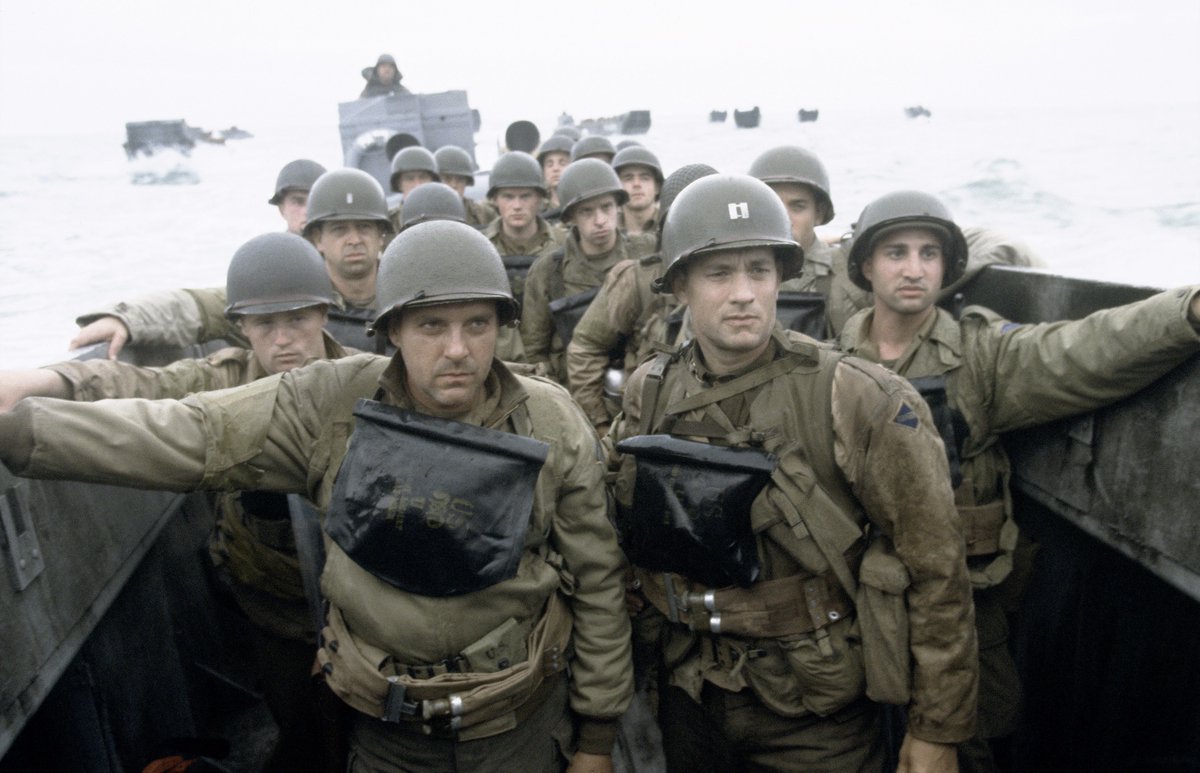
SAVING PRIVATE RYAN was released 26 years ago today. Acclaimed as one of the most realistic depictions of WWII warfare, and among Steven Spielberg’s most popular films, the making of story is enormous. Earn this…
1/36
This day in #history (1944): A hero receives the Medal of Honor. Richard Sorenson had tried to enlist in the #Navy immediately after the December 7, 1941, attack on Pearl Harbor.
/1 of X #America#history#storytimethreads
This day in #history (1778): The Continental Congress receives peace overtures from the so-called Carlisle Commission.
Let’s just say that the British peace commission achieved anything but peace.
/1 of X #America#storytimethreads 🧵👇
This day in #history (2004): A hero passes away. Richard E. Bush received the Medal of Honor for his heroism during World War II.
Bush was an unlikely hero.
/1 of X #America#storytimethreads 🧵👇
This day in #history (1943): Japanese launch a banzai charge during the Battle of Attu. That battle would soon end with an @American victory! The Japanese had held 2 of Alaska’s Aleutian Islands for nearly a year—but now we’d won one back. The 2d would soon follow.
/1 of X 🧵👇
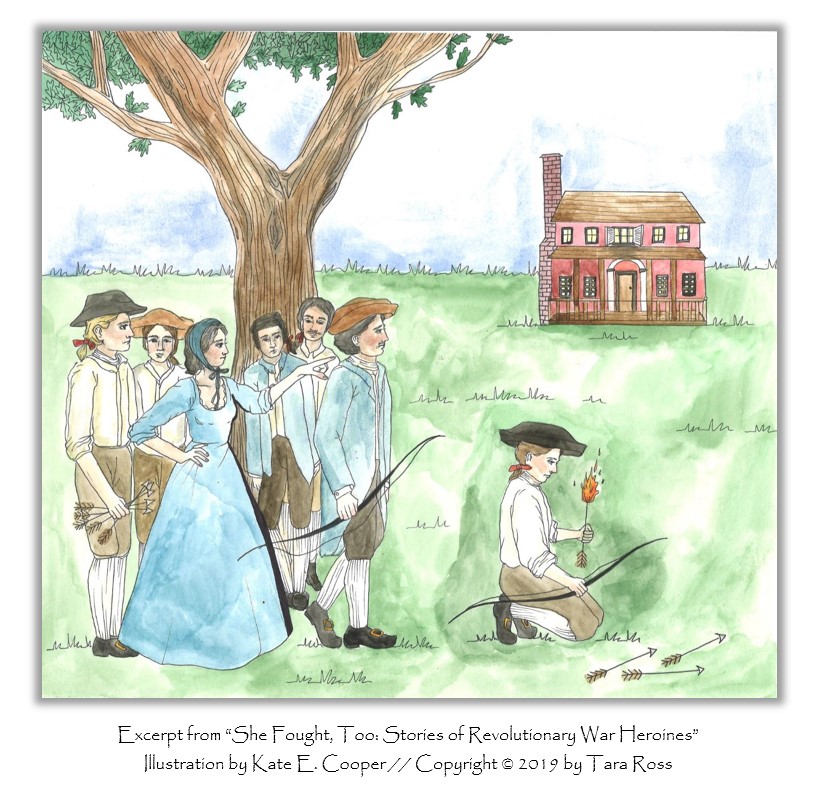
At about this time in #history (1781), a heroine makes a little-known sacrifice for the Patriot cause. A widow, Rebecca Motte, gave Brig. Gen. Francis Marion (“the Swamp Fox”) & Lt. Col. “Light Horse Harry” Lee permission to burn down her home.
/1 of X #storytimethreads 🧵👇










![TaraRoss's tweet photo. On this day in 1945, United States Marines declare the island of Iwo Jima secure. “[W]ithout responsibility and discipline,” Lt. Gen. H.M. “Howlin’ Mad” Smith subsequently wrote, “we would not have won the Battle of Iwo Jima.”
The victory had come at a steep price.
/1 of X #storytimethreads](https://pbs.twimg.com/media/Gm-gwKfXoAIODzW.jpg)