This right handed heavy pull alignment with two outs & runners on 1B & 2B makes it tough to get the force at 2B. It was especially true on this GB into the 5.5 hole with Caminero having to make a 360 spin to throw. Credit Yelich for going hard & sliding late to beat the force. It lead to 8 two out runs. If you play heavy pull with a RHH hitting, you need to have a backside catcher’s pick in the playbook where the first baseman breaks on the pitch. That way a jab step or two by the 1st baseman when not picking may force the runner at 1st to retreat. At worst it may control his primary lead some. Tough to beat teams that run the bases aggressively & intelligently.
When a base stealer has a good jump your job as a catcher is to make it close. Two reasons:
1) The next time he gets on 1B he is aware that the last time he had a + jump & it was a close play so he tries for a better jump & it may take him an extra pitch or two. In the interim while he is working for the perfect jump, you may get a DP.
2) You always have a chance to get the base stealer on an over slide. That’s just what occurred here. Also a good reason why middle infielders need to stay with tags & possibly create a little extra momentum as he is about to exit the base.
“Pogo hop” to start your long toss. Creates a co-contraction through your hip joint. Value to different pre pogo moves since there are so many pre throw movement patterns in the catcher throwing process due to unpredictable pitch locations.
1) Step back & pogo.
2) Step forward & pogo.
3) Step to each side & pogo.
Option ‘B’ is a 1/4 head turn & a quicker turn to the target. For you eye on the target guys, just because you start looking at 2B it doesn’t mean you still don’t have time to pick up a target
.
HOLDING RUNNERS ON 2B
We are seeing a lot more SB attempts of 3B in the playoffs. It will most likely carry over into next season. They interviewed Ashby after the game & he talked about the Brewers working on it 3x a week. He also talked about looking at 2B during his leg lift. Runners are less likely to run when you are looking at them. I think this is a viable process because pitchers tend to see the target in their minds eye & don’t necessarily need to be locked in on the target with their head & eyes. Pitchers need to have an efficient leg with runners on 2B just like they do with a runner on 1B . LHP’s need to mix in their slide step. An efficient stretch delivery stops the steal & gives you a better chance to throw runners out at HP. Unfortunately most pitchers have two stretch deliveries, one for when they think the runner is running & another when they don’t think the runner is running. Doing that turns the process into a guessing game plus that anti steal delivery is probably the pitcher’s 3rd best delivery & you’re making a high % of high leverage pitches out of your worst delivery.What’s the answer? Have one stretch delivery that allows you to both make pitches & hold runners. You may find that a byproduct of a quicker delivery will be quicker more efficient & consistent arm action. In the development process, how about stretch only until you develop your best stretch delivery?
Subtle effect of speed & new age positioning( Heavy pull on most hitters) shows up on a pretty routine ground ball to 3B. With one out & runners on 1B & 2B & a ground ball to 3B where you would normally have a force at 2B, Caminero is forced to throw to 1B. Reason being that it’s a sure out because Hamilton is running at 1B & Aranda is shifted well into the 4 hole with Chourio hitting. Good pre pitch prep on Caminero’s part.
Simpson steals 2B. Note “directional drop step” to create a positive shin angle & put his upper & lower body in sync. He runs 3.17 from Henderson’s 1st move till he touches 2B. Hendersons time to HP is 1.58 & Contreras “rakes” a glove side pitch to maintain his momentum & alignment towards 2B & throws 1.93( Ball caught well in front of 2B) The total elapsed time( 3.57) gives them no chance to throw out Simpson. It’s a basic math problem.
Over 2,500 games from the dugout. 50+ years in baseball. 17 as an MLB manager.
I won Manager of the Year and also lost more games than I want to count.
I led teams through losing seasons and took a team to the World Series.
If I could go back to my first day as a leader, here are the 5 lessons I'd whisper in my own ear:
Lesson 1: Be a window when it's good, a mirror when it's bad.
The leaders I respected most shared every win and absorbed every hit.
What this looks like in practice:
• Wins: name the people who made it happen
• Losses: say "that's on me" before anyone asks
• Locker room: spotlight the effort before the outcome
Your team will fight harder for a leader who deflects credit and absorbs blame.
Lesson 2: Nobody hands you trust. You earn it before you coach it.
Early in my career, plenty of coaches tried to fix my swing.
I tuned out every one I didn't trust.
Get to know your people before you try to develop them.
Their hobbies, their family, what makes them tick.
Then the coaching lands.
Lesson 3: Shower well after every loss.
After a losing streak in Colorado, our team president asked me how I kept the clubhouse together.
This was my rule:
• Self-evaluate honestly, were we prepared, did we execute?
• Shower well, wash off the grit, grime, and angst before you walk out
• Be present for whoever you're going home to
Tomorrow is a new opportunity. Don't drag yesterday into it.
Lesson 4: Lead transformationally, not transactionally.
Transactional leaders ask: what can this person do for me?
Transformational leaders ask: how do I put this person in a position to win?
The first builds compliance.
The second builds careers.
When your people start chasing growth instead of your approval, you've crossed over.
Lesson 5: Stay humble before life humbles you.
There are two kinds of people in this world: those who are humble, and those who are about to be.
Discipline keeps you in the first group:
Skill gets you in the room. Humility keeps you there.
50 years taught me leadership isn't about you.
It's about the people you serve.
@rockies
On the offensive side of this play, you generally do not put hit & run on because hitters often tend to go out of the zone & swing at ball four. When you are running with 3 balls on the hitter, you put on steal & tell the baserunner to treat it like hit & run. NO PICKS.
Premium strike out throw out DP by Contreras. 3-2 run & hit with Aranda running at 1B( Poor runner & later break so as not to get picked ) Uribe was 1.57 & Contreras made a tremendous throw(1.88) on a tough down & in pitch to a LHH. With the location of the pitch Contreras was forced to catch the ball with his right knee still in contact with the ground. Simpson fell across the plate & gave Contreras an opportunity to make contact with him & have interference called . With Aranda running with a late jump, Contreras chose to dodge Simpson & throw Aranda out.
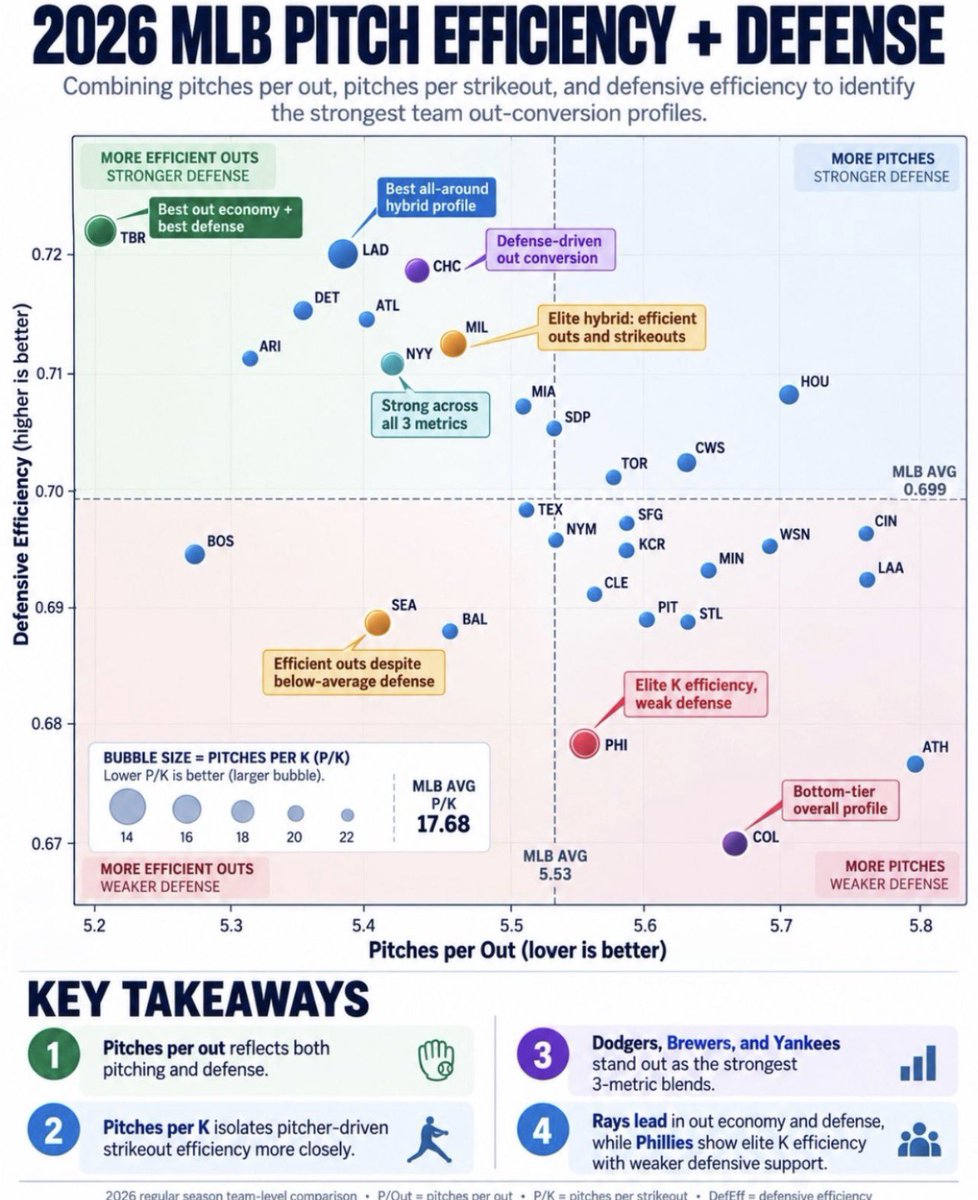
I think pitches per out is a very under valued stat. It’s consistent with an “attack mode” philosophy. Basically my goal is to get you out on this pitch.
Novel idea… Spend less pitch equity for outs, win more games.
Teams that THROW LESS PITCHES to acquire outs and strikeouts & have ⬆️ defensive efficiency win more games.
Leveraging communication is a tool to win in the margins take W’s!!!
@d1baseball
In essence the Rays only had 8 offensive innings last night. They had two caught stealing & this LD DP. No telling on this one,but if Aranda reacts back on this line drive at least he has a chance to avoid being doubled. The point is ,as an industry, we have done a poor job of conditioning the retreat move on low infield line drives.
The best advice I can give to young coaches:
Be where your feet are.
Don’t look at every job as a stepping stone.
Be the best possible coach you can be for your players, right now.
The rest will take care of itself.
Frelick movement before action steal of 3B. Martinez was 1.60 & Hicks was 1.40. ((3,00 without accounting for the tag) Frelick was 2.90 with momentum. NO CHANCE.