Female #students taught by same #gender professors in smaller classes are more likely to receive a top exam grade, but no such effect is found in larger classes. @maurer_se, Guido Schwerdt and @SimonWiederhold suggest why: Close interaction matters.
https://t.co/UfeoSFWQCD
#Wealth, #fertility, & women's work. @celine_zipfel finds that in sub-Saharan Africa, these three are uniquely intertwined — and the data shows that expanding women's #wage opportunities could reshape family size norms.
https://t.co/1s5G9u4nxX
Longer school days + better #resources = real gains. @taitarasu, @MartaFavara, Catherine Porter, & Alan Sánchez found that a Peruvian reform boosted #math scores by 0.19 SD & reading by 0.10 SD. Instructional time matters - but so do complementary inputs.
https://t.co/OOxL28nFPn
Welcome to our new coeditor, Lena Hensvik! @lenahensvik is a professor at Uppsala University and specializes in labor economics with a specific interest in job search, worker-firm matching, and wage determination.
Pipeline programs work. Sarah R. Cohodes, Helen Ho, & Silvia C. Robles found that #underrepresented#minority high schoolers offered #STEM spots were more likely to graduate from elite colleges & earn STEM degrees — raising predicted earnings up to 15%.
https://t.co/yjF5IxiqoG
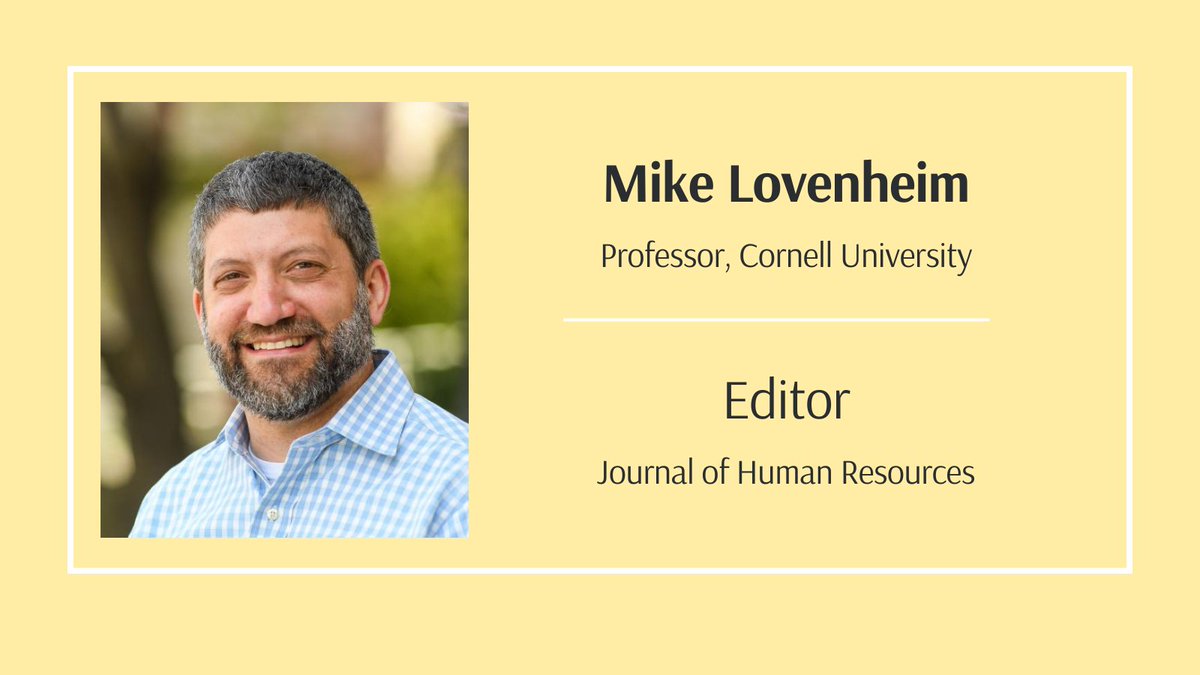
Welcome to JHR's new editor, Mike Lovenheim! His main research interests include labor economics, public finance, and the economics of education. Mike will start in this role on July 1, 2026, and we are happy to have him join the team!
https://t.co/etUVk7mQbM
Welcome to our new coeditor, Sergio Urzúa! Sergio is a professor at the University of Maryland and specializes in development economics. He also looks at uncertainty as determinants of schooling decisions, labor market outcomes, social behavior, and inequality.
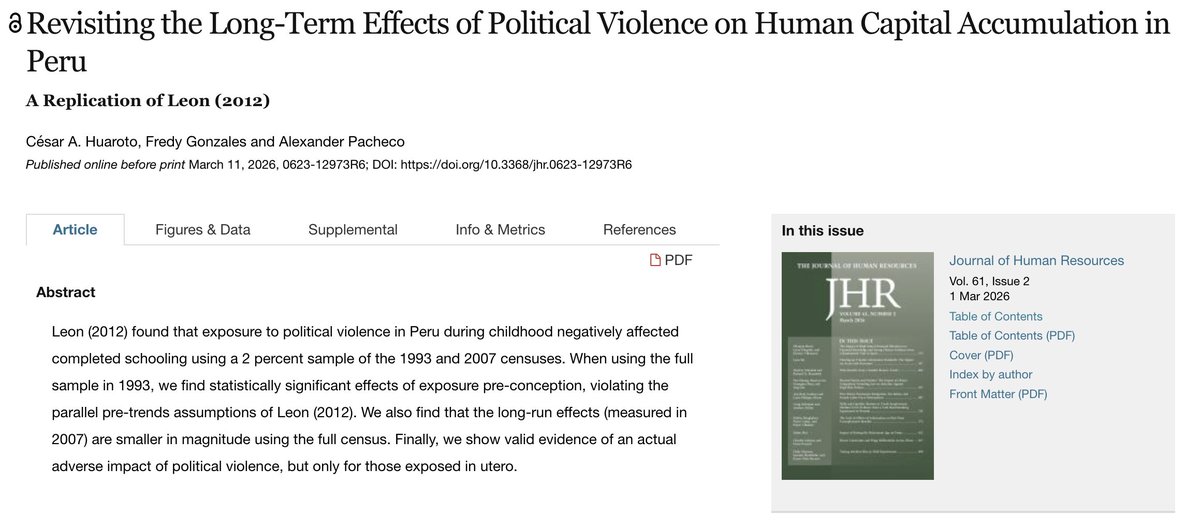
Childhood exposure to #PoliticalViolence in Peru hurt #education — but only if you were in the womb. César A. Huaroto, Fredy Gonzales, & Alexander Pacheco found the original study missed key violations. #Replication matters.
https://t.co/dFytzUviQF
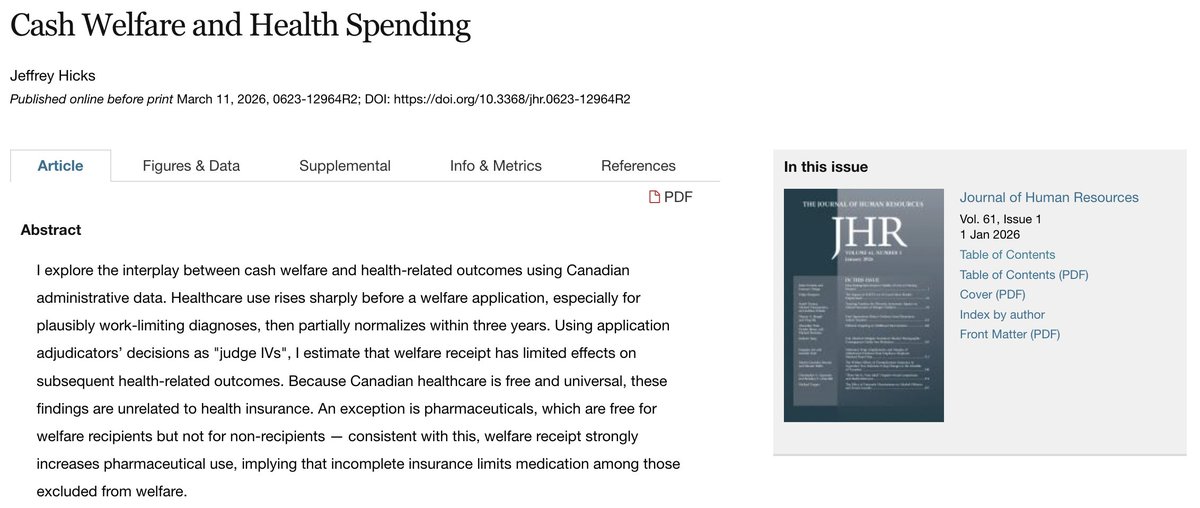
#Welfare is more than just cash – it’s a de facto health safety net. Jeffrey Hicks’s new research shows #healthcare use spikes right before people apply for #benefits, suggesting they turn to welfare to survive temporary, work-limiting #HealthShocks.
https://t.co/gCYHtnJI5J
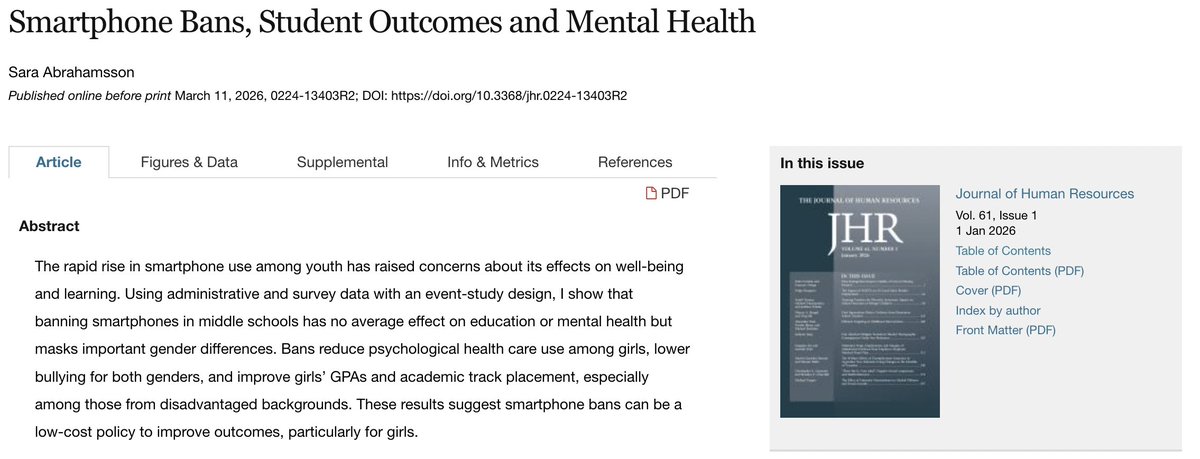
#SmartphoneBans in schools are a game changer! Sara Abrahamsson’s new research finds that these bans cut girls’ #MentalHealth visits by 60%, drastically reduce #bullying for all, and boost girls’ GPA and math scores.
https://t.co/WVujrDBm1z
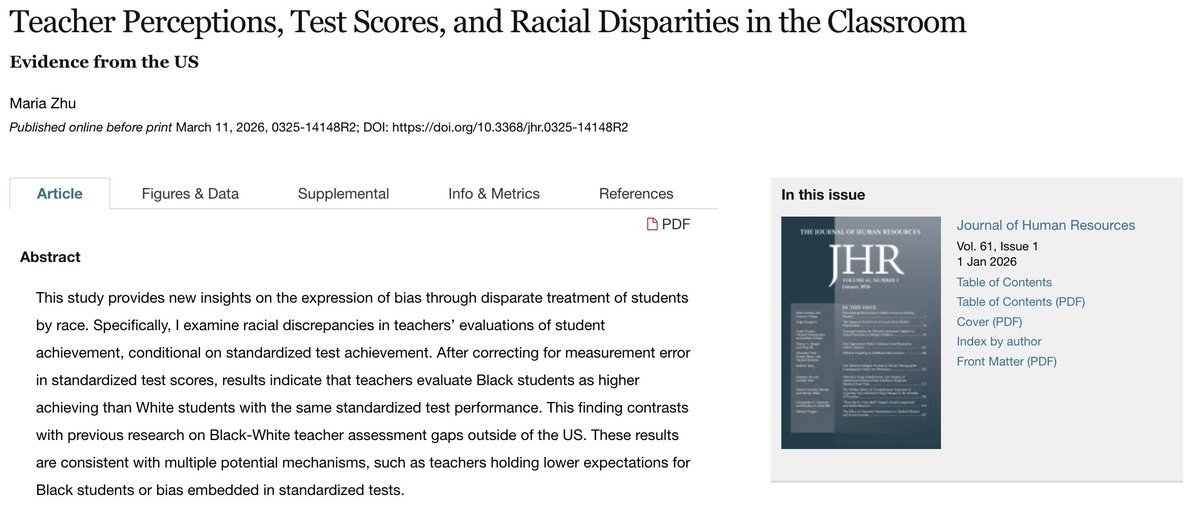
What if #StandardizedTests are the biased ones — not teachers? Maria Zhu finds teachers actually rate Black students HIGHER than White peers with equal scores, once you correct for test measurement error.
https://t.co/JKnsBUxJOi
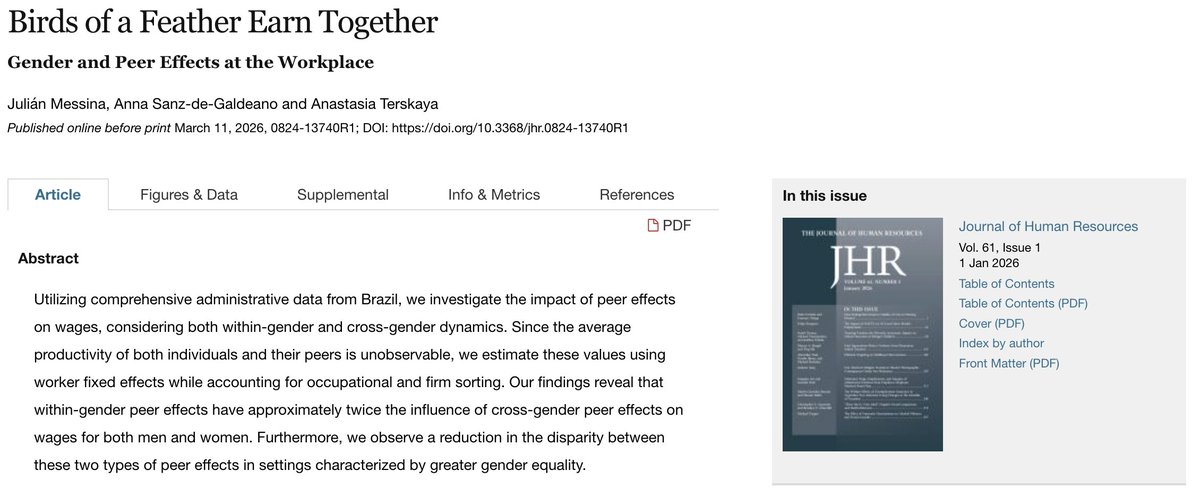
Your work besties literally make you richer. @messinajulian, Anna Sanz-de-Galdeano, & @Asia_terskaya find that same-gender coworkers boost your wages 2x more than opposite-gender peers. #GenderEquality at work = smaller gap.
https://t.co/sxsjEMJ0c1
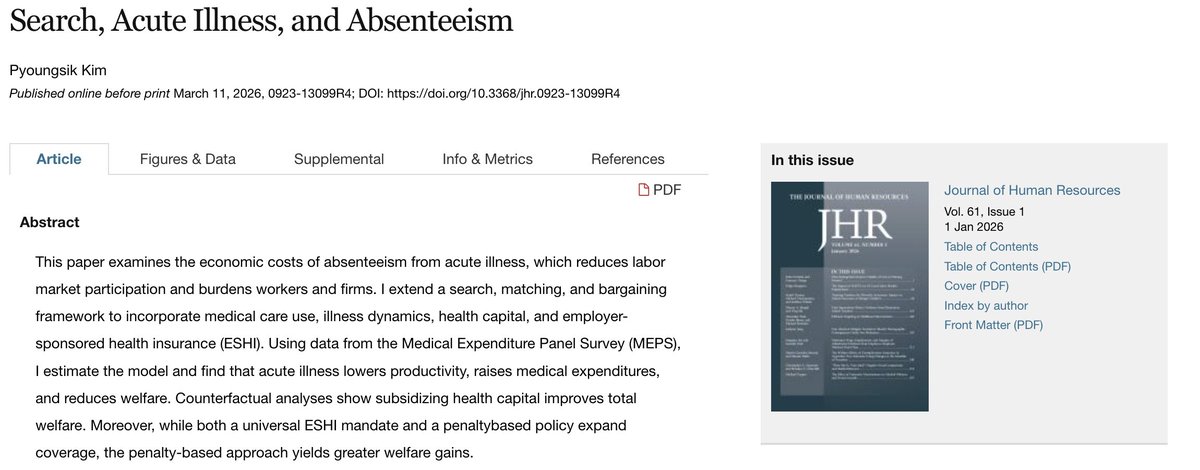
Calling in sick costs more than you think. @economicspk’s new study finds #AcuteIllness = $2,400/yr in lost #productivity per worker — and that’s before factoring in #psychological costs. The hidden price of the common cold is more than you may think.
https://t.co/c6gWeGJcW0
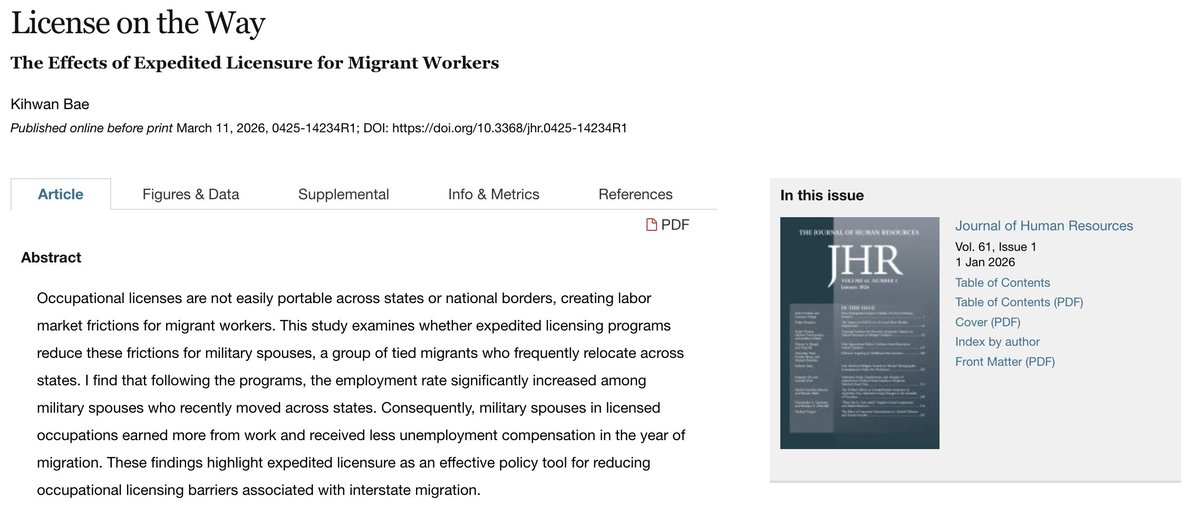
#Military spouses move every 2-4 years for their partner’s career, but their licenses don’t move with them. Kihwan Bae finds that expedited licensing programs boosted their #employment rate by 17%. A simple #policy fix with a $1.2B impact.
https://t.co/oLt9WDi2kq
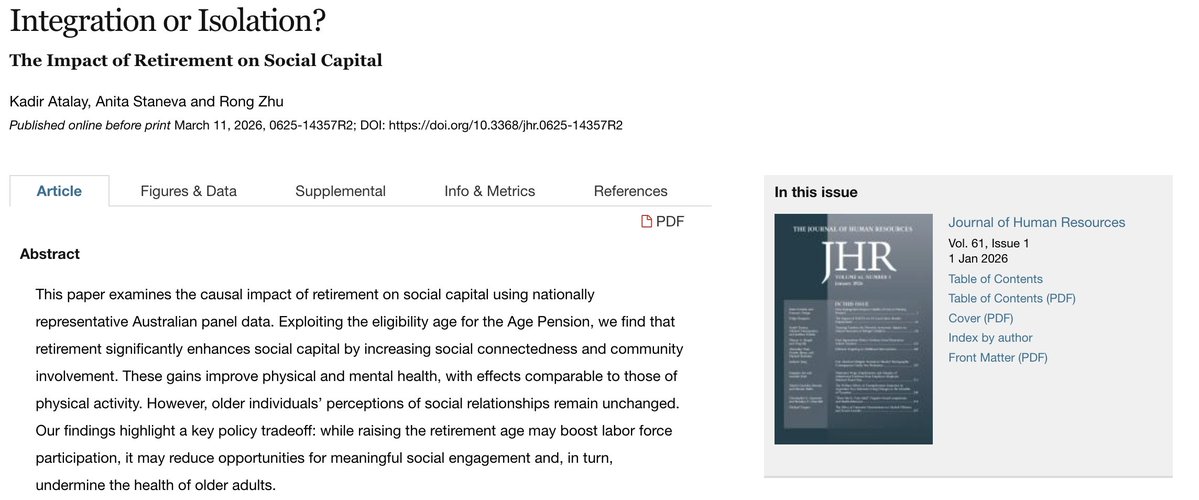
#Retirement doesn’t mean withdrawing. Kadir Atalay, Anita Staneva, & @RongZhu5’s
new study finds retirees build more social connections, volunteer more & even boost their #MentalHealth. The real cost? Raising retirement age may quietly harm older adults.
https://t.co/REyxTNk0Kn
4/4
Recipients reduced work hours but showed little change in overall income or spending patterns. Why the gender gap? That remains an open and crucial question. #MortalitySpecialIssue
https://t.co/MbDlesbtnV
1/4
Can #CashTransfers save lives? A major pension reform in rural Mexico offers surprising answers – with stark differences between men and women. @Fmenares, William H. Dow, @susanwparker_mx, Emma Aguila, Jorge Peniche, & Soomin Ryu found surprising results.
3/4
The authors found 5.5% mortality reduction for women, driven by non-cardiovascular causes and inconclusive evidence for men due to pre-existing trends, highlighting gender differences in program impacts.