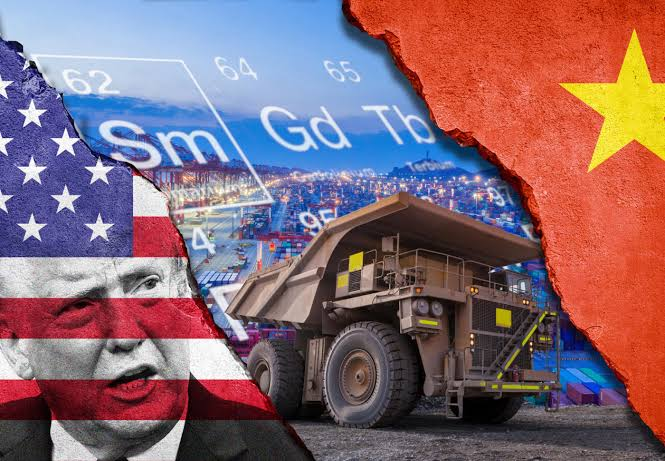
On a real note… the recent price action in the Critical Minerals & Rare Earth sector has been brutal, but it hasn’t changed my thesis.
Sure, I’m down a decent amount on a few of my favorite positions, but I’m still focused on building my core portfolio. Short-term pain may end up being a blessing in disguise if it gives me more time to accumulate shares at these prices. My portfolio is currently around $100K, and my long-term goal is to eventually reach a million bucks.
I know a lot of traders follow me, but I’m not trading this sector. I’m investing with the 2030s and beyond in mind. As long as prices remain around these levels, I plan to keep adding small amounts every week through 2027. Then, I’ll hang up my hat. My time horizon is much longer, and I’m not expecting quick gains.
The thing about this sector is that the narrative can change very quickly. If China tightens export restrictions further, or if the current U.S.-China trade truce ends without a lasting agreement, sentiment could shift overnight. If that happens, I’ll be happy with the positions I’ve built. If it doesn’t, I won’t complain about having more time to keep accumulating.
That’s just how I’m approaching it.
BREAKING: Iran is set to receive up to 400 Chinese MANPADS in a new $60–70M deal, the precise weapons sales Trump claimed Xi told him China would never make “under any circumstances," with the first shipments arriving within weeks, per Reuters citing three sources.
The contract covers QW-12 and FN-16 shoulder-fired surface-to-air missiles, signed with Hong Kong-based Zhongqing Baoshang as intermediary. Deliveries fly from Urumqi in western China and transit Pakistan.
China said four days ago it “strongly supports Iran in safeguarding its sovereignty, security, and national dignity.”
The next critical minerals winners may not simply be the companies digging the rocks out of the ground.
They could be the companies controlling what happens after the mine.
NEWS: Trump Administration Moves to Ban New Chinese Robots and Inverters to Protect U.S. AI Buildout $MP $USAR $UUUU $AREC $ALOY
The Trump administration on Tuesday plans to unveil new bans that target imports of the latest Chinese robots and power inverters, seeking to protect the U.S. AI buildout from national security threats and reshore key industries slated for explosive growth, U.S. officials said.
The Federal Communications Commission on Tuesday afternoon plans to roll out the measures, which bar Chinese imports of new humanoid and quadruped robots — in addition to connected power inverters, which enable renewable energy sources and batteries to connect to grids and data center equipment, the people said.
The restrictions, whose imminent release has not been previously reported, show the Trump administration is aiming to safeguard the U.S. artificial intelligence supply chain from Chinese threats of disruption, data theft and cyberattacks, while also driving firms to shift manufacturing to the U.S.
"The President has made clear that the United States must have independent and secure supply chains for critical and emerging technologies like robotic devices and power inverters," said an administration official, who declined to be named because the matter was not public.
Economic security is national security, and the Trump administration continues to implement a nuanced and multi-faceted policy agenda to reindustrialize America," he added.
https://t.co/4csKvPWapY
Germany Expected to Impose Conditions on Energy Fuels’ $1.9B Acquisition of Magnet Manufacturer VAC $UUUU
The German government is expected to impose conditions on the US takeover of a Frankfurt-area magnet manufacturer, threatening to strain relations between Washington and Berlin and complicate the Trump administration’s efforts to break supply-chain reliance on China.
The stipulations would be part of an investment probe examining US miner Energy Fuels Inc.’s planned $1.9 billion acquisition of Vacuumschmelze GmbH & Co., according to people familiar with the review who requested anonymity because they were not authorized to discuss the internal process.
The firm, also known as VAC, is the only company in the Western world that makes permanent magnets at scale and, as such, is a major supplier for defense and auto companies. The company is seen as key to bolstering US supplies of the magnets, which are critical for manufacturing modern defense technologies like combat drones and submarines.
But the deal would also be a blow for European efforts to establish its own secure supply chains for critical industrial components.
German officials insist the investment probe is a routine step under the country’s laws whenever transactions involve companies in strategic or critical sectors of the economy.
The German Economy Ministry confirmed that the investigation is taking place in a letter to a lawmaker seen by Bloomberg. The ministry, the US Commerce Department and the Pentagon did not respond to requests for comment.
The investigation — similar to a CFIUS review in the US — allows the German government to block the transaction entirely or impose requirements to protect German interests. The government is unlikely to kill the deal but is likely to demand concessions ensuring the company’s plant outside Frankfurt remains vital to the business, the people said.
VAC CEO Erik Eschen told Bloomberg News in an interview he assumes a probe of this kind is taking place and that other European countries are also looking into the deal. He said he would be open to committing to a German facility.
“This will not be an easy process, but Germany knows how important we are and hopefully they will make the right decision,” he said.
Still, the scope of those stipulations could make the deal less appealing to Energy Fuels, or mean that US defense companies don’t realize appreciably better access to permanent magnets.
https://t.co/2DJgoj8fxX
$AREC: We are now at a point where the US military can no longer conduct strikes because it’s worried about its munitions stockpiles.
That’s the stage at which we are at when it comes to production of munitions.
We need rare earths like yesterday. Wow.
If gold can hold $4,000 at these levels of real yields, I cannot imagine where we’re headed when they inevitably come down.
It’s already clear the housing market cannot withstand 7% mortgage rates. The federal deficit cannot withstand the 30y above 5%. That means fiscal dominance. Inflation expectations up + nominal yields down = real yields crashing.
New Rare Earth & Critical Mineral Policy Update $MP $USAR $UUUU $UAMY $AREC $ALOY
Buried inside the House version of the FY2027 National Defense Authorization Act (H.R. 8800) are some significant proposed changes to U.S. critical minerals and rare earth procurement policy. Keep in mind this has only passed House.
Section 1803 would substantially rewrite 10 U.S.C. § 4872, replacing the current Department of Defense sourcing framework with a broader, tiered system governing strategic materials used throughout the defense industrial base.
One of the most significant changes is that compliance would no longer be determined primarily by where a mineral is mined. Instead, a material would be considered sourced from a covered nation if any major stage of its production or supply chain occurs there, including:
• Mining
• Refining
• Separation
• Melting
• Processing
• Manufacturing
• Permanent magnet production
The restrictions would apply to supply chains involving China, Russia, Iran, and North Korea, and would extend throughout the defense contracting chain, including prime contractors and subcontractors at every tier.
The proposal also restructures covered materials into two categories based on their strategic importance.
Tier 1 Materials
Tier 1 represents materials considered most critical to U.S. defense procurement and includes:
• NdFeB permanent magnets
• Samarium-cobalt permanent magnets
• Neodymium ore, oxide and metal
• Praseodymium ore, oxide and metal
• Tungsten metal powder
• Tungsten heavy alloy
• Tantalum
• Gallium and gallium nitride (effective Dec. 18, 2027)
• Germanium (effective Dec. 18, 2027)
• Molybdenum metals, powders and alloys (effective Dec. 18, 2027)
For certain Tier 1 materials produced outside covered nations, the proposal goes beyond simply prohibiting Chinese sourcing. It would require at least 50% of the material’s cost to originate from domestically owned entities, introducing a domestic ownership requirement in addition to country-of-origin restrictions.
The legislation also requires contractors to certify compliance and establishes a standardized process for tracing the origin of covered materials throughout the production chain.
Tier 2 Materials
Tier 2 expands coverage to additional strategic materials used throughout defense manufacturing, including:
• Additional rare earth oxides, metals and alloys
• Gadolinium
• Samarium
• Terbium
• Niobium products
• Tungsten precursor materials
• Tungsten carbide (effective Jan. 1, 2029)
While Tier 2 materials are generally subject to later implementation dates, they significantly broaden the number of strategic materials subject to Department of Defense sourcing requirements.
Implementation
Recognizing the complexity of restructuring global supply chains, the proposal includes several implementation measures:
• An expedited supplier qualification process intended to accelerate approval of domestic and allied producers across the Department of Defense.
• Renewable waivers when compliant materials are unavailable in sufficient quantity, quality, or form. Contractors receiving waivers would be required to submit transition plans with measurable milestones toward achieving compliance.
• Expanded contractor certification requirements, supply chain documentation, and Department of Defense oversight intended to improve visibility into the origin of covered materials.