A record-breaking quarter at Kipushi!
The Kipushi Mine in the DRC produced a record 77,147 tonnes of zinc in concentrate in Q3 2026, a 10% increase over the previous quarter.
With operations continuing to ramp up, Kipushi is on track for another record-breaking year.
$IVN
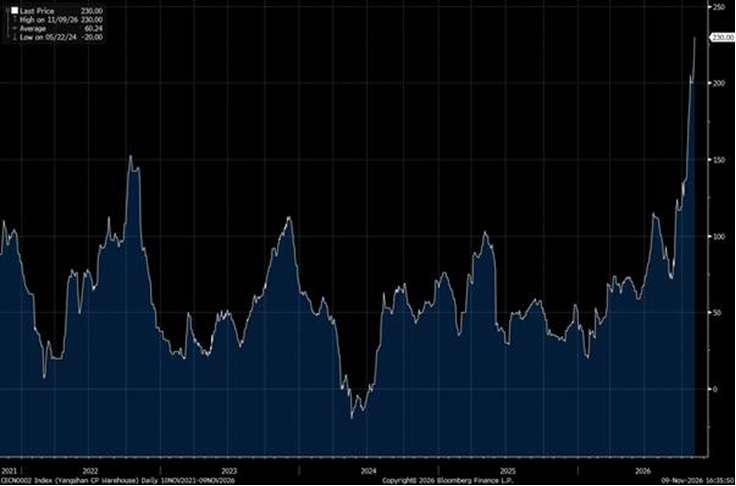
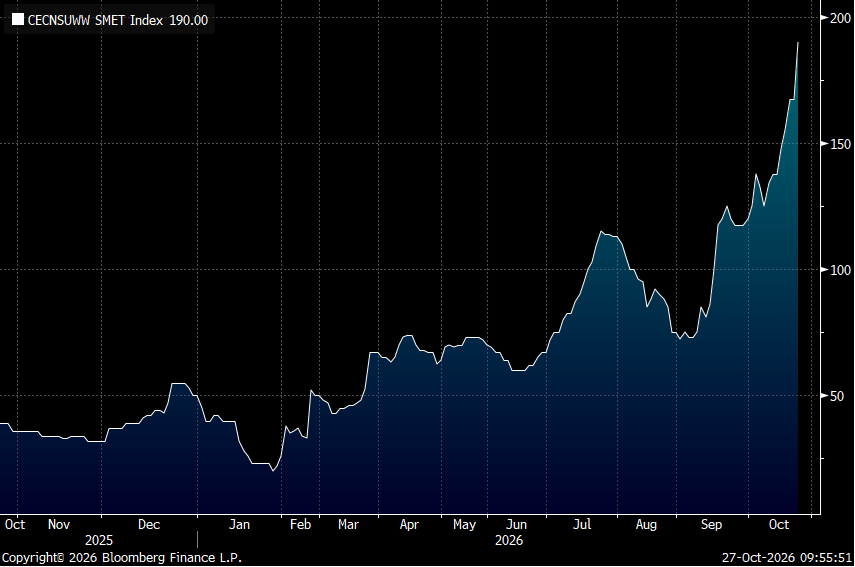
The Yangshan Copper Premium hits another all-time high... as Jimmy McGeoch at @GoldmanSachs said this morning, 'the physical copper market is tight as a drum'.
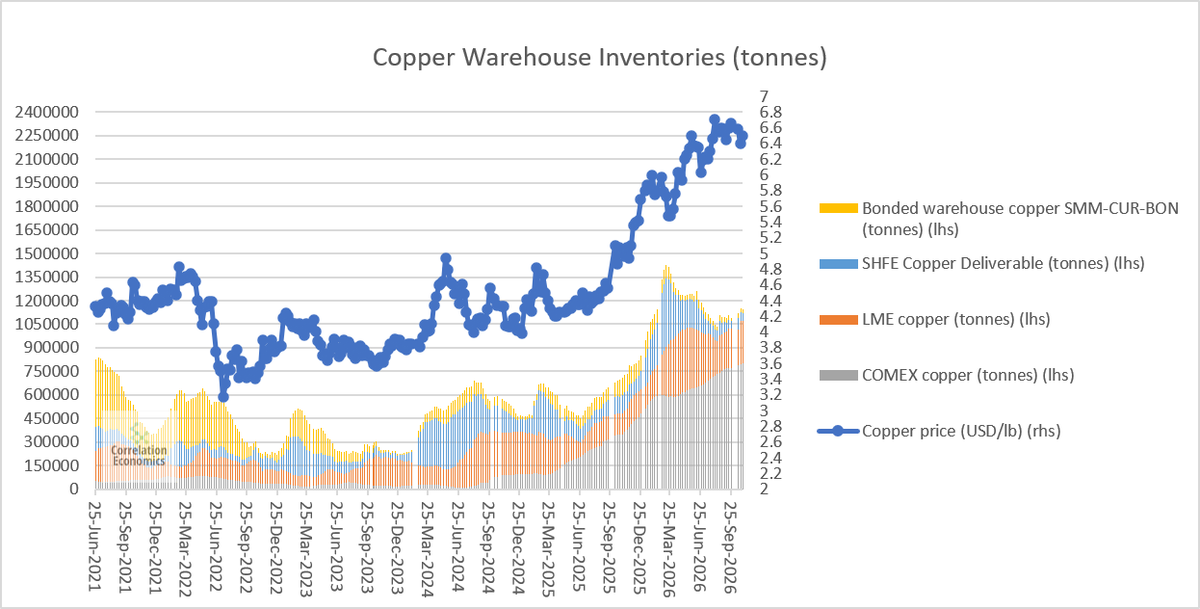
We are hearing that China’s refined copper market will continue to tighten at least through the end of the year, keeping the Yangshan premium elevated. The driving forces are on both sides: reduced domestic smelter supply and improving downstream demand.
Plans for fourth-quarter production cuts by Chinese smelters have been known about for the past few weeks... The global shortage of copper concentrates has driven spot TC/RCs to RECORD lows, and it has become increasingly hard for smelters to make an honest living, causing shutdowns.
This comes at the same time as two of China's major electricity grid operators have opened tenders for ~400 procurement packages for upcoming grid investment programs. Bids close soon, link to tender calendar: https://t.co/fyyOecftYJ
Even with refined copper imports expected to rise to 270,000 tonnes per month (previously ~230,000 tonnes per month), to ease some of the pain... it is feasible that Chinese inventories could be depleted by year-end...
We could be in for a 'stock-out'.
BlueSpark Energy Systems is in Abu Dhabi for @ADIPECOfficial conference… the world’s single largest energy gathering under one roof.
@bluesparkenergy is a spin off from our @IPulseGroup family. It is led by the fantastic Kahina Abdeli-Galinier who led M&A at @Schlumbergerltd before we convinced her to join us.
BlueSpark uses @IPulseGroup’s pulsed power technology to restore the flow of oil and gas from producing wells. We pulse the wells to clear scale and restore flow, with no chemicals and no mechanical intervention… and we’ve done this over 1,000 times.
The world doesn’t need to drill more oil and gas wells, we just need to manage what we have better. We can generate more barrels, for longer, from wells that are already in production.
Oil prices are stubbornly elevated… every additional barrel from an existing well matters… which is why a number of the companies in Abu Dhabi for ADIPEC this week are already BlueSpark customers.
Earlier today at #ADIPEC, our CEO Kahina Abdeli-Galinier previewed BlueSpark’s emerging well health platform and unveiled our new scale sampling capability.
Combining proven physics, evidence and data intelligence to move from reactive intervention to proactive well health.
Read more: https://t.co/MIzCU1m7HF
📍Come see us tomorrow, Hall 8, Booth 8610
#ModernWellIntervention
Yesterday we approved the final investment decision on Sunrise Energy Metals’ Syerston Scandium project in New South Wales, Australia.
Scandium is a critically important metal because it makes aluminium lighter and stronger, for applications in aerospace, defence and advanced electronics. Its use has been held back for decades because we have not had a reliable, scalable western source of supply…
Syerston is set to be the world’s first major primary scandium mine. Early works are under way, and we are targeting first production in 2028.
@SunriseMetals
https://t.co/8eTwXpcN7w
Chile’s copper commission, Cochilco, cut their 2026 production forecast by another ~330,000 tonnes to 4.94 million tonnes (5.27 million tonnes previously).
2026 is set to be the weakest year for Chilean copper production in more than two decades.
The 2027 forecast was also reduced by ~470,000 tonnes to 5.08 million tonnes (previously 5.55 million tonnes).
https://t.co/OjYYRwZf8u
Global copper demand is growing. Finding reliable new sources of supply matters.
At Ivanhoe Mines’ Western Forelands exploration project, an extensive drilling program has increased contained copper resources in the Makoko District by 30%, to ~12 million tonnes.
Adjacent to Kamoa-Kakula, and over six times larger, Western Forelands could help shape the next generation of copper supply.
Learn more: https://t.co/e6BvVKrAk8
$IVN
Investors are concerned at the moment about whether the AI boom is slowing. The best way to answer that question is to ask the companies that are supplying these new data centres.
One such company is @Prysmian_ They supply the power cables for these facilities. Their CEO, Massimo Battaini, recently said following another RECORD quarter that he sees NO SIGNS of slowdown in demand, delays or cancellations of orders… and in fact he is seeing growth accelerating faster than previously expected, as 2026 guidance was upgraded for the second time this year.
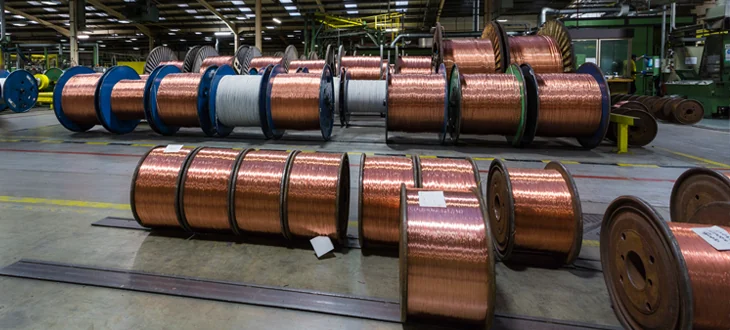
Enquiries have arrived in such volume that they have had to turn some business away. Massimo stated that the US in particular “exceeded all our best expectations, thanks to strong demand from data centres, which we were able to capitalize on...” Prysmian plans to expand production capacity further with a second copper rod mill at their plant in Texas.
This is a great example of how the booming digital economy impacts the physical one that enables it. Data centres, grids, transformers, cooling systems, and cables all need copper, along with many other critical metals, and they rely on a complicated supply chain.
The weakest link in that chain is new supply, which has been underinvested in for at least the past decade… and unlike buying cable off the shelf of a warehouse, a new copper mine can’t be delivered by the following morning.
Prysmian quarterly results press release: https://t.co/lhCX0xRK4y
Copper
Musk: 100 Million Robots
War: Rebuild Ukraine, Iran, Gaza
AI: Rebuild Power Grid
AI: $5T all-in Data Center Capex
India: Demand surge
*Where is the copper?
Following up on yesterday's post, here is what the 12-month chart looks like for the Yangshan premium, which yesterday hit a RECORD $178 per tonne of copper. That record broke again this morning. This tells us that despite all the macro noise, nothing has changed in the PHYSICAL world.
The Yangshan copper premium is the extra cost paid over the benchmark London Metal Exchange (LME) price to import refined copper into China.
The RECORD premium signals a lack of available short-term supply, strong domestic demand and low local warehouse inventories.
China is the world's largest consumer of refined copper, accounting for ~60% of global consumption. This problem is not unique to China, as other major economies around the world also face the same reality when they try to get their hands on copper metal... they have to pay up.
The copper market only wants to react upwards when the physical market globally is tight and shows no signs of easing.
The AI data center buildout is not just a software or capital investment story. It’s quickly becoming a physical infrastructure challenge, and the supply of materials and equipment is paramount in determining how quickly we can build.
If we want the US to become a leader in superintelligence, we first need to become a leader in the underlying commodities required to build the technology.
This technology requires more than capital and chips. We need transmission lines (copper), transformers (grain oriented electrical steel), fuel cells (scandium), and many more critical minerals that the US is fighting to procure. The future of AI doesn’t begin in a lab, it starts in the ground.
A great article on data center risk from AIxEnergy:
https://t.co/woKRhK3bT6
@aixenergy
Following up on yesterday's post, here is what the 12-month chart looks like for the Yangshan premium, which yesterday hit a RECORD $178 per tonne of copper. That record broke again this morning. This tells us that despite all the macro noise, nothing has changed in the PHYSICAL world.
The Yangshan copper premium is the extra cost paid over the benchmark London Metal Exchange (LME) price to import refined copper into China.
The RECORD premium signals a lack of available short-term supply, strong domestic demand and low local warehouse inventories.
China is the world's largest consumer of refined copper, accounting for ~60% of global consumption. This problem is not unique to China, as other major economies around the world also face the same reality when they try to get their hands on copper metal... they have to pay up.
The copper market only wants to react upwards when the physical market globally is tight and shows no signs of easing.
Each year during LME week the world’s leading metals traders come through London. Over the course of the week, a consensus is typically formed on what is the short- to long-term outlook for each metal.
Often the consensus is right, but sometimes it is wrong (e.g last year’s consensus was to be short zinc… and over the past 12 months it has been one of the best performing commodities). This year was probably the first year in a while where a consensus view on copper was not unanimously agreed upon.
The bears talked down data-centre/AI trade demand, saying it won’t meet expectations… while the bulls talk to the shortage of copper supply… no matter the demand outlook. Eitherway, the week ended with ‘risk-off’ selling of equities and commodities.
Copper finished the week at $6.50 per pound… only ~5% below its all-time high. Also by the end of the week, copper cathode premiums into China reached a RECORD high of $158 per tonne (up again this morning to $178 per tonne)… premiums set by @codelco for delivery into Europe were a RECORD $350 per tonne…. And Europe’s biggest copper smelter, @Aurubis_AG, increased its 2027 premium by +10% to a RECORD $347 per tonne.
Also… spot copper treatment and refining charges (TC/RCs) reached a RECORD NEGATIVE $300 per dry tonne of concentrate smelted and 30 cents per payable pound of copper refined (“-300/-30”) last week… and we expect to hear news soon of a RECORD low for next year’s annual TC/RC benchmark. We are hearing the 2027 benchmark may settle around NEGATIVE 150/15 (the previous record is this year’s 0/0)… We will know for sure by the end of CESCO Shanghai Week in mid-November.
The trend of RECORD HIGH copper premiums and RECORD LOW TC/RCs is a CLEAR indicator of imminent shortages in copper supply.
So… to echo the comments made by Max Layton of @Citi on copper, “we view any associated risk off-episodes as good long-term buying opportunities.”
https://t.co/8znAsDbdQ7
This Cliffside Italian Village Was Named the Happiest Place to Travel in Europe—and It Has Colorful Houses and Pebble Beaches.
Story link in Travel & Leisure 👆
It’s certainly our Happy Place 💙
The Payne Institute at the Colorado School of Mines has been a thought leader in our industry for decades. Its latest work on the copper investment gap is another important contribution to the conversation about where this market is heading. I encourage you to give it a read 👇
We’ve all seen the headline numbers: hundreds of billions of dollars in investment are needed to close the copper mine supply gap. This CSM report estimates that the world needs to develop an additional 16.1 million tonnes of annual mine supply by 2050, at a conservatively estimated cost of $360 billion in new mine investment. It’s clear we have a massive hill to climbs as it relates to capital requirements for copper mining.
Importantly, however, the report highlights that capital alone is not the only variable. Capital intensity has risen as the industry works vigorously to develop new supply. But the low hanging fruit is gone. The question is whether future copper prices, regulatory approvals and the cost of capital will support an environment that allows our industry to mobilize the supply needed to meet the world’s growing appetite for copper.
@coschoolofmines@MBazilian
https://t.co/LqV6kwtUoW
Each year during LME week the world’s leading metals traders come through London. Over the course of the week, a consensus is typically formed on what is the short- to long-term outlook for each metal.
Often the consensus is right, but sometimes it is wrong (e.g last year’s consensus was to be short zinc… and over the past 12 months it has been one of the best performing commodities). This year was probably the first year in a while where a consensus view on copper was not unanimously agreed upon.
The bears talked down data-centre/AI trade demand, saying it won’t meet expectations… while the bulls talk to the shortage of copper supply… no matter the demand outlook. Eitherway, the week ended with ‘risk-off’ selling of equities and commodities.
Copper finished the week at $6.50 per pound… only ~5% below its all-time high. Also by the end of the week, copper cathode premiums into China reached a RECORD high of $158 per tonne (up again this morning to $178 per tonne)… premiums set by @codelco for delivery into Europe were a RECORD $350 per tonne…. And Europe’s biggest copper smelter, @Aurubis_AG, increased its 2027 premium by +10% to a RECORD $347 per tonne.
Also… spot copper treatment and refining charges (TC/RCs) reached a RECORD NEGATIVE $300 per dry tonne of concentrate smelted and 30 cents per payable pound of copper refined (“-300/-30”) last week… and we expect to hear news soon of a RECORD low for next year’s annual TC/RC benchmark. We are hearing the 2027 benchmark may settle around NEGATIVE 150/15 (the previous record is this year’s 0/0)… We will know for sure by the end of CESCO Shanghai Week in mid-November.
The trend of RECORD HIGH copper premiums and RECORD LOW TC/RCs is a CLEAR indicator of imminent shortages in copper supply.
So… to echo the comments made by Max Layton of @Citi on copper, “we view any associated risk off-episodes as good long-term buying opportunities.”