One of the biggest killers of innovation is being blinded by hypothetical downsides. It’s easy to raise concerns about why something might be risky. It's much harder to consider the potential harm of putting too many restrictions in place.
Consider the de facto ban on nuclear with the establishment of the Nuclear Regulatory Commission. Today we'd have a modern, robust electric grid, and much higher economic growth, if we had kept building nuclear power plants.
All around us we see systems that were well-intentioned when they were introduced, but had unintended consequences.
How things fail:
- Asymmetric error costs - approve a bad reactor or drug and you’re famous. Yet if you block a good one, no one ever knows.
- Process as a veto - hourly fees, multi-step license applications, EPA reviews. Endless delays erode capital.
- Worst-case models treated as fact - LNT radiation, any sonic boom is unacceptable, etc.
- Rules written for the last accident, applied to the next design - we see this in everything from nuclear to financial services.
Change is uncomfortable, but if we stop progress, we do a disservice to our ancestors who tolerated discomfort to bring us the modern age. We owe it to them to continue making progress.
Keep building.
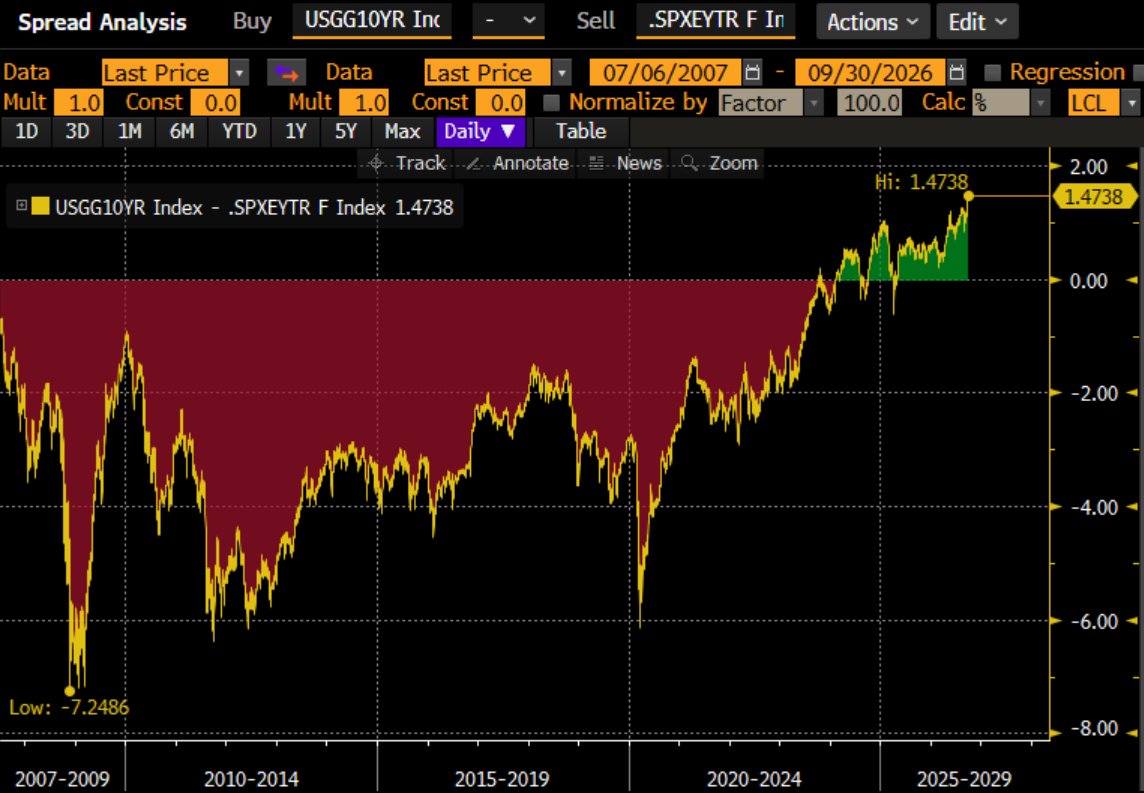
Yields on 10-year Treasuries are the highest since 2002 versus a comparable metric on the S&P 500 - the earnings yield. At a certain point, bonds will present a compelling investment proposition vs risk assets, but many investors say not yet since growth is still strong.
AI is all that matters for markets right now.
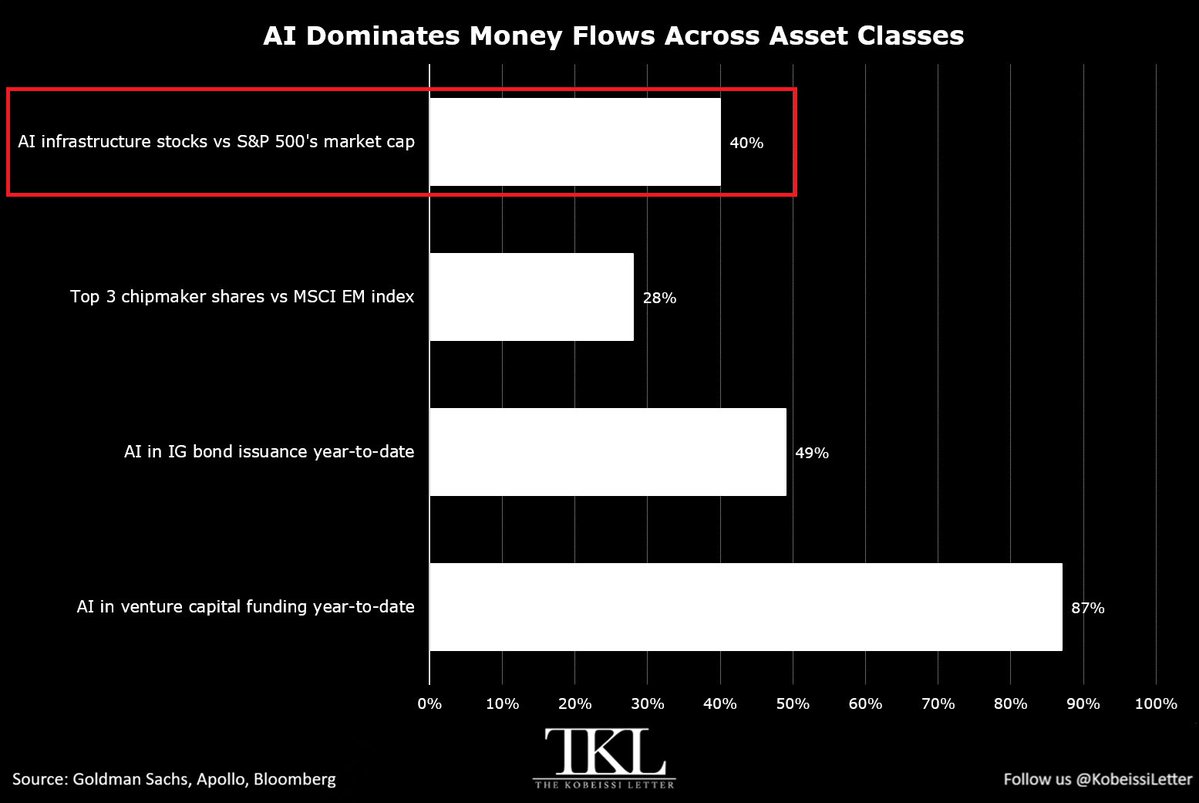
AI infrastructure companies now account for 40% of the S&P 500’s market capitalization.
At the same time, just 3 chipmaker firms represent 28% of the MSCI Emerging Markets Index.
AI-related companies also account for 49% of investment-grade bond issuance so far in 2026.
The concentration is even more extreme in private markets, with AI capturing 87% of venture capital funding year-to-date.
By comparison, in 1999, during the Dot-Com bubble, less than 40% of venture capital funding was related to internet companies.
AI has become the market.
BITCOIN TRADERS PILE INTO $90K+ CALLS
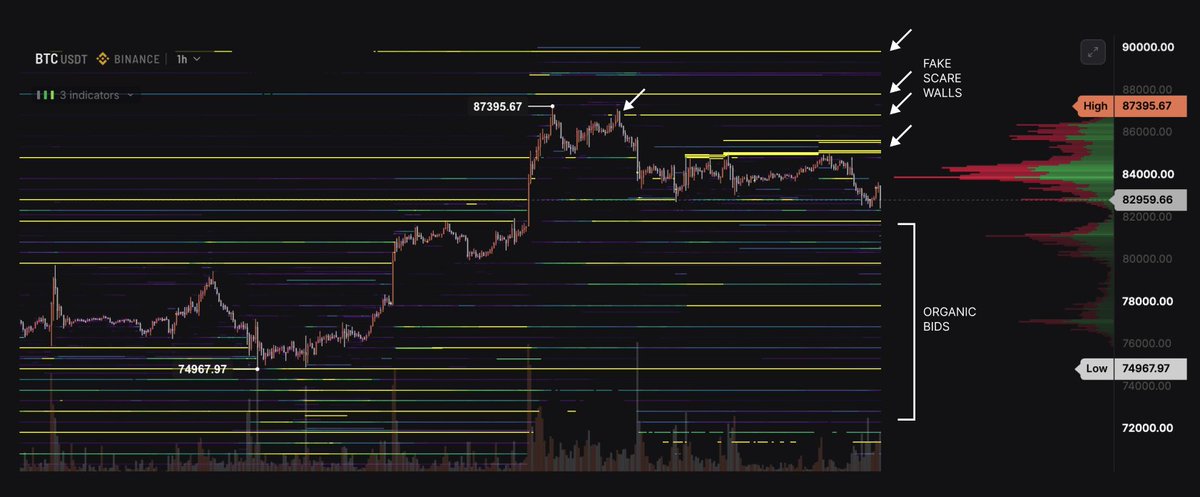
Bitcoin is trading around $83,238, but options traders are increasingly positioning for a move above $90,000, with $95,000 and $100,000 also popular strikes.
Institutional flows are improving too: Bitcoin ETFs have recorded eight consecutive days of inflows, including $31 million yesterday.
The positioning suggests upside demand remains alive even as near-term Bitcoin sentiment weakens.
The SEC issued Tesla a no-action letter today clearing the way for a voting program that empowers retail investors.
This is what ownership should look like. When millions of people own shares of a public company, it should be easier for them to vote their shares.
We are proud to work with the outstanding team at Tesla to help make this happen. Congrats @Tesla and @elonmusk.
We already help a number of companies engage with their shareholders directly with messaging, retail voting programs, and live earnings Q&A available directly in-app. And we have more coming soon.
sentiments around $PONS is probably the lowest it's been in a long time
the closest comparable is $PUMP, a $2.7 billion market cap coin that's up 17% today
zoom out and look at the data:
- $PONS annualized revenue: $156.8m
- $PUMP annualized revenue: $463.6m
- $PONS market cap: $375m
- $PUMP market cap: $2.7b
this means PUMP is currently trading at 5.82x its annualized revenue while PONS is trading at just 2.39x
and everyone agrees that $PUMP is incredibly undervalued here by crypto standards
so how much more $PONS?
while PUMP is the dominant launchpad on Solana, PONS is the dominant launchpad on Robinhood Chain
if you think Robinhood Chain continues to remain relevant into the foreseeable future
you should be aggressively bidding $PONS here
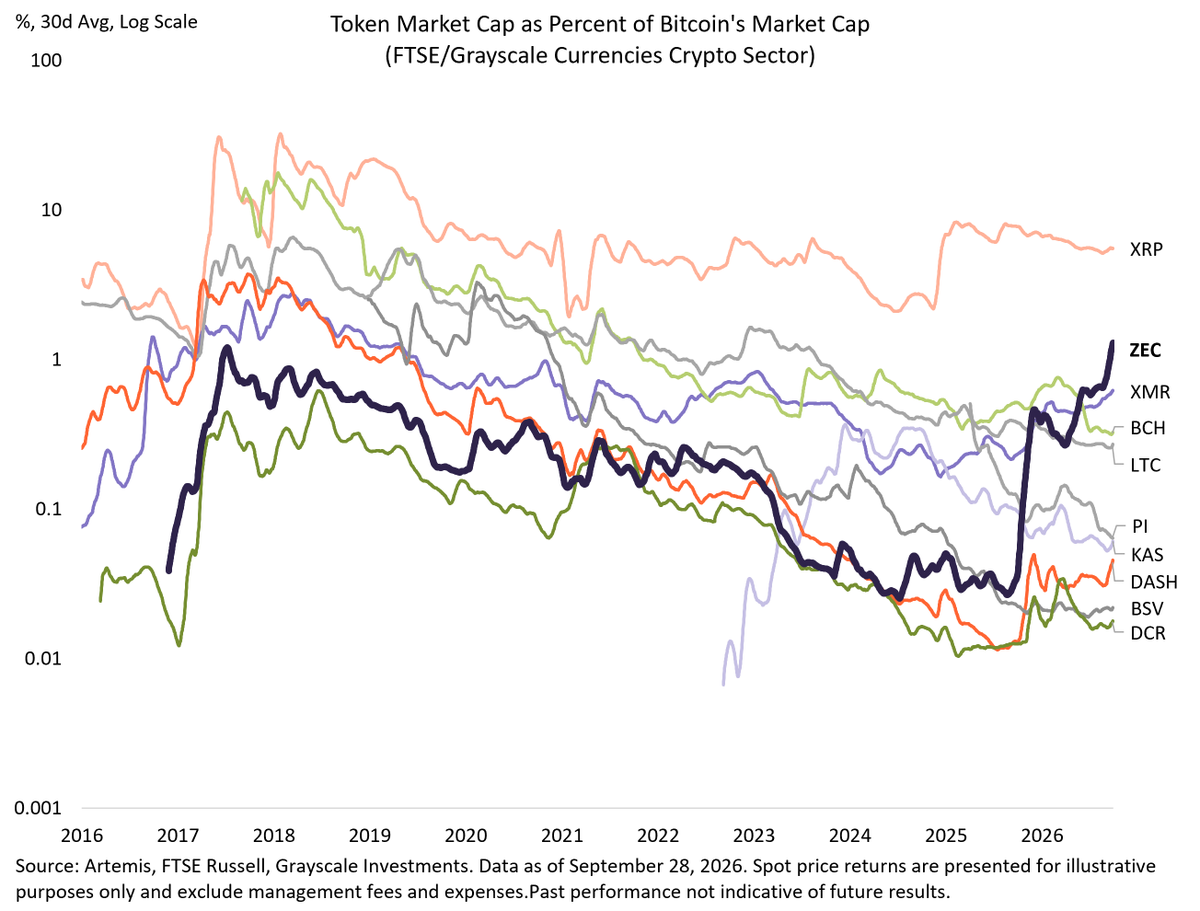
Privacy went from a niche feature to a market narrative. Zcash gaining share against Bitcoin suggests the demand is starting to show up in capital flows, not just conversation.
Assets with digital currency use case: $XRP, $LTC, $BTC, and $ZEC.
Zcash has continued to capture market share, going from ~0.1% of Bitcoin's market cap a year ago ($ZEC price: ~$60) to ~1.5% today ($ZEC price: ~$1,500).
As demand for privacy grows, Grayscale Research believes Zcash can keep capturing market share.
Read more on The Stack: https://t.co/ofxV3Gm3wH
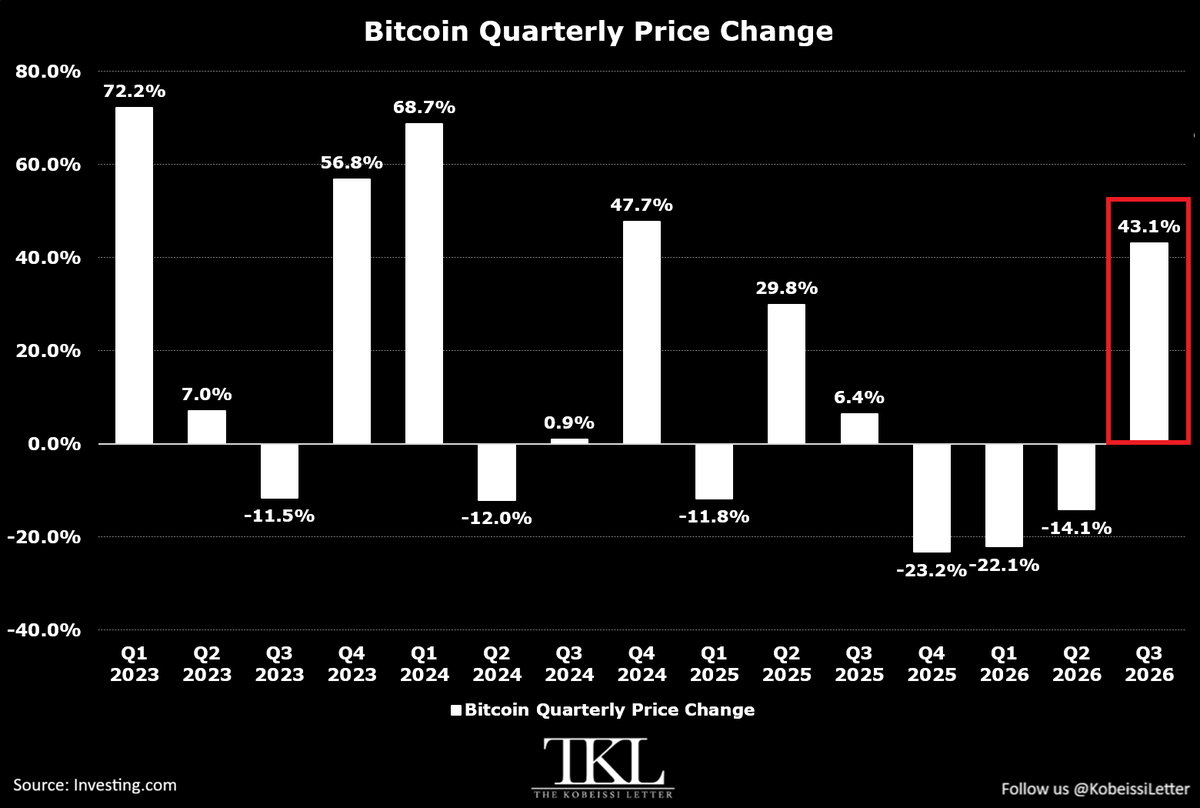
BREAKING: Bitcoin is up +43.1% so far in Q3 2026, on track for its best quarterly performance since Q4 2024.
This would also mark their 3rd-best quarterly gain since US spot Bitcoin ETFs officially began trading in January 2024.
Since August 19th alone, Bitcoin prices have surged +29.8% when the US Treasury said it would increase buybacks of long-dated Treasuries.
Meanwhile, US spot Bitcoin ETFs posted +$2.4 billion in inflows in the week ending September 25th, their largest weekly intake since October 2025.
As a result, year-to-date inflows are up to +$1.0 billion, from -$5.0 billion in total outflows recorded at the end of July.
Crypto is in a new bull market.
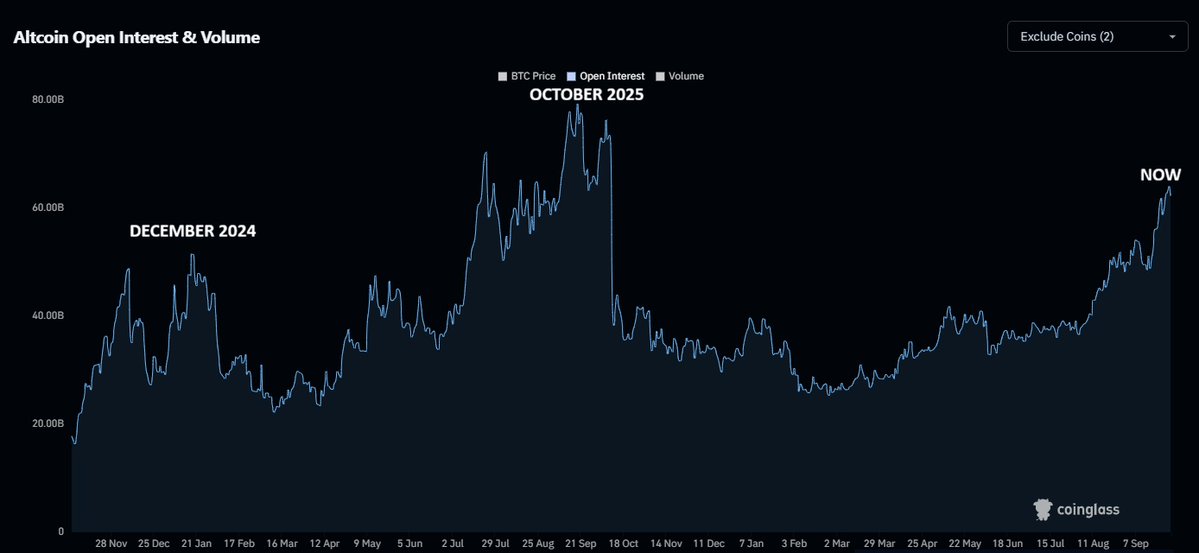
Altcoins' Open Interest has now surpassed December 2024 levels and is getting closer to the October 2025 peak.
It seems like people are becoming overly bullish before Q4.
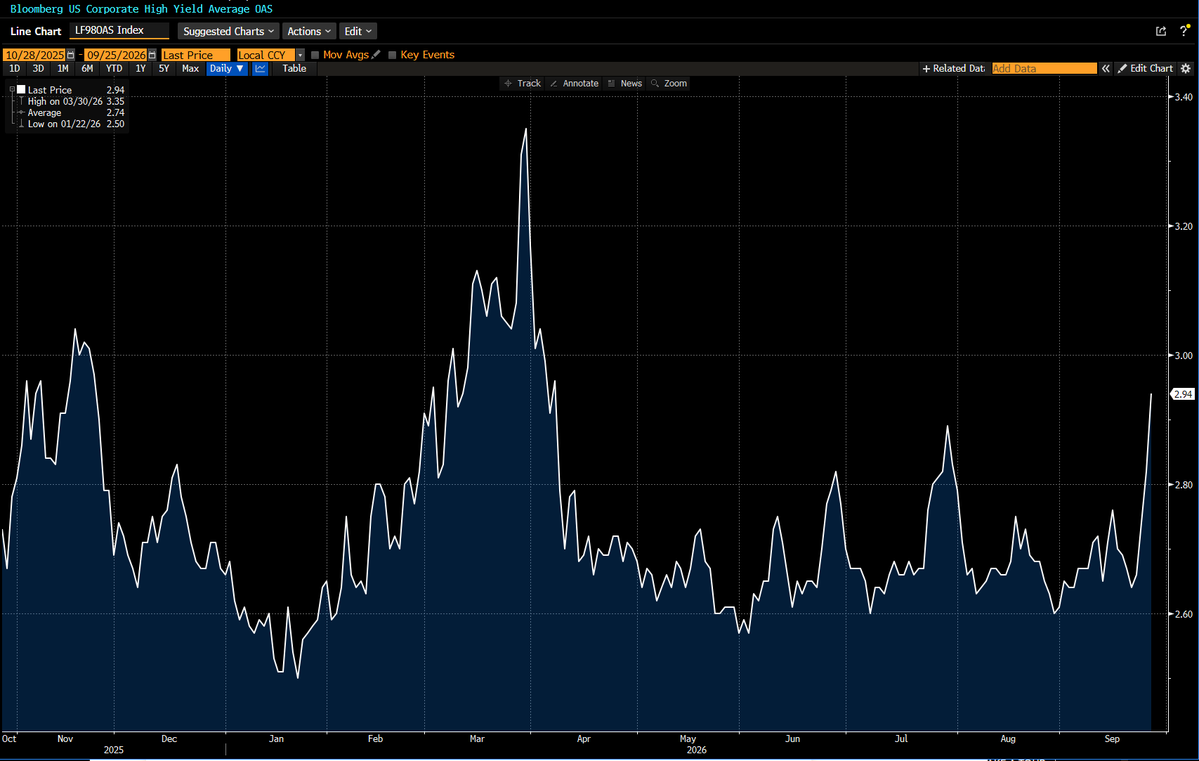
Surging benchmark rates are starting to bite corporate credit more significantly. Spreads on high-yield bonds have widened 28bp in the past three days, the most since October 2025. While spreads are still relatively low, they've been widening at an accelerating clip.
We believe superintelligence will create significant new opportunities for all people and businesses. Meta already serves billions of people at scale and helps hundreds of millions of businesses reach customers. Today we are starting the next major pillar of our business, Meta Enterprise Platform, to help businesses use AI to grow and transform in new ways as well.
Crypto has no shortage of tokens. It has a shortage of businesses that actually generate cash flow. As the market matures, revenue will matter more than narratives.
There are too few good tokens in the market.
Only ~20 projects generate around $50k+ in daily holder revenue.
Then you check valuations, unlocks and whether that revenue can last... and the list gets shorter.
Quite a few more tokens look attractive, but their MC/FDV ratios aren't sexy
So you need to bet that demand grows faster than supply unlocks. Makes some of them more a trade than a HODL.
For most tokens you're trading narratives and vibes:
the business might grow and revenue might follow, and hopefully some of it eventually reaches token holders.
But you have to trust the team to deliver. With recent trend of DAO getting dissolved the 'decentralized' accountability isn't here.
In a way this is super bullish as money and attention flows focus on them. They are on the spotlight.
So crypto is still so small from a 'value investor' perspective.
That's why I'm excited for new TGEs from products already making real revenue, like $VAR and hopefully Polymarkets does the right thing and goes TGE way.
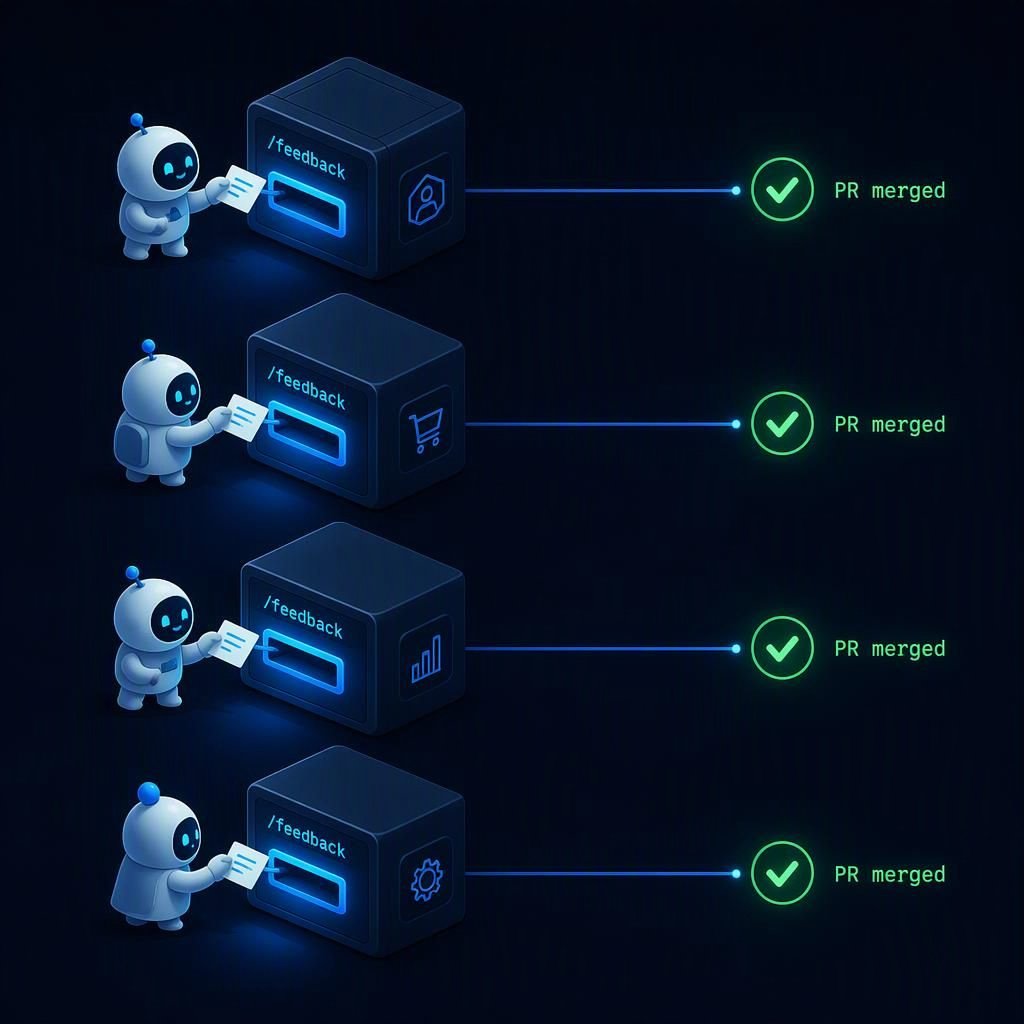
Every backend service should have a /feedback endpoint.
Agents are quickly becoming the heaviest users of most APIs. When one hits a missing feature or a bug, it should be able to say so right there, in a structured way.
If the request makes sense, another agent drafts the PR and a human approves it. Software that improves itself based on what its users actually tried to do speeds up recursive self improvement.
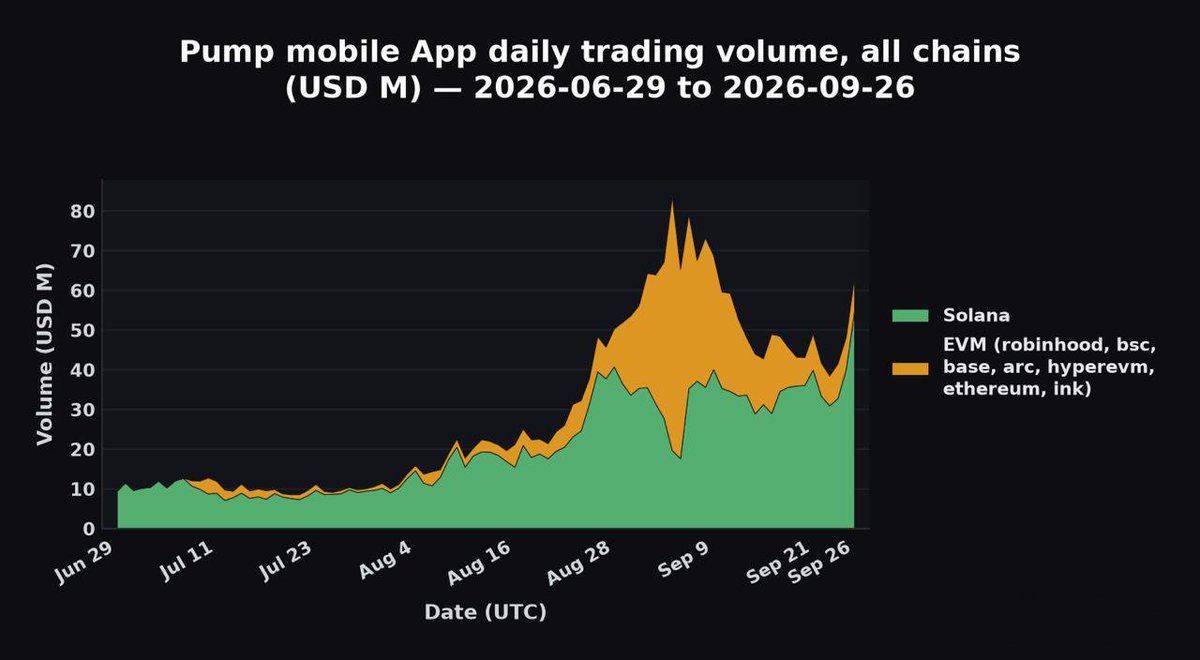
very bullish, although our actual all time high for volume was on sep 4 (~$82m) and was mostly crosschain volume
interestingly, yesterday’s ~$62m volume day was majority led by Solana, which means a couple of things:
1) Solana is still the most sticky onchain playground, even when other chains have their season
2) no matter where volume goes, Pumpfun users are at the forefront of opportunity with our crosschain support (including HyperEVM)
The market is already voting for 10,000.
Doomsayers say war keeps oil high, tariffs rekindle inflation, the Fed stays restrictive and the US economy breaks. The narrative is neat and backward-looking.
Markets vote on fear in the short run and weigh earnings in the long run. The next move will not wait for midterms, a ceasefire photo or another inflation print. Risk assets will discount the direction of travel first.
That direction is clearer. An Iran settlement removes the geopolitical premium from oil. A China deal removes the tariff and supply-chain tax. Together they create a peace dividend: lower energy and goods costs, stronger real incomes, wider margins and more investment confidence.
The sequence is simple. Geopolitical risk falls; oil falls; inflation falls; yields fall; financial conditions ease; earnings rise. The stagflation case depends on high oil and ongoing trade friction. Remove those assumptions and it collapses.
The political calendar helps. The fourth quarter of a midterm year through the second quarter of the following pre-election year has historically been the strongest stretch of the presidential cycle. Midterm weakness often sets the autumn low; the next three quarters deliver the advance.
The Fed is the holdout. Its old reflex treated above-trend growth as excess demand. Kevin Warsh’s task is to bury that. Productivity-led growth is not overheating. AI investment, energy abundance, reshoring, capex and trade normalisation expand supply and allow faster growth without persistent inflation. Under supply-side policies the false choice between growth and price stability fades.
Treasury yields have peaked. Assume the 10-year reaches 4 per cent by end-2027. Equating the S&P 500 earnings yield with that yield supports a 25-times multiple.
A 2027 earnings target of $450 a share at 25 times implies 11,250. The 10,000 target uses 22.2 times, a 4.5 per cent earnings yield above the assumed Treasury yield. That is conservatism, not exuberance.
The bull market broadens from technology to industrials, consumers, exporters, housing-linked and rate-sensitive sectors. Crypto enters a new bull run as real yields fall and liquidity improves.
Bears demand certainty. Markets never do. They price the chance that peace lowers oil, lower oil restores disinflation and disinflation extends the earnings cycle. The vote has begun.
A once-contentious thesis will become consensus. Ignore the noise. The pain trade is due north.
If this keeps going
Last cycle's highs for most 2017/21 coins should be disregarded
I'm honestly struggling not to be more pessimistic about it after such a brutal bear