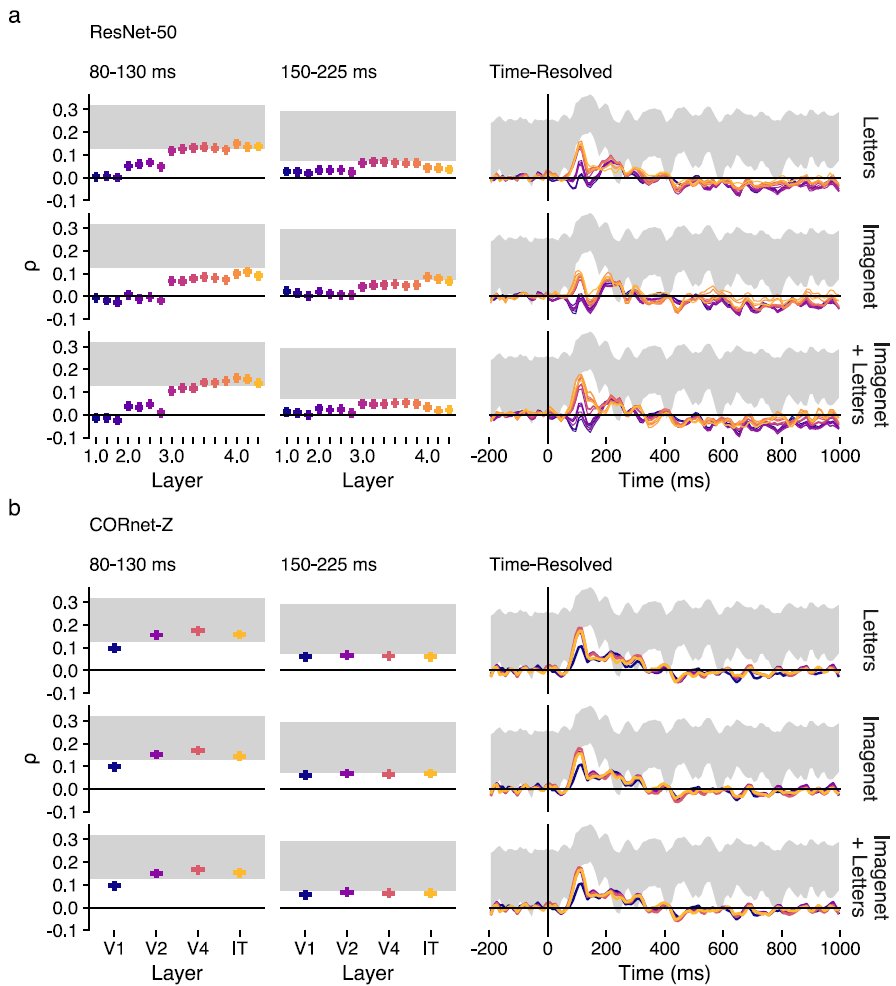
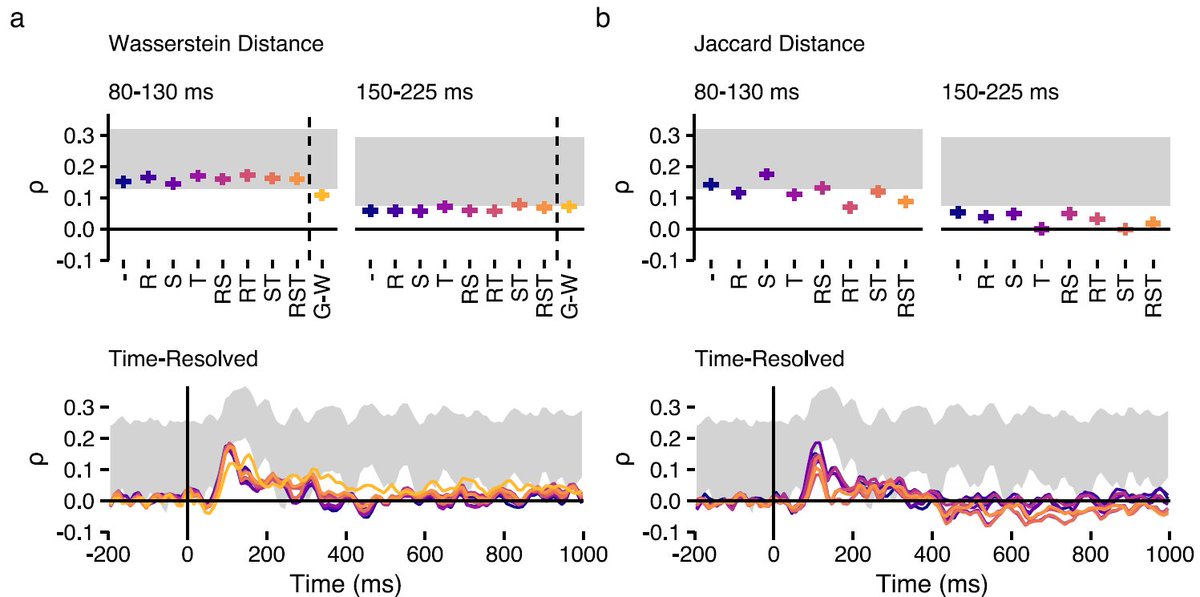
Finally, even though it is more computationally constrained and interpretable, Wasserstein distance performs similarly well to features extracted from the best-performing layers of artificial neural networks!
New preprint! 📰 We argue that optimal transport provides a useful framework for describing early orthographic processing/representations. In particular, we focus on letter shape similarity...
https://t.co/TFypvq5fO6
We also show that the optimal transport framework can accommodate geometric invariance. For example, Gromov-Wasserstein distance can be used to capture representations invariant to differences in position and size
🚀 Exciting News! I'm recruiting a PhD student to join my lab at @shefcompsci and @ShefRobotics, where you'll help shape the future of Human-Centric AI for Social Robots!
📬Project & funding details: https://t.co/7DOxR6837U
We’d love your help with a repost! #PhD#AI#Robotics
I often see this quoted from some 2005(?) Deutsche Bank report, but I've never been able to find the original.
Does anyone happen to know where I could find a copy?
Deutsche Bank describes the Scheme as a “bizarre” “triple pay system” whereby "the state funds most of the research, pays the salaries of most of those checking the quality of the research, and then buys most of the published product."
https://t.co/dBmnnFYfH2
So happy to see this EEG study out! 🧠⚡️
We were surprised to see that, in biasing contexts, the word N1 showed a pattern seemingly inconsistent with a simple predictive coding model
New paper in Imaging Neuroscience by Jack E. Taylor, Guillaume A. Rousselet, and Sara C. Sereno:
Can prediction error explain predictability effects on the N1 during picture-word verification?
https://t.co/cIUvSewORS
@wmvanvliet @robustgar (5)...(if we treat complexity as a kind of prediction error). This puts me in mind of some of the work from @GaglBenjamin et al. on orthographic prediction error where they calculate pixel differences from an orthographic prior.
New EEG preprint! 🧠⚡️👲
With @robustgar and Sara Sereno, we collected EEG data from 68 participants to test a simple predictive coding account of the word N1 (N170). Surprisingly, we found a pattern of effects in the opposite direction to that expected...
https://t.co/vkJNCNgbxz
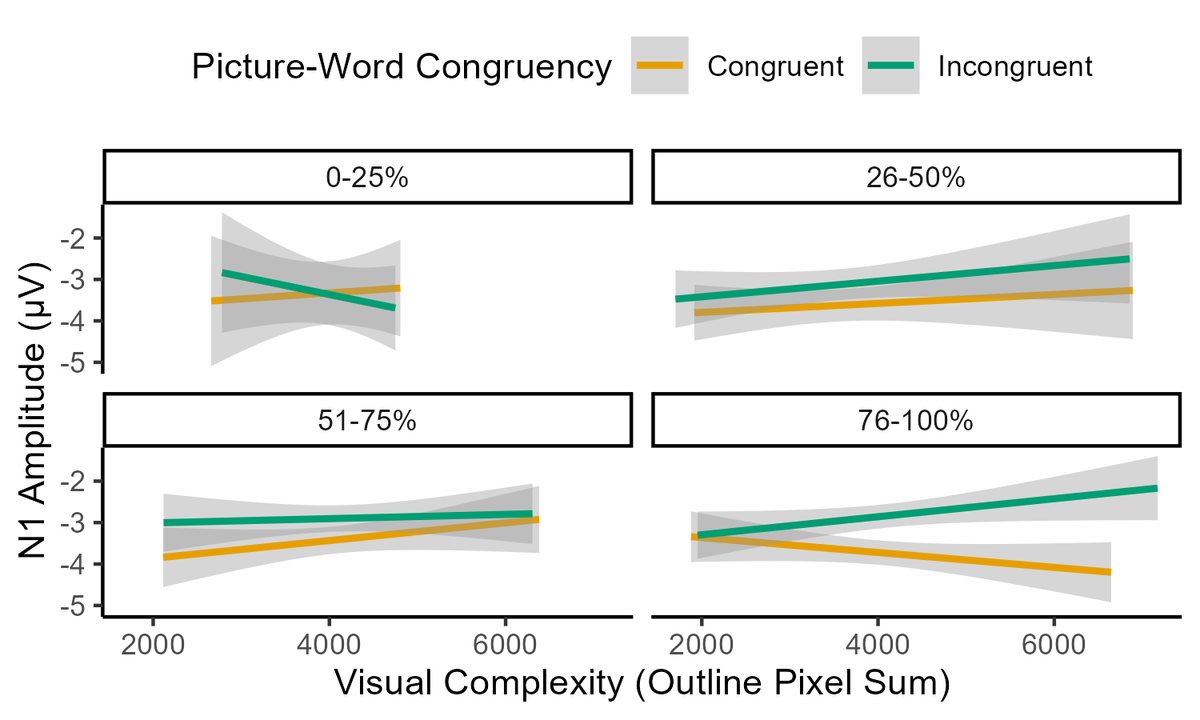
@wmvanvliet @robustgar (4) Looking at whether the effect differed across 4 bins of predictability... maybe? It looks like the complexity-amplitude correlation depends on predictability. Again though, it looks like the direction is inconsistent with predictive coding...