It should NOT be this hard to buy a privacy-respecting router. Seriously.
A router forwards packets. That should be the whole relationship. Instead you get mandatory cloud accounts, phone apps for basic settings, telemetry, and "AI security" subscriptions.
Amazon's eero will not even give you a local admin interface.
Comcast runs AI analysis on the traffic of every device in your home and markets it as a feature.
The router is the one computer that sits between everything you own and the internet. It sees every DNS lookup from every device. It sees which sites you connect to even when the traffic is encrypted. It knows when you leave, when you come home, when you sleep. That is a behavioral dossier of your entire household, and nobody audits it. Most people never log into their router at all.
Now the part everyone tiptoes around: most routers sold in America are produced in China. TP-Link, the best-selling brand in the country, has been under federal investigation since 2024.
Volt Typhoon built its US attack infrastructure out of aging home routers.
Flax Typhoon ran a botnet of more than 200,000 hijacked routers and cameras through a Beijing company until the FBI took it down.
Used routers are worse. ESET bought secondhand corporate routers and found over half still held the previous owner's full configuration: credentials, VPN keys, complete network details.
For consumer gear, assume WiFi passwords, admin logins, and device history all ship with the box.
Anything named Armor, HomeShield, AiProtection, or Advanced Security is a pipe to a third-party cloud. Netgear Armor is Bitdefender. ASUS AiProtection is Trend Micro.
Enabling them means accepting someone else's data terms for your entire network.
And the part almost nobody knows: your router's Wi-Fi hardware address sits in global location databases run by Apple and Google. Researchers mapped hundreds of millions of routers this way and tracked Starlink terminals in active war zones.
You can opt out by appending _nomap to your network name. Almost nobody does, because almost nobody knows.
Good intel on this is weirdly hard to come by.
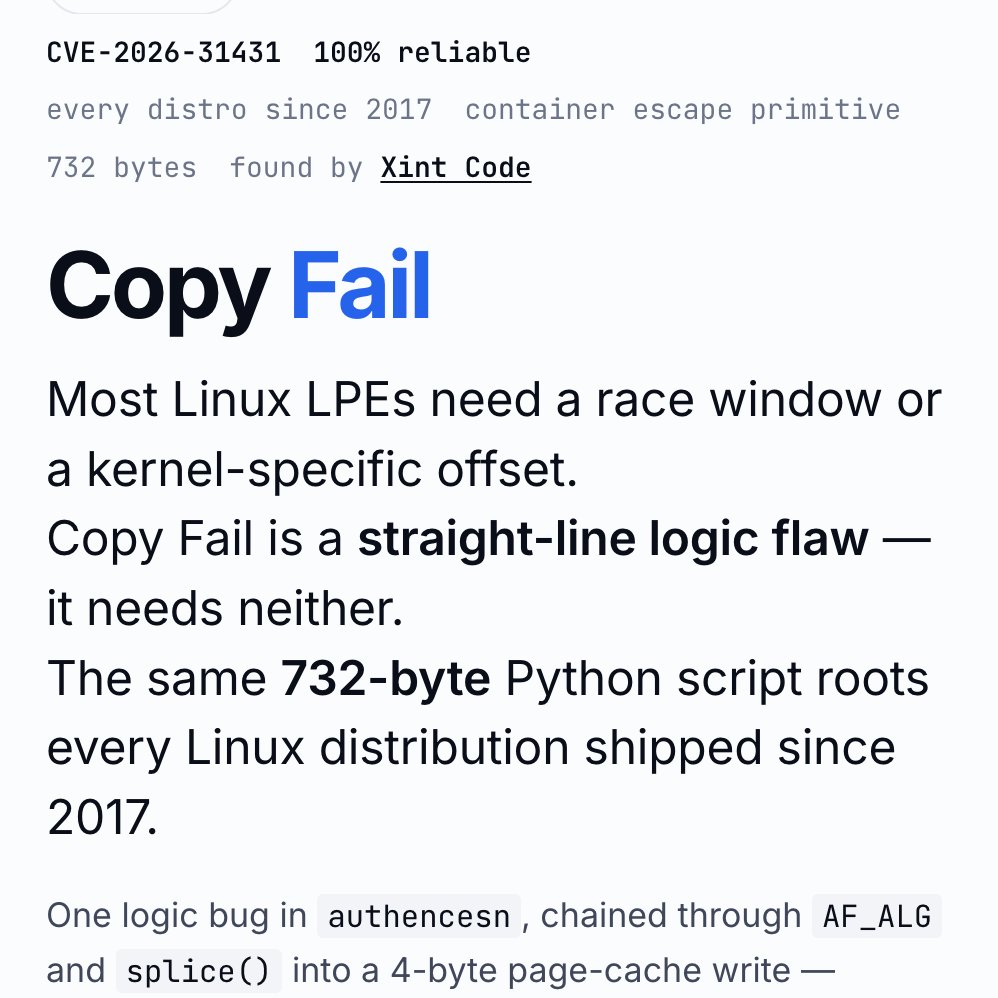
‼️🚨 BREAKING: An AI found a Linux kernel zero-day that roots every distribution since 2017. The exploit fits in 732 bytes of Python. Patch your kernel ASAP.
The vulnerability is CVE-2026-31431, nicknamed "Copy Fail," disclosed today by Theori. It has been sitting quietly in the Linux kernel for nine years.
Most Linux privilege-escalation bugs are picky. They need a precise timing window (a "race"), or specific kernel addresses leaked from somewhere, or careful tuning per distribution. Copy Fail needs none of that. It is a straight-line logic mistake that works on the first try, every time, on every mainstream Linux box.
The attacker just needs a normal user account on the machine. From there, the script asks the kernel to do some encryption work, abuses how that work is wired up, and ends up writing 4 bytes into a memory area called the "page cache" (Linux's high-speed copy of files in RAM). Those 4 bytes can be aimed at any program the system trusts, like /usr/bin/su, the shortcut to becoming root.
Result: the next time anyone runs that program, it lets the attacker in as root.
What should worry most: the corruption never touches the file on disk. It only exists in Linux's in-memory copy of that file. If you imaged the hard drive afterwards, the on-disk file would match the official package hash exactly. Reboot the machine, or just put it under memory pressure (any normal system load that needs the RAM), and the cached copy reloads fresh from disk.
Containers do not help either. The page cache is shared across the whole host, so a process inside a container can use this bug to compromise the underlying server and reach into other tenants.
The original sin was a 2017 "in-place optimization" in a kernel crypto module called algif_aead. It was meant to make encryption slightly faster. The change broke a critical safety assumption, and nobody noticed for nine years. That bug then rode every kernel update from 2017 to today.
This vulnerability affects the following:
🔴 Shared servers (dev boxes, jump hosts, build servers): any user becomes root
🔴 Kubernetes and container clusters: one compromised pod escapes to the host
🔴 CI runners (GitHub Actions, GitLab, Jenkins): a malicious pull request becomes root on the runner
🔴 Cloud platforms running user code (notebooks, agent sandboxes, serverless functions): a tenant becomes host root
Timeline:
🔴 March 23, 2026: reported to the Linux kernel security team
🔴 April 1: patch committed to mainline (commit a664bf3d603d)
🔴 April 22: CVE assigned
🔴 April 29: public disclosure
Mitigation: update your kernel to a build that includes mainline commit a664bf3d603d. If you cannot patch immediately, turn off the vulnerable module:
echo "install algif_aead /bin/false" > /etc/modprobe.d/disable-algif.conf
rmmod algif_aead 2>/dev/null || true
For environments that run untrusted code (containers, sandboxes, CI runners), block access to the kernel's AF_ALG crypto interface entirely, even after patching. Almost nothing legitimate needs it, and blocking it shuts the door on this whole class of bug...
(1/2)
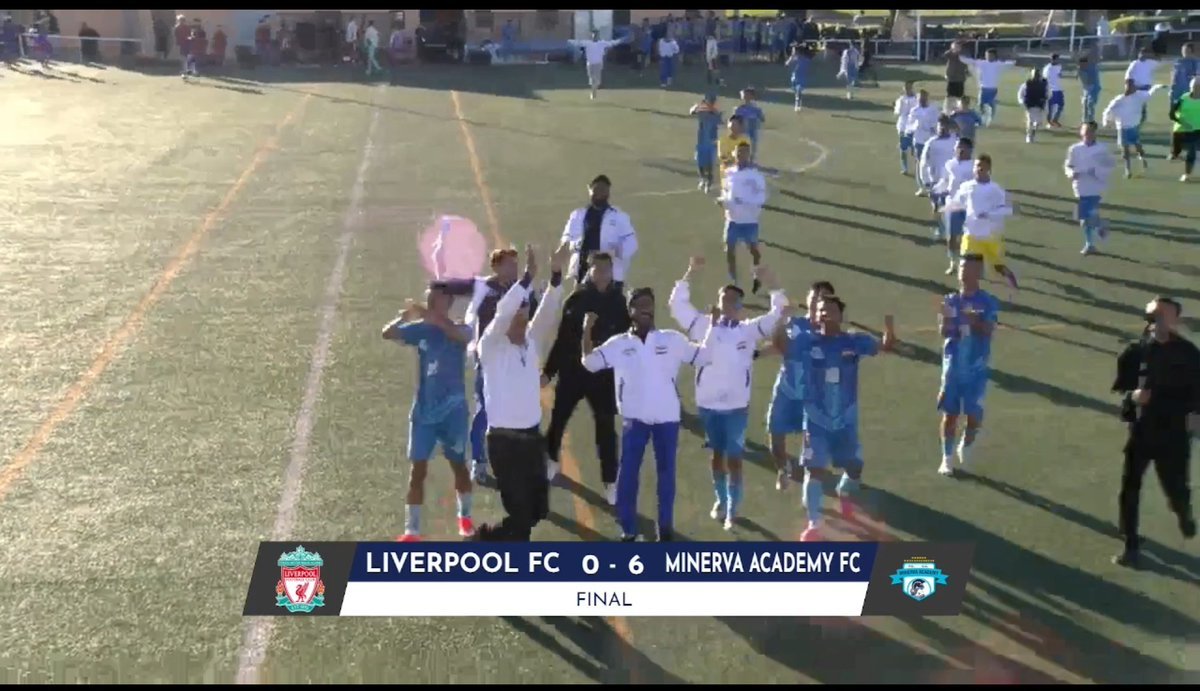
🚨 **HISTORY MADE IN SPAIN!** 🇮🇳⚽
India’s Minerva Academy just dismantled Liverpool FC 6-0 in the Round of 16 of the prestigious Mediterranean International Cup (MIC Cup - under-15) 2026 in Bascara, Spain! This isn’t just a win — it’s a statement. The boys from Punjab dominated from minute one.
Goals flew in: Mohammad Azam Khan opened the scoring in the 2nd minute + added another. Lisham Amarson Singh made it 2-0 in the 11th. Wahengbam Raj Singh scored a brilliant hat-trick (including two quick strikes and a long-ranger).
3-0 up by half-time. Complete control. No mercy. Minerva, the "Factory of Indian Football" from Mohali, have been dominating Indian youth football for years — multiple U-15 I-League titles, Subroto Cup wins, and a historic European treble last year (Gothia Cup, Dana Cup & Norway Cup).
Today they showed the world what Indian talent looks like when given the right platform, coaching and belief. This is bigger than one result. It’s proof that with proper academies and fearless play, Indian football can compete with — and beat — the biggest names in the game. Huge congratulations to the entire squad, coaches and owner Ranjit Bajaj! Indian football is rising. Slowly but surely.
The DarkSword iPhone exploit code just leaked on GitHub. This changes the threat model for everyone, not just Apple users.
Here's what most coverage is missing.
DarkSword was originally a nation-state grade tool — tracked by Google's Threat Intelligence Group since November 2025, used by Russian espionage groups and customers of a Turkish commercial surveillance vendor. This was elite capability reserved for high-value targets.
Now it's on GitHub. Anyone can download it, study it, modify it, and redeploy it.
That's the moment a spyware-grade exploit chain goes from "targeted espionage" to "commodity attack tool." Google themselves warned this is exactly what happens - leaked code gives threat actors a starting point to test, tweak, and iterate.
Three malware families deploy after compromise: GhostBlade, GhostKnife, and GhostSaber. Together they steal data, establish a backdoor for re-entry, and execute code - compressing the entire kill chain into a single click.
But here's the enterprise angle nobody is connecting.
SecurityScorecard's CISO Steve Cobb put it perfectly: once attackers gain credentials on a compromised phone, they're no longer limited to that device. They move into SaaS platforms, cloud environments, and partner systems without needing another exploit.
Now think about how many people use the same iPhone for:
→ Corporate email and Slack
→ AI agent control channels (Telegram, WhatsApp, Discord)
→ Two-factor authentication
→ Cloud storage with synced credentials
A compromised iPhone isn't a phone incident anymore. It's an enterprise access incident. If your CISO is running an OpenClaw agent through Telegram on their Mac and their iPhone connects to the same Telegram account - the phone becomes a lateral entry point to the agent.
This is the second iOS exploit kit disclosure this month. Coruna gave attackers 23 exploits across iOS 13 through 17.2.1. DarkSword covers iOS 18.4 through 18.7. Between them, nearly every iPhone version in the wild has been targeted.
What to do right now:
→ Update to iOS 26.3 immediately - this patches the DarkSword chain
→ Enable Lockdown Mode on any device you can't update
→ If your org allows BYOD, assume unpatched personal devices are compromised
→ Review what enterprise services are accessible from mobile - email, cloud, SSO tokens, AI agent channels
→ Test whether your mobile security controls can actually detect and block these exploit chains, not just in theory
The pattern is clear: nation-state exploit tools are leaking faster than organisations can patch. DarkSword is public now. The window between "elite capability" and "commodity attack" just collapsed.
Patch today. Not tomorrow.
More Info: https://t.co/U4G4e1IIkL
This is Microsoft SandDance. originally a closed-source project that was later open-sourced.
It lets you visually explore and understand data with smooth, animated transitions between multiple views.
@Rahul_J_Mathur In the late 60s avacados were very commonly grown in Sri Lanka. We had many plants gowing in our garden in Kandy. They were my "low hanging fruit" 😎