AI search is already choosing your competitors over you.
Here is what Amazon, Shopify, and Etsy sellers are missing right now:
When buyers ask ChatGPT, Perplexity, Gemini, Copilot, or Amazon Rufus for product recommendations, they get a short list of 3 answers: not 10 pages of search results.
If your listing isn't optimized for how AI interprets buyer intent, you’re invisible.
Here is the fundamental disconnect:
- Sellers write keywords & specification sheets.
- Buyers ask conversational questions.
Shoppers are asking AI engines:
- “Which espresso machine fits under low cabinets?”
- “Which earbuds stay in during a long run?”
- “Which air purifier is quiet enough for a bedroom?”
AI engines recommend products based on the buyer’s side of that conversation.
Most traditional seller tools only focus on keywords and spreadsheets.
DecodeIQ closes that gap by starting with the buyer.
With DecodeIQ, you can:
1. Uncover Real Buyer Language: Analyze how your customers actually talk across Reddit, YouTube, Amazon reviews, and 20+ sources.
2. Optimize Content: Instantly turn buyer insights into high-converting product listings, FAQs, buying guides, and blog posts.
3. Track AI Recommendations: Monitor which products AI search engines recommend in your category and see where your competitors appear.
4. Measure Visibility Gains: Re-scan your listings post-publishing to confirm your search engine presence is growing.
Stop optimizing for algorithms your buyers aren't using anymore.
Start from the buyer.
Scan your category: https://t.co/fsJVgYiEu1
Try the free tools: https://t.co/G6IcSu2vbc
ChatGPT changed its answer.
That does not prove your edit worked.
Answers vary run to run with nothing changed. To attribute a change: freeze the question wording, freeze the matching rule, run enough times before and after. Anything less is a story.
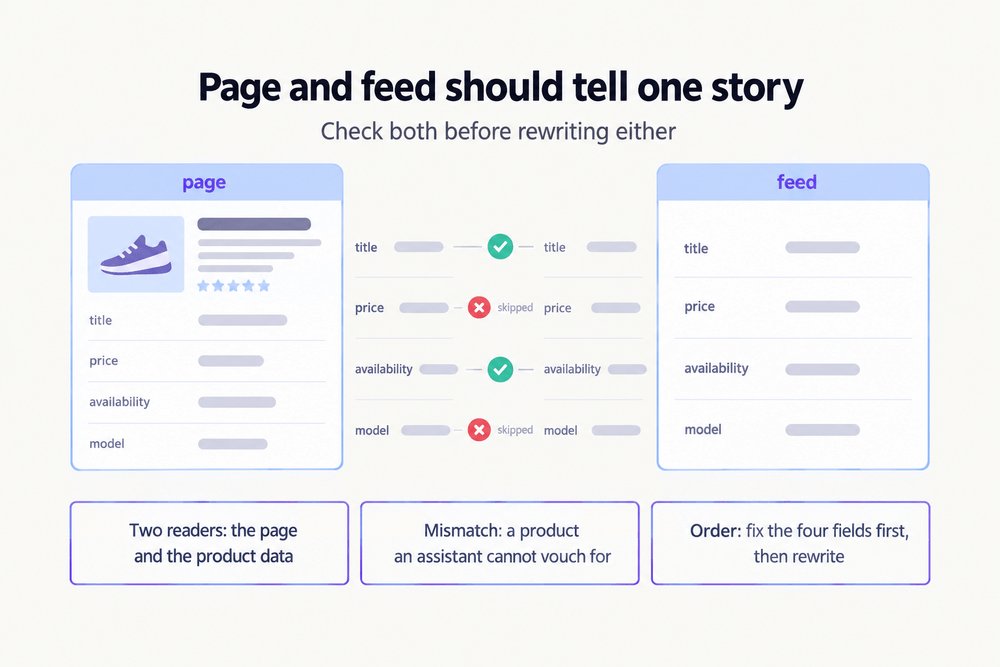
Product page and product feed should not tell different stories.
A different price, model, or availability in the feed is a reason to be skipped.
Two prices is a product an assistant cannot vouch for. Compare title, price, availability, model in both. Fix mismatches first.
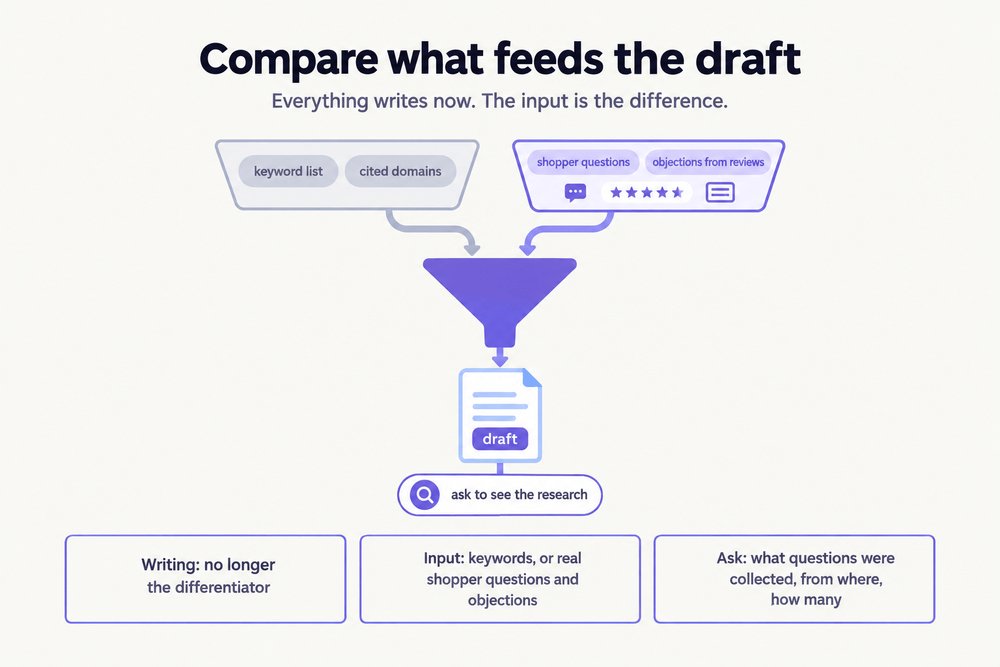
Promptwatch writes AEO articles on its Professional plan.
"Monitoring versus writing" is the wrong comparison.
Everything writes now. The question is what evidence went in: a keyword list, or real shopper questions and objections. Ask to see the research behind a sample draft.
Google rewards a page.
ChatGPT recommends a product.
Your Shopify store is optimized for the first and judged by the second.
The unit of visibility moved from page to product. Most reporting did not. For one product, list three shopper questions it should win. Ask each.
A readiness score is not a recommendation rate.
One is a page review. The other is an observed answer.
Readiness: does the page have the facts it should? Recommendation: for a real question, was your product named? You can pass one and fail the other.
Write both down.
Variants confuse AI answers.
If your page lists five sizes and no use case per size, the answer picks none.
"Small / Medium / Large" tells a machine nothing.
"Small: 12 to 16 inch chest. Dachshund to French bulldog" does.
One line per variant: who it is for.
Otterly starts at $29 a month for 15 prompts.
If monitoring is the whole job, that is a fair price.
Week two is the test. The report says you are missing from three prompts. Now what? If the answer is "fix the page," you need the full answer and a draft, not a count.
A shopper asks ChatGPT for a fragrance-free serum under $40.
Six products come back.
Is yours one of them, or is your brand a footnote?
The shortlist is built from product facts: price, ingredient, use case, what reviews say. If your page does not state the fact, it skips you.
"Not named in these answers" is not "invisible to AI."
One answer is a sample.
Absent in one answer is a data point. Absent in nine runs across three engines is a pattern.
Read the denominator before the verdict. Run one question three times and compare the lists.