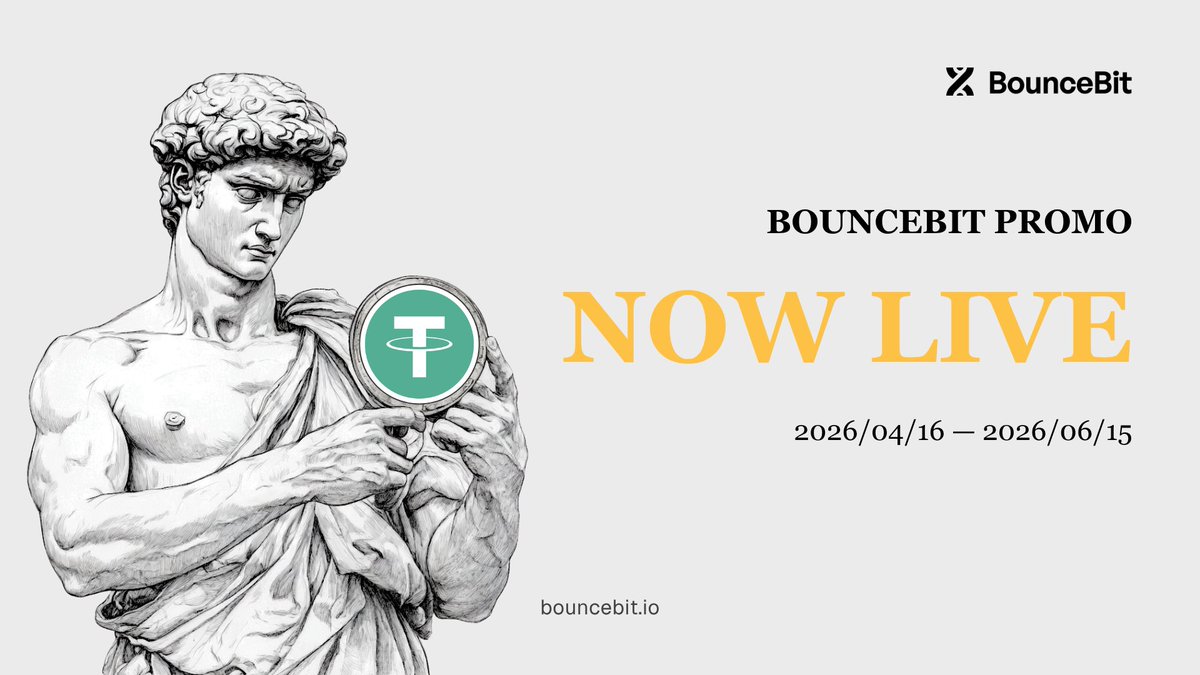
The USDT BounceBit Promo is now live!
• Stake USDT on BNBChain
• Fixed 7% APR
• 60-day term
• Capped at $1M USDT (no individual limits)
Made possible by $BB infrastructure. Link below.
Bounce Predict is now LIVE🔛
Curated lots. Verified data. Real outcomes.
Prediction markets for Sotheby’s upcoming auctions are open at:
📍https://t.co/xaP2spExfM
Call the hammer price. Back your conviction with USDT. Capture the upside.
The USDT BounceBit Promo is now live!
• Stake USDT on @BNBCHAIN
• Fixed 7% APR
• 60-day term
• Capped at $1M USDT (no individual limits)
Be quick. Link below.
Who pays the tariffs, friend?
You think I do.... my country?
Or.... Mrs. Johnson in Oregon who wants to buy a French cheese - or Italian Wine?
Or the US importer of the French cheese or Italian Wine to Oregon?
Who pays the tariff....?
So happy that Tariffs makes the US happy. We call it domestic tax. But it hurts the poorest people in the US.
All the best!
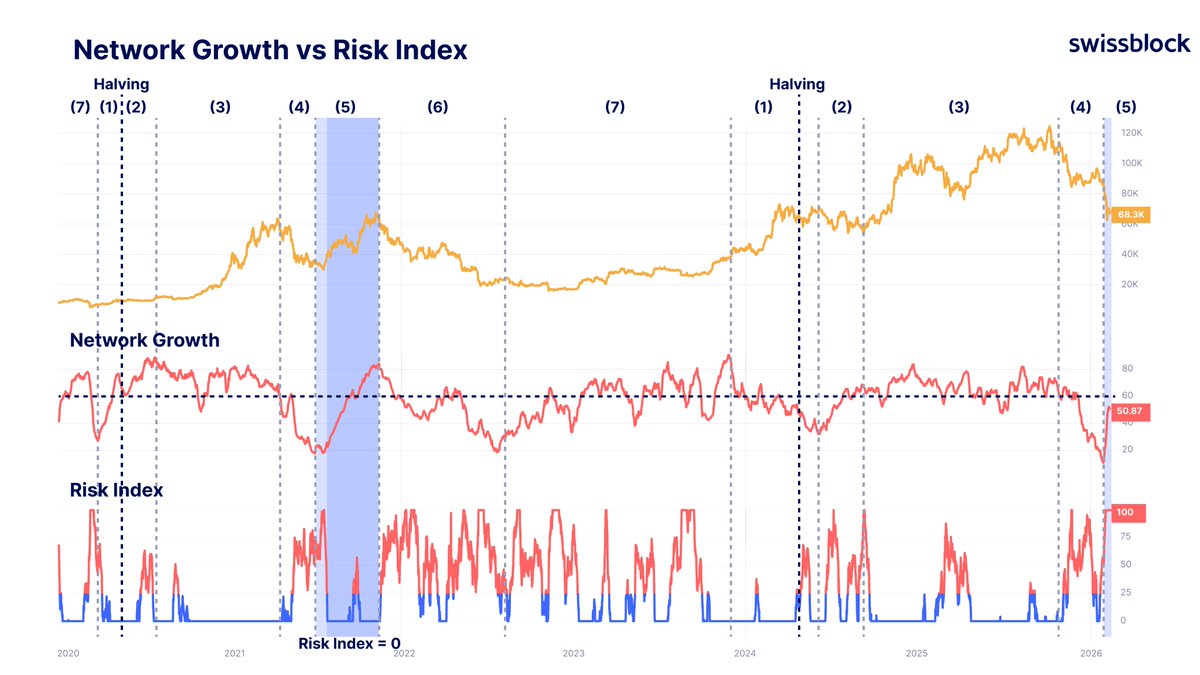
Since the beginning of February, we have observed a strong bearish move accompanied by a rapid rebound in Network Growth. This spike in Network Growth serves as a signal for an imminent transition into a specific stage of the $BTC cycle—which by extension affects the entire crypto ecosystem: the (5) Bull Trap phase.
While this stage is historically characterized by diminishing long-term structural strength, it often presents a window for market volatility to favor a final upward impulse before transitioning into the next phase: (6) Total Capitulation.
To identify the shift from (4) Disenchantment to (5) Bull Trap, the data requires a sharp recovery in Network Growth, as recently witnessed. This must be followed by a significant reduction in the Risk Index toward "Minimum Risk" levels, which would establish the theoretical foundation required for a sustained upward movement.
Currently, the Risk Index remains in the "Extreme Risk" zone (100); therefore, current market conditions do not yet reflect the technical alignment typically seen before a trend reversal.
My 2026 prediction :
Whether you follow the K-Wave or the 9-Purple Fire Period, the stars are aligning for a massive structural shift in 2026-2027.
1) The Energy Backdrop: AI and BTC are energy-hungry monsters. We are transitioning from a software-driven world to a hardware/energy-driven one. The Gold/Silver breakout is the "canary in the coal mine."
2) The Correction Catalyst: Watch for geopolitical "flare-ups." A pivot to defense spending will temporarily suck the air out of the AI/Crypto room.
3) The AI Timeline: Stop calling it a bubble. It's healthy. 2026 is when the actual mania begins (The 1997-1999 transition). 2027 will be the true birth of the next long-term cycle.
4) The BTC Path: 1H 2026 = Blow-off top driven by the Energy/AI crossover. 2H 2026 = The Great Reset.
5) There will be an altcoin season because of human nature.
@Henryleemr@star_okx Because a lot of MMs used USDE,BETH and BNSOL as collaterals to run altcoin strategies. So when these collaterals fucked up in prices , the system auto liquidated your alts.
No complexity. No accident.
10/10 was caused by irresponsible marketing campaigns by certain companies.
On October 10, tens of billions of dollars were liquidated. As CEO of OKX, we observed clearly that the crypto market’s microstructure fundamentally changed after that day.
Many industry participants believe the damage was more severe than the FTX collapse. Since then, there has been extensive discussion about why it happened and how to prevent a recurrence. The root causes are not difficult to identify.
⸻
What actually happened
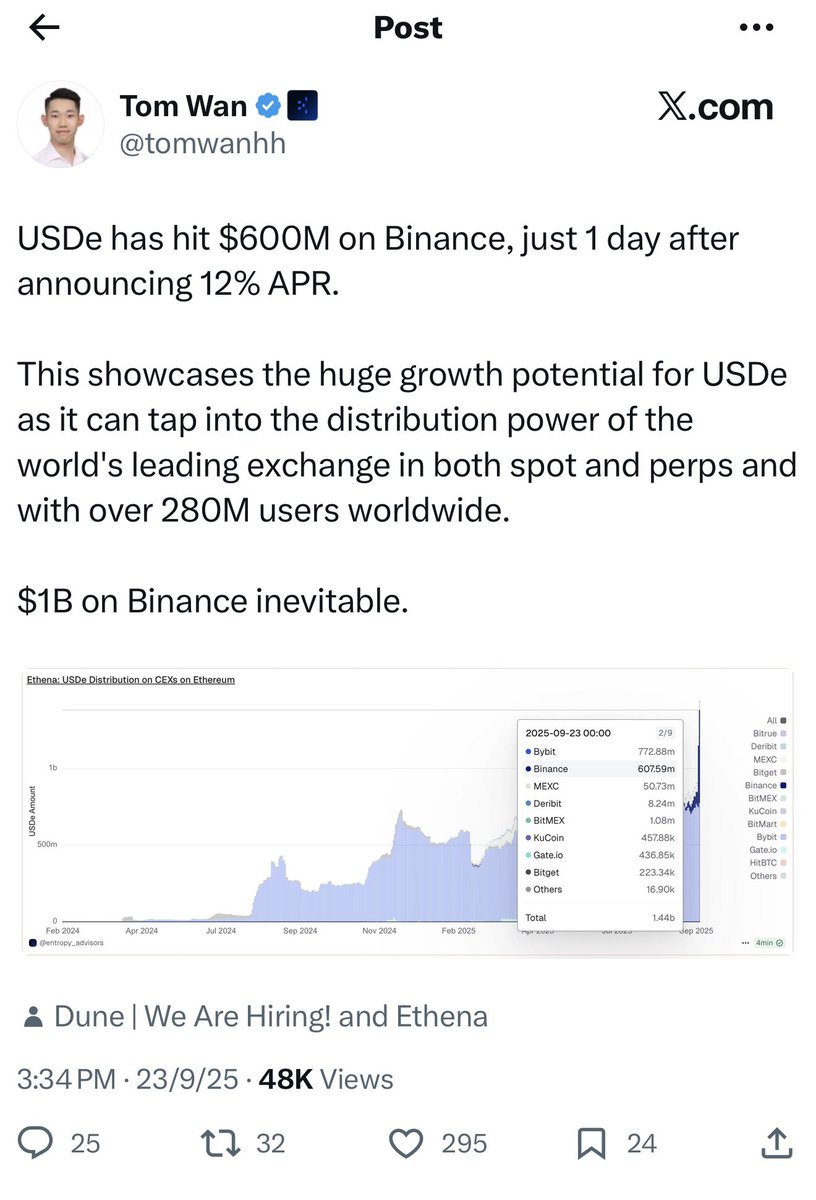
1.Binance launched a temporary user-acquisition campaign offering 12% APY on USDe, while allowing USDe to be used as collateral with the same treatment as USDT and USDC, and without effective limits.
2.USDe is a tokenized hedge fund product.
Ethena raises capital via a so-called “stablecoin,” deploys it into index arbitrage and algorithmic trading strategies, and tokenizes the resulting fund. The token can then be deposited on exchanges to earn yield.
3.USDe is fundamentally different from products such as
BlackRock BUIDL and Franklin Templeton BENJI, which are tokenized money market funds with low-risk profiles.
USDe, by contrast, embeds hedge-fund-level risk. This difference is structural, not cosmetic.
4.Binance users were encouraged to convert USDT and USDC into USDe to earn attractive yields, without sufficient emphasis on the underlying risks. From a user’s perspective, trading with USDe appeared no different from trading with traditional stablecoins—while the actual risk profile was materially higher.
5.Risk escalated further as users:
•converted USDT/USDC into USDe,
•used USDe as collateral to borrow USDT,
•converted the borrowed USDT back into USDe,
•and repeated the cycle.
This leverage loop produced artificial APYs of 24%, 36%, and even 70%+, widely perceived as “low risk” simply because they were offered by a major platform. Systemic risk accumulated rapidly across the global crypto market.
https://t.co/IK2gW4xUOP that point, even a small market shock was sufficient to trigger a collapse.
When volatility hit, USDe depegged quickly. Cascading liquidations followed, and weaknesses in risk management around assets such as WETH and BNSOL further amplified the crash. Some tokens briefly traded near zero.
The damage to global users and companies—including OKX customers—was severe, and recovery will take time.
⸻
Why this matters
I am discussing the root cause, not assigning blame or launching an attack on Binance. Speaking openly about systemic risks is sometimes uncomfortable, but it is necessary if the industry is to mature responsibly.
I expect there may be significant misinformation and coordinated FUD directed at OKX in the near future. Even so, speaking honestly about systemic risk is the right thing to do—and we will continue to do so.
As the largest global platform, Binance has outsized influence—and corresponding responsibility—as an industry leader. Long-term trust in crypto cannot be built on short-term yield games, excessive leverage, or marketing practices that obscure risk.
The industry needs leaders who prioritize market stability, transparency, and responsible innovation—not a winner-take-all mentality where criticism is treated as hostility.
Crypto is still early.
What we choose to normalize today will determine whether this industry earns lasting trust—or repeats the same mistakes again.
My conspiracy theory spidey sense says that Binance's move to prop up $BTC with their SAFU announcement was not because Binance is in trouble but rather because their friends and partners are in trouble and begging them to do something.
Most of this industry was built on a completely unsubstantiated "BTC is digital gold" narrative, and a lot of big players who tied their reputations and fortunes to this narrative are now eating crow.
I think the cabal will manually (manipulatively) start the "rotation into BTC" narrative themselves now that Gold and Silver are getting torched. Miners, exchanges, OTC desks, NYDIG, Blackrock, etc... all of them went all in on this "Digital gold" narrative and now they need to defend it.
I rarely make price predictions (and certainly don't care enough about Bitcoin to predict it's price)... but I'd be shocked if BTC doesn't have a massive candle higher this weekend/week to jumpstart that rotation narrative on the heels of Silver and Gold's collapse.