Can't speak to US-specific questions, but as a PhD student in HK, my take is the ROI on an AI PhD is simply too low right now. Nearly every traditional benefit (e.g., compute, experience, mentorship) can be obtained through alternative paths, often at higher quality. And a PhD costs you 3–5 years for a credential, which is almost an eternity given how fast AI is moving. By the time you graduate, the landscape will have shifted multiple times over. I wouldn't do it unless you land a truly exceptional opportunity. Just my two cents, hope it helps with your decision.
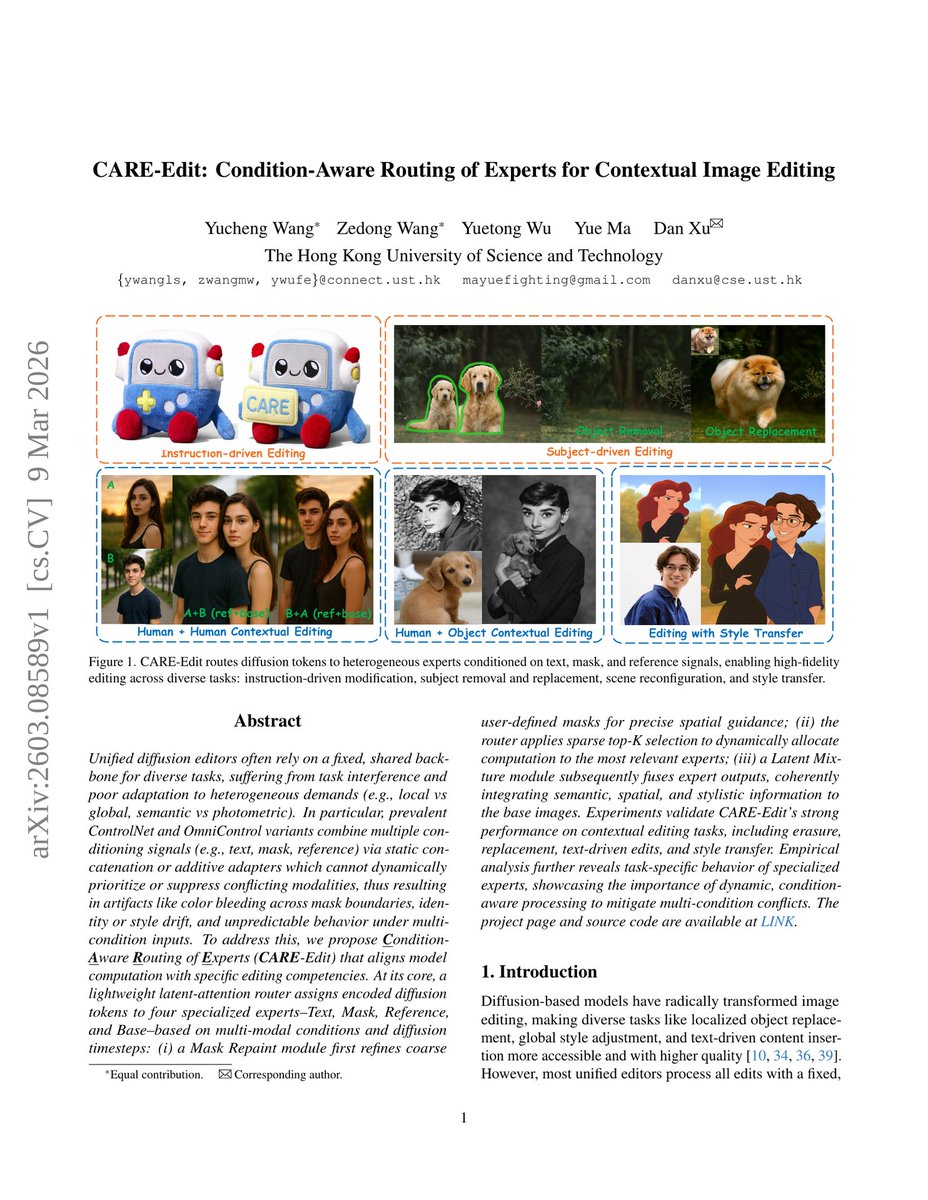
Thanks @HuggingPapers for sharing CARE-Edit! We introduce a condition-aware router that lets heterogeneous experts handle text, mask, and reference-guided edits without stepping on each other. Thrilled to see it accepted at #CVPR2026. Glad to have worked on this w/ @AndyYucheng.
CARE-Edit
Accepted at CVPR 2026. This unified diffusion editor uses a condition-aware router to dynamically assign tokens to specialized experts (Text, Mask, Reference, Base), solving task interference and color bleeding in multi-condition image editing.
CARE-Edit
Accepted at CVPR 2026. This unified diffusion editor uses a condition-aware router to dynamically assign tokens to specialized experts (Text, Mask, Reference, Base), solving task interference and color bleeding in multi-condition image editing.
@ingowoo Love this breakdown. I’d add a physical variable (sports) to that mix, too. The self-reflection during a workout just keeps me grounded. After all we’re still stuck in flesh and blood. Gotta maintain the hardware
Turning 25 today. 🍰
Lesson learned: Don’t pin all your joy and expectations on just one or two specific outcomes. This is the surest way to avoid disappointment.
Realization: We are individuals first, identities second. Being a good person matters more than any role I play.
Favorite insight from @fchollet: "Humor, art, science, and being kind to each other is how you preserve your sanity in a darkening world." (https://t.co/u7707vdLdu)
@behrouz_ali@mirrokni@meisamrr Such a refreshing take on scaling. Reframing model components as a set of nested loops compressing their own context flow with different time-scales, this just makes so much sense. Truly inspiring work!
@AndyLin2001@iclr_conf It’s baffling. Who on earth is behind this? It serves absolutely nothing other than to cause more chaos. Sorry you have to deal with this especially as an emergency reviewer.
Wow, never imagined it was THAT lean. It’s wild that a field driving tens of thousands of submissions is resting on the shoulders of such a team. Perhaps another way is extreme openness, like recent voices to 'TikTok-ify' the system with public like/dislikes. This might be an option to handle the ever-expanding scale, though it does sound a bit crazy.
Exactly. LLM reviews are blatant disregard for peer review’s core responsibility. It will be devastating without explicit and strict penalties. And, IMHO, ICLR’25 appears to set a dangerous precedent, massively expanding the reviewer pool, even inviting people with no PhD studies, no track record, no training. When you lower the bar indefinitely, quality doesn’t just dip, it evaporates.
Agreed. On one hand, ghostwriting reviews is a blatant disregard for peer review’s core responsibility. It will be devastating without explicit and strict penalties. On the other hand, IMHO, ICLR’25 set a dangerous precedent, massively expanding the reviewer pool, even inviting people with no PhD studies, no track record, no training. This year seems still the same. When you lower the bar indefinitely, quality doesn’t just dip, it evaporates.
@alexolegimas Agreed. no accountability = no trust. ICLR’25 massively expanded its reviewer pool, even inviting people with no PhD, no track record, no training. And this year seems still the same.
IMHO, when you lower the bar indefinitely, quality doesn’t just dip, it evaporates.