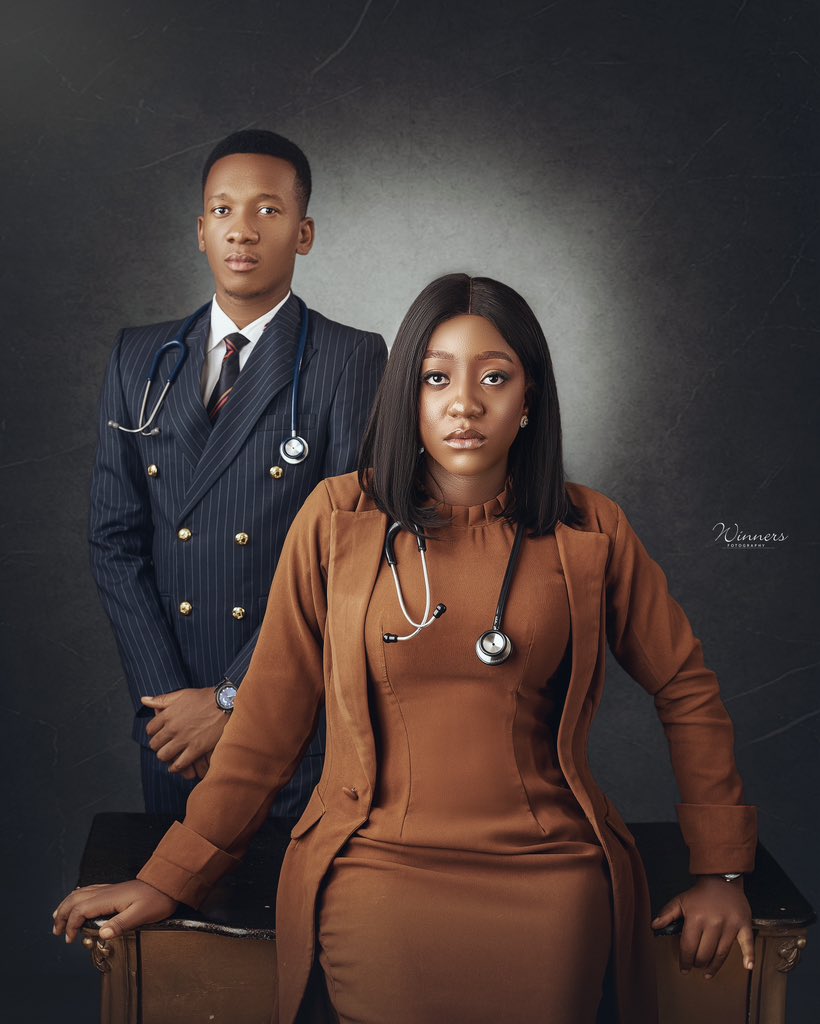
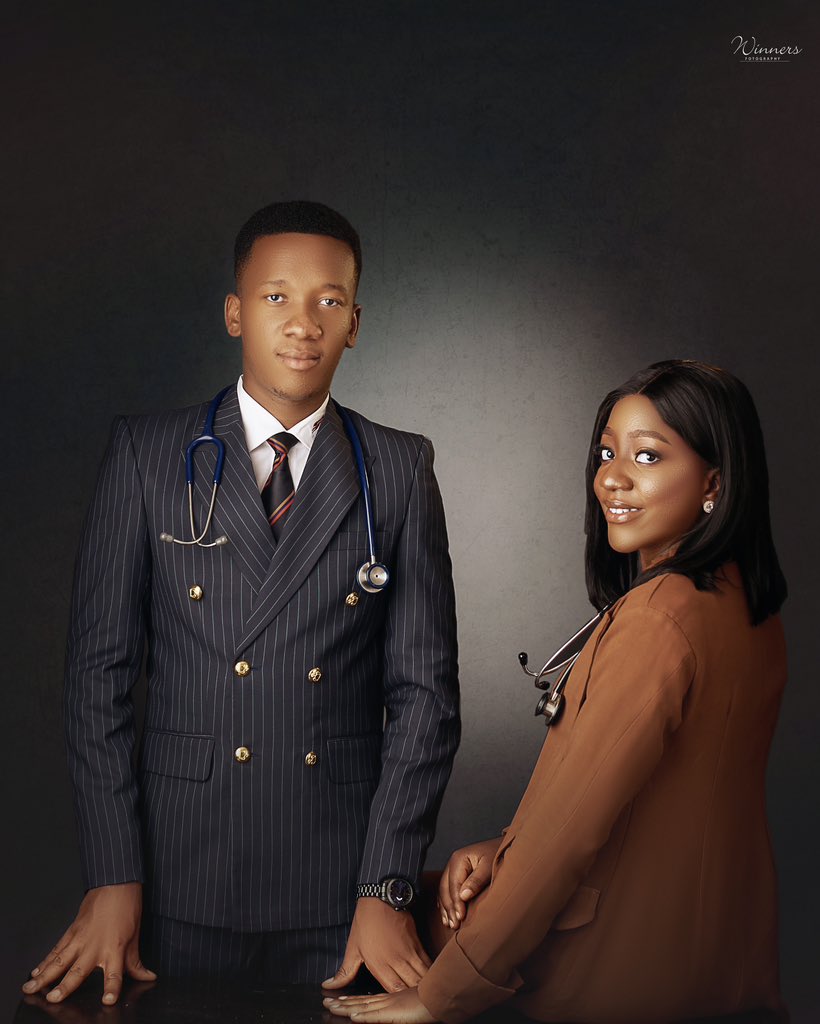
Ebenezer came Through for me and my Twin sister.
Thank you Lord for this Memorable 8years in medical school.
Officially,
Dr. Alpha Jacob Atede (MB;BS) Bingham University Teaching Hospital, Jos.
Dr. Alpha Joanna Egbi (MB;BS) Bingham University Teaching Hospital, Jos.
"I now spend almost 1 million naira every single month on fuel and power-related conversations. To fuel my car every single month, you have to spend about 400,000 naira. To fuel my generator, I am spending about 80,000 naira roughly every single week. I am also paying power bills which is on the high. Bear in mind, I also have solar power system. With solar, I am spending that much money every month... How are people surviving? How are people coping?"
- Pastor Olushola Olaleye
GOOD DAY, MR PRESIDENT: NIGERIANS DESERVE ACCOUNTABILITY
Good day, Mr President.
I congratulate you on spending a night in one of Nigeria’s states outside Lagos and Abuja. I hope you enjoyed the warmth, hospitality, and delicious cuisine of Akwa Ibom, which I am sure is even better than those of the destinations where you have spent over 260 days outside Nigeria since coming into office.
I sincerely hope this visit will inspire you to travel to the remaining 33 states of the federation, spend time with the people and, more importantly, explain what your administration has done with the ₦15.8 trillion saved from the removal of fuel subsidy, the over $100 billion you have borrowed, the increased revenues accruing to the government from taxing Nigerians, and the additional government revenues which your administration celebrated last year as having surpassed its target.
Nigerians deserve to know how many that were pulled out of poverty within this period, how many out-of-school children were returned to school, and how many functional primary healthcare centres you have built. They also deserve to know how much electricity supply has improved, especially given your promise that if you do not fix power, Nigerians should not vote for you. They deserve an explanation of how you have secured the country, which still ranks among the most terrorised countries in the world.
Mr President, Nigerians deserve answers. They deserve to know what has been done with the resources entrusted to your government.
The New Nigeria we want to build will be based on accountability, transparency, and the physical, measurable impact of our public resources on the lives of citizens.
A new Nigeria is POssible. -PO
Hello Distinguished Senator and the entire senate, Good day.
Is it in these types of “hospitals” that emergency aren’t to be rejected ? Is it in these type of hospitals that ambulance is to be arranged ?
Doctors are begging for good pay and working environment, thats not being attended to, doctors now want to leave the country for better life outside and that’s been unstrategically blocked by MDCN on the grounds of COGS. Still the ones on ground are still being threatened with 6 months imprisonment if they don’t work with the 1966 tools given to them.
If this isn’t slavery I don’t know what else to say Mr Senator. I tremble at the thought of the future of health care in Nigeria.
I really don't know why people feel comfortable talking about their professions online.
What I want to hear from Nigerian doctors is how to make medical practice and residency better and more fulfilling for us.
-Better accomodations for residents, not 1980 run-down buildings
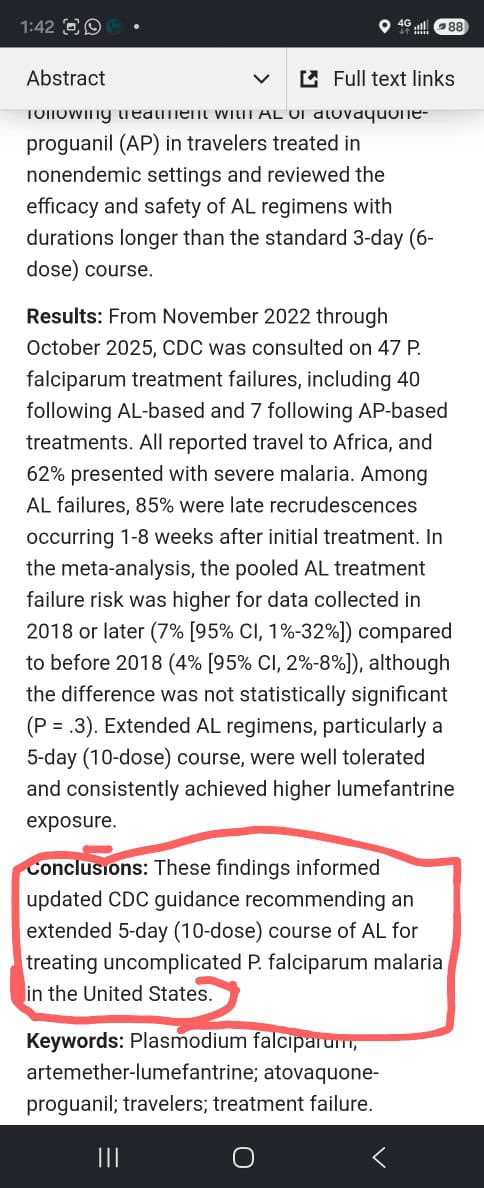
THE ISSUE AROUND THE RECENT US-CDC UPDATE REGARDING EXTENDED ARTEMETHER-LUMEFANTRINE TREATMENT DURATION OF 5DAYS.
Recent discussions among some Nigerian healthcare professionals and members of the public regarding the United States Centers for Disease Control and Prevention (CDC) update on extending Artemether-Lumefantrine (AL) treatment duration for malaria require proper contextual understanding.
It is important to clarify that the CDC recommendation of extending Artemether-Lumefantrine treatment to five days (10 doses) is not a universal recommendation for malaria treatment worldwide. Rather, it represents a specific response within the United States healthcare setting, particularly for travellers returning from malaria endemic regions who are managed in a population with different epidemiological characteristics from malaria endemic countries such as Nigeria.
The CDC’s position was informed by observations from a limited number of malaria cases managed in the United States. The report involved 47 patients, of whom 40 received Artemether-Lumefantrine and seven received Artesunate-Pyronaridine. Treatment failures, including some cases of severe malaria, were documented. However, such findings should be interpreted within the context of the study population, sample size, and healthcare setting in which the observations were made.
In countries where malaria transmission is endemic, treatment recommendations are developed using broader evidence from different regions, including clinical trials and continuous therapeutic efficacy studies. This is because malaria behaves differently in populations with varying levels of immunity. Individuals living in malaria endemic areas often develop partial immunity due to repeated exposure, unlike non immune travellers who acquire malaria after visiting endemic regions.
It is also important to understand that treatment failure does not automatically mean drug resistance. A treatment failure simply indicates that the expected treatment outcome was not achieved. The underlying causes may be varied and can include parasite factors, patient factors, drug absorption, adherence issues, reinfection, or true resistance. This is why molecular correction using PCR methods is essential to differentiate recrudescence (return of the original infection) from reinfection.
The National Malaria Elimination Programme (NMEP) continues to apply evidence based approaches to protect the effectiveness of available antimalarial medicines. A national Antimalarial Drug Resistance (AMDR) strategy has been developed to strengthen resistance monitoring, improve preparedness and provide strategic options should resistance challenges emerge.
For now, the recommended practice remains clear: suspected malaria cases should undergo parasitological confirmation before treatment whenever possible. We must continue to trust quality Rapid Diagnostic Tests (RDTs) and strengthen malaria microscopy capacity among laboratory personnel.
The current recommendation remains the use of approved ACTs, including Artemether-Lumefantrine, as a three day treatment course for uncomplicated malaria in Nigeria, in accordance with national guidelines.
Regarding special populations, Artemether-Lumefantrine remains an option for confirmed malaria infection in pregnant women during the first trimester when clinically indicated, while treatment choices in later trimesters should follow national recommendations. Artesunate-Pyronaridine requires careful consideration because WHO guidance remains limited due to insufficient pregnancy safety data.
The fight against malaria requires collective responsibility. Preserving our antimalarial medicines depends not only on identifying resistance early but also on ensuring rational prescribing practices and avoiding unnecessary modifications of treatment regimens without local evidence.
Pastey @pst_iren do more than preaching every morning, he gives life hacks too🥹🔥.
I don’t know why you’re not joining T30 every morning, it would change your devotion life.🥹❤️
Here’s the link for today: https://t.co/t2aV0lxDBt
Thank you @pst_iren
Thank you @t30devotion