Our Sociotechnical Framework to Assess Patient-Facing eHealth Tools has now been published in npj Digital Medicine https://t.co/haz45BpSRc
We validated and complemented an initial list of 55 assessment criteria based on previous frameworks through a two-round modified Delphi process with 57 experts from 9 stakeholder groups and 18 countries.
Expert consensus was reached on 46 criteria that were classified into foundational and contextual criteria.
This is an innovation project sponsored by Innosuisse, with the @FHNW as the research partner, and @Roche and KPT - Die Krankenkasse mit dem Plus as the practice partners
#DigitalHealth #eHealth #HealthIT #MedTech #HealthTech
I’m proud to introduce The Medical Futurist’s 100 Digital Health and AI Companies of 2026!
Just like in previous years, we don’t accept any sponsorship or financial support. We do not have any interest or connection in any of the companies listed in the infographic either.
Here are also 3 insights about the 23 new additions.
Read the full analysis with the high-resolution infographic: https://t.co/nsOeUNwL5g
Walmart is reentering healthcare with a digital-first model that bundles telehealth, pharmacy, nutrition and delivery... raising questions about quality and coordination when healthcare becomes part of everyday retail journeys.
#DigitalHealth#Telehealth
https://t.co/cNGTCuUf2h
The FDA is piloting a new approach that allows some #DigitalHealth devices to be used in reimbursed care before premarket authorization, in exchange for RWD. Success will hinge on strong oversight and safety monitoring.
#FDA#HealthRegulation#ChronicCare
https://t.co/4VEAmKForf
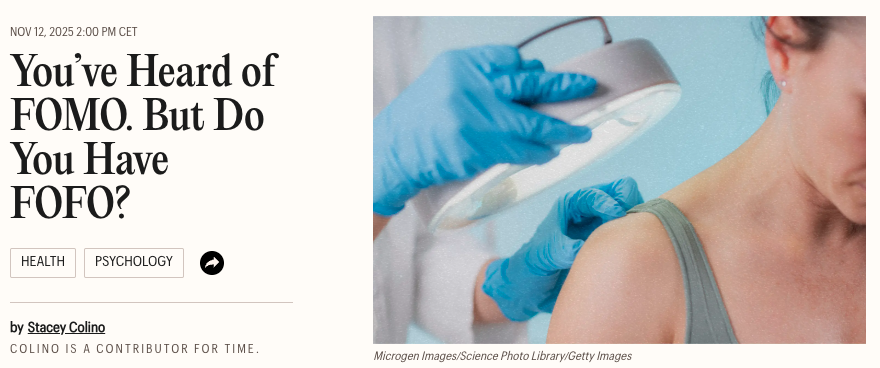
FOFO, fear of finding out, helps explain why many people avoid routine health screenings despite knowing their value. Addressing prevention means designing care that acknowledges fear, not just access.
#PreventiveHealth#MentalHealth#PatientExperience
https://t.co/It6rKatJCw
A new report shows most countries still lack clear rules on who is responsible when AI causes harm in healthcare. Without accountability frameworks, trust and patient safety are at risk.
#AIinHealthcare#ResponsibleAI#HealthPolicy
https://t.co/PY9NB0enTu
How Our Brain Drains Its Waste Products
and its relevance to our sleep quality and risk of neurodegenerative diseases
A podcast with @jonykipnis and illustrative summary of 3 of his recent review articles
https://t.co/X9OQIX6U42
This population-based study reveals dramatic increases in thyroid cancer diagnoses among young people worldwide, especially in higher-HDI countries, yet mortality remains very low, suggesting that overdiagnosis may be a major factor.
New research shows AI scribes perform better when given patient history. Ambient listening alone misses key context like labs and comorbidities. For real clinical value, scribing must be context aware and EHR integrated
#AIinHealthcare#HealthIT
https://t.co/v6ej8gmkOV
FDA is rolling out #AgenticAI tools for staff to support multi step regulatory work like reviews and surveillance. Big potential for efficiency, but key questions remain around accountability, oversight and how AI shapes regulatory judgment
#ResponsibleAI
https://t.co/GbL91CWV0O
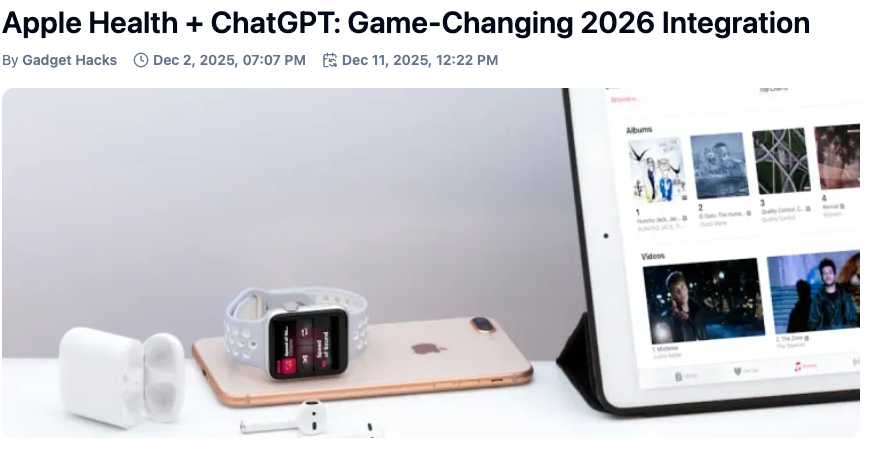
Apple’s planned ChatGPT integration offering personalised insights beyond today’s dashboards has huge potential, but privacy, accuracy and clear safeguards will determine whether this becomes a trusted tool or a risky leap.
#DigitalHealth#AIinHealthcare
https://t.co/PVqbPaCGTY
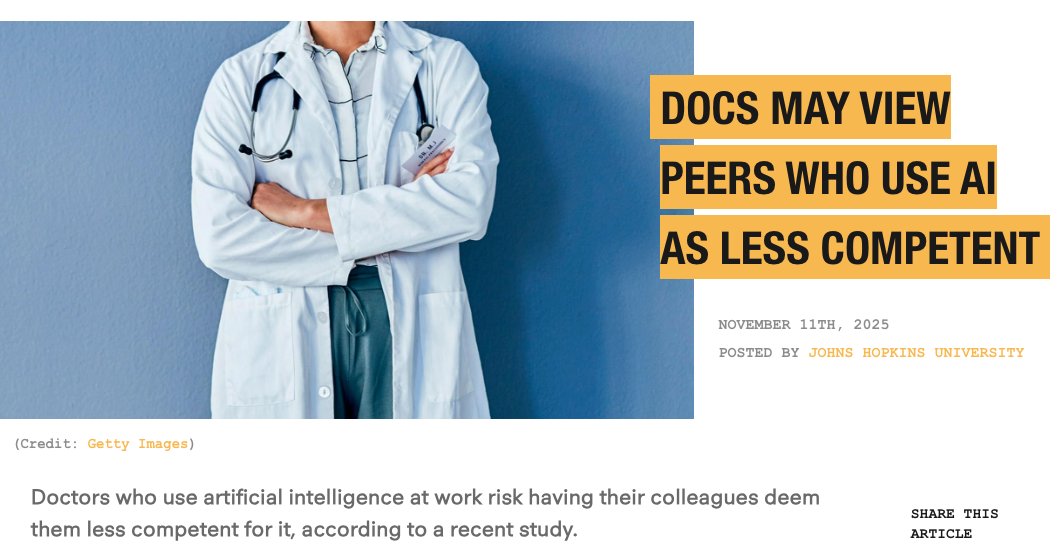
Study shows clinicians who rely on gen AI face a competence penalty from peers, being viewed as less skilled even when AI improves accuracy. Culture and trust will shape AI adoption as much as performance.
#AIinHealthcare#MedicalCulture#DigitalHealth
https://t.co/AUYzBzdMcc
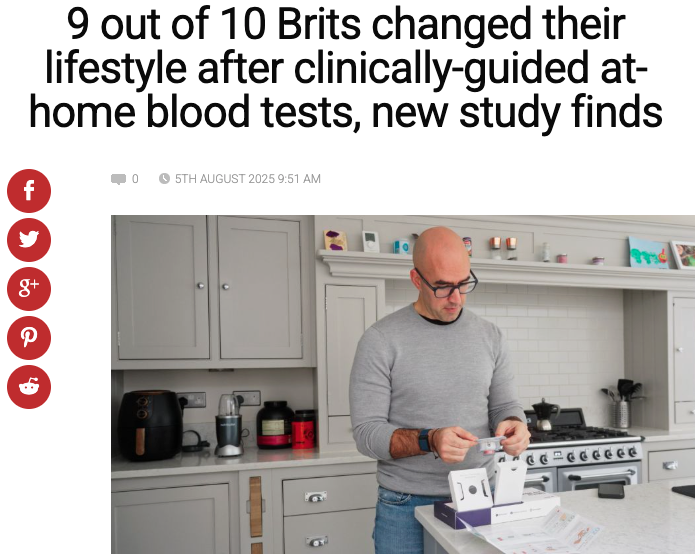
A study found 90% people changed their lifestyle after at-home blood tests with clinical guidance. #DigitalHealth can drive #Prevention, but reliability, regulation, and access will decide whether it empowers or deepens health inequalities
https://t.co/nhRRnh4inY
A new study finds AR/VR sports games can boost mental health by enhancing social connection, especially for those experiencing loneliness. Virtual presence can support well-being, but thoughtful, inclusive design remains key.
#ARVR#MentalHealth#XR
https://t.co/uVG7gErtqc
Researchers developed an AI that predicts risk for 1,000+ diseases up to 10 years ahead. A leap toward preventive medicine, but accuracy, bias, and ethics remain key challenges. Predictive power comes with responsibility.
#AIinHealthcare#DigitalHealth
https://t.co/vyhIx9PTnw
FDA clears iWatch feature to detect signs of hypertension using optical sensors and 30-day data analysis. A step toward preventive health, but questions remain on accuracy, equity, and how users interpret alerts.
#DigitalHealth#Wearables#Hypertension
https://t.co/7e2DmOA85G
With a projected shortage of 4.5M nurses by 2030, Taiwan’s Nurabot aims to cut nurse workload by 20–30% ... but robots cannot replace empathy and judgment. They are one piece of a broader workforce solution.
#AIinHealthcare#Nursing
https://t.co/K2D3RcCl41
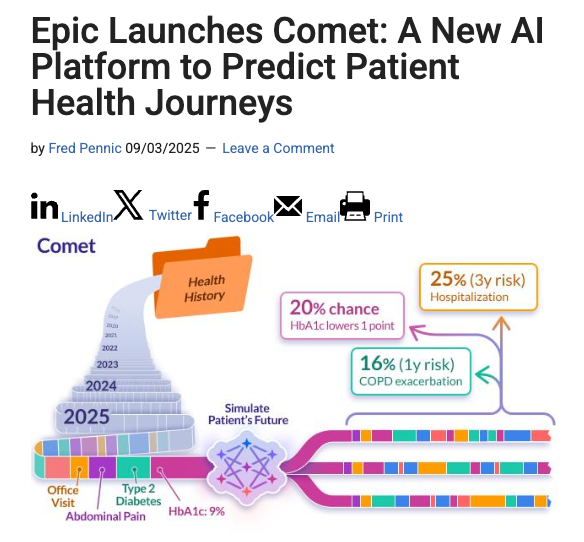
Epic’s new AI platform predicts patient health journeys from 100B+ medical events. Promise is clear, but incomplete and fragmented #HealthData risk bias and blind spots. Predictive AI must prove it adds equity and clarity, not complexity.
#AIinHealthcare
https://t.co/EXVFNEcAbH
This trial shows AI-enabled stethoscopes can boost early detection: 2.3x more heart failure, 3.5x more AFib, 1.9x more valve disease. A routine exam could become a powerful tool for life-saving intervention
#AIinHealthcare#Cardiology#DigitalHealth
https://t.co/0VbvrTZqRd