"Quid pro quo assumes equality, and equality does not factor into the casting couch, which belongs to the 'caster' who controls its use and whatever job opportunity might arise from it."
Excellent commentary on Harvey Weinstein's retrial by @marymacTV
https://t.co/EUarv84ePG
Mastercard has agreed to pay $26 million and audit its employment practices to settle claims that it systematically underpaid an estimated 7,500 female, Black, and Hispanic employees across the country, according to a court filing https://t.co/Hr0S5tM0am
Mastercard, Inc. has agreed to pay $26 million to settle a proposed class action accusing the company of underpaying female, Black and Hispanic employees.
Mastercard disputed the allegations and did not admit to wrongdoing as part of the settlement. https://t.co/rb0tvnHzsX
Women know that men don’t scheme to “dress like girls” to assault them.
They do it every day in broad daylight. And the ones in power protect each other to keep it quiet.
Just ask the House Ethics Committee. Or the President-elect of the United States.
Leave women alone.
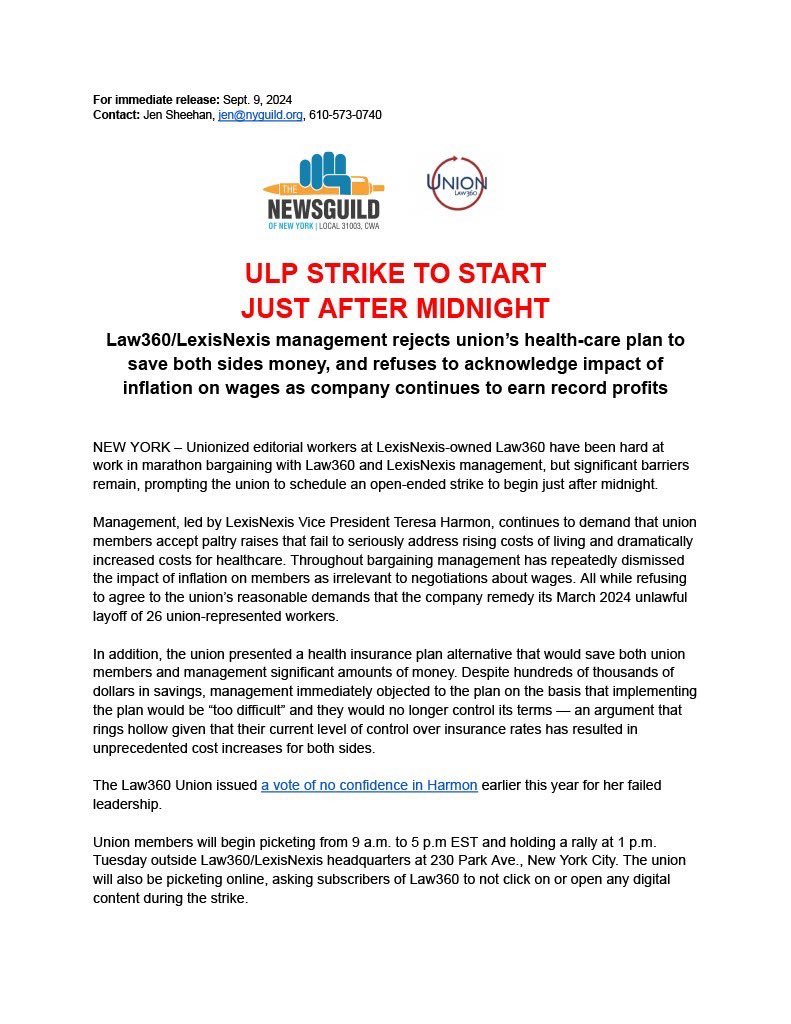
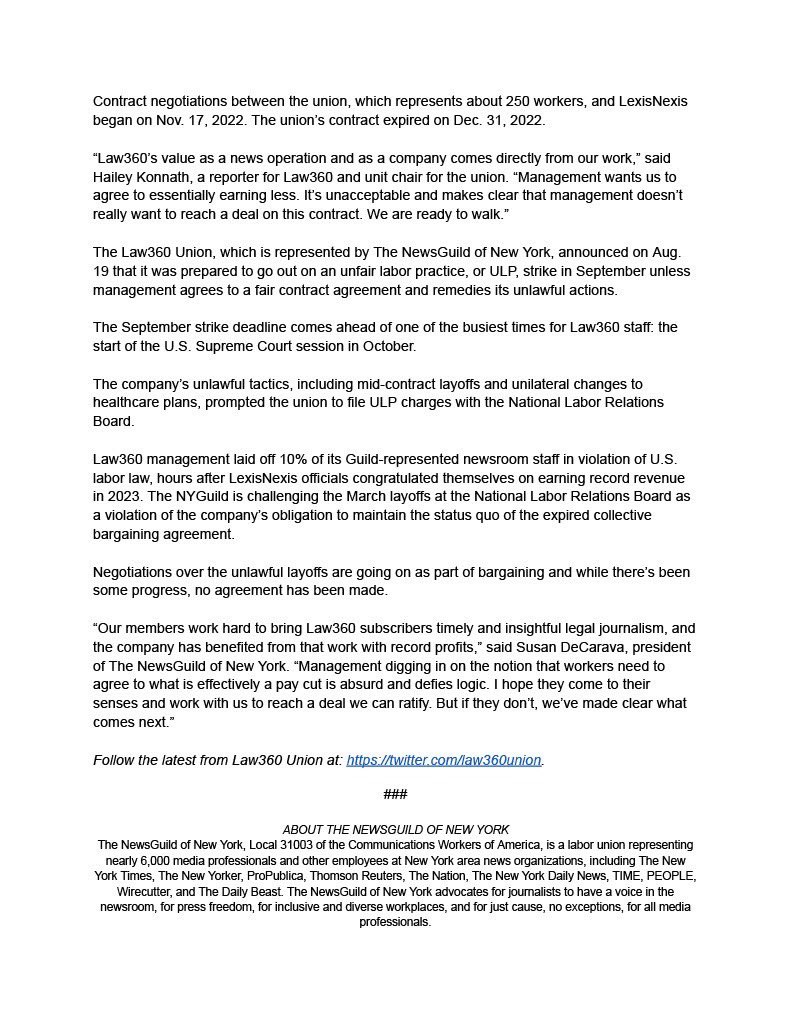
TIME’S UP @Law360 and @LexisNexis: We’ve offered you plenty of opportunities to reach a fair contract and remedy your unlawful practices at the table but tonight, just after midnight, we will walk off the job on an open-ended ULP strike.
A Texas federal judge has blocked the FTC's nationwide ban on non-compete agreements.
Non-competes are still banned in four states, and restricted in many others.
Here's what workers need to know about the Texas ruling. #FTC#BanNonCompetes https://t.co/lWUhRI7Yoq
As a Philadelphian, I can tell you this question matters to local voters.
(He went to Pat's, in case you need more evidence of JD Vance's untrustworthiness)
I've had a few people ask me about this, so just going to share my thoughts publically. The thing that's kinda crazy about it is that if you just look purely at the language of the agreements, there's a logical way to get where Disney is going. There IS in fact an arbitration agreement, and it DOES in fact purport to cover all claims against Disney, and it isn't limited to just things arising from the use of Disney+ or anything like that. So if you're just looking at the contractual language, it's not completely bananas.
With that said, while arbitration clauses are generally enforceable, you're not going to find any reported case where such a clause has been applied so broadly or to such draconian effect. To say that Disney's argument is "novel" would be a colossal understatement. So just asking "does the contract say this" doesn't necessarily end the inquiry.
In short, there does need to be some common sense applied. The law is not supposed to create bizarre, nonsensical outcomes, it's supposed to align with what people generally expect. And no one would ever expect that signing up for a 1 month free trial for a streaming service would waive your 7th Amendment rights and preclude you from ever suing Disney about anything, even things totally unrelated to the Disney+ service like a wrongful death claim at a restaurant on Disney property, in perpetuity. It's absurd.
For that reason, there's a concept in contract law called unconscionability that basically says that contractual terms that are so procedurally and/or substantively unfair or lopsided are void. And I think the reaction of the general public to this underscores that this falls into the "shock the conscience" category of contractual terms. So for that reason, I doubt Disney's argument succeeds (though we've seen courts do some pretty weird things lately, so who knows).
One final note: arbitration agreements are everywhere these days, and I hate them as a consumer protection lawyer. There's a case from 2011 called AT&T Mobility LLC v. Concepcion where the Supreme Court blessed the use of arbitration clauses buried in terms and conditions to preclude people from bringing their claims before a jury and bringing class actions to remedy consumer wrongs at all -- which, because the amount in controversy is generally too small to warrant individual litigation, means that there's no recourse at all. SCOTUS basically included a blueprint in the decision for how to insure that corporations would never have to face a consumer class action, and every company worth its salt has followed it. I can't tell you how many otherwise viable cases I have had to turn down because of Concepcion in the last decade. Consumers are largely without meaningful recourse.
So, if there is one good thing that's come of this, it's that it is shining a light on something really awful but super common that very few consumers are aware of. These arbitration clauses have a very real impact on your consumer rights, and we ought to be pushing back on their inclusion.
If you've read this far, thanks for indulging me.
Members of the Law 360 Union told me that bargaining has been moving at a glacial pace for the last year and a half and management has been trying to "claw back," some provisions workers got in their first contract.
My story on the strike threat:
https://t.co/ToSAUn081C