@JasonRink On the one hand, this is annoying. On the other hand, it often confirms that the movie isn’t worth seeing. If they teased you with less information, it might (falsely) seem more interesting.
Of course you can "speak ill of the dead."
Sure, the gratuitous airing of a deceased man's peccadilloes is in poor taste and serves no good purpose, and in general we ought to avoid attacking people who cannot defend themselves.
But as historians we must render judgment on the actions of a consequential person who affected the course of history -- otherwise we would fall into the trap of failing to "learn from history," as the hackneyed maxim goes. After all, wrote Shakespeare, "The evil that men do lives after them; / The good is oft interred with their bones."
Now to our topic: Alan Greenspan, former chairman of the Federal Reserve System, just died at age 100.
The general public wants to blame the United States president for the health of the U.S. economy, but the Fed chairman has much more influence over economic conditions.
Greenspan spent some time early in his career as an Ayn Rand acolyte, and in fact three chapters of Rand's book Capitalism: The Unknown Ideal, were written by the future Fed chairman.
(Ron Paul owned a copy of Ayn Rand's newsletter in which the Greenspan chapter "Gold and Economic Freedom" originally appeared, and even got it signed by the author.)
Greenspan's opponents on the left therefore interpreted his whole career through a Randian lens, which serves to remind us how stubbornly they refuse to understand the world.
Had Greenspan wanted to run the Federal Reserve in such a way as to approximate a gold standard as much as possible, he could certainly have done so. Instead, he used it as an instrument for central planning, with disastrous results.
Initially, Greenspan could do no wrong. He became known as "The Maestro," effortlessly conducting the economy through treacherous waters.
The New Republic ran a story co-authored by Stephen Glass about a Wall Street firm that had built a literal shrine to Greenspan, complete with dozens of news photographs and quotations from Greenspan's speeches, and a red leather chair cordoned off by blue velvet ropes, where Greenspan had allegedly sat in 1948.
Traders from the firm claimed they would sit in the chair for "inspiration" after losing money; brokers said they literally prayed to Greenspan and used a software program called "The Talmud of the Federal Reserve."
That was a fake story and there was no such firm (the Stephen Glass oeuvre of fake stories was eventually exposed, and in fact became the subject of the film Shattered Glass), but the fact that a story like that seemed plausible enough as to have aroused no suspicion tells us something.
Meanwhile, Greenspan's contempt for the public was legendary: he confessed to Lesley Stahl of CBS that before congressional committees he would speak gibberish -- a tactic he called "syntax destruction."
The next day the headlines would report two different things about what he had said, and for Greenspan that meant he had succeeded.
Greenspan's policy moves (like arranging for a bailout of Long Term Capital Management in 1998) gave rise to the belief in a "Greenspan put," according to which investors could be assured that the Fed chairman was prepared to use the tools at his disposal to backstop the market if it should ever fall below a certain level.
And of course his monetary stimulus after the dot-com bust in 2000-2001, which looked to some observers at the time as a brilliant move, only delayed the reckoning, and transformed that bust into a real estate bubble (and eventual bust).
When the lights of the economy should have turned red, Greenspan made them all green. That was the only recession on record in which housing starts rose rather than fell.
The Federal Reserve, like the government itself, has no real goods at its disposal, so while its various tricks can redistribute resources and simulate prosperity, it cannot generate real wealth. It simply arranges the economy into an unsustainable configuration that has to come apart.
Because of Greenspan's earlier association with Ayn Rand, and because the general public knows so little about the Fed, when the 2008 crash occurred, people generally went along with blaming "capitalism" -- even though the Federal Reserve is a non-market institution created by act of Congress and enjoying a government-granted monopoly, and even though Greenspan's manipulations overrode what the market was trying to say.
Greenspan's legacy is 2008, and the undeserved reputational damage that the market economy suffered as a result.
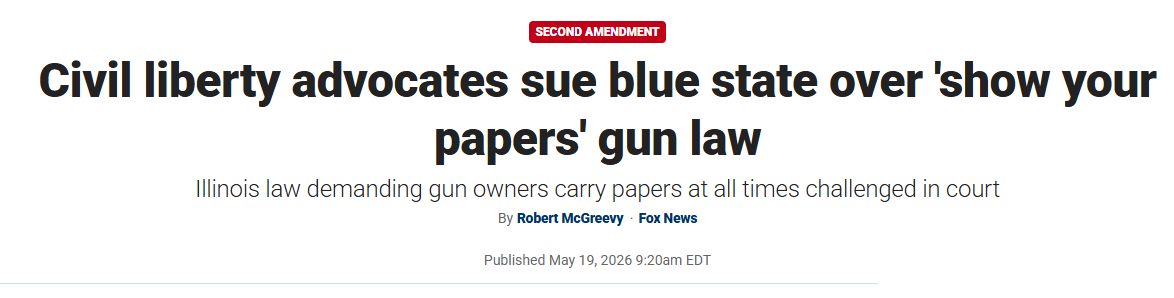
Today's SCOTUS decision in U.S. v. Hemani is great news for our lawsuit challenging Illinois's FOID Card requirement.
Today's case involved a federal law that makes it a crime for marijuana users to possess a firearm. The government tried to justify this by pointing to founding-era "habitual drunkard" laws. But, as Justice Gorsuch observes, those laws required some kind of pre-deprivation process--in general, a court had to decide that someone was a habitual drunkard (a high bar in those days of heavy alcohol consumption) before that person could be disarmed. The federal law doesn't work that way: if you use marijuana at all, you're automatically committing a crime if you possess a firearm--no court has to decide in advance that you, specifically, are too dangerous to have a gun.
In Illinois, it's like that, but worse: everyone is disarmed, by default, on suspicion that they might be disqualified--and each person has to prove his or her eligibility to the Illinois State Police before so much as touching any gun. That's not how constitutional rights are supposed work, and it violates both the Second Amendment and the right not to be deprived of liberty without due process of law. We look forward to seeing the courts strike it down, just as the Court struck down the federal marijuana-user ban today.
Illinois gun laws are awful, and the state is trying to make them even worse. But our lawsuit challenging the FOID card could restore Second Amendment rights, and due process of law, for the state's long-suffering law-abiding citizens. I talked about it with @washexaminer:
Anti-Glock agenda could be next target for Illinois gun advocates | Emily Hallas, Washington Examiner
Illinois is considering boosting gun control measures, even as its laws are under fire from Second Amendment advocates concerned they undermine constitutional rights.
Illinois is one of two states that require residents to obtain a government-issued license to legally possess or purchase any firearm, giving state police up to 30 days to approve or deny applications. While the New Civil Liberties Alliance is suing to block the Illinois Firearm Owners Identification Card Act, gun rights proponents could find themselves facing yet another hurdle in the coming months, as state Democrats begin to eye a bill that would effectively ban Glocks.
The trend toward stricter gun control has sparked intense opposition from Second Amendment activists, with NCLA senior litigation counsel Jacob Huebert telling the Washington Examiner that the licensing case is especially important “because it involves the licensing of a constitutional right.”
“Illinois has had just about the least respect for gun rights of any state historically,” he said. “Forcing someone to get a license to exercise a constitutional right at all violates due process, because that’s not how rights work. The right is something you’re supposed to have, and it means you can do something without the government’s permission. When you flip that, putting the burden on the citizen, you’re depriving people of liberty without due process of law.”
“It’s very doubtful that this law does much to prevent crime, but it certainly prevents law-abiding citizens from getting a firearm when they urgently need one because it’s not like you can get this thing instantly,” Huebert continued, pointing to FOID card wait times, which averaged between eight and 17 days last year. “A lot of people may suddenly realize that they need to defend themselves urgently if they face a threat, and if you have to apply and wait, you’re out of luck, and you don’t get to exercise this right when you need it the most.”
Now, Illinois could be poised to embrace another gun control measure and become the next state to pass legislation targeting Glocks after Connecticut recently passed a similar measure into law. Democrats hold a supermajority in the Illinois legislature, making the blue state far more amenable to such measures.
Democratic state Rep. Justin Slaughter spearheaded the Illinois legislation, House Bill 4471, which would make the firing mechanism design of Glock guns illegal. The bill seeks to ban the sale of any semiautomatic pistol with a cruciform trigger bar, due to concerns that the weapon could be altered to install a switch that turns a pistol into a machine gun.
Such switches are already illegal in Illinois, as they are in Connecticut, where Gov. Ned Lamont (D-CT) signed the “Glock switch bill” into law in late May. But Illinois lawmakers are under intense pressure from gun control groups such as Everytown for Gun Safety to pass the bill, citing fears that criminals are using cheap conversion devices to turn pistols into machine guns within minutes.
“It is to put pressure on Glock; it’s eaten away at one of its markets, like California, and New York, and Maryland, and Illinois, and anyone else who will join in this fight to make sure they can’t continue to sell guns that they know are this easy to convert into machine guns,” Everytown for Gun Safety Director Sam Levy said.
“For students and young people, this issue is terrifying because we are the generation growing up practicing lockdown drills while weapons capable of firing dozens of rounds in seconds continue spreading in our communities,” added Ajani Crenshaw, a student activist with Everytown.
The Illinois Glock measure did not pass the legislature before the last session ended May 31. But it could be revived during the next session, as Slaughter touts the bill as “a consumer product safety measure” that “continues to support smart, sensible gun ownership.” Slaughter’s office did not respond to the Washington Examiner’s request for comment.
Gun control issues are sensitive in Illinois, as the state is home to some of the country’s most intense laws regulating firearms.
Massachusetts is the only other state that requires residents to obtain a license from the government in order to own a firearm.
The law was challenged in court in Massachusetts due to its impact on nonresidents. Two New Hampshire residents were involved in the lawsuit after they were arrested on suspicion of carrying guns while traveling in Massachusetts. Over two dozen states joined the lawsuit, and it made it all the way to the Supreme Court before justices declined to consider the case in January.
In Illinois, NCLA’s Huebert said the pushback against gun regulation is real, arguing it penalizes law-abiding citizens while failing to achieve real gun safety reform.
“Emails, voicemails are flooding in from people who want to say that they support what we’re doing, want to join what we’re doing, really like, I’ve never seen within a case I’ve done before,” he said, musing on feedback to NCLA’s lawsuit challenging the FOID law. “It’s been a really big response, one of the biggest responses that I’ve got in my career as a constitutional litigator.”
“If you want to murder somebody or be involved in crime and want firearms for the commission of crimes, why would you care about complying with the FOID law if you’re going to break other laws anyway that could get you in even bigger trouble?” he added. “Law-abiding citizens of course are the ones who are going to apply for the FOID card if they want to respect the laws on the books, and they don’t want to get in trouble with the government … If you’re not law-abiding, then you are not going to abide by the FOID crime requirement.”
https://t.co/llvzFtkRci
@richard_normal He is certainly referring to Anakin, the one who does in fact kill the Emperor. If there was any question about this, how could it not have been resolved by what actually happens.
Astute analysis of our lawsuit challenging Illinois's FOID Card Act--which requires Illinois residents to get permission from the State Police before so much as touching a gun--from @GunWashington https://t.co/E4dWmfvs73
@BrianCostin I suppose they included some carve-outs for non-residents to avoid certain constitutional challenges. But of course the Constitution requires Illinois to respect its own residents' rights, too.
There's A New 2A Lawsuit You Need To Know About: 'The FOID Card Act violates both the Due Process Clause of the Fourteenth Amendment and the Second Amendment' https://t.co/LgfdzsTQ3p
Former co-worker @JacobHuebert and the @NCLAlegal are suing to end Illinois’ FOID scheme.
In Illinois, you need permission from the State Police just to touch a gun.
That’s not how constitutional rights work.
End FOID. Restore the constitution.
In Illinois, you have to get permission from the State Police to even touch a gun--any gun, anywhere, for any reason. And the burden of proof is on you.
That's not how rights are supposed to work. A right means you don't need anyone's permission.
So today we sued. 👇