Ancillary services are used to support reliability and respond to uncertain circumstances that arise on the grid. But, the way we define AS products can significantly impact prices and therefore which types of resources are rewarded in electricity markets.
"Additionally, the VOLL underlying the ASDCs is substantially less than the VOLL implied by a
1-in-10 reliability standard. Even if deep shortages are capped at $5000, the lower segments of
the ASDCs that price shallow shortages (which are by far the most frequent)..."
PJM's new paper is candid: the assumptions of organized capacity markets no longer fit. The concerns aren't novel; they were visible in 2009. Capacity mechanisms remain an attempt to remedy the consequences of a distortionary policy with another distortionary policy.
@Astoll15 I’ve always interpreted “too cheap to meter” to mean that it wouldn’t be worth tracking the kWh consumed—you could still charge a fixed fee for each customer class to cover fixed costs but have a marginal cost of zero.
BIG NEWS: Our first Frequency Band podcast episode is LIVE! 🎙️ Rob Gramlich (@RobGramlichDC) from Grid Strategies and Kyri Baker (@kyrib) from CU Boulder join us to talk grid innovation. ⚡
🎧 Stream it now and let’s power up energy conversations: https://t.co/uELXgJt3wE
New paper on non-convexity, uncertainty, and uplift in wholesale electricity markets: in our NYISO simulations, operational policy mattered more than the pricing rule, and uncertainty + look-ahead price inconsistency drove most make-whole payments. https://t.co/BdVPWnEDDo
New paper: as power systems add more wind, solar, and storage, prices depend more on uncertainty and storage opportunity costs. We show deterministic production cost models can misvalue flexibility and understate real-time price dynamics. https://t.co/ERLweq9j6G
I agree with @PaulSegal12 that there shouldn't be an *exception* for TMI. But TMI is a clear example of how a first-in first-out queue will not deliver optimal results--more evidence that a more fundamental process change is needed.
@fredstaffordcs@JaneAFlegal SPP seems to be pursuing it now, and I don't see why it can't happen (though see the discussion about TO objections below the linked tweet): https://t.co/y5h4mhBgrp
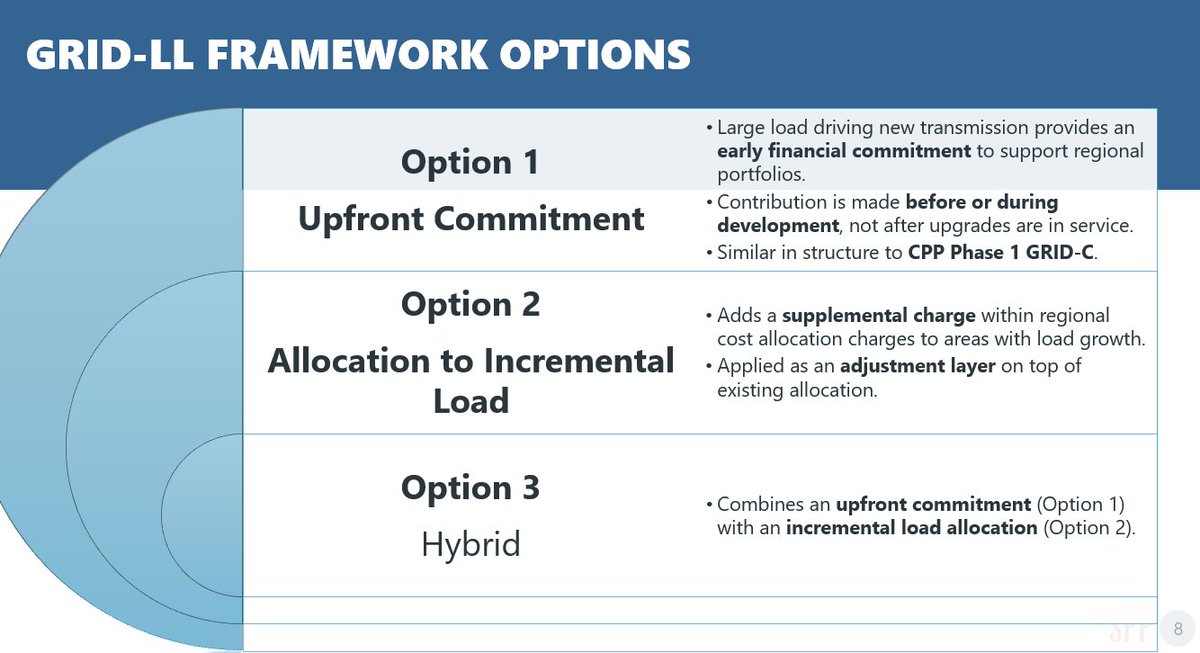
SPP showing that it's possible to allocate regional transmission costs to data centers. It's proposing 3 options to stakeholders.
This is a HUGE missing piece to ensure data centers are paying for all infrastructure built for them.
@fredstaffordcs@JaneAFlegal I think the second is better, but leads to the question: can we identify individual DCs as beneficiaries and thus allocate cost to them, or can we only allocate cost at a higher level? Order 1920 seemed to imply individual customers could be beneficiaries; 1920a walked it back.