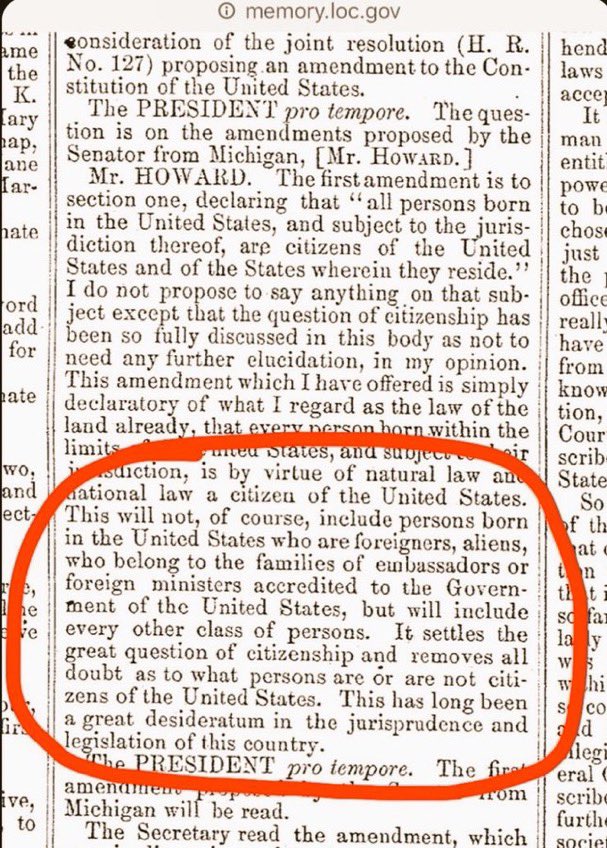
@mattvanswol A screenshot of an excerpt of the speech given by the author of the 14th amendment. Any originalist can plainly see that birthright citizenship does not extend to foreign invaders. It is a shame that our court could not.
San Francisco (June 24) — Leftist lawmaker @Scott_Wiener was aggressively accosted in the Mission district by a far-left extremist demanding he chant “Free Palestine.” The demand mirrors how leftists and liberals hounded people to support BLM in 2020, or to wear masks.
"And, sir, permit me to say that of all the causes which justify the action of the Southern States I know none of greater gravity and more alarming magnitude than that now developed of the denial of the right of secession. A pretension so monstrous as that which perverts a restricted agency, constituted by sovereign States for common purposes, into the unlimited despotism of the majority, and denies all legitimate escape from such despotism when powers not delegated are usurped, converts the whole constitutional fabric into the secure abode of lawless tyranny and degrades sovereign States into Provincial dependencies."
-Judah P. Benjmain (D-LA 2/4/1861)
"We are an unwilling bride. I think incompatibility of temper began when it was made plain to us that we got all the opprobrium of slavery & they all the money there was in it with their tariff."
-Mary Chestnut (SC 6/27/1861)
Senator John Kennedy says the Democrats are "living proof evolution is a slow process."
The Louisiana senator blasting the party's progressive wing after recent primary wins by socialist-backed candidates, arguing most Americans will reject that direction and says Democratic leadership now faces growing pressure to respond.
"The Bolsheviks are in charge of his party, and they're stone cold crazy."
@AmericaNewsroom
Unumquodque dissolvatur eo modo quo colligatur
Everything is dissolved by the same mode in which it is bound together. In 1788, the sovereign people of NC assembled in convention at Hillsborough and, by a vote of 184 to 84, declined to ratify the proposed federal Constitution. That decision bound the state outside the new Union. Yet the same sovereign authority that had withheld consent could, and did, later grant it. In August 1789 the people elected an entirely new convention; on November 16–23, 1789, that body at Fayetteville ratified the Constitution by a decisive 194–77 margin. What one convention of the people had refused, a subsequent convention of the people accepted. The maxim was fulfilled: the same power that withholds can confer. Seventy years later the same logic operated in reverse.
In 1861 the sovereign people of North Carolina once again elected a convention—this time to consider withdrawing from the Union they had entered at Fayetteville. That convention exercised the identical authority the people had used in 1789. If the 1861 act of secession by convention was illegitimate because it overturned a prior popular decision, then the 1789 ratification itself must have been illegitimate on the same ground, for it overturned the 1788 refusal. Both acts derived their legitimacy from the same source: the people’s inherent right, expressed through specially elected conventions, to bind or to unbind their political obligations.
Governor Samuel Johnston recognized this principle as early as May 10, 1789, when he assured President Washington that North Carolina’s ultimate relation to the Union would be settled by the people themselves once amendments addressed their concerns. The people, therefore, retain the perpetual capacity to revisit and reverse any prior convention’s judgment. No decision of one sovereign assembly can permanently disable the same sovereign people from assembling again and rendering a contrary judgment. Whether the question is ratification in 1789 or secession in 1861, the maxim governs: that which is joined together by convention of the people may be dissolved by convention of the people. The mode of creation and the mode of dissolution remain identical.
Secession was possible from the "perpetual" Articles of Confederation when 11 states formed a new Union without RI and NC; and likewise, secession was possible from the new Union on the same principles.
"Though this state (NC) be not yet a member of the union under the new form of government, we look forward with the pleasing hope of its shortly becoming such; and in the mean time consider ourselves bound in a common interest and affection with the other states, waiting only for the happy event of such alterations being proposed as will remove the apprehensions of many of the good citizens of this state, for those liberties for which they have fought and suffered in common with others.
This happy event, we doubt not, will be accelerated by your Excellency’s appointment to the first office in the union, since we are well assured the same greatness of mind, which in all scenes has so eminently characterised your Excellency, will induce you to advise every measure calculated to compose party divisions, and to abate any animosity that may be excited by a mere difference in opinion.
Your Excellency will consider (however others may forget) how extremely difficult it is to unite all the people of a great country in one common sentiment upon almost any political subject, much less upon a new form of government materially different from one they have been accustomed to, and will therefore rather be disposed to rejoice that so much has been effected, than regret that more could not all at once be accomplished.
We sincerely believe America is the only country in the world where such a deliberate change of government could take place under any circumstances whatever. We hope your Excellency will pardon the liberty we take in writing so particularly on this subject; but this state, however it may differ in any political opinions with the other states, cordially joins with them in sentiments of the utmost gratitude and veneration for those distinguished talents and that illustrious virtue, which we feel a pride in saying we believe, under God, have been the principal means of preserving the liberty and procuring the independence of your country. We cannot help considering you, Sir, in some measure, as the father of it, and hope to experience the good effects of that confidence you so justly have acquired, in an abatement of the party spirit which so much endangers a union on which the safety and happiness of America can alone be founded.
May that union, at a short distance of time, be as perfect and more safe than ever! And in the mean while, may the state of North-Carolina be considered, as it truly deserves to be, attached with equal warmth with any state in the union, to the true interest, prosperity, and glory of America, differing only in some particulars in opinion as to the means of promoting them!"
-Governor Samuel Johnston (5/10/1789)
By order and on behalf of the Council,
Wm. Johnston Dawson Clerk Council.
May 10th, 1789
Last month, we put the open borders industrial complex on notice—fraudulent asylum claims would result in fines against attorneys. Today we fined an attorney over $255k for filing multiple fraudulent claims on behalf of Indian nationals. https://t.co/tqskAzbRjM
The notion that admiration for Robert E. Lee was somehow limited to so-called “heritage Americans” would align with modern activist distortions that ignore the historical record. English poet and playwright John Drinkwater—very much British—wrote and staged the full historical drama "Robert E. Lee: A Play" in 1923, centering the story on Lee’s agonizing internal conflict, his profound sense of duty to Virginia, and his personal conscience. That a leading British literary figure would devote an entire serious drama to portraying Lee as a tragic, honorable figure just a few years after World War I demonstrates that respect for Lee extended far beyond American regional lines and into the broader Western world. The same pattern appears in the well-documented admiration from British statesman Winston Churchill, who called Lee one of the noblest Americans who ever lived and one of the greatest captains in history, and from French Marshal Ferdinand Foch, who ranked Lee among the supreme military leaders of all time. These were not fringe opinions; they reflected a widespread view across the English-speaking and Western world that Lee embodied timeless virtues of duty, character, and leadership.
Immigrants arriving in America during the great waves of the late nineteenth and early twentieth centuries encountered Lee as an established part of the national lexicon and adopted that view by default, just as they adopted Washington, Lincoln, and other American icons. Far from being an exclusively Southern or “heritage stock” figure, Lee had already been nationalized in the post-Reconciliation era through biographies, monuments, school curricula, and cultural memory as a symbol of selfless duty and gentlemanly conduct. It is only in recent decades that a coordinated political campaign has sought to recast him as a villain for contemporary ideological purposes. I won’t cede an inch to that revisionism or the activists pushing it; the historical evidence—from British playwrights to Allied commanders to the everyday American culture that millions of immigrants entered and embraced—shows Lee was widely respected as a hero long before today’s selective outrage. The same selective outrage is used against other founding fathers and other American heroes.
-Staff of Jefferson Davis
“It’s an astonishing story”
They’re feeding your children to the crocodiles and the Government won’t say who did it because it would be ‘racist’ to do so…