You can buy your parents' house from them for $120,000 while they're alive, fund it with 0% business credit cards, let them keep living in it, and skip $40,000-$60,000 in probate costs, estate taxes, and attorney fees when they die
The house is worth $310,000. Your parents sell it to you for $120,000. The $190,000 difference is called a "gift of equity." It's legal. The IRS allows it. Your parents file a gift tax return (Form 709) but owe $0 in gift tax because the lifetime gift tax exemption is $13.61 million per person in 2026
Your parents just transferred a $310,000 asset to you for $120,000 with zero tax consequences for either side
Fund the $120,000 with 0% business credit cards. Liquidate through Trykashu. Wire $112,200 (after 6.5% fee) to the title company. Your parents sign the deed. You own the house. They keep living in it. You charge them $0 rent (or charge below-market rent, either is fine from a legal perspective when the transaction is between family members)
What you just avoided:
Probate: when your parents die, their house goes through probate court if it's in their name. Probate takes 6-18 months. Probate attorney fees: 2-4% of the estate value. On a $310K house: $6,200-$12,400 in legal fees just to transfer the title to you
Estate administration: executor fees, court filing fees, accounting fees, appraisal fees. Another $3,000-$8,000
Capital gains basis: if you INHERIT the house, you get a stepped-up basis (the value at date of death). But if the estate is large enough to trigger estate tax (over $13.61M per person), the heirs pay 40% on the excess. Most families don't hit this threshold, but blended families and families with multiple properties or business assets can
The real killer: family disputes. If your parents die without a clear plan, siblings fight over the house. Attorney fees for contested estates: $30,000-$100,000+. The house sits in limbo for 2 years while your brother's attorney argues with your sister's attorney. By the time it's settled, $60K went to lawyers and everyone hates each other
Buying the house now at a gift-of-equity price eliminates ALL of that. The house is in your name. There's no probate. There's no estate dispute. There's no attorney. When your parents pass, the house is already yours. Your siblings can argue about the couch
The credit card payoff strategy:
You bought the house for $120K on 0% cards. Your parents are living in it rent-free. The cards need to be paid within 12 months before interest hits
Option 1: your parents pay you $1,500/month in "below-market rent" that covers the credit card minimums and pays the balance down. They were paying property tax and insurance anyway. Adding $1,500/month in rent is often less than what they'd pay for a mortgage or senior living facility. Cards paid off in 8 months
Option 2: refinance the house with a DSCR or conventional mortgage after purchase. You bought at $120K. The house appraises at $310K. Even a conservative 70% LTV refi gives you $217,000. Pay off the $120K in credit cards. Pocket $97K in tax-free cash (refi proceeds are not income). Cards at $0. Cash in hand. House in your name. Parents still living there
Option 3: rent a portion of the house (if it's a multi-bedroom, rent spare rooms on Airbnb or to a long-term tenant). The rent covers the credit card payments. Parents stay in the master. Tenant pays for the card
A family in our network executed this last year. Parents' house in suburban Phoenix: appraised at $385,000. Son bought it for $145,000 (gift of equity: $240,000). Funded with $148,000 in 0% business cards (extra for closing costs). Parents signed the deed. Filed Form 709 reporting the $240K gift (well under the $13.61M lifetime exemption, $0 tax)
Son refinanced at month 4. Appraisal: $392,000 (market went up slightly). 75% LTV refi: $294,000. Paid off all credit cards ($148K). Net cash in pocket: $146,000
He now owns a $392K house. Has $146K in cash. Pays a mortgage of $1,860/month. His parents live in the house and pay him $1,200/month in rent. His net monthly cost on the house: $660
His parents were going to leave him the house in a will. Probate would have cost $15K-$25K. Would have taken 14 months. His sister would have contested it
instead he bought it on a Tuesday with credit card money. the deed is in his name. there's no will to contest. there's no probate to wait for. there's no attorney to pay. his sister can be mad about it but she can't be mad about it in court because the house was sold fair and square lmfaooo
dm me "funding" and i'll show you how you can qualify for up to 250k in 0% APR funding (if you have a 700+)
NOBODY IS TELLING YOU ABOUT THESE PLATFORMS PAYING REAL USD THIS MAY
Don't joke with any of these this month
1 TranscribeMe — $15–$70/audio hour
2 Testlio — $50 per task
3 Mercor AI — $50–$200/hour
4 Mindrift — $30/hour
5 Luel AI — $10.20/hour
6 Micro1 — AI tasks & remote jobs
7 Turing — remote developer jobs
8 uTest — software testing
9 UserTesting — $10–$120 per test
10 TesterWork — paid testing tasks
Sharing this again for those who missed it the last time!
If I were in my 30s or 40s right now and wanted to leverage AI to retire within 10 years, here's what I'd do:
1. Immediately form an LLC company. Not next month. Not once you're 'ready.' This week.
Every county in America has a public list of houses it's about to sell for 40 cents on the dollar
It's on your county's website right now. Legally required to be public. Updated constantly
Almost nobody has ever looked at it
I've bought houses off these lists for less than the price of a used pickup truck. Here's what the list is and why it exists:
When a homeowner stops paying property taxes, the county doesn't just send angry letters forever. After a few years of non-payment, the county takes the house and sells it at a public auction to recover the taxes owed
Think about what that means. The county doesn't want the house. They want their $8,000 in back taxes. So the bidding on a $150,000 house can START at $8,000
These are called tax foreclosure sales or sheriff's sales depending on your state. Every county runs them. The schedule, the addresses, and the opening bids are published on the county website or in the county courthouse because the law says they have to be
The same courthouse also publishes the foreclosure auctions. Houses where the owner stopped paying the mortgage and the bank is selling to recover the loan. Opening bids are often just what's left on the mortgage, which on a house someone bought 20 years ago can be a fraction of what it's worth today
And the government itself sells its own foreclosed homes on a public website called the HUD Home Store. Real houses. Listed by the federal government. Sold to whoever shows up
Nobody looks. Everyone shops on Zillow where every house has full retail pricing and 40 other buyers bidding against you. The discount houses are on a government webpage nobody visits, wearing a URL nobody clicks
Now the honest part, because these auctions eat beginners alive if nobody warns them:
Rule 1: You usually can't inspect the inside before you buy. You're bidding based on the outside, county records, and photos. Assume the inside is destroyed and price your bid like it needs a full $35,000 renovation. If it turns out nicer, that's a bonus
Rule 2: Some houses carry other debts attached to them. Liens. A second mortgage. Unpaid contractor bills. Before you bid a dollar, pay a title company $75-$150 for a title search on the property. This tells you every debt attached to the house. If the list is ugly, skip it
Rule 3: You typically need to pay fast. Some auctions want cash or cashier's check same day, some give you 30 days. This is why investors use hard money lenders or private funds instead of waiting 45 days for a bank mortgage that doesn't move at auction speed
Rule 4: Run the same math as any deal. Never bid more than 70% of what the house will be worth fixed up, minus the repair costs. The auction crowd gets emotional and bids retail. Set your max number before you walk in and never cross it. The win is walking away from 20 auctions and buying the 21st
My rough math on a tax sale house:
Worth fixed up: $145,000
Repairs assumed: $35,000
70% of $145,000 = $101,500
Minus repairs = my max bid is $66,500
Opening bid: $11,400 in back taxes
Anything between $11,400 and $66,500 and I'm making money. The crowd usually stops bidding way before my ceiling because they don't have funding lined up and I do
This entire market exists because the county needs its tax money and the law forces everything into public view. The information is free. The websites are public. The houses are real
People spend hours a day scrolling Zillow listings they can't afford and have never once typed "[their county] sheriff sale" into Google
Now you know what to type
If you want to flip a house but have $0 in the bank, you can get funded for up to $150k with a hard money loan or 0% APR credit cards. I'm going to keep showing where the cheap houses actually hide, keep an eye out
My aunt has had a Costco Executive Membership for 4 years.
She thought it just meant "slightly bigger discount at checkout."
I pulled up her account. She had over $1,300/year sitting inside a membership she already pays for — untouched.
Here's everything she didn't know:
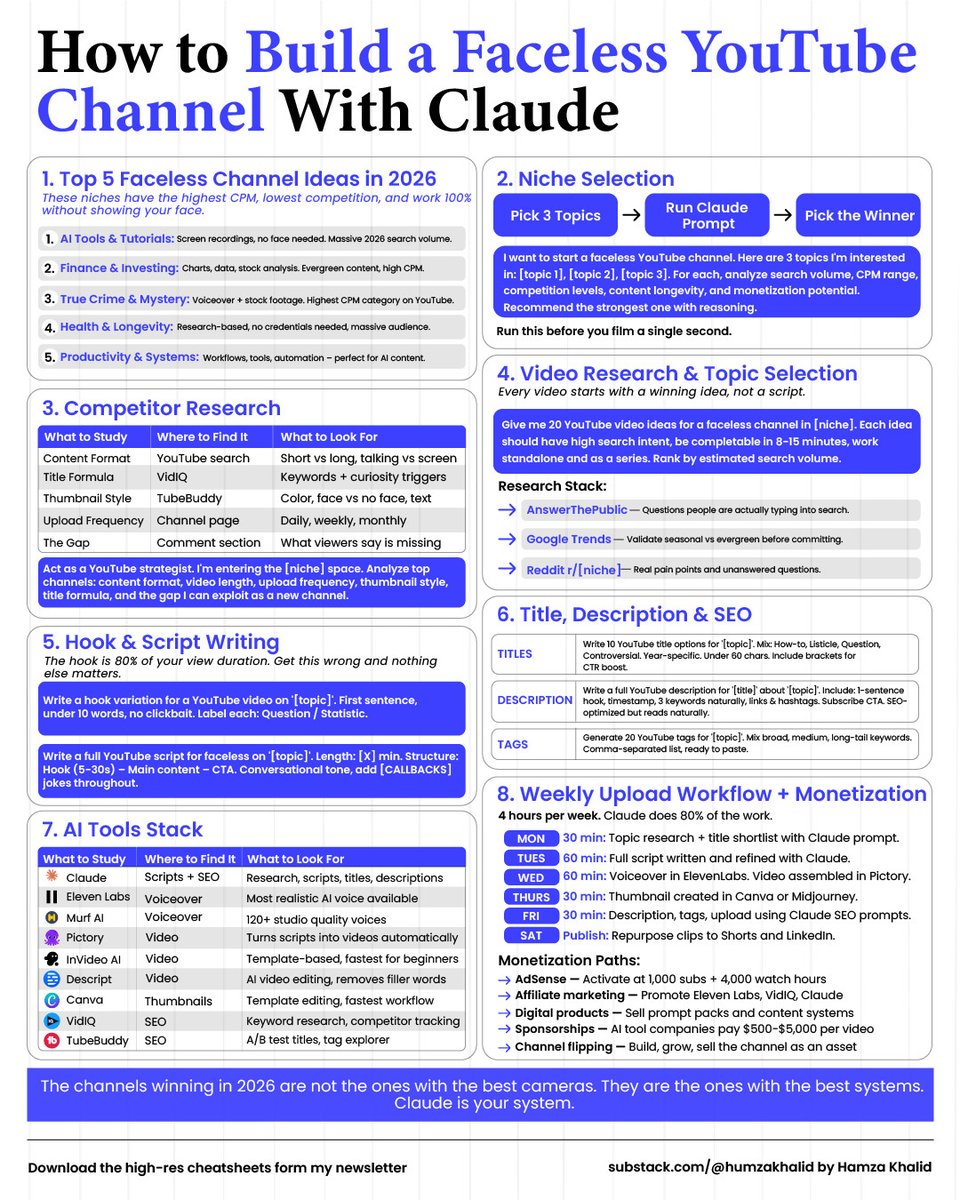
this is f*cking gold
the complete system for building a faceless YouTube channel where claude does 80% of the work
if I had this a year ago I would've had a monetised channel running while I slept
full guide in the article below ↓
🚨 BREAKING: Claude can now build and run your entire content empire across YouTube, Instagram and TikTok. For free.
Here are 8 prompts to own all 3 platforms:
Last year I said to…
• Target Drake Maye (QB2)
• Target Dak Prescott (QB6)
• Avoid Baker Mayfield (WR12)
Here are the QBs you need to Target and Avoid this Fantasy season🧵⬇️
Clipping is the simplest online business right now and almost nobody is doing it properly.
You take a creator's long videos, cut them into short clips for TikTok, Instagram, and YouTube, and get paid every month for it.
3 clients at $3k each gets you to $9k a month in your first year.
This is the exact business model I’m running right now.
Here's the full breakdown 🧵
Un YouTuber japonés mostró su apartamento en Tokio. En su escritorio hay Minecraft, software de edición y una cámara.
No ha abierto el programa de edición en 10 meses. Todo su contenido lo produce un equipo de 7 agentes de IA: uno revisa virales, otro escribe guiones, otro genera gameplay, edita, hace miniaturas y se encarga del SEO.
Asia ya trabaja así: en lugar de contratar un equipo, conectas agentes especializados.
Sube 4 videos largos por semana + un short diario. El tour del apartamento es lo único que hace él personalmente.
Su canal genera $180.000 dólares al mes con un costo de solo $70 dólares en API.
Working at American Express taught me one thing:
The top 1% don't put their money in a 401(k).
If you want to retire early with enough cash to live comfortably...
Stop funding the government and do this instead:
🚨𝗨𝗟𝗧𝗜𝗠𝗔𝗧𝗘 𝗛𝗢𝗨𝗥: GOOGLE GEMINI HAS BRUTAL FEATURES THAT ALMOST NO ONE IS USING.
MOST PEOPLE ONLY USE GEMINI FOR BASIC PROMPTS… WHILE GOOGLE QUIETLY PACKED IT WITH TOOLS THAT REPLACE HOURS OF WORK IN SECONDS.
YOU'RE PROBABLY USING LESS THAN 5% OF WHAT GEMINI REALLY DOES.
HERE ARE 10 HIDDEN GEMINI FEATURES THAT FEEL ALMOST UNFAIR ONCE YOU START USING THEM: 👇
I bought a Kindle in 2019.
Read 60+ books on it.
Then my sister-in-law (a librarian, 800+ books read) watched me read for 20 minutes on a flight and said:
"You're using a Ferrari like a bicycle."
She changed 9 settings in 6 minutes.
I finished my next book in HALF the time.
🧵 The 9 Kindle settings nobody tells you about:
It's perfectly legal to start a YouTube channel with zero followers, find viral videos, copy them to your niche, post one video a week, and grow your channel to 10,000 subscribers in 60 days.
Here's how it works:
R.I.P. WORKING FOR SOMEONE ELSE.
$100 a day is $3,000 a month.
$3,000 a month is your freedom number.
Claude gets you there faster than anything alive right now.
Here are the 5 prompts that start the whole thing: