As we prepare for the opening of the Senate impeachment court, Team Pinas is calling for organizations and youth and citizen volunteers to join the organizing committee for the BANTAY SENADO network. The network aims to monitor how Senate will handle the impeachment trial of VP Sara Duterte. If you're keen to contribute, and we're very open to all interested folks, please complete this sign-up form. We'll be hosting a preparatory meeting soon! https://t.co/pG3mOKcuG5
@Sarilec@JamesSot Happy that Iga has found confidence in her groundstrokes this tournament. With more matches under her belt, she'll be a definite threat again in every tournament she enters
The Senate should publicize all it's CCTV records, identify kung sino-sino yung mga armadong grupo na nagpaputok and who their superiors are... Senador man yan, NBI or PNP dapat panagutin
VICO SOTTO PUSHES ANTI-POLITICAL DYNASTY BILL
WATCH: Pasig Mayor Vico Sotto calls for the passage of a law banning political dynasties during a consultative meeting led by Senator Risa Hontiveros in Pasig City.
“Hindi ito tungkol sa kahit sinong indibidwal o spesipikong pamilya… What we are against here is the concentration of power in the hands of a few political elite,” Sotto said.
He stressed the need to level the playing field and prevent state resources from being used to perpetuate political families in power.
“Sa sitwasyon natin sa Pilipinas, nine times out of ten, ang nananalo ay miyembro ng political family,” he added.
Sotto hopes Congress “will really be serious” about passing the anti-political dynasty bill now and urged civil society organizations to rally support for the measure. | @eimorpsantos
Happy Birthday, Mr. President. Under the present circumstances, your absence has become more pronounced.
ONE SOLITARY PUBLIC SERVAT
He was born into a dynasty,
but he never treated power as inheritance.
He studied, served, waited
and when history called,
he did not pretend to be extraordinary.
He held no dictatorship in his hands,
no cult of personality at his back.
He commanded no armies loyal to him,
owned no business empire,
and built no monuments to himself.
He governed with no theatrics.
He spoke plainly, often in Filipino,
often without flourish,
but always with a stubborn belief
that rules mattered
and institutions were worth defending.
He inherited a government accustomed to shortcuts
but he insisted on process.
He faced crises that demanded rage
and responded with restraint.
When decisions went against him,
he respected them
even when they constrained him.
He did not enrich himself in office.
He broke rice bowls that enriched the few.
He used resources of the state
to lift the poorest from poverty.
He did not weaponize government for personal vengeance.
He trusted that transparency, though slow,
would outlast noise.
He respected accountability,
even when charges were filed against him
and only later dismissed.
He faced a giant beyond our shores
and chose law over bravado.
Outmatched in arms,
he stood his ground with principle.
He brought a great power before the judgment of nations
and let the world decide.
When the ruling came,
it affirmed not might, but right
and proved that even the small,
when steadfast,
need not bow.
Under his stewardship, the economy grew.
The international financial community
granted the country investment-grade ratings
we had never known before.
We held our heads high abroad,
and nations around the world
respected and envied our standing.
He left office with no fortune,
no dynasty expanded,
no loyal machinery demanding his return.
He went back to private life
as quietly as he entered public service.
He died without calling himself a hero.
Nearly every reformist ideal we now invoke:
clean governance, independent institutions,
respect for the rule of law
passes, in some way,
through the choices he made
when he had the power to choose otherwise.
And though he governed for only six years
without spectacle or myth,
the question he left behind
continues to trouble the nation:
If leadership can be decent,
if power can be restrained,
if public office can be treated as a trust
THEN why do we keep settling for less?
China, over the years, has destroyed over 8,500 hectares of coral reefs in SCS through island expansion and giant clam harvesting.
In Philippines's water, China has destroyed 800 hectares had already been destroyed at Fiery Cross Reef, which was occupied by China on the pretext of building weather radar stations to help Unesco in its global oceanic survey.
Damage is even more extensive at Mischief Reef, which was seized by China in 1995, explaining that the structures it built were for shelters for Chinese fishermen. Close to 1,000 hectares had already been destroyed.
China has destroyed thousands of acres of Coral Reefs and still claims to be the biggest protector of environment!
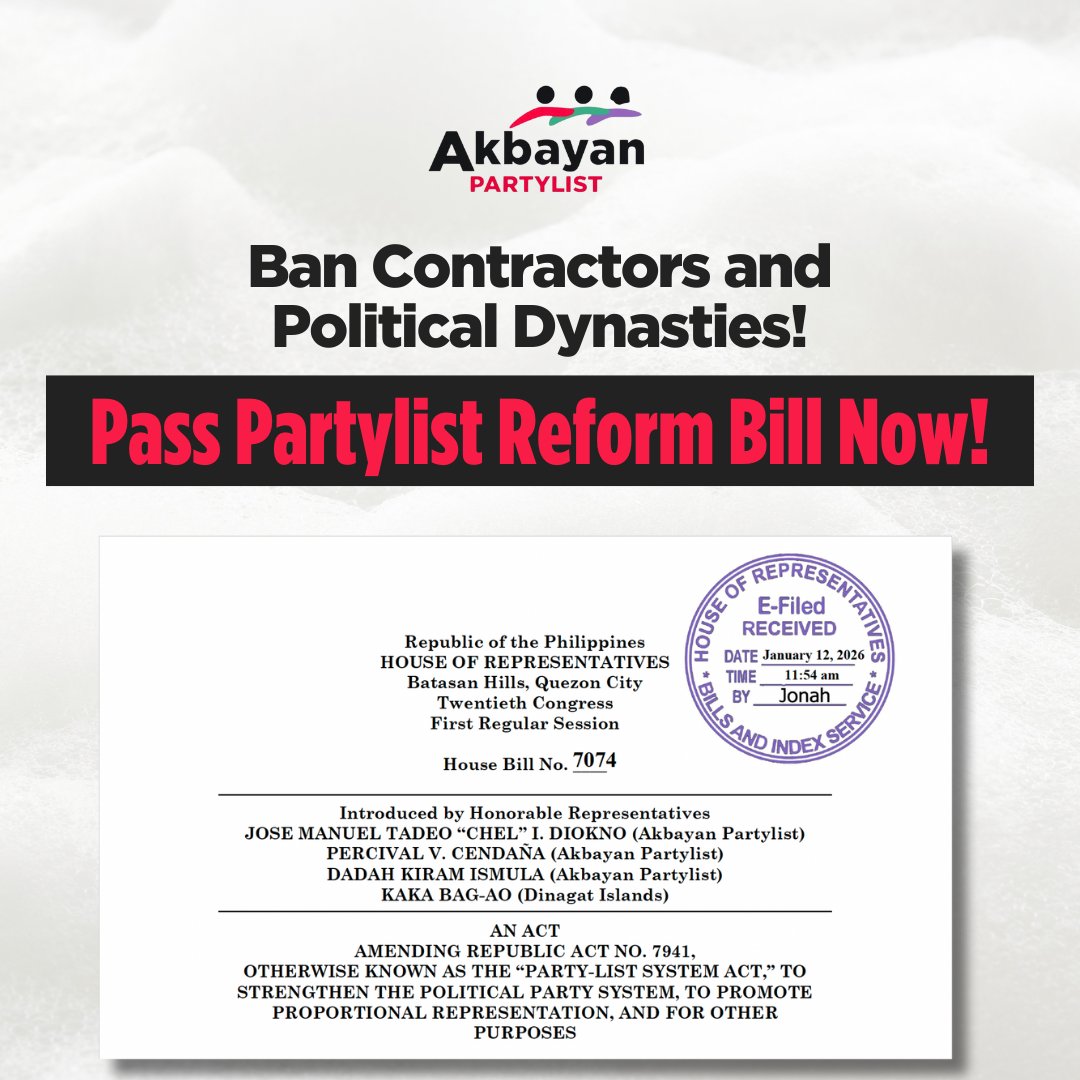
𝗕𝗔𝗡 𝗖𝗢𝗡𝗧𝗥𝗔𝗖𝗧𝗢𝗥𝗦, 𝗣𝗢𝗟𝗜𝗧𝗜𝗖𝗔𝗟 𝗗𝗬𝗡𝗔𝗦𝗧𝗜𝗘𝗦: 𝗛𝗼𝗻𝘁𝗶𝘃𝗲𝗿𝗼𝘀, 𝗔𝗸𝗯𝗮𝘆𝗮𝗻 𝗺𝗼𝘃𝗲 𝘁𝗼 𝗲𝗻𝗱 𝗽𝗮𝗿𝘁𝘆𝗹𝗶𝘀𝘁 𝗮𝗯𝘂𝘀𝗲
Sen. Risa Hontiveros and Akbayan Party have filed a bill proposing sweeping amendments to the Party-List System Act aimed at guarding against abuses by political dynasties and contractors.
Hontiveros’ Senate Bill No. 1656 seeks to bar political dynasties from participating in the party-list system and to prohibit party-list nominees and representatives who have interests in government contracts.
A counterpart bill (House Bill No. 7074) was also filed by Akbayan Party-list Reps. Chel Diokno, Perci Cendaña and Dadah Ismula, together with Dinagat Islands Rep. Kaka Bag-ao.
“Kung gusto nilang rumaket, huwag nilang gamitin ang partylist system. This bill aims to reclaim the voice of ordinary Filipinos who've been shut out of power because of abusive personalities who are using the partylist system as a backdoor to power. Tama na ang pangha-hijack nila. If they’re not genuinely fighting for the Filipino people, they don't belong in this system,” Hontiveros said.
“Our bill seeks to restore the true intent of the law and keep the party-list system out of the hands of those who seek to exploit it. It also guarantees that marginalized sectors have a real voice in Congress, enabling them to fight for their rights and welfare,” Diokno said.
The bills don't stop at banning dynasties and contractors.
The bill also prohibits the registration of party-list organizations that are patterned after television or radio programs, government assistance programs, or the names of public officials, celebrities, and other public figures, ensuring that the system remains focused on genuine sectoral representation.
Both proposed measures also push for the removal of the three-seat limit to enable full, democratic, and proportional representation.
Diokno stressed that the imposition of a three-seat cap undermines proportional representation, distorts outcomes, and prevents parties from scaling their representation according to public support.
“The limit contradicts the Constitution’s intent to achieve proportionality,” he said.
Philippine Center for Investigative Journalism recently reported that 66 percent of party-lists in the 19th Congress had at least one nominee from an established political dynasty.
Recent congressional inquiries into anomalies in flood control projects have also revealed that a substantial number of party-list representatives benefit directly from government projects by acting as contractors.
“Someone who votes on infrastructure budgets while their company bids on those same projects is a scammer. This blatant conflict of interest has no place in a democracy. After decades of abuse and loopholes, the sweeping reforms proposed in these bills hope to hand the reins back to everyday Filipinos,” Sen. Hontiveros added.
#AkbayanPartylist
We extend our condolences to the family of former DPWH Usec. Maria Catalina Cabral.
Amid the ongoing investigations into the massive corruption in which she has been implicated, her death invites great suspicion.
The death of Cabral can benefit a lot of people. Needless to state, it adversely impacts, to a large degree, the ongoing flood control investigation because now, everything might be pinned on Cabral as the mastermind.
This should be thoroughly investigated by the authorities, especially by the NBI. Cabral's residence, documents, and other personal effects should be applied for a seizure warrant and immediately secured by the authorities.
Hindi ito dapat maging dead end ng mga imbestigasyon. Mabilis na ring kumikilos ang mastermind o mga mastermind at sindikato para makalusot sa pandarambong kaya wala dapat sayanging oras ang mga kinauukulan sa paghahanap at pagprotekta sa mga ebidensya at sa pagpapanagot sa lahat ng sangkot.
Statement
Rep. Leila M. de Lima
House Deputy Minority Leader
Mamamayang Liberal (ML) Partylist
On Malacañang’s reason for not certifying the ICAIC/IPC Bill and the Anti-Political Dynasty Bill as urgent
10 December 2025
Pinapalabas ng Malacañang na walang public calamity o emergency na pwede raw mag-justify sa presidential certification na urgent ang mga bills sa ICAIC/IPC, at anti-political dynasty. Makitid po ang interpretasyon nila sa kung ano lamang ang ibig sabihin ng “public calamity” at “emergency”.
Hindi po ito patungkol lamang sa mga kalamidad gaya ng bagyo, lindol, o baha, o kaya’y mga emergency tulad ng gyera o malawakang karahasan. Kinakatigan ng Supreme Court sa mga desisyon nito ang legislative practice, o kung paano ang pagtanggap o pagtrato ng Kongreso sa sertipikasyon ng Pangulo.
In Tolentino vs. Executive Secretary, a 1994 case, no one in the Senate questioned that the 2nd and 3rd readings of the bill were done on the same day on the strength of the presidential certification. The bill, which became RA 7716, was about expanding the VAT system, while the reason cited in the presidential certification was “growing budget deficit”.
In Calleja vs. Executive Secretary, a 2021 case, both Houses did not dispute the presidential certification to the necessity of enacting RA 11479 (the Anti-Terrorism Act), respecting the determination of the President that terrorism is an emergency.
In both Tolentino and Calleja cases, the validity of the presidential certification is determined by Congress such that legislative acceptance of the certification preempts the Supreme Court’s judicial review power. The issue is a political question, in other words.
Kaya ang mas tamang tanong dito: kung mag-certify ba ang Pangulo – na syang tama naman – na urgent bills ang pagtatayo ng ICAIC/IPC, at pagbabawal ng political dynasties, ano ang magiging pagtanggap ng mga kasama natin sa Kongreso? Hindi ba emergency itong biggest corruption scandal sa kasaysayan? At hindi rin ba emergency na itong pagkasira at patuloy na banta sa ating demokrasya dulot ng political dynasties?
For me, it’s crystal clear: corruption of this magnitude is THE biggest public emergency. Inequalities in the access to the levers of political power is a public calamity of unquantifiable proportion.
#EnactICAICLawUrgently
#BanPoliticalDynastiesNowNa
38 TAON NANG NAIPIT ANG BATAS NA ’TO. Bakit kaya? 🤔
Mandato ng Konstitusyon na ipagbawal ng Kongreso ang political dynasties, pero di pa rin ito nagagawa. Sa ating Comprehensive Anti-Political Dynasty Bill (HB 5905), itutupad natin ’yan!
💬 Sawa na rin ba kayo sa ilang pamilyang sakim sa kapangyarihan? Comment down below.
👍 Like and share this video para lumakas pa ang boses natin laban sa korapsyon at abuso!
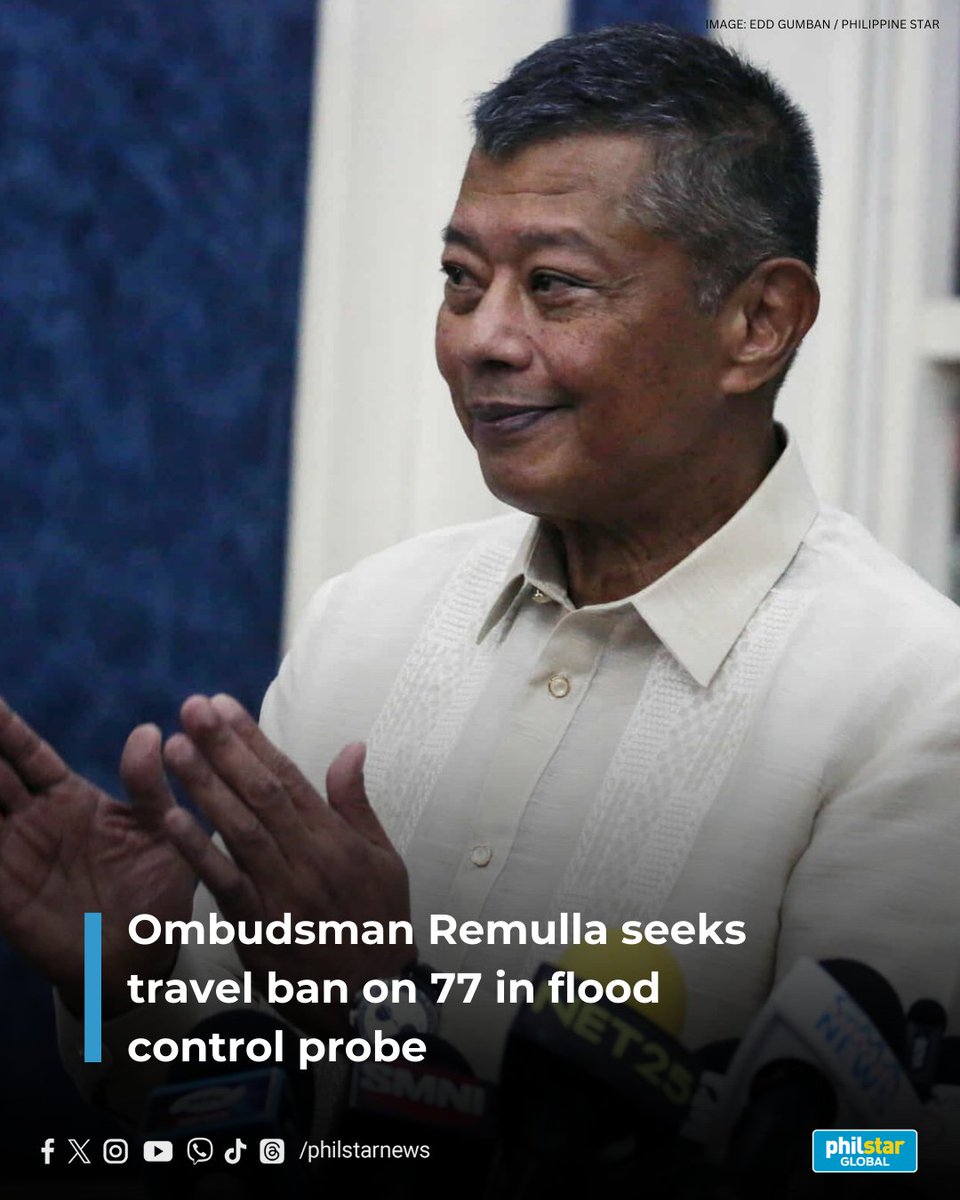
'YOU SHOULD NOT BE TRAVELLING AND LEAVING THIS JURISDICTION'
Ombudsman Jesus Crispin "Boying" Remulla has requested the Bureau of Immigration to impose a foreign travel restriction order on 77 officials and private individuals who are subject to a fact-finding investigation concerning the alleged anomalous flood control projects.
Read: https://t.co/2kv3MwCiOA
Zaldy Co was allowed to escape. Former DPWH Secretary Bonoan left with wife to the US. Bong Revilla requested for a medical check up, probably overseas. Jinggoy Estrada submits request to travel abroad.
Why is this gov't allowing criminals to flee?
LEILA QUESTIONS COMELEC UNIT'S FINDING OF 'NO VIOLATION' IN ESCUDERO–LUBIANO CONTRIBUTION ISSUE
House Deputy Minority Leader and ML Partylist Rep. Leila de Lima on Wednesday raised concerns over the diligence of the Commission on Elections–Political Finance and Affairs Department (PFAD) after it ruled that no violation of the Omnibus Election Code was committed in the case involving Sen. Chiz Escudero and campaign contributor Lawrence Lubiano.
De Lima said the PFAD's conclusion—that no prohibited contribution occurred—may have failed to thoroughly examine the legal and factual nuances of the matter.
"The Comelec-Political Finance and Affairs Department's (PFAD) finding of no violation of the Omnibus Election Code on prohibited contributions on the part of Sen. Francis Escudero and contributor Lawrence Lubiano may have been short on diligence," she said.
She emphasized that the law covers both natural and juridical persons who have contracts with the government. According to De Lima, this means a private individual who is the beneficial owner of a corporate government contractor could still fall under the prohibition.
"It does not prevent a natural person from being penalized under the law if that person as the beneficial owner of a corporate contractor donates to an election campaign," she explained.
De Lima questioned whether the PFAD examined the ownership structure of Centerways Construction and Development, Inc., the contractor linked to the donor.
"I wonder if said Comelec office had looked into the ownership structure of Centerways Construction and Development, Inc. and found out if it is wholly owned by the donor, in which case they are one and the same," she said, citing the legal doctrine of "piercing the corporate veil."
The lawmaker also noted that the PFAD's resolution terminating the investigation is merely recommendatory.
"In any case, the PFAD's Resolution terminating the investigation of the case is merely recommendatory to the Comelec en banc, which is expected to further scrutinize the factual and legal issues involved," she said.
De Lima expressed hope that the Comelec en banc will thoroughly reexamine the case in light of broader principles and safeguards governing campaign finance and public contracting.
Every single corrupt
designer bag,
luxury car,
house in Forbes,
helicopter,
bare lot,
European vacation,
ISM tuition,
BGC condo
is a receipt for a malnourished kid, dead newborn, disabled elder, or flood-ravaged home.
No increase in taxes. No debts or loans. But drastic increase in the annual budget every year since 2019.
₱39 Billion in 2024.
₱40.6 Billion in 2025.
And now, ₱43 Billion for 2026!
This gives Quezon City the distinction of having the highest annual budget (higher than Makati and Pasig) in the country and the richest LGU (richer than Cebu Province and Makati).
Only improved tax collection. Improving the ease of doing business. Digitalization of application of city permits – removing fixers and middlemen.
In short, GOOD GOVERNANCE.
Of course there are many challenges that continue to be addressed. And even with a seemingly big budget, it’s still not enough or appropriate for a city with 3.4 Million people.
That’s why Quezon City prioritizes the poor and marginalized through a data-driven needs-based social welfare approach especially for special sectors like senior citizens and solo parents.
But on budget management alone, Mayor Joy Belmonte proves why she is one of the founders, along with Vico Sotto, of the group Mayors For Good Governance.
Grabe ang corruption nuon sa Quezon City!
It’s not gone but it’s definitely way way less than before. And tulad sa Pasig, nahuhuli na sila ngayon at kinakasuhan ng QC LGU.
Sa QC, kasama ka sa pag-unlad.
#JoyBelmonte
#GoodGovernance
From someone who was supposed to be an officer of the law, this is beyond sick— it’s depraved and shameful.
To make a mockery of a tragic death and insinuate a ‘pattern’ as if it were divine justice is the kind of moral decay that Duterte fanatics have perfected.
And for a lawyer to do this, is the height of irresponsibility. When you’re part of the toxic exchanges that drive people to despair, and then laugh about it, you’ve lost every ounce of decency. How stupidly low can one sink before realising they’ve become the very disgrace they defend?
The DOJ should discipline this bone-headed fanatic. @dojphofficial
The recent acquittal of high-profile personalities accused of corruption in the PDAF scandal gives rise to the question: Do prolonged delays in the trial of corruption cases favor the accused?
When the trial of a corruption case takes a decade or more, witnesses are vulnerable: their memories can fade, they can easily lose interest in testifying (“kasi wala namang nangyayari”); and they may no longer be available to testify because they have to work abroad, get sick, or die of natural or unnatural causes. Prosecutors are just as vulnerable. Like witnesses, they can lose interest in prosecuting the case, or succumb to offers of promotion or financial gain in exchange for “going easy” on the accused. Physical and electronic evidence are also at risk: they can be misplaced, deleted or tampered. And as the years pass, the attention of the media and the public wanes, which gives officials accused of corruption the space to “operate” – to use all means, fair or foul, to sabotage the prosecution’s case or influence the decision-makers and eventually secure an acquittal.
Prolonged corruption trials not only favor the accused; they also destroy public confidence in the justice system, and corrode the people’s faith in the ability of the government to hold corrupt officials accountable—paving the way for corruption to be normalized and for impunity to take hold.
When the judiciary recently appeared before the House of Representatives to defend its budget, I was shocked to learn that there are hundreds of corruption cases that have been pending in the Sandiganbayan for over 20 years. This is totally unacceptable in a country like ours where the people are demanding public accountability.
No corruption trial should last longer than 3 years maximum; and no appeal should take longer than 2 years. Corruption cases deserve the highest priority because the victims of corruption are all of us—the people—ordinary citizens whose taxes should go to improving their quality of life, not fattening the wallets of those entrusted with government authority.
When justice is delayed in corruption cases, justice is not only denied—it is desecrated. Kaya nananawagan tayo sa Korte Suprema to impose strict time limits on the trials and appeals of corruption cases.