Not to brag, but I’m a very experienced grumbler.
As the point of contact for 300+ portfolio companies, I’ve had plenty of practice fielding all types of questions/requests/demands. While I love all our portfolio founders, not every single inbound email is a winner. Sometimes an exasperated sigh is inevitable.
As a community service, I wanted to share some groan-inducers to avoid that will help you keep your investors happy and frictionless:
Don’t send shareholder consents without context.
Occasionally you’re going to need your existing investors to sign something: approval of a new round of financing, an increase to the option pool, or the appointment of a new director, etc. These are standard asks we’re used to receiving and generally happy to approve. But we need context!
Too often, company counsel sends signature pages over to investors with no accompanying explanation for what’s being requested. If you’re asking for a bigger option pool, spend a few minutes to explain the percentage increase (not just the raw number of shares, which are meaningless of their own). If you’re appointing a new director, a brief bio is always appreciated. Try and anticipate the obvious questions the recipient will have and preempt them. Everybody loves less friction!
Communication is part of the job. As CEO, you’re responsible for whatever company counsel sends out. Now as far as grievances go, this is more annoyance than grave. But it’s an easy thing to fix. Be proactive with your asks, and your investors will thank you for it.
@poseidonaero just announced their $60M Series A.
We invested early at @DraperVC and doubled down in this latest round. Autonomous cargo planes, designed and built from the ground up, going after air logistics from first principles rather than retrofitting yesterday's airframes.
Congratulations to the Poseidon Aerospace team.
Announcing Poseidon Aerospace's $60M Series A, led by TQ Ventures with participation from JAWS, Hanwha, G Squared, Starship Ventures, Drover Ventures, and others.
At @poseidonaero, we are building the future of air logistics with autonomous cargo planes designed and built from the ground up.
@RadiantNuclear just landed $750 million from the U.S. Army for 15 Kaleidos microreactors, one of the largest contracts the Defense Innovation Unit has issued to date.
Congratulations to the Radiant team!
@DraperVC was named to @TIME's America's Top Venture Capital Firms of 2026 list.
We run lean and mean, and pound for pound I’d put our work up against any of the big dogs in the space. It’s great to see our work recognized and we’re thankful to all of our Draper founders who make it possible.
https://t.co/ViX1cRJSWH
When @colossal originally pitched us their vision of de-extinction in 2021, I was an incredibly easy sell. It should surprise no one that bringing back various extinct species has long been a dream of mine. So my only request for @BenLamm was that they add the Passenger Pigeon to their “to-do” list. He assured me that while the Wooly Mammoth was their north star, they would have room for avian resurrections as they expanded their platform to encompass all types of biologies.
Five years later, Colossal has delivered on that promise (and many others). Their most recent achievement is building a fully functional artificial egg. It’s a machine that grows a chick from a cracked embryo to a hatchling with no shell involved.
It’s a tricky engineering problem given that evolution spent millions of years perfecting the eggshell and Colossal's team had to replace it entirely. It took 14 iterations to land on the final version. There's a window on top so that the embryology team can watch development happen in real time instead of guessing.
18 days in, the chick starts "pipping" or tapping against the shell to signal it's ready to come out.
This proof of concept will help Colossal continue to develop a path for bringing back extinct bird species, including the Moa, a gigantic Emu native to New Zealand. Peter Jackson of LOTR-fame is helping lead the charge there.
It’s a rare thing to have business and personal goals align so perfectly, and I’d like to thank the Colossal team for working to preserve and improve biodiversity of the past and present.
Next stop, Passenger Pigeons…
We built a digital twin of @TimDraper and he’s live on our contact page, waiting to hear your pitch.
As much as I love the cold emails from founders (said truly, not in jest), these emails would be much more effective and efficient if these founders had an insight into how we at Draper think about deals.
Go to https://t.co/LG5pwgbznp and talk to him. Ask him about moonshots. Ask him what Bitcoin will be worth in 100 years and what industries most need a shakeup.
It’s great for understanding how we evaluate "weird and wonderful" ideas before you pitch a human and getting a gut check on your idea whenever inspiration hits, 2pm or 2am.
Is it really Tim? No. Will it get things wrong occasionally? Maybe. Is it a genuinely useful front door into how we think as a fund? I think so.
Tim funded Tesla, SpaceX, and Skype before it made sense on paper. Seemed worth encoding some of that thinking into something founders could talk to at any hour.
Go say hi.
P.S. If “he” starts sending you term sheets, let me know.
“Speak as you might to a young child, or a golden retriever”
This is one of my favorite lines from one of my favorite movies (Margin Call). It’s also a useful approach as a generalist VC.
On any given day, I find myself hopping between pitches on small modular nuclear reactors, blended-wing-body aircraft, humanoid robotics, AI agent infrastructure, bioreactor operating systems, etc. It would take an Icarian level of hubris for me to think I could match the expertise of all these founders across all these subjects. So, how is a sector-agnostic vc supposed to evaluate these deals, or even (gasp), add value?
The best approach I’ve found is to not be afraid of asking the “dumb” questions. By having a founder clearly lay out in plain terms what they’re building, I’m able to get a peek at how they’ll do when selling to other investors, customers, recruiting employees, or anything that requires them to communicate with a wider audience. Once I have a sense of the technical problem they’re solving, I can dive deeper into more familiar ground, such as fundraising history, business model, and future expansion.
When the technical analysis gets truly deep, we can turn to third-party experts in our network or seek out research on the topic. And this expertise builds on itself, so that next time we’re talking about induced pluripotent stem cells, we have some foundation to build on.
So for all interested in VC or working in the ecosystem, my advice is to never be afraid to ask the dumb question. The only dumb questions are those you could’ve answered yourself by paying more attention. Everything else is fair game and part of the process.
And if you’re a founder, be prepared to answer the simple questions about your business. Elevator pitches are a skill you can rehearse and tailor for each audience.
Now go and watch Margin Call if you haven’t seen it already.
The 80/20 on how to read a term sheet, and other generally useful terms to help you speak legalese.
(Part VII)
ROFR (or right of first refusal) and Co-Sale Rights.
If a founder wants to sell shares of the company to a third party and they agree on a price, ROFR would give the original investors the right to purchase those shares first. The purpose of this arrangement is to prevent the founders from selling all their shares to a third party and leaving the original investors holding the bag, if you will.
Again, this is fairly common and standard practice, but you may have a carve out from ROFR where there is an allowance for a founder to sell a small percentage (2-5%) of their shares without needing to seek approval.
In a similar vein, there are co-sale rights. This would occur if a founder has a buyer for their shares; the owner of this right would be able to sell a proportional number of shares at the same price.
Say an investor owns half as many shares as the founder, and the founder is selling 10 shares. That investor would have the right to sell 5 of their shares.
Next week might be the last in this series with a description of liquidity preference. Please try to contain your excitement.
And as always, let me know if you have any questions regarding any of these points.
Excited to share that @DraperVC led Auto's $2.6M round.
Vibe coding is the future, but most of us still aren’t taking full advantage - despite what our LinkedIn posts might suggest.
Auto’s thesis is that photos can be the gateway for getting more of us to explore the potential of custom software. Simply take some pictures and in plain english tell Auto what type of app you want to build. These can be calorie counters, clothing fit checks, or even a custom animal pokedex (guess which one I built). It’s incredibly intuitive and easy to share your projects with friends.
The 80/20 on how to read a term sheet:
(Part VI)
In the last post, we covered reimbursement for investor counsel expenses.
For the rest of this series, I’ll try and address a few more odds and ends that pop up in term sheets. Aiming to keep these a little more bite sized.
Here, the “no shop” clause.
This simply means that an investor doesn’t want you to use their term sheet as a way to try and get a better offer from others. Generally a lead investor is happy to have the company share the term sheet with other prospective investors who are interested in joining the round. However it’s not ok to share a signed term sheet with other potential lead investors and say “please beat this.” Admittedly this is a grey area and not something most investors will go out of their way to enforce, but it’s reputationally harmful and frankly just rude.
I’ll follow up in later posts with two remaining points worth calling out, ROFR/Co-Sale rights and Liquidation Preference. If you have anything specific you want discussed, feel free to shoot me a DM or comment below.
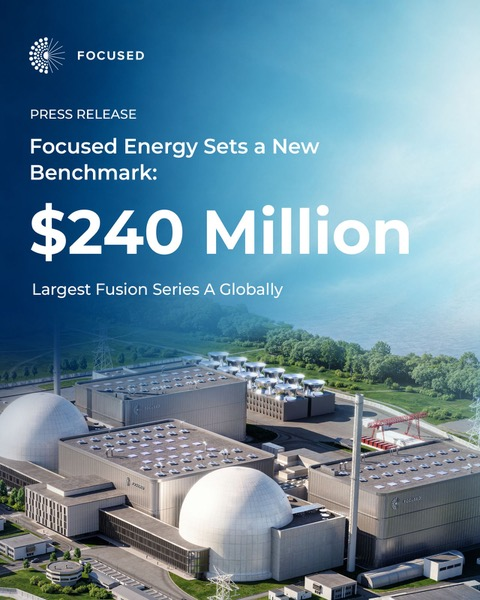
Exciting news from Chris and the Focused Energy team.
They announced SourceLight, a laser-driven radiation-source business that is a next step in their vision of using fusion to power civilization.
They also have great taste in company counsel (shout out Latham and Watkins).
Congrats to all involved.
The 80/20 on how to read a term sheet:
(Part V)
In the last post, we covered pro rata and information and inspection rights.
This time around, we’re covering reimbursement for investor counsel expenses.
This is a cap or a maximum amount that you as a founder will be expected to pay for the investors’ lawyers. It tends to be a small percentage of the money going into the round and keeps VCs from having to pay out of pocket to diligence and draft documents for a company…on top of the millions of dollars they’re already investing.
What’s reasonable for investor counsel reimbursement can depend, but it’s typically 1-2% of the money going in.
For example, if you’re receiving a $1,000,000 investment from a fund, the investor might ask for $10,000 in legal reimbursement.
More complex deals will have larger numbers and for SAFEs there is often no reimbursement cap because there is no term sheet.
From the founder and company standpoint, you should want counsel looking under the hood, so to speak, because there might be clerical errors that you are unaware of because you are spending your time building your business and not checking every 409A valuation that you have ever done.
As investor counsel, we are not working with external counsel to try and find things wrong with the company. We like the companies that we give term sheets to and we very much want to invest in them. We are simply trying to ensure there are no obvious red flags.
Next up in Part VI, we’ll wrap up the series!
@TimDraper has been doing this for 41 years and @DraperVC has been operating as an independent firm with outside investors for 12 of them. It’s been a pleasure to work with and learn from him for the past 6 of those years.
DA continues to put early-stage capital behind founders who are technically serious and commercially contrarian. Tim’s target has always been founders who have decided to disrupt entire industries.
That thesis produced early positions in @Tesla, @SpaceX, Hotmail, @Skype, and @Baidu_inc. More recently, the portfolio includes Bitcoin, @Coinbase, @Robinhood, @Oklo, @Polymarket, @XanaduAI, @iceye_global, and @Colossal.
The pattern across those investments is a consistent willingness to take founders seriously before the rest of the market does.
DA8 continues that work. Tim, Andy Tang, and the broader team are grateful to the new limited partners who've placed their trust here, and to the founders who've chosen to build with Draper's support.
The 80/20 on how to read a term sheet:
(Part IV)
A summary:
Part I: What to know before you dive into the document
Part II: The front half of the actual document
Part III: Major investment definition and founder revesting
Now we’re at Part IV: Pro rata rights and information and inspection rights.
As we covered last time, major investors tend to get two things that others don't: pro rata rights and information rights.
Pro rata is an important concept, as it gives an investor the right to participate in any future financing the company undertakes in proportion to the amount they currently own in the company.
For example, if an investor owns 10% of a company and the company goes on to raise a fresh $10 million, the investor will have the option, but not the obligation, to invest $1,000,000 - i.e. 10% of that round. The investor doesn’t get a discount, so it’s not quite special treatment; they're only allowed, if they so choose, to put in more money to maintain their ownership.
At the end of the day, a pro rata right is about making sure that an investor doesn’t get diluted without getting the chance to put more money in.
Typically this isn’t a controversial right and for your major investors, it's really not something worth arguing over.
However, it is worth understanding because it’s not completely free to give away. If you have a series A investor down the road that wants to put in $20m and they don’t want to share with anyone else, then it becomes a negotiation where accommodations have to be made. But that’s an extreme case. In practice, it’s not really an issue since it’s something you should expect your investors to want and their participation signals to others that your existing investors have confidence in the company.
Now, if you have friends and family investing in the company, I wouldn't recommend giving them all pro rata rights as it becomes a lot of rights to keep track of…so save this right for the big players.
Now, the information and inspection rights.
Simply put these rights are the ability to receive financial statements and to come and visit HQ.
The latter doesn’t come up too often, so it’s really more about the financial statements and access to company updates.
Again, as a company, you don’t necessarily want to give these rights to any and every investor on your cap table, but as a whole, you should be fond of the investors in your company as you agreed to bring them on in the first place.
211 national soccer teams recognized by FIFA
193 member states in the United Nations
48 teams in this year’s World Cup
8 countries that have ever won
1 more day until it starts!
Happy World Cup Eve everyone.
Reminder to sign up for the Draper Associates World Cup Bracket Challenge here: https://t.co/VaNH40tK4C
And a bonus…the first game tomorrow is Mexico vs. South Africa.
Last time these teams played in the World Cup, we got to witness this magic (https://t.co/ajvg5rhwmd).
Let’s hope there’s more in store this time around.