Life cannot just be about one sad thing after another.
There must also be things that make us super excited and inspired about the future. This is one of things. Bigtime.
Nigeria loses more crude to pipeline failures and theft than most African countries produce in a month.
A theft tap gets punched into your trunkline tonight. Flow balance diverges. Pressure drops. Acoustic spikes.
Our AI locates it within 300m — in 90 seconds. Not an alarm. A location, a rate, an action plan.
#OilAndGas #AI #PipelineIntegrity
Every stuck pipe event I've seen had warning signs. Rising torque. Falling ROP. Hookload creeping up.
The data was always there. What's missing is one person tracking 20 parameters at once, at 3am, with $50K/hour on the line.
We built AI that watches all of it, in real time, and tells you exactly what's happening and what to do about it.
15–30% NPT reduction on active drilling programs.
#OilAndGas #AI #DrillingOptimization
Twitter/X — Thread
1/
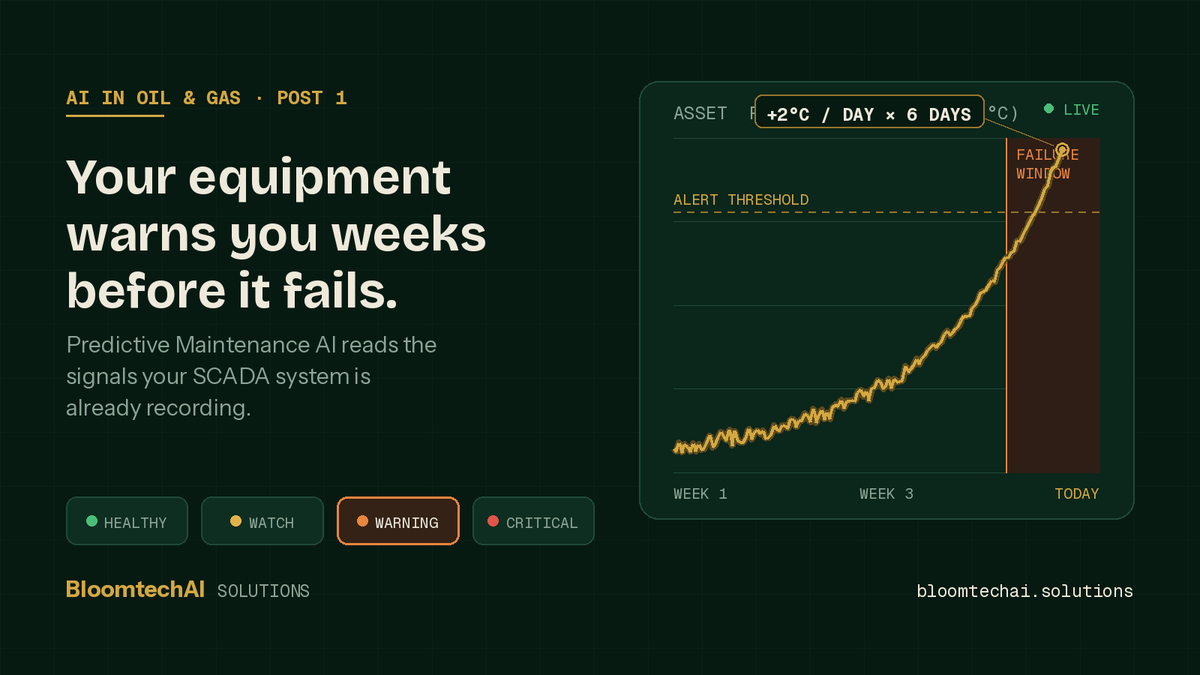
Most operators find out equipment is failing after it fails.
That's the expensive way to learn.
Here's how AI catches compressor failures in the Niger Delta weeks before they happen 🧵
2/
Most compressor failures don't happen suddenly. They announce themselves:
— Rising bearing temperatures
— Abnormal vibration
— A slow drop in discharge pressure
— Current draw creeping 8% above baseline
The warning signs are always there.
3/
Here's the part nobody talks about:
Your SCADA system is already recording all of it.
The problem isn't data. It's that nobody's reading it fast or consistently enough to catch the pattern before it becomes a failure.
4/
That's what we built at BloomtechAI.
Our Predictive Maintenance AI monitors compressors, pumps, and turbines in real time and scores every asset: healthy → watch → warning → critical.
5/
And it doesn't just alert. It diagnoses:
"Pump P-101's bearing temp rose 2°C/day for 6 days. Combined with elevated vibration, this matches early-stage lubricant breakdown. Failure window: 10–14 days. Recommended: inspect within 72 hours."
That's the difference.
6/
I spent 18 years in Nigeria's upstream sector — inspection, QC, terminal operations.
I know what unplanned downtime costs. And I know what a team looks like when it reacts instead of predicts.
That gap is now solvable.
7/
No rip-and-replace. No 12-month integration. No foreign consultants.
We deploy, train your team, and you own the system.
No monitoring system at all? We build it from scratch — AI models, dashboard, alerts — tailored to your equipment and your data.
8/
If you're responsible for asset reliability at a producing facility in West Africa, let's talk.
📧 [email protected]
🌐 https://t.co/U0SIjoKLYj
📞 +234 916 433 2273
Post 1 of the AI in Oil & Gas series. Follow for the rest.
Anthropic just dropped a 100% free course on Loop Engineering with Fable 5.
This is the clearest breakdown of Claude Code and agentic loops you'll find anywhere.
People are paying for tutorials that teach less than this one hour does.
Watch it today, then read the step by step guide on building loops below.
The re-release of Fable 5 is probably the greatest thing to ever happen in AI.
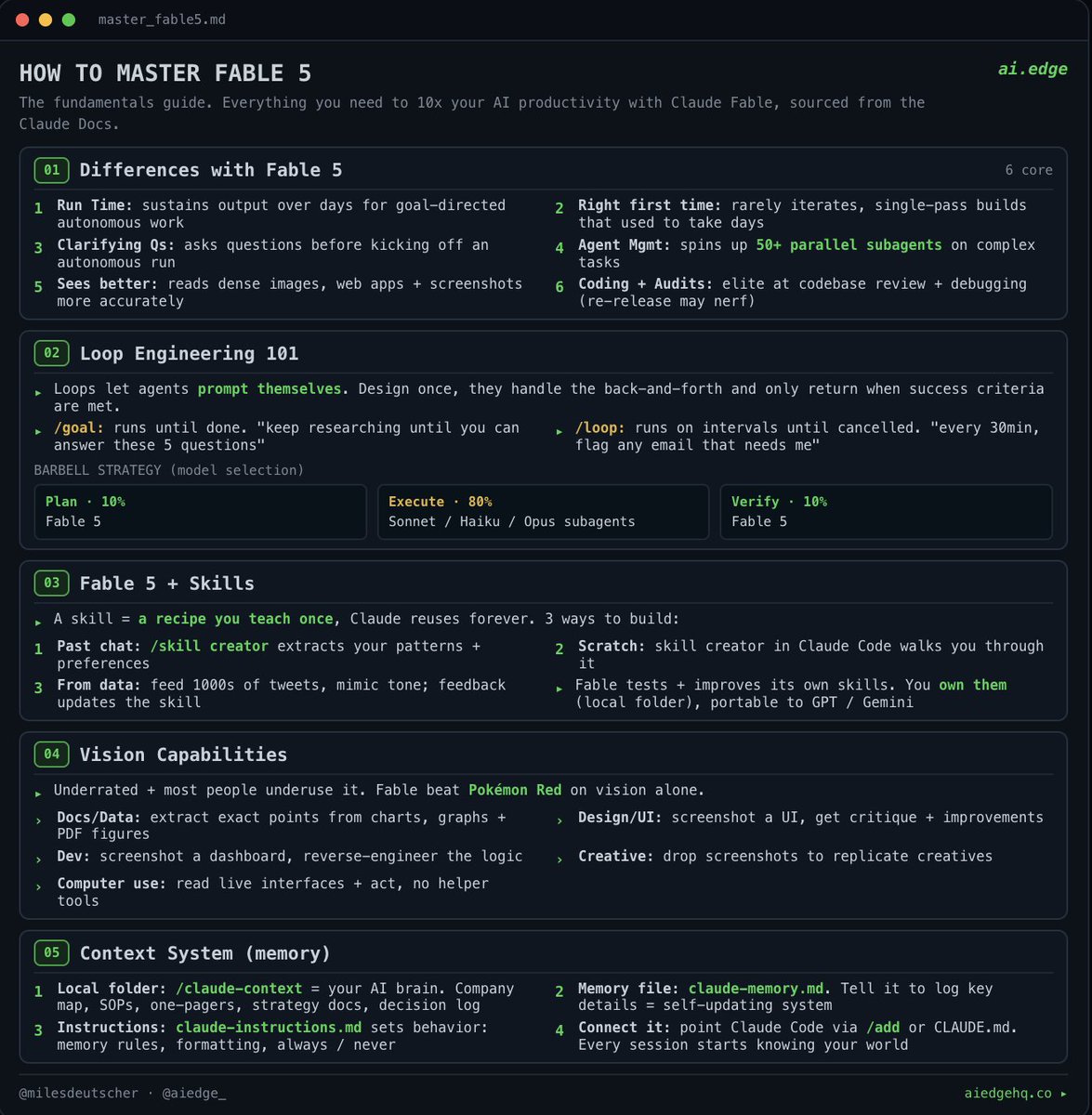
I spent the last few hours putting together an ultimate guide to help you master Fable.
Key model differences, loop engineering 101, Fable + Skills, how to build a context memory system & more:
Fable 5 is officially back online, and you're probably wondering how to use it without going broke.
Here's the advice from Anthropic engineers, and the exact system I've personally come up with to cut token costs by 50%+:
The 10-80-10 System - Biggest difference:
→ First 10% (Planning): Use Fable to define the structure, approach, success criteria, and constraints. Think of it as your architect. Get the plan right before anything else.
→ Middle 80% (Execution): Switch to a cheaper model. Opus 4.8 for standard work, Haiku for light tasks.
Pro tip here: Ask Fable to fan out subagents for/loops.
→ Final 10% (Review): Bring Fable back in to check the output against the original plan. Because it reviews a finished result rather than generating from scratch, it uses a fraction of the tokens.
4 smaller tips that also make a difference:
• Start on medium effort, not max - Fable on medium beats Opus on extra high.
• Delete old skills and instructions. Prompts built for earlier models perform worse and cost more in Fable. Anthropic recommends starting fresh.
• Give Fable the "why" behind every request. It gets things right the first time more often. Fewer iterations = fewer tokens burned.
• Run /usage regularly. Once Fable moves to pay-per-token on July 7th, this becomes essential.
Two expensive mistakes to avoid:
• Fable is now the default model when you open Claude Code. Check the model selector before every session.
• Set a hard monthly spend cap before July 7th. Settings → Usage → Adjust Limit. Fable burns fast on autonomous runs.
The model is worth every token when used right, but you can quickly rack up token costs. Be sure to save and implement these tips.
Introducing Claude Tag, a new way for teams to work with Claude.
In Slack, Claude joins as a team member with access to the channels and tools you choose. Tag Claude in and delegate tasks to it while you focus on other work.
@AnthropicAI@blockchainchick And to think that I have plans to use it to ship some apps this morning only to see this news. Well I'll fall back to Opus 4.8.
SpaceX IPO at $135. Largest IPO in history.
OpenAI and Anthropic are next.
The biggest wealth transfer of this generation is happening in tech — and most Nigerians are watching from the sidelines.
You don't need to be in the US to pay attention. You need to understand what's coming.
$SPCX ticker is officially live on 𝕏
Introducing Claude Fable 5: a Mythos-class model that we’ve made safe for general use.
Its capabilities exceed those of any model we’ve ever made generally available.