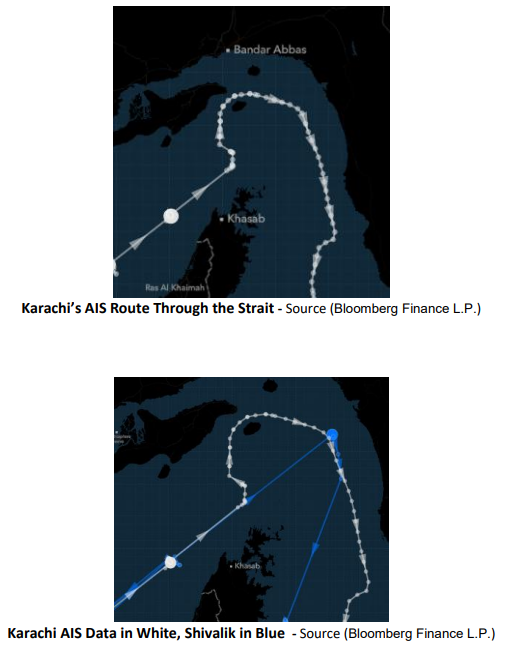
looks like someone is having fun today #oil#oiltankers#freight#shipping I personally haven't been to these locations, maybe the crews know more than I do
Where’s the Wet FFA market now?
Welcome back to the Wet FFA fortnightly newsletter. First note, I’m joining the Posidonia action next week, So I’m looking forward to seeing everyone there.
TC14 - clean MR east
The bright spot in Atlantic clean. Jun 26 averaged WS 225 last Wednesday and worked higher through the week to a session VWAP of WS 252 on the 28th, with the bulk trading 250-255 and an intraday peak of 258. That's +12% over the window. Volume confirms the move - 265 lots in one session on the 27th, another 137 on the 28th. Jul 26 firmed in sympathy from VWAP 220 to 232. Cal 27 ticked from 35.80 to 36.50 $/mt.
The setup is MR cover demand into UKC standing apart from softer Atlantic product flows elsewhere - TC2 the other way is down 46% on the month. What we're watching: whether the front holds through the early-June window or whether Thursday's volume was owners locking in. M1 vs M2 has widened to 3.95 WS; if that compresses, the curve will follow.
Aframax - US Gulf
US-AFRAS is where the bigger move is. Jun 26 came off from 255 last Wednesday to 184 today, a 28% drop over six sessions on heavy two-way flow - 580 lots cleared on the 28th alone. Jul 26 has tracked it 220 → 185. Q3 26 now bid 174-178.
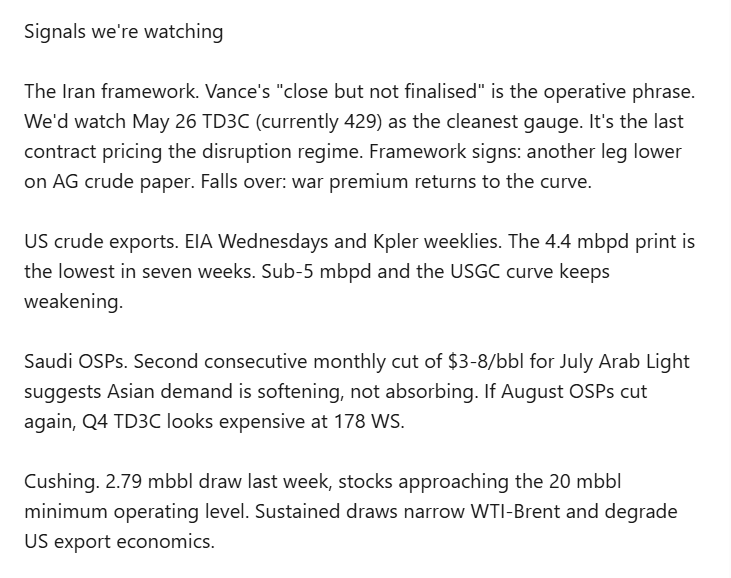
Two things underneath. First, US crude exports printed 4.4 mbpd last week, the lowest since early April and well off the April record above 6.4 mbpd. Second, the 60-day ceasefire framework is unwinding the geopolitical bid for transatlantic tonnage. TD20 in lockstep - Jun 165 → 142.5, Q3 134.5 → 115 - and WAF flows to Asia were the weakest since February at 1.67 mbpd in May.
If exports stay sub-5 mbpd through June, this curve has further to give. Above 5.5 mbpd is the level that puts a floor in.
Super El Niño
When- NOAA's mid-May discussion has a roughly 65% chance of a strong or very strong El Niño peaking between Q4 26 and Q1 27, with onset May-July. ECMWF and BOM agree, and recent runs are outpacing the 1997 and 2015 super event analogs at the same point in their evolution.
What it could mean- Atlantic hurricane suppression - NOAA's 2026 forecast is 8-14 named storms versus the 14/7/3 long-run average - removes some of the implicit hurricane optionality from Aug-Sep USGC paper. The counterweight is a wetter, stormier southern US through Q4-Q1, with Florida historically averaging 23 river flood events a year in El Niño phases versus 5 in neutral. Operational risk shifts from August into the autumn and winter.
#posidonia #wetfreight #oil #signals #elnino #oilshipping
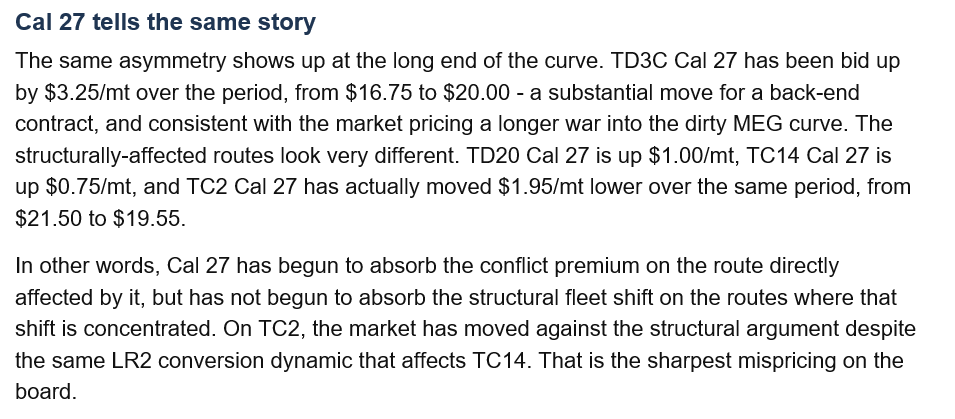
We've priced the war, not the rewiring.
#Wet#Freight Opinion Piece Newsletter is back.
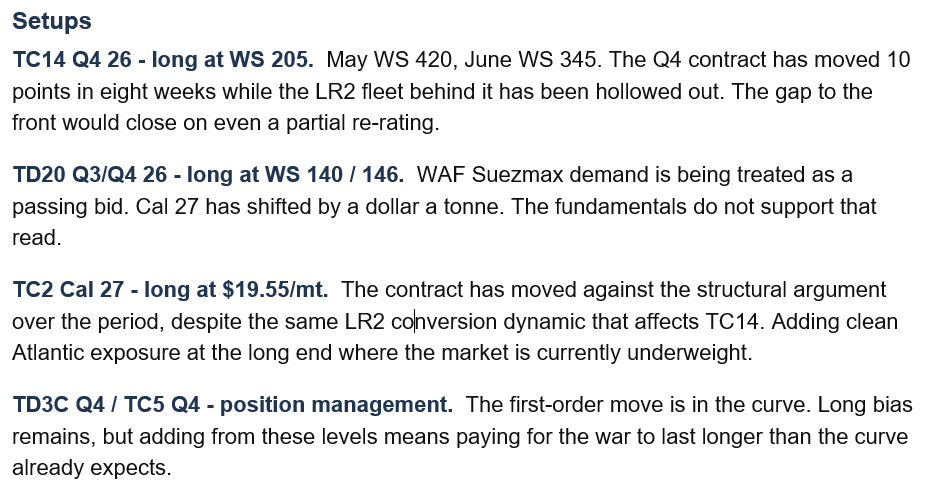
#Oil#Shipping Trade ideas below (in the pictures)
Where we are
Two months ago, Iran shut the Strait of Hormuz. Forward curves bent into shapes the market hadn’t seen since 2019, and every contract on the board moved at once. Two months on, the curve has had time to find a level it can live with. The Q4 26 contracts show what it decided.
Our view
The rallies on TD3C and TC5 reflect the conflict itself, and that premium will compress on any meaningful de-escalation. The flat lines on TC14 and TD20 suggest the curve is treating the structural shift as either temporary or incidental, when neither characterisation fits the underlying numbers.
So far this year, 68 LR2 product carriers have switched from clean to dirty trade already more than the 49 recorded across all of 2025. Two-thirds of the global LR2 fleet now hauls crude, the highest share since 2019. Switching back costs around $1m and 1–2 weeks per ship, and only happens when a charterer wears the cleanup risk. We treat the clean MR fleet shortage as structural over the next 12 to 18 months, rather than something that resolves with the conflict.
The dirty side has its own structural story. European refiners cut off from MEG barrels are pulling West African crude harder. Of eleven Forties cargoes scheduled for late April and May, eight have been deferred. Term arrangements are being signed; new buyer-seller relationships are forming. Supply chains take longer to unwind than they take to assemble. We do not expect a Hormuz reopening to return these flows to a pre-conflict baseline.
The repricing has been asymmetric.
Routes where the Hormuz disruption is direct have rallied hard:
TD3C Q4 26 (VLCC, MEG → China, straight through the Strait): +87 WS points (113 → 200)
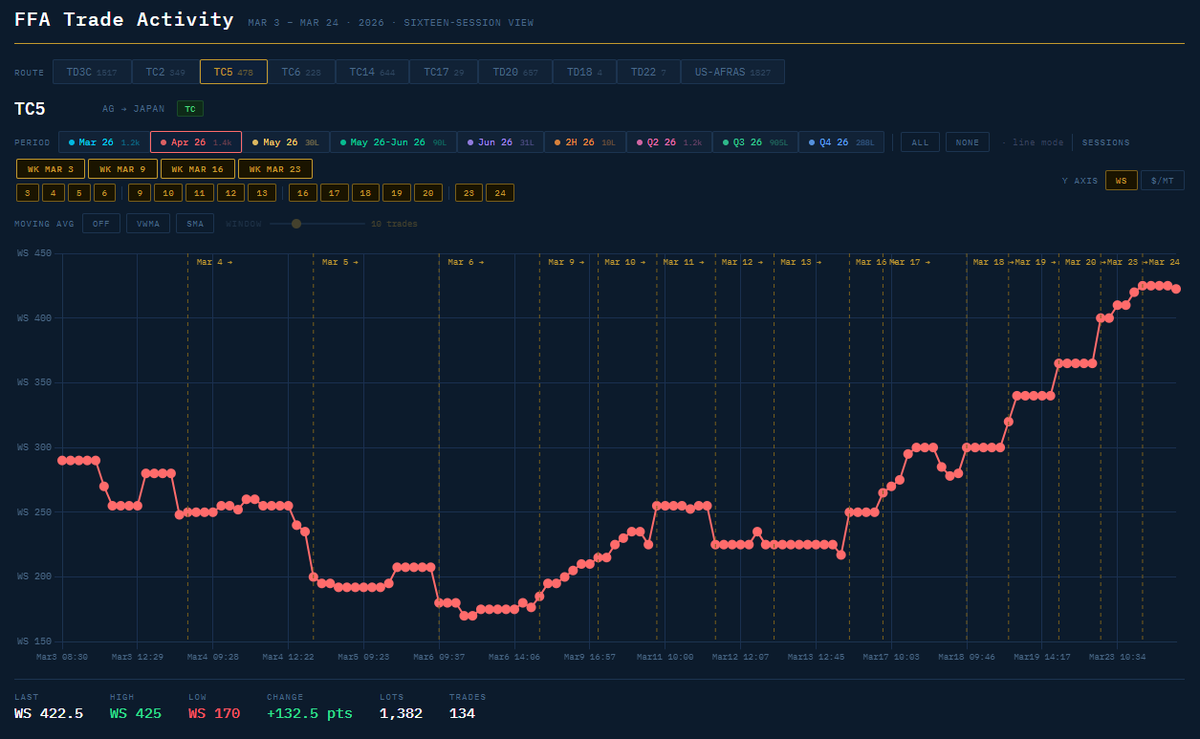
TC5 Q4 26 (LR1 clean, MEG → Japan): +78 WS points (182 → 260)
Routes where the disruption is structural and second-order have moved very little:
TC14 Q4 26 (clean MR, US Gulf → Europe): +10 WS points (195 → 205)
TD20 Q4 26 (Suezmax, West Africa → Europe): +6 WS points (140 → 146)
The TD3C and TC5 moves track the visible disruption: Cape rerouting, Pacific LR queues, naphtha cargoes scrambling for lift. The flat lines on TC14 and TD20 suggest the second-order effects are not yet being absorbed: the hollowing-out of the clean MR fleet, and the rebuild of European supply chains away from MEG.
Market update
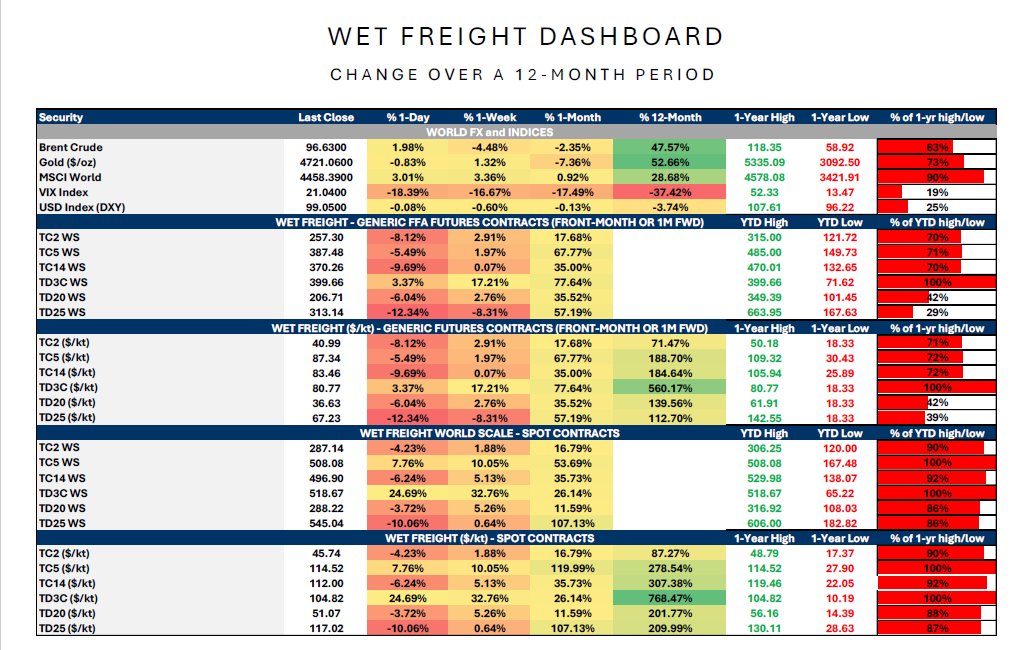
The #wet#freight market continues to firm, with broad-based gains across most routes pointing to tightening conditions, particularly in the Atlantic and US-linked flows.
In the #Atlantic basin, clean and dirty segments moved higher. TC2 spot edged up 0.73% to WS 283.89, while TC14 rose 2.45% to WS 484.26, reflecting steady transatlantic demand. On the #crude side, TD20 saw a sharper move, jumping 12.93% to WS 309.24 spot, indicating tightening tonnage in the region and improved West African export flows into Europe.
In the Middle East-Gulf, strength remained evident but more measured. #TD3C spot rates increased 1.75% to WS 397.53, holding near elevated levels, while #TC5 climbed 3.94% to WS 479.88. The basin continues to be supported by sustained long-haul demand into Asia, although gains are less aggressive relative to the Atlantic.
In the #WestAfrica and US Gulf basin, the strongest upside was observed. #TD25 surged 10.53% to WS 598.58, extending its rally and highlighting robust US export demand and tightening vessel availability. This strength is feeding into broader Atlantic sentiment, reinforcing the upward momentum across linked routes.
Overall, the market is firming, with clear signs of tightening vessel supply, particularly in the Atlantic-linked trades.
Near term, rates are likely to remain supported. Strong crude export flows from the US and West Africa, combined with ongoing tonne-mile demand and potential geopolitical disruptions, should keep upward pressure on freight, although volatility may increase as positioning becomes more stretched.
News flow
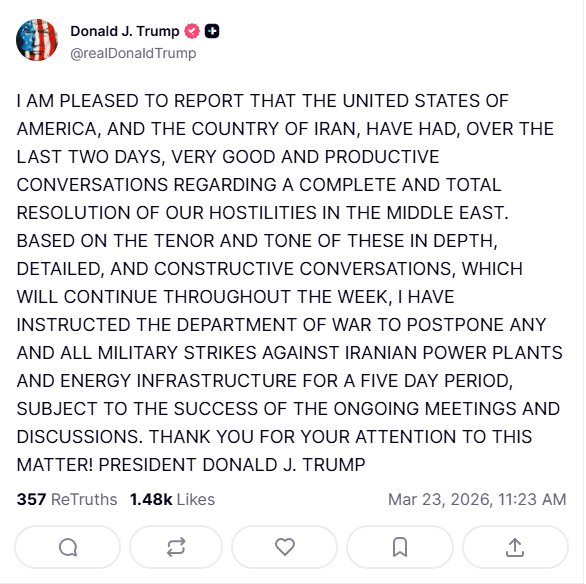
United States and North America: US crude and wet-freight markets tightened further overnight as Brent futures held near $111 per barrel and West Texas Intermediate climbed toward $115, its highest since June 2022, amid escalating White House threats to strike #Iranian power plants and bridges before the Tuesday evening deadline. The WTI prompt spread widened to a near-record $15.50 per barrel, reflecting acute domestic tightness as overseas buyers diverted to American barrels to offset persistent Strait of Hormuz disruptions. Differentials surged across the continent: Bakken at Clearbrook traded at an $18 premium to the monthly WTI average (from a $1.20 discount pre-war. In a notable wet-freight arbitrage, Trafigura drew on Merey 16 (16° API heavy sour) inventories from Liwathon’s South Riding Point terminal in the Bahamas; the Suezmax tankers Advantage Angel and Seaways Shenandoah each delivered approximately 494,000 barrels to #Exxon Baytown and PBF Delaware City refineries, easing Gulf Coast pressure while supporting elevated intra-Americas tanker demand.
#Gulf: Vessel transits through the Strait of Hormuz reached 21 over the weekend—the highest two-day total since early March—with the seven-day rolling average climbing to its peak since the conflict began. Iran’s exemption for “brotherly Iraq” prompted the State Organisation for Marketing of #Oil to demand 24-hour lifting schedules from buyers, confirming full operations at Basrah terminals after the #Suezmax Ocean Thunder successfully carried one million #barrels of Basrah Heavy crude (30° API, 2.5 per cent sulphur). Up to three million barrels per day of exports could resume, potentially restarting shuttered southern fields, yet some 25 million #barrels linger on 21 trapped #tankers amid buyer demands for Iraqi-flagged tonnage and clearer security terms. Outbound flows remain dominated by Iran-linked, often US-sanctioned vessels hugging the northern Larak-Qeshm corridor, though southern Omani routes have emerged after Muscat talks; Qatari LNG carriers turned back. Persistent AIS interference and spoofing continue to delay reliable tracking, keeping risk premia elevated on #VLCC and #Suezmax fixtures out of the #Gulf.
#OPEC+ plans symbolic production increase: Global crude and wet-freight #markets absorbed #OPEC+’s largely symbolic decision to raise output quotas by 206,000 barrels per day for May with little reaction, as the group warned that Iranian attacks on Gulf energy infrastructure would impose costly, protracted repairs lasting weeks or even into June. The increase-agreed by eight core members including Saudi Arabia, Russia, the UAE, Kuwait and Iraq-remains theoretical: Russian exports are hampered by Ukrainian strikes on export terminals and refineries, while Gulf producers’ barrels remain trapped behind Tehran’s tolling regime and northern-route restrictions. Even if hostilities cease swiftly, damaged terminals, pipelines and storage facilities would delay full resumption, sustaining the record supply shock that has already removed up to 12 million barrels per day of Gulf flow. Brent and WTI futures held near $110 per barrel, with tight prompt spreads underscoring continued westward tanker diversions and elevated #VLCC/#Suezmax demand on alternative Atlantic and intra-Americas routes.
Floating storage down: Global #crude and #wet-#freight markets saw floating storage contract sharply overnight, with #crude held on tankers stationary for at least seven days falling 3.9 per cent week-on-week to 130.25 million barrels as of 3 April. Independent tanker-tracking confirms the drawdown, driven by the Strait of #Hormuz #supply #shock forcing accelerated discharge of trapped barrels. The Middle East fell 12 per cent to 45.08 million barrels while Asia-Pacific dropped 6.7 per cent to 38.85 million—the lowest since September—as eastbound buyers cleared inventories. In contrast, the US #Gulf Coast built 31 per cent to 11.17 million #barrels and Europe surged 58 per cent to 8.48 million (highest since December), reflecting surging light-sweet US and Canadian synthetic exports rerouted via #Panama or transatlantic legs. West Africa eased to 5.78 million and the #North Sea rose 13 per cent to 2.28 million. The #Atlantic build-up signals tighter prompt #Suezmax and #Aframax availability, sustaining elevated wet-freight rates amid westward barrel rotation.
NSEA Update: Given the public holidays, this roundup features data from Thursday the 2nd April. North Sea #crude differentials reached fresh record premiums in the Platts window overnight amid a sustained bid-only market, driven by acute physical tightness stemming from ongoing #Strait of #Hormuz disruptions and reduced Gulf export availability. Aggressive bidding lifted WTI Midland CIF to +$17.85 for early-May arrival windows (up from Wednesday’s +$14.30–15.80 range), while Forties FOB climbed to +$15.50 for late-April loading, Troll to +$15.60, Ekofisk to +$15.70, Oseberg to +$14.75 and Statfjord CIF to +$17.60. No offers were tabled, underscoring seller caution. Brent forward chains absorbed only seven April-loading #cargoes—five WTI Midland, one Forties and one Troll—sharply lower than March’s 24, signalling scant prompt supply into the Dated Brent basket. June Brent futures on ICE advanced to $109.57, reflecting the westward #barrel rotation and supporting stronger #Suezmax/#Aframax wet-freight demand into ARA on tighter transatlantic economics.
WAF Update: Given the public holidays, this roundup features data from Thursday the 2nd April. West African #crude markets reflected sustained Asian demand overnight, as Vietnam’s Binh Son Refining secured 950,000-barrel parcels of Nigerian Erha (light sweet, 35–37° API, low-sulphur gasoline/jet feedstock) and Angolan Palanca for June arrival via tender. This supports eastbound flows of 61,000 barrels per day last month, a four-year high to #Vietnam and #China. Chad’s May Doba programme lifts exports to 153,000 barrels per day with five 950,000-barrel cargoes – highest since November and above the 133,000 barrels-per-day 12-month average – signalling stabilisation in the Doba basin via the 1,070-kilometre Chad-Cameroon pipeline. #Freight tightness was evident in a 260,000-tonne fixture to China on 1 May and TotalEnergies’ #Suezmax charter of the Sonangol Kulumbimbi for 130,000 tonnes to the western Mediterranean at Worldscale 370.
We are aware of what is happening in the paper oil market, including the firms hired to influence oil futures. We also see the broader jawboning campaign.
But let’s see if they can turn that into "actual fuel" at the pump —or maybe even print gas molecules!
We are aware of what is happening in the paper oil market, including the firms hired to influence oil futures. We also see the broader jawboning campaign.
But let’s see if they can turn that into "actual fuel" at the pump —or maybe even print gas molecules!
shipping analytics, or if you'd like to see different routes. #TC2#TC5#TC6#TC14 hashtag#TC17 #TD20#TD25#Afras Feel free to reach out.
https://t.co/Kxcfe4YRYi
Strait movement (Presence of sea mines)
The FT reported at least eight vessels including #Oil#tankers and bulk carriers from India, Pakistan and Greece, used Iranian waters to pass through the Strait of Hormuz. All the ships reportedly used an unusual route around Larak Island
Uranium last night, however Netanyahu also said Israel will continue to target Iran’s facilities and quoted “We will crush them completely, down to dust”. If you've enjoyed todays post and look forward to the next one in two weeks. Whether you're in freight trading, #crude,